

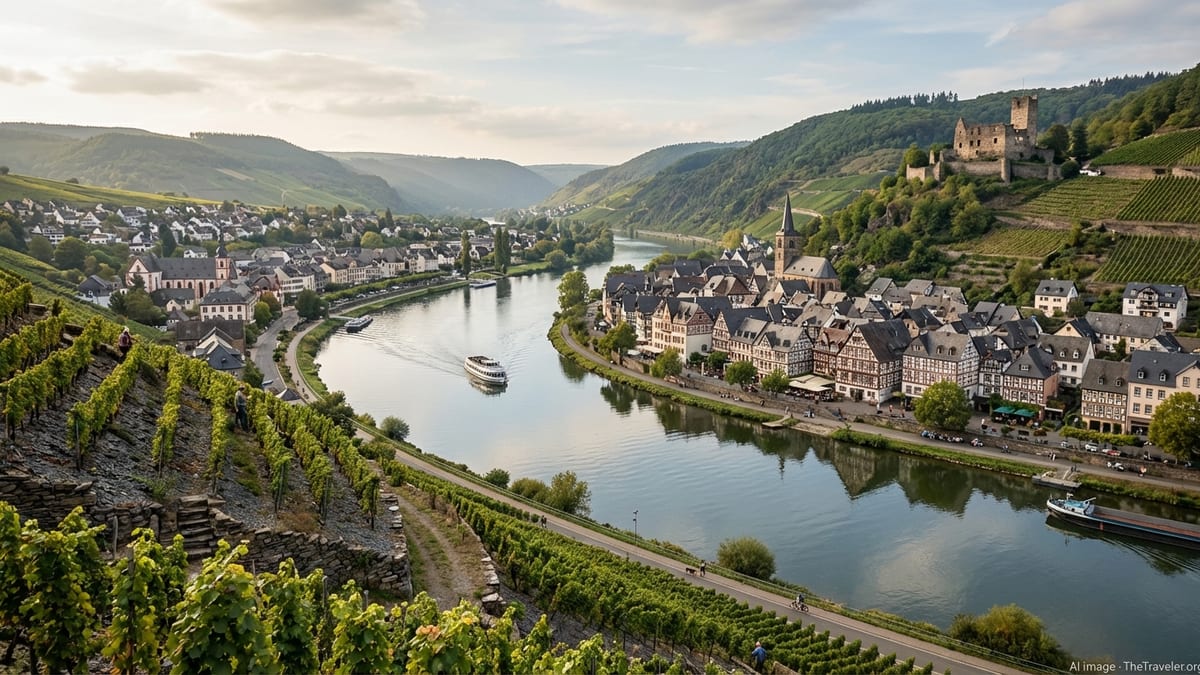
On a sweeping bend of the Moselle in western Germany, the twin town of Bernkastel-Kues rises in a layered scene of steep vineyards, half-timbered houses and castle ruins. It is one of the most atmospheric small towns in the Moselle valley, shaped over two millennia by river trade, grape cultivation and the ebb and flow of regional power. Today it is celebrated for its Riesling wines, its preserved medieval streetscape and its leisurely riverside lifestyle, making it an essential stop for travelers who want to understand the culture of the Moselle.
The Moselle Setting: Geography, Light and Slopes
Bernkastel-Kues sits in the Middle Moselle, roughly 50 kilometers northeast of Trier, where the river carves a tight meander through slate hills. The town sprawls across both banks of the Moselle, with Bernkastel and the small district of Andel on the right bank and Kues and Wehlen on the left. The river is not just a scenic backdrop. It moderates the climate, reflects light onto the terraced vineyards and historically served as a trade artery that linked the Moselle to the Rhine and onward to the North Sea.
The surrounding slopes are among the steepest cultivated vineyards in Europe. In many places the gradient rises so sharply from the water’s edge that tractors are impossible, and work must be done by hand or with small monorack rail systems. The soil is dominated by fractured slate that absorbs heat during the day and releases it at night, insulating the vines against chill and extending the ripening season. Combined with the river’s microclimate, this environment gives Moselle Riesling its famous combination of bright acidity, low alcohol and mineral-driven complexity.
That background leads naturally into the question of whether Bernkastel-Kues is worth visiting today. The town itself occupies terraces between river and hillside. Narrow streets climb up from the embankment into Bernkastel’s medieval core and weave through Alt-Kues on the opposite bank. Above them all stands the ruined castle of Landshut, watching over both river and vineyards. This compact geography allows travelers to experience river, town and vines in a single glance, especially from the many viewpoints on the surrounding hiking trails.
From Roman Castellum to Twin Town: A Compressed History
The recorded history of Bernkastel-Kues begins in late antiquity and the early Middle Ages, but evidence suggests human settlement here as far back as the Neolithic period. Archaeological finds in Kues point to habitation around 3000 BC, and Celtic traces from roughly 6000 BC have been documented. In the Roman period, the Moselle became a vital transport corridor for wine, stone and agricultural goods, and there are signs that a small fort or castellum existed beneath what is now Castle Landshut.
By the 11th century the settlement at Bernkastel was important enough to appear in written records. The name evolved from Latinized forms such as Princastellum and Beronis castellum, referring to a fortified place tied to regional lords and the powerful archbishops of Trier. In 1291 King Rudolph I of Germany granted Bernkastel town rights, confirming its status as a trading hub and administrative center along the river. Subsequent imperial decrees in the 14th century reaffirmed its privileges and embedded it into the political structure of the Holy Roman Empire.
Medieval Bernkastel prospered through wine, tolls and river commerce. The town marketplace, today preserved in remarkable detail, grew as a symbol of the civic pride of its merchants and winemakers. At the same time, religious institutions like the St. Nicholas Hospital founded by Nikolaus von Kues in the 15th century underscored the intertwining of spirituality, scholarship and social care in Moselle society.
This historical context explains many of the key things to do in Bernkastel-Kues. Modern history brought upheaval yet also continuity. From 1794 the region fell under French control, then passed to Prussia after the Congress of Vienna in 1815. The 19th century saw the arrival of the first bridge connecting Bernkastel and Kues, railway links to the wider region and the beginnings of organized tourism.
On April 1, 1905, the towns of Bernkastel and Kues officially merged, later absorbing the nearby villages of Andel and Wehlen. War, economic hardship and the decline of river transport reshaped the town in the 20th century, but winegrowing and health tourism kept it firmly anchored to the Moselle landscape.
Bernkastel’s Old Town: Timber Frames and Market Life
The historic core of Bernkastel is one of the best-preserved medieval townscapes on the Moselle. At its heart lies the market square, a compact space ringed with steep-gabled half-timbered houses that crowd together like a theatre set. Many of these structures date to the 17th century, when the town was rebuilding from earlier conflicts, yet their ornamented facades deliberately evoke the Gothic and Renaissance forms of a prouder past.
The most photographed building is the Spitzhäuschen, the pointed house, which dates to the early 15th century. Its upper stories jut out over a narrow stone base, with a sharp gable that seems to defy gravity. Nearby, the Renaissance town hall, completed in 1608, anchors the square with its stone arcades and richly articulated facade. In front of it, the St. Michael’s Fountain, erected in 1606, combines sculpture and wrought iron as a celebration of civic prosperity and religious symbolism.
A short walk from the market square, visitors encounter the Graacher Tor, the only surviving town gate. Once part of the city walls, it now houses a small museum of local history. The parish church of St. Michael and St. Sebastian rises close by, its massive tower originally serving as a defensive structure before becoming the town’s primary bell tower. Wandering the lanes connecting these landmarks offers intimate glimpses of slate roofs, carved door lintels and hidden inner courtyards that tell of centuries of domestic life on the Moselle.
Despite its modest size, Bernkastel’s old town maintains a lively rhythm throughout the year. Small wine taverns, cafes and boutiques occupy the ground floors of the half-timbered houses, while seasonal decorations transform the alleyways for harvest festivals and the Advent period. The effect can feel almost theatrical, but beneath the picturesque surface is a working community where winemakers, innkeepers and shopkeepers carry on traditions rooted in the medieval period.
Kues and the Legacy of Nikolaus von Kues
Across the river, Kues presents a quieter but equally significant face of Bernkastel-Kues. It is the largest of the town’s four districts and, according to archaeological finds, one of the oldest continually inhabited sites on the Middle Moselle. Its gently sloping bank offers space for riverside promenades, cyclist routes and harbors that give an open, airy contrast to the dense medieval fabric of Bernkastel.
Kues is most famous as the birthplace of Nikolaus von Kues, also known as Nicolaus Cusanus, a 15th century theologian, philosopher, mathematician and church reformer. Born in 1401 to a family involved in river trade, he rose to become a cardinal and one of the most original thinkers of his age, exploring concepts of infinity, learned ignorance and the harmony of opposites. His ideas influenced both late medieval scholasticism and early modern philosophy.
The Cusanus House, where he was born, still stands in Kues and now serves as a museum and study center. More striking still is the St. Nicholas Hospital, a charitable institution he founded in the mid 15th century to care for the poor and elderly. The hospital complex, located close to the river, is a masterpiece of late Gothic architecture, housing a celebrated library that contains rare manuscripts and early printed books. For visitors, it offers a tangible link between intellectual history and the lived reality of a Moselle town.
Modern Kues retains a strong winegrowing identity. Numerous family-run wineries cluster in and around the old streets, and a central vinotheque showcases hundreds of wines and sparkling wines from the Middle Moselle. The riverbank hosts campsites and motorhome areas, while events such as the Moselle Blue Festival and summer riverside concerts make Kues a focal point for contemporary cultural life in Bernkastel-Kues.
The Myth and Reality of Moselle Wine
Winegrowing is the economic and cultural backbone of Bernkastel-Kues. The town lies at the heart of the Mosel wine region, and within its administrative boundaries thousands of hectares of vineyards climb the valley sides. Most are steep-slope plots where manual labor remains essential. Riesling dominates the plantings, valued for its ability to express subtle variations in soil, exposure and microclimate. Smaller areas host other varieties such as Pinot Blanc, Pinot Gris, Müller-Thurgau, Kerner and Dornfelder, but it is Riesling that defines the town’s global reputation.
The most celebrated site is the Bernkasteler Doctor, a compact vineyard that rises behind Bernkastel on a sun-drenched, south-facing slope. Covering just over three hectares, it is one of the most valuable pieces of cultivated land in the world. According to a 14th century legend, Archbishop Bohemond II of Trier fell gravely ill at Castle Landshut and was cured only when he drank wine from this steep hillside. Declaring it the only true doctor, he supposedly granted the vineyard its name and special privileges. Whether or not the story is literally true, the vineyard’s wines have been prized for centuries, fetching some of the highest prices in Germany.
Working such sites is arduous. The inclination often reaches 70 percent or more, making mechanization nearly impossible. Vines are tended by hand, with workers climbing narrow terraces or using winch-driven sleds to move equipment. The slate soils are thin and stony, forcing roots deep into the rock in search of water and nutrients. This stress, combined with the valley’s cool climate and long growing season, yields grapes that are concentrated in flavor yet naturally low in sugar, a combination that allows winemakers to craft wines that age for decades.
For travelers, wine in Bernkastel-Kues is not an abstract subject but an everyday presence. Tasting rooms line the streets of both Bernkastel and Kues, offering flights of dry and off-dry Rieslings, late-harvest specialties and sparkling wines made in the traditional method. Many estates welcome visitors by appointment for cellar tours and guided tastings that delve into topics such as pruning, soil management and the delicate balance of sweetness and acidity. Even a simple glass in a riverside tavern becomes a lesson in how the Moselle’s geology and climate are distilled into flavor.
The Moselle in Motion: River Life, Festivals and Seasons
The Moselle is both stage and participant in daily life at Bernkastel-Kues. Passenger boats and river cruise ships dock along both banks, bringing visitors from Koblenz, Trier and beyond. Local excursion boats offer short trips upstream and downstream, giving views of the steep vineyards and castle ruins that are otherwise difficult to appreciate from the road. In summer, paddleboarders, kayakers and small pleasure craft share the water with commercial barges that still carry bulk goods along the Rhine-Moselle network.
On land, the Moselle Cycle Path passes directly through the town, following the contours of the river as it meanders between villages and vineyard slopes. The former railway trackbed between Bernkastel-Kues and Wittlich has been converted into the Maare-Mosel cycle route, connecting the river valley to the volcanic lakes of the Eifel region. Walkers can explore waymarked trails that link Bernkastel-Kues with neighboring wine villages, most of them designed to pass through vineyard viewpoints and forested ridges before circling back to the riverbanks.
Festivals mark the rhythm of the year and reveal how deeply wine and river are woven into local identity. Spring and summer bring open wine cellar weekends and outdoor concerts. In early autumn, the Middle Moselle Wine Festival turns the town into a large open-air celebration, combining parades, fireworks, wine tastings and live music. Local wineries pour their latest vintages, brass bands march through the streets and illuminated boats glide along the Moselle after dark.
Winter has its own charms. The Bernkastel Christmas market takes over the old town from late November, filling the alleys with stalls selling regional specialties, handicrafts and hot spiced wine. One of the most distinctive events is the arrival of St. Nicholas by rowing boat, accompanied by a flotilla of torch-bearing swimmers who cross the cold river in neoprene suits. This spectacle, which has roots in a 14th century mariners’ brotherhood devoted to St. Nicholas, has become a highlight of Advent on the Moselle and underlines the enduring bond between town and water.
Experiencing Bernkastel-Kues: From Castle Ruins to Vinotheques
Exploring Bernkastel-Kues rewards unhurried wandering rather than box-ticking sightseeing. A classic day begins with a stroll through Bernkastel’s lanes, pausing at the market square and church before heading uphill to the ruins of Castle Landshut. The path winds through vineyards and offers constantly shifting views of the river and town. At the top, the castle’s remaining walls and towers frame broad panoramas of the Moselle valley, its loops and ridges stretching into the distance. The site has been partially restored as a viewing platform and restaurant, linking centuries of military, ecclesiastical and now touristic use.
Back in town, visitors often cross the bridge to Kues to follow the river promenade, visit the Cusanus House and tour the St. Nicholas Hospital complex. The hospital’s library, with its medieval vaults and carefully preserved volumes, feels a world away from the tourist bustle yet remains integral to the town’s identity. Temporary exhibitions and small concerts often take place here, blending scholarship and culture in a way that echoes its founder’s humanist ideals.
Wine-focused travelers will find numerous vinotheques and estate tasting rooms on both banks. Some occupy centuries-old cellars, their slate walls and vaulted ceilings holding steady temperatures ideal for long-term bottle aging. Staff often include family members of the winemakers themselves, and conversations can range from the merits of individual vineyard parcels to the effects of recent vintages. Many wineries ship internationally, making it possible to send a case of Moselle wine home instead of carrying bottles in luggage.
The town also functions as a base for discovering the broader Moselle. Nearby villages such as Zeltingen-Rachtig, Graach, Lieser and Wehlen each have their own distinctive vineyards and architectural character, yet are close enough for a relaxed bike ride or short river journey. This dense network of small communities, each centered on wine and the river, gives the Middle Moselle a patchwork charm that is best appreciated over several days rather than a rushed stop.
The Takeaway
Bernkastel-Kues is more than a pretty wine town on a famous river. It is a place where the physical landscape of slate hills and looping water has shaped human history, from Roman trade routes and medieval town rights to the philosophies of Nikolaus von Kues and the quiet resilience of small family wineries. Its vineyards, especially storied sites like the Bernkasteler Doctor, embody centuries of adaptation to steep terrain and cool climate, resulting in wines that speak clearly of their origin.
For travelers, the appeal lies in how seamlessly these stories overlap. Standing on the market square, walking the riverbank in Kues, tasting Riesling in a vaulted cellar or watching torchlit swimmers cross the Moselle in Advent, you encounter layers of history rendered in stone, water and wine. Bernkastel-Kues offers a compact, deeply textured introduction to the culture of the Moselle valley, and to the enduring relationship between a river, its slopes and the people who have called them home.
FAQ
Q1: Where exactly is Bernkastel-Kues located?
Bernkastel-Kues lies on the Middle Moselle in the German state of Rhineland-Palatinate, about 50 kilometers northeast of Trier and within easy reach of the Eifel and Hunsrück hills.
Q2: What is the best time of year to visit Bernkastel-Kues?
Late spring through early autumn offers the warmest weather and the most vineyard activity, with September and early October especially attractive during harvest and wine festivals. Advent is also popular thanks to the atmospheric Christmas market and seasonal river events.
Q3: Is Bernkastel-Kues only interesting for wine enthusiasts?
No. While wine is central to the town’s identity, visitors also come for medieval architecture, river scenery, hiking and cycling routes, and cultural sites such as the Cusanus House and St. Nicholas Hospital in Kues.
Q4: What makes Moselle Riesling from Bernkastel-Kues unique?
Steep slate slopes, a cool but sunny climate and long ripening periods produce Rieslings that are light in alcohol yet intensely flavored, with pronounced acidity and a distinctive mineral profile that reflects the valley’s geology.
Q5: Can I visit the Bernkasteler Doctor vineyard?
The vineyard itself is privately owned and actively farmed, but you can walk along paths that pass close to the vines and enjoy views over the site. Wines from the Bernkasteler Doctor are widely available in local vinotheques and winery tasting rooms.
Q6: How much time should I plan for Bernkastel-Kues?
A full day allows you to explore the old town, visit Castle Landshut and sample local wines, but two or three days provide a more relaxed pace and time for side trips to neighboring villages and cycling or walking excursions.
Q7: Is Bernkastel-Kues suitable for travelers without a car?
Yes. The town is compact and walkable, and regional buses, river boats and cycling paths connect it to nearby communities. Many visitors arrive by river cruise or public transport and explore entirely on foot or by bike.
Q8: What non-wine activities are available?
Beyond wine, visitors can enjoy river cruises, hiking on vineyard and forest trails, museum visits, classical concerts and seasonal events such as markets and open-air performances. Families often appreciate the riverside promenades and nearby swimming facilities.
Q9: Are there notable local dishes to try with Moselle wine?
Regional menus often feature dishes like pan-fried river fish, game from nearby forests, hearty stews and desserts using apples or plums. Many restaurants design pairings specifically for local Rieslings, from dry styles to late-harvest wines.
Q10: How does Bernkastel-Kues compare to other Moselle towns?
Bernkastel-Kues is one of the most architecturally intact and historically layered towns on the Moselle, with a particularly striking old town and a concentration of renowned vineyards. It is larger and more bustling than some neighboring wine villages, yet still compact enough to feel intimate and closely tied to the surrounding landscape.