


I had wanted to visit Bernkastel-Kues for years. The images of steep Mosel vineyards, half-timbered houses leaning over cobbled lanes, and a fairy-tale castle ruin above the river had lodged themselves in my imagination as the perfect small-town escape in Germany.
When I finally went, I found a place that was in many ways as pretty as the photos, but also more crowded, more curated, and a bit more limited than I expected. If you are wondering whether Bernkastel-Kues is worth visiting, my honest answer is: it depends very much on when you go, how much you like wine, and what you are willing to compromise on in exchange for postcard charm. Once you decide to include the town, this guide to the best hotels in Bernkastel-Kues helps you choose the right base.
First Impressions: Pretty, Compact, and Busier Than I Expected
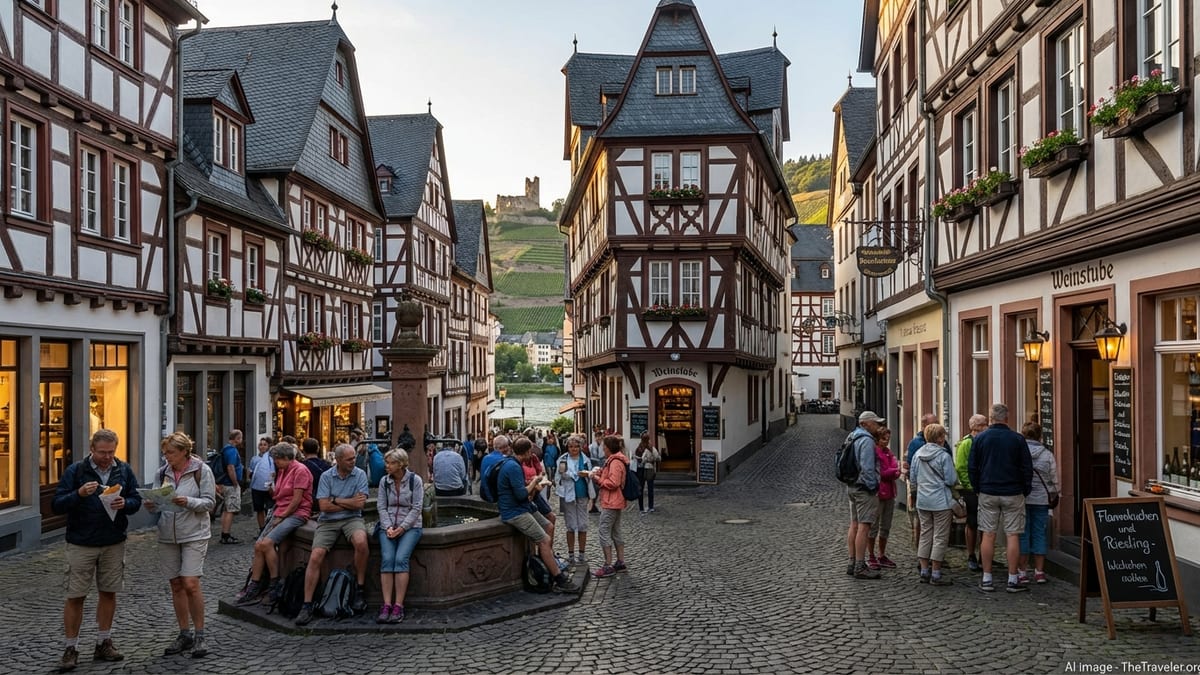
Arriving in Bernkastel-Kues, my first reaction was visual overload in a good way. The historic market square really does look like something from a storybook, with its tight cluster of half-timbered houses, including the famous Spitzhäuschen that seems to hover over the corner like it is defying gravity. The Mosel curves gently below, vineyards climb in tight rows up impossibly steep slopes, and Burg Landshut sits on the hill watching over everything. I had braced myself for the possibility that online photos were selectively framed, but what you see on Instagram is actually quite close to reality in the core old town.
What did surprise me was how quickly the illusion frayed when I stepped just a street or two off the main lanes. The medieval core is very small, and beyond that it starts to feel more like a normal, slightly traffic-heavy riverside town with supermarkets, parking lots, and through-roads.
That is not a criticism in itself, but it did clash a bit with the fully “medieval wine village” picture that tourism marketing quietly encourages you to expect. If wine is part of your plan, this breakdown of Bernkastel-Kues wine tastings offers a balanced starting point. I was glad I had mentally prepared for the idea that this was a real place where people live and commute, not a sealed museum set.
Another thing that hit me immediately was how busy it was. I visited once in late August, during wine season, and again in early December during the Christmas market period. In August the town was thick with day-trippers and river cruise passengers; in December it was wall-to-wall people in the evenings when the Christmas market stalls and the Advent calendar on the square were in full swing. I did find quiet corners, especially early in the morning and up on the vineyard paths, but if you are picturing peaceful empty lanes at midday in high season, that is not the reality anymore.
Getting There and Getting Around: Pretty Journey, Practical Frustrations
Reaching Bernkastel-Kues is scenic but not always straightforward. There is no train station in town, which I had somehow glossed over when planning. The usual approach is to take a train to Wittlich or Trier and continue by bus or car. The bus from Wittlich to Bernkastel-Kues is functional and the ride is pleasant through fields and vineyards, but the schedules are not built for spontaneous late evenings. On my summer visit I watched the time more than I wanted to, knowing that missing a bus would mean a long wait or an expensive taxi back.
If you drive, the story is different but not necessarily easier. The roads along the Mosel are lovely and winding, but on sunny weekends they turn into steady streams of cars, motorbikes, and cyclists. Parking in Bernkastel-Kues exists and is reasonably signed, including large riverside lots, but it can fill up fast around peak events like the Christmas market or the Middle Moselle wine festival. I spent more time than I liked circling for a space in December, then feeding an automatic machine in the cold with gloved fingers, trying to interpret German-only instructions while a line of impatient people formed behind me.
Once I was in town, however, I barely needed transport. Bernkastel’s old town on the right bank and Kues on the left are very walkable, connected by a bridge that gives good river views. The core attractions are compact enough that everything felt within a 10 to 15 minute walk, including the riverside promenade, the market square, and the start of the vineyard trails. The only major climb is up to Burg Landshut, which I will come back to, but otherwise I never felt the need for local buses or taxis inside the town itself.
The Old Town: Charm, Crowds, and the Line Between Authentic and Stage-Set
The historic center of Bernkastel is the reason most people come, and I was no exception. Walking into the main square the first time, I genuinely felt a little rush of delight. The half-timbered facades are intricately detailed and well preserved, the fountain in the middle adds life, and the narrow alleys radiating from the square invite you to wander and get lost. It is hard not to pull out a camera every few steps. In that sense, the town absolutely delivers on charm.
At the same time, that very charm has clearly been turned into a product. Many of the ground floors are now wine bars, souvenir shops, and ice-cream stands that are pleasant enough but quite similar to each other. I did find a few genuinely interesting artisan stores and small wine producers, but I also saw plenty of generic trinkets and the same fridge magnets and postcards you see in other tourist towns. In the height of the day it can feel more like an open-air mall with medieval façades rather than a living town center where people shop for daily needs.
The atmosphere changes if you get out early. On my August visit, I went out around 7:30 in the morning while delivery vans were restocking bakeries, locals were walking dogs, and the tourist flow had not yet started. That was when I caught moments that felt more authentic: an older couple chatting across their windows, a winemaker hosing down a courtyard, the smell of fresh bread. By midday I had to accept that I was sharing the town with hundreds of other visitors and that much of the street-level life was there to serve us.
Wine, Food, and River Life: Highlights with Asterisks
Bernkastel-Kues is Mosel wine country, and if you enjoy German Riesling you will find plenty to like. Tasting rooms and weinstuben are everywhere, ranging from small family-run spaces to more polished operations. I had some very good wines, particularly dry and off-dry Rieslings that were bright, mineral, and far more nuanced than the cheap “German wine” stereotype. Several producers offered tasting flights at fair prices, especially if you were willing to buy a bottle afterward. I left feeling that this is a genuinely rewarding place to deepen your understanding of Mosel wines.
However, the wine focus is also a limitation if you are not a drinker or are traveling with children. Outside of wine and beer, the drink options are basic. I found non-alcoholic options, but they felt like an afterthought. In restaurants, the conversation with servers almost always started with wine recommendations, and I could imagine a non-drinker feeling marginalised or simply bored of the theme after a day or two. Wine is not just an added attraction here; it is the central story that everything else supports.
Food was a mixed experience for me. There are some genuinely good places serving regional dishes like Flammkuchen, hearty meat plates, and seasonal specials during events. I had one particularly satisfying meal of grilled fish with a local wine sauce that felt rooted in the region rather than invented for tourists. But I also encountered menus that looked almost copy-pasted from one restaurant to another: schnitzel, pizza, burgers, and a handful of “Mosel specialties” that were clearly aimed at pleasing everybody without offending anyone.
Prices were not outrageous by European tourist-town standards, but they were noticeably higher than in non-touristy towns nearby, and in peak evenings I sometimes felt I was paying more for the riverside or half-timbered view than for what was actually on the plate. When choosing between Moselle towns, comparing Bernkastel-Kues vs Cochem often helps finalize the decision.
The river itself is a major part of the appeal, and on that front Bernkastel-Kues largely lived up to my hopes. Boat tours run on the Mosel, giving a relaxing way to see the vineyards and neighboring villages from the water. In season there are regular round trips and longer excursions that connect to other towns along the valley, and in winter there are special Advent and Christmas-themed cruises.
How long you stay often depends on whether nearby day trips from Bernkastel-Kues match the experience you want. Being on deck with a glass of wine while the town slowly receded behind me was one of my favorite memories from the trip. The downside is that on busy days the ships can feel crowded and the commentary can lean heavily into canned jokes and generic history, which undermined the serenity a bit.
Burg Landshut and the Vineyards: Views Worth the Climb, But Manage Expectations
The ruined castle of Burg Landshut sits directly above Bernkastel and is impossible to miss. I had seen many photos of the view from the top, and that climb was one of the experiences I was most looking forward to. The path starts from town and winds steadily upward; it is not technically difficult, but it is steep enough that you will feel it, especially in summer heat. There is also a small shuttle that runs part of the way in season, but I chose to walk to get a closer feel for the vineyards.
The ascent itself was rewarding. As I gained height, the town gradually shrank to a neat cluster of roofs framed by the wide curve of the Mosel. I passed workers in the vines and had several chances to stop and catch my breath while looking back down. Reaching the castle, the view really is as good as the photos suggest, especially late in the day when the light softens and warms the slopes. That part absolutely met my expectations, and I would say the climb is a must if your mobility allows it.
What I had not quite expected was how commercial the castle area itself feels today. The ruin has been partially stabilized and includes a modern restaurant with a large terrace and glass elements. On a practical level I appreciated having toilets and a place to get a drink, but architecturally it breaks the illusion of a wild, romantic ruin a bit. I could see both sides: as a visitor I enjoyed the amenities and the chance to linger, but part of me missed the rougher, more atmospheric feeling that older photos of the site suggest.
The broader vineyard walks around Bernkastel-Kues are, for me, where the town truly breathes and escapes its own tourism. Once I followed a marked trail up and along the ridge between Bernkastel and the neighboring villages, and in twenty minutes I was in a world of rows, soil, sky, and silence broken only by farm machinery. Up there, the town below felt more like a reference point than the whole story. If you visit, I would strongly recommend making time for at least one proper vineyard hike, not just the climb to the castle. It is where the region’s agricultural reality shows through the postcard image.
Seasonal Experiences: Christmas Market Magic and Logistical Headaches
My return visit in December was entirely motivated by the famous Christmas market, which stretches for several weeks through the decorated old town. In photos, it looks like a dream: wooden stalls under half-timbered gables, Riesling mulled wine, the largest Advent calendar in the region revealed window by window on the market square, and torchlight swimmers accompanying St. Nicholas across the Mosel. Having now seen it firsthand, I can say it is indeed atmospheric, but it also comes with some real trade-offs.
On the positive side, the setting is almost unbeatable for an Advent market. The medieval square and lanes lend a sense of intimacy and scale that bigger city markets often lack. The stalls lean toward regional products, including local wines, artisanal foods, and crafts alongside the usual sweets and decorations. The Riesling-based mulled wine impressed me more than I expected, with a cleaner, more aromatic profile than many generic red Glühweins I have had elsewhere. Watching a window of the Advent calendar house open in the early evening, with music and a small performance, felt surprisingly moving rather than kitschy.
The problems start with the sheer volume of people packed into a very small space, especially in the late afternoon and evening. On my Saturday visit it was genuinely hard to move at certain choke points, and meeting points or “let’s just quickly grab a drink from that stall” became minor logistical operations. Families with strollers or anyone with mobility challenges will have a tough time once the rush begins. On some evenings the crowding was intense enough that I was more focused on not losing the people I was with than on enjoying the atmosphere.
Accommodation and prices also spike noticeably during market season. Rooms book out early, and what is left can be significantly more expensive than at other times of year. Restaurants are packed, reservations become almost essential, and the whole town feels like it has been reoriented around this one event. If your priority is that specific Christmas magic, it is worth it. If you are sensitive to crowds or operating on a tight budget, I would think twice about visiting in December and might aim for shoulder seasons instead.
Is a Day Trip Enough, or Should You Stay Longer?
After two visits, one as a long day trip and one as a two-night stay, I have a clearer sense of how much time Bernkastel-Kues really justifies. In practical terms, you can see the old town, walk to Burg Landshut, do a short boat ride, and have a decent meal all in one fairly full day. For many travelers, especially those already touring the Mosel by car, that will be enough. You get the main views, a feel for the place, and a taste of the wine scene without committing too much of your itinerary.
Staying overnight, however, changed my relationship with the town. Early mornings before the buses rolled in and late evenings after the day-trippers left were when Bernkastel-Kues softened. Streets that had been clogged at 3 p.m. were quiet at 9 p.m., and I could wander the lanes under lit gables listening to the river in the background instead of a constant murmur of voices. I lingered longer in wine bars and had time to venture into the vineyards without worrying about racing back to a train.
The risk of a longer stay is that the town’s limitations become more obvious. Beyond wine, walks, and the river, there is not a huge variety of activities, especially if the weather turns bad. On a rainy day in August I found myself cycling through the same handful of indoor options: a small museum, a couple of churches, and more time than I intended spent in cafés watching the drizzle. You can of course use Bernkastel-Kues as a base to explore other Mosel villages, but that demands either a car or a willingness to adapt to regional bus schedules.
If I were advising my past self, I would say: one full day and one night is the sweet spot for most people. Arrive by late morning, stay through the evening when the town is prettiest, sleep in town so you can enjoy wine without transport worries, and leave the next day after a vineyard walk. Only stretch it to multiple nights if you are a serious Mosel wine enthusiast, a hiker who wants to explore more trails, or someone seeking a deliberately slow, repetitive rhythm.
The Takeaway: Who Bernkastel-Kues Is Really For
So, is Bernkastel-Kues worth visiting? For me, the answer is yes, but not unconditionally. It is worth it if you are already drawn to the Mosel region and understand that this is one of its most popular and polished showpieces rather than a hidden gem. The beauty of the town and its setting is undeniable, especially when seen from the castle or the river, and the wine culture is rich enough to reward serious interest. Moments like sipping Riesling in a quiet weinstube, watching the light fade over the vineyards, or seeing the Advent calendar window open on a cold December evening are exactly as romantic as you might hope.
At the same time, if you dislike overtly touristic places, have little interest in wine, or crave a wide variety of cultural institutions and nightlife, Bernkastel-Kues may leave you underwhelmed. It can feel crowded, commercial, and somewhat one-dimensional if you stay too long or expect it to offer the depth of a larger city. Practical frustrations like bus connections, parking competition in high season, and high demand for rooms during major events are real. You should not come here expecting untouched authenticity or solitude in the middle of summer or Advent.
If I were to do it again, I would avoid peak Saturdays in both August and December, book accommodation as close to the old town as possible to avoid parking headaches, and prioritize early-morning and later-evening explorations when the town relaxes. I would also make a deliberate effort to balance time in Bernkastel-Kues with short trips to smaller neighboring villages that offer a quieter, less polished version of Mosel life.
In the end, I am glad I went, and I would go again with adjusted expectations. Bernkastel-Kues is not perfect and it is certainly not undiscovered, but if you come for what it actually is a picturesque, wine-focused Mosel town with some beautiful views and a strong seasonal atmosphere rather than what the brochures subtly suggest, it can still be a very rewarding stop on a German journey.
FAQ
Q1: How long should I spend in Bernkastel-Kues?
For most travelers, one full day and one night is enough to see the old town, walk up to Burg Landshut, do a short boat trip, and enjoy a proper dinner with local wine without feeling rushed.
Q2: Is Bernkastel-Kues worth visiting if I do not drink alcohol?
It can still be enjoyable for the scenery, river views, and historic architecture, but so much of the town’s identity revolves around wine that non-drinkers may feel limited after a day or two.
Q3: What is the best time of year to visit?
Late spring and early autumn offer a good balance of pleasant weather and manageable crowds; summer and Christmas market weeks are atmospheric but noticeably busier and more expensive.
Q4: Is the Christmas market in Bernkastel-Kues really special?
The setting among half-timbered houses and the Riesling mulled wine make it feel distinctive, but you have to accept heavy crowds in the evenings and higher accommodation prices during the season.
Q5: How difficult is the walk up to Burg Landshut?
The climb is short but fairly steep; most reasonably fit people can do it in 20 to 30 minutes, but it may be challenging for those with mobility issues or in hot weather.
Q6: Do I need a car to enjoy Bernkastel-Kues?
You can reach the town by train and bus and explore it entirely on foot, but a car makes regional day trips along the Mosel easier and removes some dependence on bus timetables.
Q7: Is Bernkastel-Kues suitable for children?
Families will find the river, boats, and castle views appealing, but the focus on wine and the lack of varied attractions may mean that children run out of things to do after a short stay. This question becomes clearer after reviewing the main things to do in Bernkastel-Kues.
Q8: How expensive is Bernkastel-Kues compared with other German towns?
Prices for food and accommodation are slightly higher than in non-touristy towns, with noticeable surcharges during major festivals and the Christmas market period.
Q9: Can I easily combine Bernkastel-Kues with other destinations?
Yes, it works well as a stop on a broader Mosel or Rhine itinerary, and it can be paired with Trier or Koblenz, though travel involves regional trains plus bus or car connections.
Q10: Would I go back to Bernkastel-Kues?
I would return, but likely for a short, targeted stay in a quieter shoulder season, focusing on vineyard walks, a few well-chosen wine tastings, and the views from the castle rather than trying to do everything at once.