

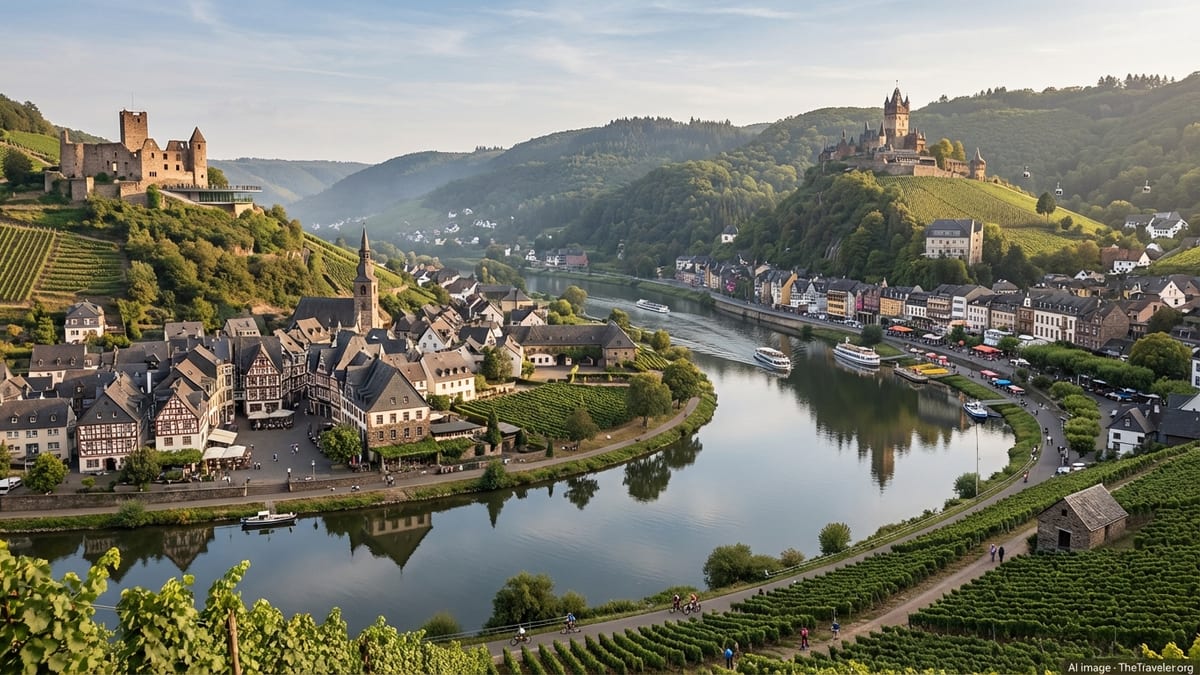
The Moselle Valley in western Germany is one of Europe’s classic wine regions, a ribbon of slate hills, Riesling vines and fairy tale towns squeezed between river and cliffs. Among its many stops, two names dominate most itineraries: Bernkastel-Kues and Cochem.
Both offer half-timbered houses, hilltop castles and riverside promenades, yet the experience on the ground is strikingly different. If you only have time for one Moselle base, choosing between them is not straightforward. This comparison works best after understanding whether Bernkastel-Kues is worth visiting on its own merits.
First Impressions: Character and Atmosphere
Bernkastel-Kues immediately feels like a textbook medieval wine town. Bernkastel’s old center is compact and impeccably preserved, its marketplace ringed with steep-gabled half-timbered houses that lean and curve over cobbled lanes. The famous Spitzhäuschen, a narrow pointed house from the early 15th century, seems almost too whimsical to be real.
The town’s scale is intimate; streets twist uphill to the Graacher Tor city gate and down to the Moselle, where riverside paths are lined with terraces and tasting rooms. Across the river, the quieter district of Kues stretches along the banks, more residential but still dotted with wine estates and historic buildings.
Cochem, by contrast, has a livelier, more resort-like feel. The town spreads along a broader bend in the river and feels more open, with a wide promenade, a small yacht harbor and a bustle that peaks in summer when tour buses, day trippers and river cruise groups arrive. Above everything looms Reichsburg Cochem, the dramatically restored castle that dominates almost every view.
The old town has its share of timbered facades and narrow alleys, but the volume of cafés, souvenir shops and ice cream stands is noticeably higher than in Bernkastel-Kues, giving Cochem a slightly more commercial, holiday-town energy. Reviewing the main things to do in Bernkastel-Kues highlights how it differs from Cochem.
If your ideal Moselle stay is about quiet charm and architectural detail, Bernkastel-Kues has the edge. If you enjoy a bit of buzz, people-watching and classic postcard castle panoramas, Cochem will likely win your first impression.
Historic Cores and Signature Sights
Bernkastel’s old town centers on its historic market square, framed by the Renaissance town hall and St. Michael’s Fountain, with facades that showcase centuries of craftsmanship. Wandering here is largely about soaking up the atmosphere: small boutiques, wine taverns and cafés occupy houses that date back hundreds of years. St. Michael’s Church, with its massive 600-year-old tower, anchors the skyline. The preserved Graacher Tor city gate and several enclosed courtyards speak to the town’s former importance along the Moselle trade route.
High above the rooftops, the ruins of Landshut Castle watch over the town. Once a residence of the archbishops and electors of Trier, the castle burned in 1692 and remained a romantic ruin until a sensitive redevelopment added a restaurant and modern viewing areas. Today it offers one of the most memorable panoramas on the middle Moselle, with vineyards, the S-shaped bend of the river and the tight cluster of Bernkastel’s houses below. The hike up is short but steep and can be replaced in season by the Burg Landshut Express shuttle for those who prefer not to climb.
Cochem’s old town radiates out from its medieval marketplace, a compact square framed by decorative facades, the baroque town hall and the Church of St. Martin. The real centerpiece, however, is Reichsburg Cochem, a hilltop castle that looks almost too perfect. Unlike Landshut’s ruin, Reichsburg is a fully furnished 19th century reconstruction on medieval foundations, complete with fanciful towers, turrets and a drawbridge. Guided tours lead through atmospheric rooms, many filled with neo-Gothic woodwork, antique furniture and stained glass. The castle terrace opens onto sweeping river views that take in the old town, the bridge and the upstream curve of the Moselle.
Cochem also adds a distinctive chairlift that climbs from the town to the Pinnerkreuz viewpoint. From here you look straight down on the town and castle, an angle that photographers love. While Bernkastel-Kues offers more in the way of medieval street fabric and subtle details, Cochem trades depth of history for spectacle, with its castle and viewpoints dominating the experience.
Wine Culture, Food and Evenings Out
Wine is the thread that ties both towns to their landscapes, but the way you experience it differs. Bernkastel-Kues sits amid some of the Moselle’s most storied Riesling vineyards, including the steep Bernkasteler Doctor. The legend says a sick prince-elector recovered after drinking wine from this site, and the story still fuels the prestige attached to its bottles. In practice, this means a dense concentration of wine estates in and around town, many of which open their doors for tastings. Rustic wine taverns, some on quiet side streets, pour local wines alongside hearty Moselle fare; menus lean toward regional classics such as marinated pork, sausages, river fish and seasonal game, often paired with specific vineyard bottlings.
Kues, on the opposite riverbank, complements this scene with additional wineries, some housed in traditional estates that combine stone farm buildings and timbered living quarters. The mild local climate, slate soils and steep slopes have made this stretch of the Moselle synonymous with refined, mineral Rieslings, and Bernkastel-Kues leans into that reputation with wine festivals, guided tastings and themed walks through the vines. Evenings tend to be relaxed rather than riotous, centered around long dinners, glasses of spätlese on a terrace and slow strolls through the lantern-lit alleys.
Cochem also has a deep wine tradition, though the vineyards directly around town are less dominated by a single legendary site. Instead, the town forms the commercial heart of a broader wine region stretching from Bremm and its famously steep Calmont slope to Klotten and beyond. You will find plenty of Weinstuben and wine merchants around the old town and along the promenade, many with outdoor seating that fills quickly on warm evenings. Wine lists focus on Riesling in all its styles, from bone-dry to honeyed dessert wines, but are often more oriented toward approachable, easy-drinking options for visitors who may be sampling Moselle wine for the first time.
In terms of nightlife, Cochem generally offers more obvious options, from lively pubs to riverside bars. It remains a small town, so “nightlife” is relative, but if you are looking for someplace with live music on a summer Friday, Cochem is more likely to deliver than Bernkastel-Kues. For a refined, wine-focused evening with a quieter crowd and a more local feel, Bernkastel-Kues is the stronger choice.
Outdoor Activities and Scenic Excursions
Bernkastel-Kues is exceptionally well positioned for hiking and cycling. The Moselsteig long-distance trail passes nearby, with stages that climb from the town through vineyards and mixed forest to viewpoints over the valley. Shorter circular walks thread through the slopes above Bernkastel and Kues, including routes that link Landshut Castle, the Tiefenbach valley waterfall and the so-called Bernkasteler Schweiz, a green hilly area of ravines and streambeds. The gradients can be steep, but well-marked paths and frequent viewpoints make even short hikes rewarding.
Cyclists benefit from direct access to the Moselle cycle path, a largely flat route that follows the river past villages, ferry crossings and countless vineyard views. From Bernkastel-Kues you can ride downstream toward Traben-Trarbach with its art nouveau architecture or upstream toward Zeltingen-Rachtig and beyond. Bike rentals in town range from standard touring bikes to e-bikes that make the gentle gradients easier still. River cruises from Bernkastel-Kues add another dimension, offering everything from one-hour panorama trips to longer journeys with stops in neighboring villages.
Cochem’s outdoor offerings are more dramatic. To the west lies the Bremmer Calmont, often cited as Europe’s steepest vineyard. A via ferrata route climbs across these vertiginous slopes, combining steel cables, ladders and narrow tracks with vast views of a tight Moselle loop and the ruins of Stuben Monastery on a riverside spur. This is a serious outing requiring surefootedness and a head for heights, making Cochem an appealing base for more adventurous travelers. Even if you skip the via ferrata, hiking trails around Cochem lead through forests and vineyards to viewpoints such as the Pinnerkreuz and the plateau around the chairlift.
On the water, Cochem is a major stop for river cruises, with frequent departures in high season that run both upstream and downstream, often incorporating commentary on local history and viticulture. The broader Cochem holiday region also includes nature reserves, side valleys and quiet villages ideal for day hikes. If you want a gentler walking and cycling holiday with easy access to trails and well-developed infrastructure, Bernkastel-Kues is ideal. If you are aiming for standout hikes, adventurous via ferrata routes and dramatic photo opportunities, Cochem may suit you better.
Access, Transport and Practical Logistics
For many visitors coming from major German cities, how easy it is to reach each town can be a deciding factor. Cochem has a clear advantage in rail connections. It sits on the main Moselle rail line between Koblenz and Trier, with regular regional trains allowing straightforward access from Cologne, Frankfurt and beyond with just one or two changes. Once in Cochem, the train station is a short walk or bus ride from the riverfront, and public transport makes it easy to reach nearby villages, hiking trailheads and attractions without a car.
Bernkastel-Kues, by contrast, is not directly served by trains. The nearest rail hubs are Wittlich and Trier, from which buses run into town. Travel times are reasonable, but the extra transfer can be less convenient if you are hauling luggage or traveling with children. Many visitors opt to arrive by car, which offers flexibility for exploring side valleys and lesser-known wine villages, but parking in the historic core is limited and often regulated. On the positive side, once you are in Bernkastel-Kues, much of what you will want to see lies within walking distance, and local buses connect to villages along the river.
Both towns are well integrated into the Moselle region’s broader tourism infrastructure. Tourist information centers provide maps, event calendars and help with booking local tours. Boat piers in each town offer excursions, and seasonal guest cards or regional passes sometimes bundle local transit with discounts on attractions. If you intend to travel primarily by train and prefer to avoid buses and transfers, Cochem is the more straightforward choice. If you are comfortable with a bus link or are driving your own car and value a quieter riverside base, Bernkastel-Kues remains very practical.
Festivals, Seasons and Crowd Levels
Bernkastel-Kues has a busy events calendar that reflects its role as a wine and cultural hub. Spring and early summer bring wine and street festivals, outdoor concerts and regional celebrations that spill through the alleys of the old town and the riverside promenades. The Middle Moselle wine festival, typically held in late summer or early autumn, is one of the region’s major events, combining tastings, parades and fireworks along the river. As autumn deepens, wine and culinary hikes invite visitors to explore the vineyards on foot, sampling new vintages with food pairings at stops along the way.
In Advent, Bernkastel-Kues transforms into a classic German Christmas setting. The Christmas market spreads through the medieval center, with wooden stalls beneath timbered facades, unhurried shoppers and mulled wine served in commemorative mugs. Even outside these headline events, the town hosts a steady rhythm of concerts, smaller wine celebrations and cultural evenings, many of them tailored as much to locals as to tourists. This gives the town a year-round life that continues even when visitor numbers drop in winter.
Cochem also embraces the seasonal cycle of wine and river tourism. The Mosel Wine Festival in Cochem is a highlight of late summer, drawing crowds for tastings, live music and fireworks against the backdrop of Reichsburg lit above the town. In December, the Cochem Christmas market combines riverside stalls with events at the castle, which sometimes hosts special Advent programs that add a fairy tale layer to the season. The town’s role as a hub for day cruises means that during peak months from late spring through early fall, the waterfront and main lanes can feel busy from mid-morning into the early evening.
In terms of crowd patterns, Bernkastel-Kues also sees plenty of visitors, but its slightly less direct access and the division between Bernkastel and Kues help spread people out. Cochem, with its single compact center served directly by trains and cruise ships, often feels more crowded at peak times. If your priority is a lively festival with big crowds and a castle backdrop, Cochem delivers. If you are looking for an atmospheric but slightly more contained celebration of wine and history, Bernkastel-Kues has a slight advantage.
Which Town Works Better as a Base?
Choosing between Bernkastel-Kues and Cochem as a base for a Moselle trip comes down to what you value most. As a central location on the middle Moselle, Bernkastel-Kues works particularly well for travelers focused on wine, hiking and cycling. From here, you can easily explore nearby villages on both sides of the river, join themed wine walks, cycle to Traben-Trarbach or Zeltingen-Rachtig, and return in the evening to a town that feels lived-in rather than purely touristic. The split personality of Bernkastel and Kues, connected by a bridge and pedestrian routes, adds variety to daily wanderings.
Cochem, on the other hand, makes an excellent base for those who want to combine Moselle exploration with access to other regions. Its rail connections allow side trips to the Rhine valley, Eifel uplands and cities like Koblenz or Trier without a car. The town’s extensive tourism services, from boat schedules to guided castle tours, mean that you can arrive with minimal planning and still fill a few days with classic experiences. It is also well positioned for excursions to the dramatic Calmont area and to villages that are easily reached by local trains or ferries.
Budget considerations are relatively balanced. Both towns offer a spectrum of accommodation from family-run guesthouses and holiday apartments to more upscale hotels with river views. Where you stay can tip the balance, especially when looking at the best hotels in Bernkastel-Kues. In peak season, prices can be high in either town, but Cochem’s larger size may give it a slight edge in variety, especially for last-minute bookings. Bernkastel-Kues, however, often rewards early planners with particularly atmospheric stays in centuries-old houses right in the old town.
For a first-time visitor who wants the archetypal castle-on-a-hill view, easy logistics and a sociable holiday vibe, Cochem is hard to beat. For travelers who prioritize a slightly more authentic-feeling wine town with deeper immersion in vineyard culture and excellent walking and cycling, Bernkastel-Kues is likely to be more satisfying over several days.
The Takeaway
Presented side by side, Bernkastel-Kues and Cochem reveal just how varied the Moselle can be along a short stretch of river. Cochem is the better choice if you are traveling by train, are drawn to fully furnished castles and want a town with an unmistakable holiday energy. Its combination of Reichsburg Cochem, the chairlift and dramatic nearby hikes like the Calmont via ferrata will appeal strongly to photographers, families and travelers who want a visually spectacular but logistically simple base.
Bernkastel-Kues stakes its claim on atmosphere and wine. It offers one of the most beautiful medieval market squares in Germany, a network of alleys that reward aimless wandering, and immediate access to some of the Moselle’s most respected Riesling vineyards. Landshut Castle’s ruined walls and panoramic terrace provide a quieter, more contemplative counterpart to Cochem’s storybook fortress. For travelers keen on tasting their way through cellar doors, lingering over riverside dinners and taking unhurried walks through vineyards, Bernkastel-Kues often emerges as the more compelling choice.
In the end, there is no wrong answer. If your schedule allows, visiting both towns on a single trip will show you two distinct faces of the Moselle. If you must choose, let your priorities guide you. Think about how you plan to arrive, how much you want to move around by train or boat, whether you lean more toward dramatic castles or intimate old streets, and how central wine is to your plans. Whichever town you select, the combination of river, steep vineyards and slate-roofed houses will deliver that quintessential Moselle feeling that keeps travelers returning year after year.
FAQ
Q1: Which town is easier to reach without a car, Bernkastel-Kues or Cochem?
Cochem is easier to reach without a car because it has its own train station on the main Moselle rail line, with frequent connections to Koblenz and Trier. Bernkastel-Kues requires a bus transfer from nearby rail stations such as Wittlich or Trier, which adds an extra step for travelers relying solely on public transport.
Q2: Which is better for wine tasting, Bernkastel-Kues or Cochem?
Both towns offer ample opportunities to taste Moselle Riesling, but Bernkastel-Kues has a slight edge for dedicated wine enthusiasts. It sits amid some of the region’s most renowned vineyards and concentrates a high number of estates and rustic wine taverns within walking distance, giving visitors a more in-depth look at local viticulture and terroir.
Q3: If I want the best castle experience, which town should I choose?
Cochem is the better choice for a classic castle experience. Reichsburg Cochem is a fully restored hilltop fortress with guided tours, furnished rooms and a commanding position over the river. Bernkastel-Kues has Landshut Castle, which is a romantic ruin with excellent views and a restaurant, but it lacks the furnished interiors and theatrical presence of Cochem’s castle.
Q4: Is one town generally less crowded than the other?
Cochem tends to be more crowded at peak times because it is directly served by trains and river cruises and functions as a regional hub. Bernkastel-Kues also receives many visitors, especially during festivals and summer weekends, but its slightly less direct access and the spread between Bernkastel and Kues help diffuse crowds more effectively.
Q5: Which town is better for hiking and cycling?
Both towns are excellent for outdoor activities, but they offer different strengths. Bernkastel-Kues is particularly good for gentle to moderate vineyard hikes and long-distance cycling along the Moselle cycle path. Cochem is better for those seeking dramatic hikes and challenges such as the nearby Calmont via ferrata, while still providing access to riverside cycling routes.
Q6: How many days should I spend in each town?
Most travelers find that two to three days in either town provides enough time to explore the main sights, enjoy a river cruise and sample local wine. Bernkastel-Kues can easily anchor a longer stay focused on hiking and vineyard visits, while Cochem works well as a three or four night base for combining Moselle exploration with day trips by train.
Q7: Are both towns suitable for families with children?
Yes, both towns are family-friendly. In Cochem, the castle tours, chairlift and boat trips are particular hits with children. In Bernkastel-Kues, the compact old town, riverside walks and shorter hikes to Landshut Castle suit families who prefer a slightly quieter setting. In both places, riverside promenades, playgrounds and easy boat excursions help keep younger travelers engaged.
Q8: Which town offers a more authentic local feel?
Bernkastel-Kues generally feels more like a living wine town that happens to welcome many visitors, especially in the evenings when day trippers have departed. Cochem, while still home to a local community, has a more overtly touristic atmosphere in its central streets due to the constant flow of cruise passengers and bus groups in high season.
Q9: Is it realistic to visit both Bernkastel-Kues and Cochem in one day?
It is technically possible to visit both in one long day if you have a car, but it can feel rushed. Travel between the two towns takes around an hour or more depending on route and traffic, and each destination deserves at least several unhurried hours. If your schedule allows, allocating a full day to each town provides a far richer experience.
Q10: For a first-time Moselle trip, which town should I choose if I can only pick one?
If you prioritize ease of access, a storybook furnished castle and a lively holiday atmosphere, choose Cochem. If you are most interested in wine culture, atmospheric medieval streets and gentle hiking and cycling right from your doorstep, Bernkastel-Kues is likely the better fit. Your personal travel style and transport plans should ultimately guide the decision.