

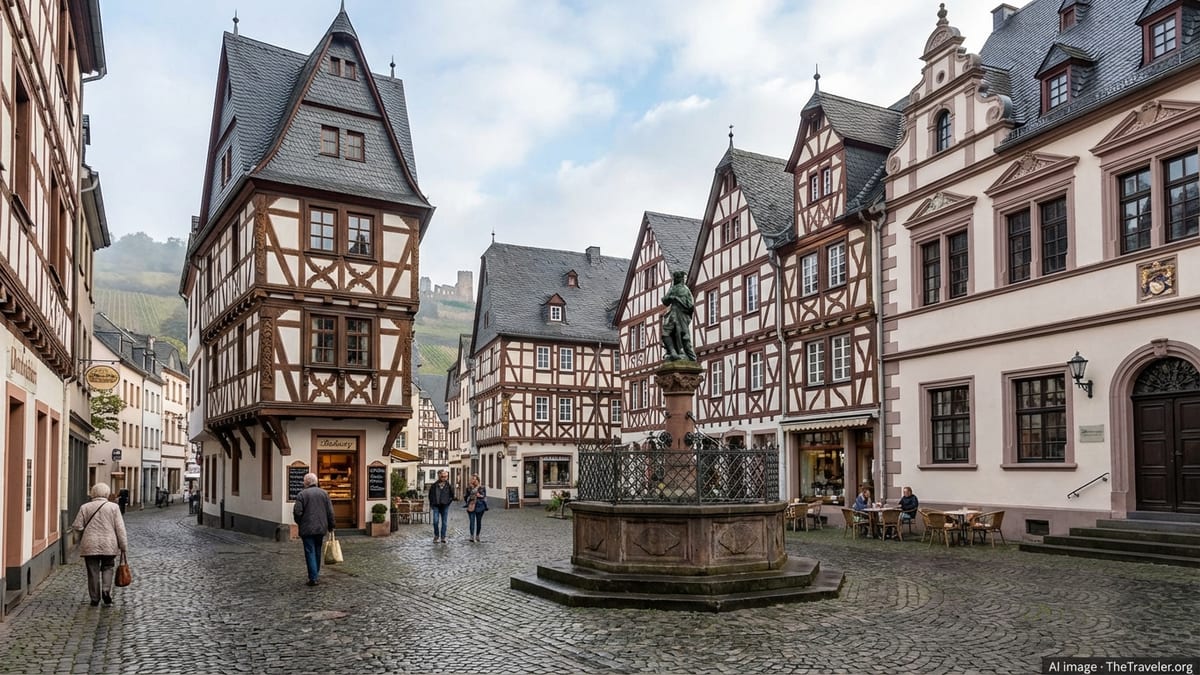
Bernkastel’s Old Town is the kind of place travelers imagine when they picture storybook Germany. Timber-framed houses lean companionably over cobbled lanes, slate roofs point toward the vineyard-covered hills, and the Market Square hums with a rhythm that has barely changed in centuries. Yet behind the postcard views lies a surprisingly complex history of trade, wine, craftsmanship, and everyday life.
If you want a classic introduction, the Old Town anchors many things to do in Bernkastel-Kues. Understanding Bernkastel’s timber houses and its intimate Marktplatz turns a pretty stop on the Moselle into a richly layered experience.
The Medieval Heart of Bernkastel
Bernkastel sits on the right bank of the Moselle River, facing its twin settlement of Kues across the water. The river here bends gently between steep, terraced vineyards, funnelling merchants, pilgrims, and later holidaymakers straight into the Old Town. That geography is the reason a settlement existed here long before it rose to prominence in the Middle Ages, and why its market square became such an important stage for commerce and civic life.
Bernkastel was granted town rights in 1291, a step that allowed it to organize markets, fortify its perimeter, and develop institutions of self-government under the broad authority of the powerful archbishops of Trier. Those privileges brought merchants and artisans who needed places to trade, worship, and live. The compact Old Town that visitors walk today is a direct descendant of that medieval burst of civic confidence: a tight grid of lanes flowing toward a central marketplace, overseen by church, town hall, and the looming ruins of Castle Landshut on the hill above.
The Market Square quickly took on multiple identities. It served as a trading floor where local winegrowers and farmers sold their produce, as a court of public opinion where news and proclamations were read out, and as a stage for festivals and religious processions. Even now, with tourism a mainstay of the local economy, the square remains both a living room for residents and a magnet for visitors who sense that this compact space has anchored the town for more than 700 years.
Reading the Market Square: A Living Room of Timber and Stone
Step into Bernkastel’s Market Square and you are immediately surrounded on all sides by timber-framed houses that seem to crowd in like spectators at a performance. Many of these façades date back 400 years or more, although most buildings have been altered, repaired, and modernized repeatedly over the centuries. What you see now is a living palimpsest: medieval ground plans, early modern timber construction, 19th-century plaster layers, and 20th-century restoration work all overlapping in a single streetscape.
The square is not large, and that intimacy is part of its charm. It feels more like a courtyard than an urban plaza, a space whose scale suits human voices rather than traffic noise. In the center stands the St Michael’s Fountain, a richly decorated well crowned by a statue of the archangel, while the Renaissance town hall presents its ornate façade to the southern side. Around them, gabled houses push forward, some with bow windows or carved corner posts, others flaunting more restrained geometry in white and dark brown.
Architecturally, the Market Square is a small catalogue of regional half-timbered design. Some houses rise on sturdy stone or plastered ground floors that once housed shops, storage rooms, or wine cellars. Above, successive stories project increasingly outward, creating a characteristic overhang. The pattern of beams, braces, and infill varies from house to house. Diagonal struts form decorative crosses and diamonds, while painted motifs and inscriptions celebrate the piety, profession, or pride of long-vanished owners.
Timber-Framed Houses: How and Why They Were Built
The timber houses that frame Bernkastel’s Old Town were shaped as much by economics and regulations as by local taste. Solid stone construction was expensive and time-consuming. Timber framing, by contrast, allowed builders to raise multi-story homes more efficiently, using a combination of oak posts, beams, and braces locked together with mortise-and-tenon joints and wooden pegs. The spaces between the structural members were filled with a mixture of wattle and daub or brick, then plastered and limewashed.
Overhanging upper stories served both practical and fiscal functions. Many medieval towns levied taxes based on the footprint of the ground floor, which encouraged owners to build upward and outward. The resulting jettying not only increased interior space but also sheltered the street below from rain. In Bernkastel, as in other Moselle towns, those overhangs can be quite pronounced, giving some houses a slightly top-heavy, almost playful appearance that adds to the fairy-tale quality of the Old Town. For many visitors, the Old Town heavily shapes whether Bernkastel-Kues is worth visiting.
Fire regulations and changing tastes periodically altered the look of these façades. In times of heightened fire risk, many town councils insisted on plastering over exposed timber to slow the spread of flames. That is why some of Bernkastel’s houses spent long stretches of their history hidden behind plain render. Only in the late 19th and early 20th centuries, as Romantic interest in medieval architecture surged, did owners begin uncovering and restoring the original timbers and painted decoration.
For today’s visitor, it is important to remember that these picturesque homes were first and foremost working buildings. Many doubled as winegrowers’ houses, with cool slate cellars below street level for storing casks, a kitchen and perhaps a modest public room at ground level, and family quarters on the floors above. Attics, with their steeply pitched roofs, served as storage for winter provisions, livestock feed, and equipment associated with the wine trade that still dominates the surrounding hillsides.
The Spitzhäuschen: Bernkastel’s Most Photographed House
No building in Bernkastel captures the imagination quite like the Spitzhäuschen, literally the “Pointed House,” which stands in a corner of the Market Square. Dating back to 1416, it is older than most of the neighboring façades and instantly recognizable. The ground floor is strikingly narrower than the upper stories, so that the building appears to widen as it rises, giving it an exaggerated, slightly precarious profile that visitors rarely resist photographing.
The Spitzhäuschen embodies several themes central to Bernkastel’s built heritage. Its three-sided overhanging timber frame is a particularly dramatic example of the jettying technique, while its high, steep roof underlines how builders in this river valley made the most of both vertical space and rainfall. Like many of the town’s structures, its timber skeleton was once concealed under layers of protective plaster. Only in 1914 were the beams exposed again, revealing the intricate carpentry and decorative details that have become so emblematic of the Old Town’s character.
Architecturally, the pointed house stands at the transition between late medieval forms and the early stirrings of Renaissance and Baroque styles. Decorative flourishes around windows and on the beam ends hint at a growing concern with elegance and individual expression, even as the basic structural system remains rooted in tried and tested techniques. The building also illustrates the traditional layout of a Moselle winegrower’s house, with cellar, living space, and storage all stacked efficiently above each other under one roof.
Today, the Spitzhäuschen is more than just a visual symbol. It houses a wine tavern that continues the building’s long association with local viticulture. Visitors who step inside move from the Instagram-famous façade into a working interior that still hums with conversation, clinking glasses, and the scents of regional wines. In that sense, the house remains what it has always been: a partner in Bernkastel’s communal life, not a static museum piece.
St Michael’s Fountain, Town Hall, and the Stage of Civic Life
At the center of the Market Square, the St Michael’s Fountain offers another lens on Bernkastel’s history. Created in the early 17th century, its sculpted figure of the archangel stands watch over the town, echoing his role on city gates and church façades throughout the region. The fountain provided water for residents and animals, but it also served a more symbolic function as a civic ornament, a sign of prosperity and confidence in the town’s future.
The well’s filigree metal lattice and carved stone elements demonstrate the skill of local artisans at a time when Bernkastel was benefiting from river traffic and thriving vineyards. Look closely at the details and you will see motifs that echo the geometry of nearby timber façades, a subtle conversation between stone, metal, and wood that ties the square together visually. In festivals and processions, the fountain often acts as a focal point, around which events unfold and crowds gather.
Facing the fountain is the Renaissance town hall, built in 1608 to replace an earlier municipal building. Its façade is more regular and monumental than the surrounding houses, with orderly window arrangements and decorative gables that broadcast the might of local authorities. Inside, the town council once deliberated on matters ranging from trade regulation to maintenance of the walls and gates. From its balcony and steps, proclamations could be read out to citizens assembled in the square below.
The interplay between fountain, town hall, and surrounding houses underlines the Market Square’s status as a civic stage. Religious, political, and economic power all appear here in tangible form, whether in the figure of the archangel, the ornate municipal façade, or the timber homes that sheltered the merchants and craftsmen who paid the taxes. When travelers stroll across the cobbles today, they step into a carefully choreographed space that has long choreographed the town’s public life.
Beyond the Square: Gates, Lanes, and Castle Landshut
While the Market Square is the best-known scene in Bernkastel’s Old Town, its surrounding streets and landmarks deepen an understanding of how this place functioned historically. One of the most evocative structures is the Graacher Tor, the last surviving town gate. Originally built around 1300 as part of a full circuit of fortifications, it once controlled access from the direction of the neighboring village of Graach and formed part of the defensive ring that protected the market and riverfront.
Over the centuries, the Graacher Tor has changed roles repeatedly. After the destruction of parts of the fortifications during conflicts in the late 17th century, it was rebuilt in a lower, less militarized form. It served as a prison in the early 18th century and later housed the homeless. Since the late 20th century it has functioned as a small museum of local history, underlining how Bernkastel continues to reinterpret its medieval structures for new uses rather than discarding them altogether.
Above the Old Town, the ruins of Castle Landshut command one of the most impressive viewpoints on the Moselle. Once a fortified residence of the archbishops of Trier, the castle was largely destroyed by fire in the late 17th century. Today, its restored walls and walking paths offer panoramas over the patchwork of vineyards and the dense cluster of roofs that signal the Old Town below. From this vantage point, the relationship between town, river, and hills comes into sharp focus.
Descending back into the Old Town, narrow alleys radiate from the market area toward the river and the former walls. Many of these lanes retain their medieval widths and alignments, even if the ground-floor uses have shifted from stables and workshops to wine bars, bakeries, and guesthouses. Together, they form an urban fabric that supports the Market Square, feeding it with daily traffic and connecting it to moorings on the Moselle where goods and people arrived over the centuries.
Experiencing the Old Town Today
For contemporary travelers, Bernkastel’s Old Town offers more than just a visual feast. The timber houses that line its streets now accommodate a mix of wine taverns, cafés, boutique shops, and small hotels that help keep the historic core vibrantly occupied. Many businesses are family-run, continuing a tradition of small-scale entrepreneurship that stretches back to the town’s earliest days as a market center.
The calendar is studded with events that bring additional life to the Market Square. Seasonal markets, including Christmas stalls in winter, frame the fountain and town hall with stands selling crafts, regional foods, and mulled wine. Wine festivals spotlight the production of the surrounding vineyards, turning the square into an open-air tasting room where local winemakers pour Rieslings and other Moselle specialties for a mix of residents and guests.
Yet even outside major events, the Old Town rewards unhurried exploration. Early mornings can be particularly atmospheric, when delivery vans share the cobbles with just a few locals heading for errands and the façades catch the first light from the river. Later in the day, the terraces of wine bars fill up and multilingual conversation spills into the lanes. Evening brings another transformation, as warm lighting emphasizes the timber patterns and decorative details that might be easy to overlook in the glare of midday.
Responsible tourism has become an important topic here, as in many picturesque European towns. The compact nature of the Old Town makes it easy to explore on foot, and visitors are encouraged to give space to residents going about their routines, to keep noise reasonable in the evenings, and to remember that those photogenic windows and doorways are very often someone’s home. Observing those courtesies helps ensure that Bernkastel remains both livable and lovable.
Planning a Visit: Practical Pointers for Old Town Explorers
Most travelers encounter Bernkastel as part of a broader exploration of the Moselle valley, often combining river cruises, cycling, and vineyard visits with time in town. The Old Town is compact enough that a few hours allow for a circuit of the Market Square, the riverfront promenade, and the Graacher Tor, but a full day or more is recommended for those who wish to include Castle Landshut, museums, or a leisurely wine tasting.
The Market Square is accessible at all hours, which means you can experience it under very different moods. Arriving early allows for quieter photographs of the Spitzhäuschen and surrounding façades, while late afternoon and early evening showcase the social life of the square at its liveliest. Weekdays outside school holidays tend to feel more local, while weekends and peak summer weeks bring larger crowds and a distinctly festive atmosphere.
Comfortable footwear is essential, as cobblestone surfaces define much of the Old Town. Elevation changes within the historic core are modest, but the climb to Castle Landshut involves a steeper path that rewards walkers with sweeping views over the rooftops. Weather along the Moselle can shift quickly, so layers are useful, particularly in shoulder seasons when mornings remain cool but afternoons grow warm.
Many visitors like to pair an architectural focus with wine-focused activities, such as cellar tours, guided tastings, or vineyard walks that explain the terroir behind Bernkastel’s celebrated bottles. Doing so offers a more complete picture of how the town’s fortunes have always been tied to the slopes above, and how the timber houses and market life form just one part of a broader cultural landscape shaped by the river and the vines.
The Takeaway
Bernkastel’s Old Town is more than a cluster of pretty façades. It is a coherent historical organism whose timber houses, intimate Market Square, surviving gate, and hilltop castle together tell a story of resilience, adaptation, and local pride along the Moselle. The half-timbered architecture documents centuries of craftsmanship and regulation, from tax-saving overhangs to fire-conscious plastering, while the Spitzhäuschen distills that story into one unforgettable silhouette.
Spending time here with an observant eye transforms the experience. The archangel atop the fountain, the carved beams above shopfronts, the irregular footprints of centuries-old houses, and the way residents navigate lanes their ancestors also knew all contribute to a sense of continuity that is rare in the modern world. Visitors who look beyond the postcard views discover a town that has continually reinterpreted its built heritage without losing its essential character.
In the end, Bernkastel’s Old Town works so well because it has never been frozen in amber. Its timber houses still house active businesses and families, its Market Square still hosts everyday encounters as well as festivals, and its streets still lead purposefully between river, vineyards, and gates. For travelers interested in how history lives on in the present, this compact corner of the Moselle offers an unusually eloquent lesson.
FAQ
Q1: What is special about Bernkastel’s Market Square?
The Market Square is a remarkably well-preserved medieval marketplace framed by timber-framed houses, a Renaissance town hall, and the St Michael’s Fountain, all within an intimate, human-scale space that still functions as the town’s social and civic heart.
Q2: Why do so many houses in Bernkastel have overhanging upper stories?
Overhanging stories were a way to maximize living space above a relatively small ground-floor footprint, especially when taxes were calculated on ground area. The projecting upper levels also provided some shelter to the street and contributed to the town’s distinctive appearance.
Q3: What makes the Spitzhäuschen different from other timber houses in town?
The Spitzhäuschen is unusually narrow at street level and widens noticeably as it rises, creating a striking, almost top-heavy look. Built in 1416, it combines a dramatic three-sided overhang with a steep roof and decorative timberwork that capture the essence of Bernkastel’s medieval architecture.
Q4: Are the timber façades original or reconstructed?
Many of the structural timbers are historically old, but most houses have undergone repairs, alterations, and restorations over time. Some façades were once plastered over for fire safety and later uncovered, so what visitors see today is a blend of original elements and carefully executed restoration work.
Q5: Can you visit the inside of the timber houses?
Some timber-framed buildings in the Old Town are private residences and not open to visitors, but many house wine taverns, shops, cafés, or guest accommodations where the public is welcome. Stepping into these businesses offers a chance to experience the interiors behind the historic façades.
Q6: How long should I plan to explore the Old Town?
A focused visit of two to three hours is enough to stroll the Market Square, wander nearby lanes, and reach the Graacher Tor, but a full day or more allows time for Castle Landshut, wine tastings, riverside walks, and a more relaxed appreciation of the town’s atmosphere.
Q7: Is the Old Town suitable for travelers with limited mobility?
The Old Town is compact and largely level, but its cobblestone surfaces and occasional steps can pose challenges. Main routes through the Market Square and along the riverfront are generally manageable, while steeper paths, such as the climb to Castle Landshut, may require more caution.
Q8: When is the best time of year to visit Bernkastel’s Old Town?
Spring and autumn offer pleasant temperatures, active vineyards, and somewhat lighter crowds. Summer brings a busier, more festive atmosphere with open-air events, while winter, especially around Christmas, can be very atmospheric when seasonal markets fill the Market Square.
Q9: What other sights near the Old Town should I not miss?
Highlights include the Graacher Tor, the last surviving town gate; the riverside promenade with views across to Kues; Castle Landshut above the town; and smaller squares and fountains that branch off from the main market area and reveal quieter corners of Bernkastel.
Q10: Is Bernkastel mainly a tourist town, or do many locals live in the Old Town?
While tourism plays a significant role in the local economy and many ground-floor spaces serve visitors, the upper stories of numerous buildings are still home to residents. The Old Town remains a lived-in neighborhood, which is one reason its streets and squares feel genuinely alive rather than purely staged for tourism.