

Foreign buyers considering property in the United Arab Emirates face a structurally unique market where investment conditions vary significantly between the seven emirates. While federal rules shape overall foreign ownership and company structures, each emirate defines its own freehold and leasehold zones, planning priorities, and pricing dynamics. Selecting the right emirate is therefore a critical early decision for expatriates evaluating a property purchase in the UAE.
How Emirate-Level Rules Shape Expat Property Choices
Property ownership for foreigners in the UAE is primarily governed at emirate level. All emirates allow some form of foreign participation in real estate, but the scope ranges from extensive freehold zones in Dubai and Abu Dhabi to more limited designated areas in smaller emirates. In general, expatriates can buy full freehold, long leasehold, or usufruct rights only in specified districts, while other areas remain restricted to Emirati or GCC nationals.
Across the country, freehold ownership by non-GCC nationals is now well established in the major urban markets. Dubai opened freehold to foreigners in 2006, and Abu Dhabi followed with designated investment zones. Sharjah, once highly restrictive, has progressively allowed non-Arab foreigners to buy in selected master communities through long leases or freehold-like arrangements, while Ras Al Khaimah and Ajman have positioned themselves as relatively open, value-oriented markets. Smaller emirates such as Umm Al Quwain and Fujairah currently have narrower but evolving frameworks.
Because rules and execution quality differ by emirate, the choice of where to buy is not only a price question. Investors and relocating families must assess legal clarity, maturity of land registration systems, prevalence of strata-title management, mortgage availability, and the depth and transparency of the resale market. These factors are strongest in Dubai and Abu Dhabi, reasonably established in Sharjah and Ras Al Khaimah, and still developing in the smallest emirates.
For practical decision-making, the most relevant emirates for expatriate property purchases today are Dubai, Abu Dhabi, Sharjah, Ras Al Khaimah, Ajman, and to a lesser extent Umm Al Quwain and Fujairah. The sections below compare them on access, pricing, yields, and market depth to identify where expats are most likely to find suitable opportunities.
Dubai: Deepest Market and Widest Choice for Expat Buyers
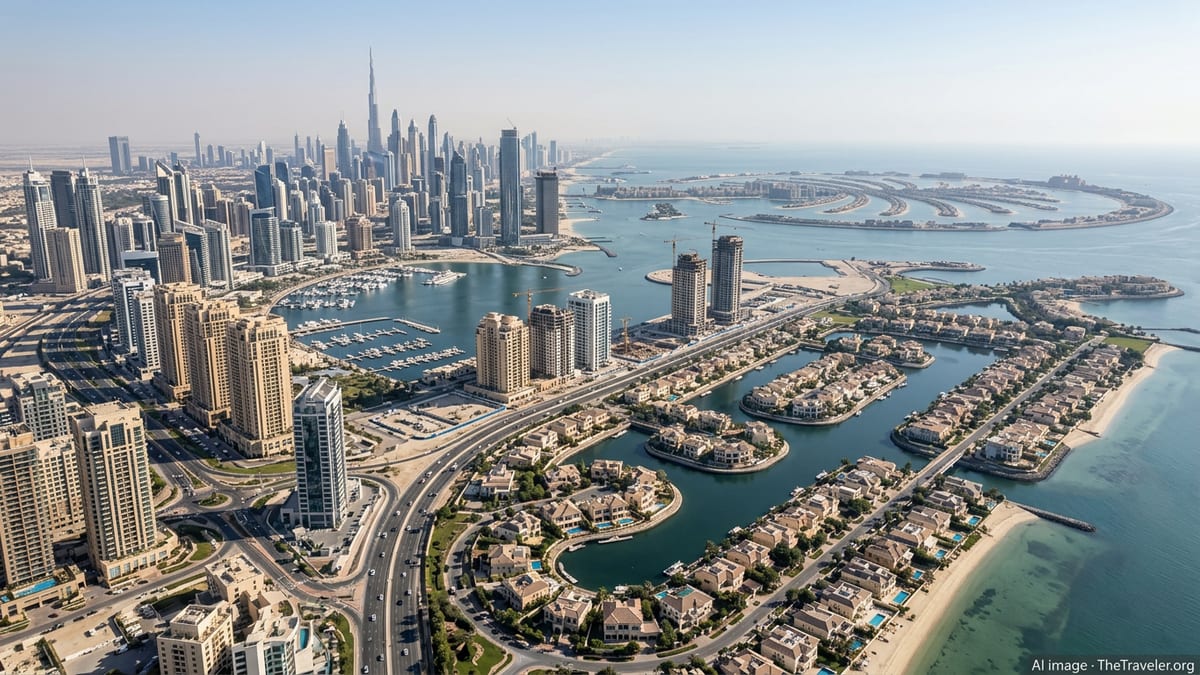
Dubai is the largest, most liquid expat property market in the UAE. A broad network of designated freehold communities allows foreigners to purchase apartments, townhouses, and villas with full title in a wide range of price brackets. Market reports for 2024 and 2025 consistently show Dubai accounting for the majority of UAE residential transactions and much of the country’s luxury segment, with average prices per square foot typically higher than any other emirate.
Recent data indicates that average residential prices in Dubai are often in the range of roughly AED 1,500 to 1,700 per square foot across the city, with prime locations exceeding this level and emerging communities somewhat below it. Villas and townhouses in established freehold districts can reach well above AED 2,000 per square foot, while mid-market apartment clusters remain more affordable. Transaction volume is high, with off-plan sales and ready stock both actively traded, which gives expatriates relatively good entry and exit liquidity compared with other emirates.
Rental yields for Dubai residential properties typically cluster in the mid single digits. Market analyses in late 2024 and 2025 show gross yields on apartments commonly around 5 to 7 percent, with villas producing somewhat lower yields but stronger long-term capital appreciation potential in certain areas. The city’s large expatriate tenant base, diversified economy, and ongoing population inflows underpin demand, although price growth in recent years has outpaced some income growth, which may moderate future appreciation.
For expatriates prioritizing legal clarity, international-standard transaction processes, bank financing options, and the ability to choose among a wide spectrum of communities and price bands, Dubai remains the benchmark emirate. The trade-off is higher entry cost per square meter and stronger correlation with global capital flows, which can increase volatility relative to smaller, more domestically driven markets.
Abu Dhabi: Growing Alternative with Strong Fundamentals
Abu Dhabi has developed into a robust second hub for expatriate property buyers. Foreigners can purchase in multiple designated investment zones, including large master-planned communities on the main island and adjacent islands. While the city started liberalizing later than Dubai, its framework is now mature and supported by a modern land registration and regulatory environment.
Recent market reports show average residential prices in Abu Dhabi below those in Dubai but rising at a faster rate from a lower base. In early 2025, weighted average home values were reported around AED 10,000 per square meter, equivalent to roughly AED 900 to 1,100 per square foot, with apartments priced somewhat higher per square foot than villas. Annual price growth in some subsegments has been in the mid to high single digits, with certain neighborhoods recording stronger increases linked to limited new supply and solid owner-occupier demand.
Abu Dhabi’s rental yields are broadly comparable to, and in some data points slightly higher than, Dubai’s. Market analyses for late 2024 and 2025 refer to gross yields for apartments clustering around 6 to 7 percent in many investment zones, with villas producing slightly lower but still healthy returns. As a result, Abu Dhabi is increasingly viewed by expatriates as a more value-oriented alternative, offering larger average living space and relatively lower prices per square foot, especially for family-sized units.
For expat buyers, Abu Dhabi is particularly relevant when the primary objective is long-term owner-occupation in a stable environment, with an additional expectation of reasonable capital preservation and yield. The market is less speculative than Dubai, with a higher share of end users, and overall price levels are materially below Dubai’s primes. The principal trade-off is a somewhat narrower choice of communities and lower overall market depth, which may matter for very short investment horizons.
Sharjah: Value-Oriented Market with Selective Expat Access
Sharjah has historically had more conservative property rules for non-GCC nationals, but changes over the past decade have opened several major master communities to foreigners on freehold or long leasehold bases. Flagship developments on the outskirts and in new growth corridors now market actively to expatriates, especially mid-income families working across the northern emirates and in Dubai but seeking lower housing costs.
Available market data for 2025 indicates that Sharjah’s average apartment sale prices per square foot remain materially below Dubai and Abu Dhabi. Some emirate-level reports show prices that have recently climbed from around the mid-hundreds to approximately AED 1,000 per square foot in active new communities, with strong percentage growth from a low base. Transaction volumes and the aggregate value of deals have increased notably, supported by improving developer quality and infrastructure.
Gross rental yields in Sharjah are typically higher than in the two largest emirates, reflecting lower purchase prices relative to achievable rents. While concrete yield figures vary by project and location, investor-oriented analyses often reference yields in the mid to high single digits for well-located apartments targeting the commuter and family market. The low entry ticket size and potential for further convergence with Dubai-area pricing are key attractions for expat investors focused on returns rather than prestige addresses.
From a relocation perspective, Sharjah can be attractive for expatriates who work nearby but are priced out of Dubai’s central freehold districts or who prioritize cost-efficiency over brand recognition. However, expat buyers must pay close attention to project-specific ownership structures, ensure alignment with local rules on freehold versus leasehold, and understand that the secondary market is thinner, which can lengthen resale timelines.
Ras Al Khaimah: Emerging Resort and Lifestyle Investment Hub
Ras Al Khaimah (RAK) has gained prominence among expatriate property buyers as a relatively affordable coastal emirate with growing tourism and resort-oriented development. Foreigners can buy in several master communities, including island and waterfront projects that are increasingly marketed as second-home and lifestyle investment options, supported by improving connectivity and infrastructure.
Recent analyses of the RAK market highlight rapid growth from a modest base. Between 2017 and mid-2024, mortgage volumes reportedly increased dramatically, and in 2025 local reports noted strong price growth in villa and apartment segments, with some villa prices rising by more than 40 percent year on year in specific locations. Even after this surge, typical price points in RAK remain substantially below Dubai and Abu Dhabi for comparable property types, offering a lower entry cost into waterfront and villa stock.
Available data and investor commentary suggest that rental yields in RAK can be competitive, especially in short-stay and holiday-let formats in resort areas, with some references to yields around the mid single digits to low double digits for well-managed units. However, yields vary widely depending on occupancy and management quality, and the long-term depth of the secondary market is still developing. The future opening of large-scale integrated resort projects is expected to support further demand for both owner-occupied and investment properties.
RAK is best suited for expatriates with a mixed objective of part-time personal use and investment, or for those seeking a quieter environment with lower acquisition costs. The key trade-offs are a smaller, less liquid resale market and greater sensitivity to tourism cycles and future project delivery compared with the main metropolitan emirates.
Ajman, Umm Al Quwain and Fujairah: Niche, High-Yielding but Thin Markets
Ajman, Umm Al Quwain (UAQ) and Fujairah round out the UAE’s northern emirates and present more niche opportunities for expat buyers. Ajman in particular has been positioned as a low-cost alternative to Dubai and Sharjah, with a number of apartment-focused developments targeted at budget-conscious residents and small investors. Foreign ownership is possible in designated areas, and prices per square foot are typically among the lowest in the country.
Market commentary and transaction data indicate that Ajman’s residential units can be significantly cheaper than comparable stock in Sharjah or northern Dubai, often resulting in headline rental yields that appear higher on paper. In practice, yields depend heavily on tenant quality, service-charge levels, and building management standards, which can be inconsistent. Liquidity is improving but still limited relative to Dubai or Abu Dhabi, which can affect exit timelines and pricing during market slowdowns.
UAQ and Fujairah offer even smaller property markets, with limited but gradually expanding opportunities for foreign buyers in selected freehold or long-lease zones. Price levels are generally low compared with the main emirates, and rental yields can be attractive on a percentage basis for properties with stable, long-term tenants. However, transaction volumes are very modest, and future capital appreciation is likely to depend closely on localized industrial, port, or tourism projects rather than broad-based national demand.
For most relocating expatriates, these three emirates are secondary options rather than primary relocation destinations. They may suit investors seeking speculative exposure to early-stage markets or those with specific lifestyle or work reasons to be based there. Rigorous due diligence on developer track record, building quality and local demand drivers is essential before committing capital.
Comparative Overview: Which Emirates Suit Which Expat Profiles?
When assessing the best emirates in the UAE to buy property as an expat, the decision often comes down to balancing legal robustness, market depth, price level, and investment objective. The following high-level comparison reflects typical conditions as of late 2024 and early 2025, recognizing that precise figures vary by district and project.
Dubai generally offers the strongest combination of legal clarity, choice, and liquidity, but at the highest average price per square foot. Abu Dhabi provides a slightly lower price point with solid governance and increasingly strong demand, appealing to long-term end users and investors who favor stability. Sharjah and Ajman are geared more toward cost-conscious buyers and yield-focused investors who accept thinner resale markets in exchange for lower entry prices.
Ras Al Khaimah occupies a middle ground as an emerging resort and lifestyle hub with lower prices than Dubai and Abu Dhabi but rapid recent growth, while UAQ and Fujairah remain small, specialized markets where opportunities exist but must be evaluated case by case. Across the UAE, gross residential yields for expat-suitable properties commonly fall in the approximate range of 5 to 8 percent, with variation by emirate and micro-location. Higher yields often signal higher risk in terms of tenant stability, market depth, or building quality.
In deciding where to buy, expatriates should align their emirate choice with their primary aim: secure long-term residence, income-focused investment, capital appreciation, or mixed-use second-home ownership. They should also account for the likelihood of future relocation, since the ability to resell or lease out the property efficiently is highly dependent on emirate-level market depth and regulatory maturity.
The Takeaway
For expatriates, the best emirate in the UAE to buy property is not universally the same; it depends on price tolerance, investment horizon, and risk appetite. Dubai stands out for breadth of options, established freehold zones, and transaction liquidity, albeit at premium prices. Abu Dhabi offers a more value-oriented environment with strong fundamentals, making it a compelling choice for end users and medium to long-term investors.
Sharjah and Ajman provide lower entry costs and potentially higher percentage yields for buyers willing to navigate more selective foreign ownership zones and thinner secondary markets. Ras Al Khaimah is emerging as a notable alternative for lifestyle and resort-led investment, combining relatively moderate prices with significant development momentum. The smallest emirates, UAQ and Fujairah, remain niche plays where careful, localized analysis is critical.
Expatriates evaluating a property purchase should therefore begin by choosing the emirate that best matches their financial objectives and risk profile, then conduct granular due diligence at community and project level. With clear understanding of emirate-specific rules, pricing structures, and market depth, a UAE property acquisition can form a viable component of a broader relocation or investment strategy.
FAQ
Q1. Can expatriates buy freehold property in every emirate of the UAE?
Non-GCC expatriates can generally buy freehold or long-lease property only in designated zones, and the number and size of these zones differ significantly by emirate.
Q2. Which emirate is usually most attractive for expat property buyers?
Dubai is typically the most attractive because it offers the widest choice of freehold communities, deep market liquidity, and mature transaction processes, albeit at higher prices.
Q3. How do average property prices compare between Dubai and Abu Dhabi?
Dubai’s average residential prices per square foot are usually higher than Abu Dhabi’s, with many reports indicating a premium of several hundred dirhams per square foot in recent years.
Q4. Are rental yields higher in smaller emirates than in Dubai?
In percentage terms, rental yields in Sharjah, Ajman, and Ras Al Khaimah can be higher due to lower purchase prices, but they may come with thinner resale markets and higher risk.
Q5. Is Sharjah a good emirate for expats to buy property?
Sharjah can be attractive for cost-conscious expats, offering relatively low entry prices and solid yields in designated communities, provided buyers understand the specific ownership rules.
Q6. Why are some expats considering Ras Al Khaimah for property purchases?
Ras Al Khaimah offers comparatively affordable villas and waterfront properties, growing tourism-led demand, and potential for capital appreciation from a lower starting price base.
Q7. Do all emirates provide similar legal protections for foreign owners?
Core property rights are recognized across the UAE, but the level of regulatory maturity, strata management, and process transparency is generally strongest in Dubai and Abu Dhabi.
Q8. Are mortgages readily available to expatriates in all emirates?
Main banks are most active in Dubai and Abu Dhabi, with expanding but more selective lending in other emirates; availability and terms vary by lender and project.
Q9. Which emirates are best suited for long-term end-user buyers?
Dubai and Abu Dhabi are best suited for long-term end users seeking stability, established communities, and easier future resale or leasing options.
Q10. Which emirates appeal most to yield-focused property investors?
Yield-focused investors often look to Sharjah, Ajman, and selected areas of Ras Al Khaimah, where lower purchase prices can translate into higher headline gross rental yields.