


The night sky has quietly become one of the world’s most sought-after luxury experiences. As cities grow brighter, travelers are going farther in search of true darkness, pristine stars and encounters with professional observatories. For 2027, astro-tourism is maturing into a sophisticated niche, with destinations developing dark-sky reserves, regulating light pollution and fine-tuning small-group tours that combine science, Indigenous knowledge and unforgettable Milky Way views. The result is a global menu of stargazing journeys that can be as casual as pulling off a highway overlook or as immersive as spending a week in high desert observatory country.
Get the latest updates straight to your inbox!
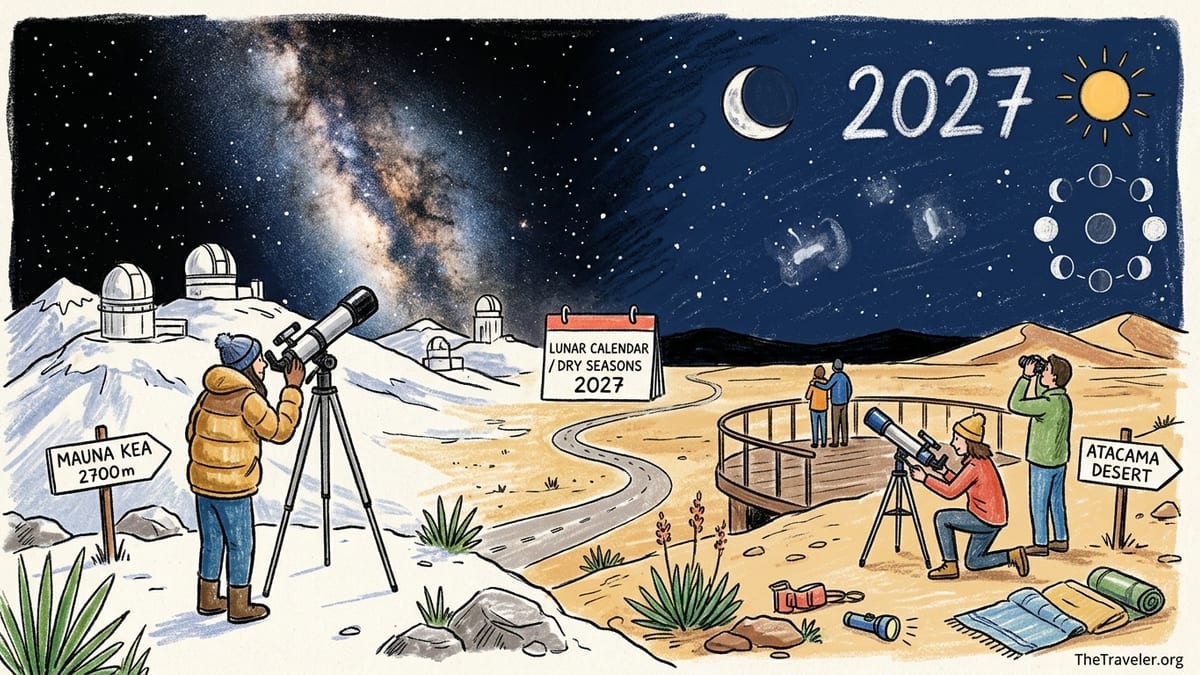
Planning for 2027: Seasons, Moon Phases and Solar Activity
Before choosing a destination, it helps to understand how timing affects what you will see. The best deep-sky observing typically happens during the darkest third of the lunar month, around the new moon, when moonlight does not wash out fainter stars and the Milky Way. Many specialist tour operators in places such as Hawaii and Chile publish their schedules around these dark windows and reduce or even pause departures when the moon is above about 20 percent illumination. Travelers planning a 2027 trip should start by checking a lunar calendar, then matching those dates to their preferred region’s dry season.
Seasonality is equally important. The Atacama Desert in northern Chile, one of the world’s premier astro-tourism hubs, combines altitude with extremely dry air and tends to have clear skies year-round, with the southern winter months from June to August favored for long, crisp nights. In contrast, the Mauna Kea region on Hawaii’s Big Island offers good observing across all seasons but can see more unstable weather in the wettest winter weeks, which sometimes leads to tour cancellations for safety. European dark-sky parks such as those in France and Spain work within a more defined summer tourist season, when roads are open and temperatures are comfortable enough for night-time viewing.
Looking ahead to 2027, there is another factor in play: the solar cycle. The current solar maximum period is delivering vivid aurora displays in higher latitudes, from Iceland and northern Scandinavia to parts of Canada and Alaska. Solar activity is expected to gradually taper off toward the late 2020s, but 2027 should still offer a reasonable chance of aurora hunting in the right conditions. Unlike traditional stargazing, aurora trips do not require total darkness from the moon, but they do depend heavily on short-notice forecasts, so flexible travel plans and local guides who run nightly “chase” tours remain valuable.
Whatever the target, travelers should build backup nights into their itinerary. In practical terms, that means allocating at least two or three possible observing nights in a given destination. A traveler staying four nights in San Pedro de Atacama or three nights near Utah’s national parks, for example, has a much better chance of enjoying at least one crystal-clear, dark-sky experience if one evening is lost to wind or cloud.
Mauna Kea and the Big Island of Hawaii
Hawaii’s Big Island remains one of the most accessible ways for North American travelers to taste world-class astronomy in 2027. The cluster of research telescopes atop Mauna Kea sits near 4,200 meters above sea level, and while the summit itself is reserved for scientific work and carefully regulated, commercial tours bring visitors to the upper slopes for sunset and then descend to around 2,700 meters for stargazing. Current summit and stargazing excursions with established operators often run around 8 to 9 hours, include thermal jackets and hot drinks, and are typically priced in the region of 300 to 330 US dollars per adult, reflecting both the small group size and the long drive from coastal resorts.
Independent travelers can also drive to the Maunakea Visitor Information Station on the Saddle Road, in a mid- to high-clearance vehicle, to enjoy stargazing from the public parking area. The University of Hawaii advises that children under 13 should not go above the station due to altitude, and private stargazing is restricted at the summit itself, so most self-guided visitors remain at this mid-mountain level. On clear moonless nights, the Milky Way is visible to the naked eye, and many visitors report that simply stepping out of the car and letting their eyes adapt is enough to experience a sky very different from the mainland United States.
For 2027, travelers should watch for evolving cultural and access regulations around Mauna Kea, where Native Hawaiian groups continue to advocate for respectful management of the mountain. Established tour companies already incorporate cultural interpretation into their briefings, and some resorts on the Kohala Coast offer lower-altitude astronomy programs that pair Hawaiian star navigation stories with modern telescopes on the hotel grounds. These alternatives can suit visitors who prefer to avoid high altitude yet still want a guided introduction to the southern sky.
Practical preparation is essential. Even visitors coming from tropical beach resorts will encounter sub-freezing windchill at higher elevations after dark. Most summit tours provide parkas and gloves, but those driving themselves should pack winter layers, closed shoes and headwear. Checking the moon phase and booking tours that operate only on darker nights can make a visible difference; some specialist operators on the island openly advertise that they do not run trips when the moon exceeds roughly one-fifth illumination because of its effect on deep-sky contrast.
Chile’s Atacama Desert and High-End Observatory Tourism
Chile’s Atacama Desert is already a byword for astro-tourism, and by 2027 it will remain one of the most ambitious destinations for travelers who want to combine vacation time with serious night-sky photography or observatory visits. The town of San Pedro de Atacama acts as the main base, with dozens of small agencies offering shared astronomy tours, usually including transport to a dark-site outside town, use of medium- or large-aperture telescopes, and bilingual explanations. As of late 2026, many standard tours are priced in the region of 40,000 to 50,000 Chilean pesos per person, which at recent exchange rates translates to roughly 40 to 55 US dollars, and typically last 2 to 3 hours including pickups.
More specialized astrophotography experiences cost more but are still competitive by global standards. A dedicated astronomical and astrophotography tour with a local provider might be advertised at about 45,000 Chilean pesos per person, with small groups and time allocated for guests to attach their own cameras to tracking mounts. Private astronomy tours in the wider Atacama region regularly list prices between about 200 and 400 US dollars for a group of two to six people, trading a higher per-tour cost for more personalized guidance and the ability to shape the schedule around a particular new moon night or specific targets such as the Magellanic Clouds.
Crucially, the Atacama is not just about tourist telescopes. Several of the world’s major observatory complexes, including high-altitude sites operated under international partnerships, lie in the surrounding desert. While core research facilities have strict security and limited public access, some centers offer guided daytime tours on fixed days of the week, bookable well in advance. These visits often include a talk by staff, a walk around the control rooms and antennas, and insight into how the same clear, dry conditions that appeal to visitors are harnessed for cutting-edge astrophysics. With demand high and capacity tightly controlled, travelers planning a 2027 visit should check official observatory visitor pages many months ahead and be prepared for free but fully booked tours.
Weather patterns in the Atacama favor year-round observing. However, even here, moonlight is managed carefully. Many San Pedro tour agencies publish monthly calendars, marking which departures focus on the moon itself and which are timed for new moon periods when faint galaxies and nebulae are easier to see. For visitors flying long-haul from North America or Europe to Chile, locking in a dark-sky week and then building other desert excursions, such as the Valley of the Moon or high Andean lagoon trips, around their astronomy nights can make the most of the journey.
Europe’s Dark-Sky Parks and Accessible Astro-Weekends
For travelers based in Europe, 2027 offers a maturing network of officially recognized dark-sky parks and reserves, especially in rural France, Spain and central Europe. Areas such as the Pic du Midi in the French Pyrenees and high plateaus in southern Spain combine relatively easy road access with firm efforts to control light pollution. Regional tourism boards now promote astro-friendly accommodations, from mountain refuges to small rural hotels that dim exterior lighting and provide information on constellations and meteor showers in several languages.
Many European dark-sky parks favor spring and autumn for organized events. In April, when nights are still reasonably long but temperatures begin to rise, it is common to find weekend star parties hosted by local astronomy clubs, where visitors can look through member telescopes free of charge after paying a modest park entrance fee. Summer months see family-oriented stargazing walks paired with sunset hikes, often scheduled around new moon weekends in July and August. Prices for guided night walks are often in the range of 15 to 30 euros per person, a comparatively affordable way for new observers to gain experience under darker skies without traveling far.
Observatories open to the public play a key role in this European scene. Facilities associated with universities or regional science centers sometimes run scheduled “open nights,” which can include a dome visit, a short lecture and views through permanent telescopes if weather permits. Tickets for these evenings are typically booked online in advance, with capacities ranging from a few dozen to more than a hundred visitors per session. Because of the unpredictable nature of European weather, operators often stress that even cloudy nights will proceed with indoor programs, so travelers should view telescope time as a welcome bonus rather than a guarantee.
For a 2027 weekend break, a Belgian or Dutch traveler might combine a rural hotel stay in the Ardennes or Eifel region with a visit to a nearby observatory and a night hike in a dark-sky park, timing the trip around a major meteor shower such as the Perseids in mid-August. While Europe rarely matches the raw darkness of deserts in Chile or Namibia, careful planning around moon phase and weather still delivers skies far richer than those over major cities.
Utah, the American Southwest and the Growth of Dark-Sky Tourism
The American Southwest has emerged as a flagship region for organized dark-sky tourism, and by 2027 that trend looks set to deepen. Utah’s government, for instance, has proclaimed April as Dark Sky Month in recent years, using the period to highlight the state’s concentration of certified dark-sky parks around national park gateways such as Moab, Torrey and Springdale. Lodges and outfitters now routinely offer night-sky add-ons, from simple constellation talks at campground amphitheaters to guided photography sessions on remote overlooks.
Travelers can expect a wide range of price points. In and around national parks, basic ranger-led night sky programs are often covered by the standard park entrance fee, though they may run only a few nights per week in peak season. Private outfitters operating out of towns like Moab or Kanab advertise small-group astrophotography tours that might cost from about 150 to 250 US dollars per person for 3 to 4 hours, including transport to a dark location, headlamps with red filters, and instruction on camera settings. Some glamping operations and high-end resorts fold stargazing into their nightly resort fee, setting up large binoculars or portable telescopes on communal decks.
Unlike alpine or equatorial destinations, much of the Southwest is reachable by standard rental car. This opens up an entire category of self-guided stargazing, where visitors simply drive to a park viewpoint, stay within signed parking areas for safety and switch off their headlights. To make the most of this approach in 2027, travelers should check park websites for any night access restrictions, seasonal road closures or requirements to remain in developed campgrounds after dark. Fire regulations and wildlife advisories can change year by year, especially as the region responds to drought.
The combination of dark-sky recognition and visitor education is particularly visible in gateway communities. Some towns host annual star festivals, drawing both local families and international visitors, with talks from astronomers alongside telescope fields. While specific 2027 dates are still being announced, April and October remain likely months for such events, when temperatures are comfortable and nights long enough to host extended observing sessions without crowds staying out until very late.
Southern Skies in New Zealand and the Pacific
The southern hemisphere offers star fields that never rise over Europe or North America, and New Zealand has positioned itself at the forefront of southern-sky tourism. The Aoraki Mackenzie region on the South Island is recognized internationally as a dark-sky reserve, with local councils and tourism operators collaborating to limit outdoor lighting and promote night-sky experiences. Visitors to the lakeside town of Tekapo, for example, can pair daytime hikes or hot pools with evening stargazing sessions on nearby hilltops, using medium-sized telescopes to observe objects such as the Southern Cross and the Magellanic Clouds.
Organized tours in New Zealand’s dark-sky regions typically include transport from town, warm clothing, and guided use of telescopes, often lasting around two hours. Prices for these experiences commonly fall between about 130 and 200 New Zealand dollars per adult, reflecting both the specialized equipment and the relatively remote locations. Some operators offer “premium” options with smaller groups and longer telescope time, while others combine stargazing with astrophotography tuition, providing tripods and camera mounts for guests who bring their own DSLRs or mirrorless cameras.
Elsewhere in the Pacific, destinations are experimenting with integrating astronomy into broader cultural tourism. In parts of Polynesia, small-group boat or coastal tours highlight traditional celestial navigation, explaining how wayfinders read star paths, swells and bird behavior. On islands where formal observatories are not accessible, upmarket resorts sometimes host visiting astronomers during peak holiday months, arranging rooftop talks and telescope sessions for guests at no extra charge beyond the nightly rate.
Because seasons are reversed in the southern hemisphere, travelers planning a 2027 trip from the northern side of the equator should remember that New Zealand’s darkest and longest nights fall between May and August. However, winter brings cold temperatures and occasional snow to high country roads, so those uncomfortable with icy conditions might target shoulder months such as April or September, trading slightly shorter nights for easier logistics.
Aurora and Arctic Night: Stargazing at High Latitudes
High-latitude destinations, from Iceland and northern Norway to Canada’s Yukon and Alaska, occupy a special corner of the astro-tourism world. Here, the night sky is often dominated not by the Milky Way but by the aurora borealis, especially during active phases of the solar cycle. In practical terms, 2027 is likely to see continued demand for aurora trips, even if peak solar activity begins to ease compared with 2024 and 2025. Many operators already recommend that visitors book at least three or four nights in an auroral zone to improve their odds of a strong display.
Aurora tours typically work differently from classic stargazing excursions. Rather than scheduling strictly around the new moon, guides focus on short-term space weather forecasts and cloud cover. In northern Norway, small-van “aurora chase” trips that depart Tromso or similar hubs frequently charge in the region of 150 to 200 euros per person for an evening outing, including thermal suits, hot drinks and professional photography. Purpose-built aurora lodges in remote areas, particularly in Finnish Lapland or northern Canada, may cost several hundred euros or dollars per night but include heated glass igloos or domes that allow guests to watch the sky in comfort if the lights appear.
For travelers who also want a more traditional stargazing experience, timing is important. Winters in the far north bring long nights, yet the combination of snow, moisture and occasional local light pollution around resort areas can wash out fainter stars. Shoulder seasons such as September and March often provide a balance of reasonable temperatures, dark skies and active aurora, while also leaving enough time at dawn and dusk for daytime activities. Guests who arrive with realistic expectations, prepared to enjoy sledding, saunas and cultural visits even if the sky does not fully cooperate, tend to leave more satisfied.
Because aurora conditions are so variable, booking flexible, refundable tours or packages remains wise for 2027. Many reputable operators allow date changes if a particular night’s forecast is poor, and some offer reduced “re-run” prices if guests do not see the lights on their first outing. Prospective visitors should review contract terms carefully before committing to high-ticket lodge stays, paying attention to what is and is not guaranteed.
How to Choose Your 2027 Astro-Trip
With so many options, from Hawaii and Chile to New Zealand, Europe and the Arctic, the best astro-tourism destination for 2027 will depend less on a ranked list and more on matching personal priorities to what each region does best. Travelers who want to pair world-class telescopes with relatively straightforward logistics might focus on the Big Island of Hawaii or Utah’s dark-sky parks, where rental cars, mid-range hotels and familiar currencies simplify planning. Those seeking the faintest deep-sky objects and specialist astrophotography support may lean toward the Atacama Desert or New Zealand’s South Island, where altitude and low humidity significantly darken the sky.
Budget and comfort also shape the decision. A traveler willing to spend more per night on accommodation might opt for an all-inclusive desert lodge or aurora resort that builds astronomy into the stay, preferring hot tubs and observatory domes just steps from their room. Others may choose to base themselves in a simple guesthouse near a dark-sky reserve and allocate funds toward a handful of professionally guided nights, using free evenings for independent stargazing with a pair of binoculars. By late 2026, it is already clear that both models coexist successfully in major astro-tourism regions, giving visitors a wide range of price points.
Regardless of destination, a few shared strategies will help maximize a 2027 sky trip. First, consult moon phase calendars and aim for dates within about a week of the new moon when deep-sky views matter. Second, build redundancy into the schedule, allowing for one or two “backup” nights in case of poor weather. Third, confirm the latest local regulations regarding protected areas, road access and observatory visitor rules, as these can evolve year by year. Finally, consider bringing simple gear such as warm clothing, a red-light headlamp and basic binoculars, which can dramatically improve the experience even on nights when large telescopes are not available.
As destinations from South Africa to rural Australia continue to develop dark-sky strategies, the map of astro-tourism is likely to become even richer beyond 2027. For now, travelers who plan carefully around seasons, moonlight and their own comfort level can already choose from a remarkable collection of places where, for a few nights at least, darkness is not something to fear, but the main attraction.