


Miseno is best known for its long ribbon of sand and busy lidos, a classic summer escape for Neapolitans. Yet step away from the rows of umbrellas and you find a very different place: a quiet headland of tufa cliffs and vineyards, Roman ruins tucked into the rock, and languid village evenings looking across to Procida and Ischia. For travelers willing to explore beyond the famous beach, Miseno becomes one of the most atmospheric corners of the Campi Flegrei.
Get the latest updates straight to your inbox!
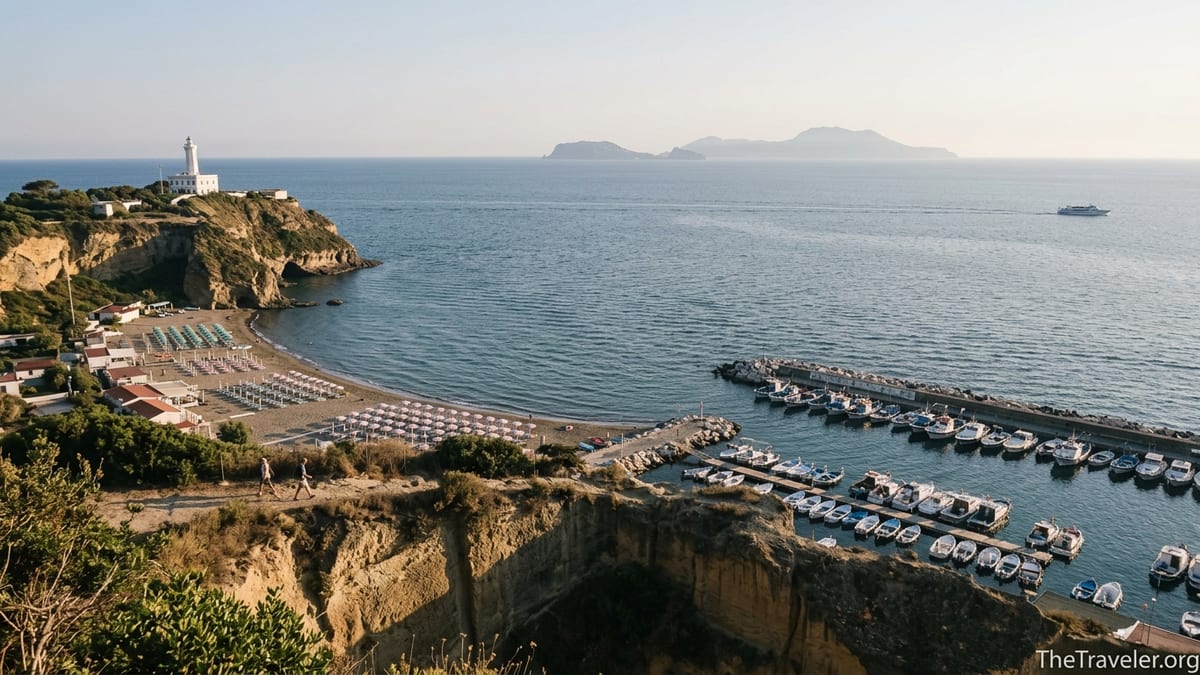
Climb Capo Miseno for the Bay of Naples’ Grandstand View
The most rewarding thing you can do beyond the shoreline is to walk up Capo Miseno, the tufa promontory that closes the Gulf of Naples. From the marina area near the beach, follow Via Dragonara and then Via Faro uphill to pick up the path to the lighthouse. The route starts as a paved lane and then turns into a stone path that zigzags up the side of the ancient volcanic crater. Allow about 30 to 40 minutes at a relaxed pace from the seafront to the upper terrace.
Near the top you reach a wide viewpoint terrace at roughly 60 to 70 meters above sea level, where low walls and benches make it easy to stop and take in the panorama. On clear days you can pick out the serrated skyline of Naples in one direction and the perfect cone of Vesuvius in the other, with Procida and Ischia seemingly floating in the middle distance. Locals often come up towards sunset with takeaway coffee or a slice of pizza from Bacoli, so you will not feel out of place lingering for photos.
From the terrace a further path climbs toward the summit and the white Capo Miseno lighthouse. The final stretch is more exposed, with uneven tufa blocks underfoot, so sturdy shoes help. In summer the sun is intense and there is almost no shade, which makes early morning or late afternoon the best times to attempt the walk. There is no ticket office or infrastructure on the trail, just a couple of basic information panels, so bring water from the bars by the marina before you set out.
Even if you have limited time, trying to fit this walk into your day in Miseno gives you a completely different sense of place than staying at beach level. The height and silence on the headland contrast sharply with the music drifting up from the lidos below, and you begin to understand why this natural amphitheater impressed ancient writers as much as modern visitors.
Explore the Roman Heart of Ancient Misenum
Long before it became a beach destination, Miseno was Misenum, the main naval base of the Roman Empire. Traces of that past remain scattered on and around the headland. The most atmospheric is the Grotta della Dragonara, a Roman cistern dug into the side of Capo Miseno above the marina. From outside it looks like a simple doorway in the rock, but inside you find a cool grid of tufa pillars and vaulted corridors lined with ancient waterproof plaster.
The cistern dates from the Augustan period and once helped supply water to the fleet and villas on the cape. Today visits are usually managed as part of guided routes organized locally in Bacoli and the wider Parco Archeologico dei Campi Flegrei, especially on weekends and during cultural events. Entry is typically just a few euros when open. Access can change seasonally, so it is worth asking at your hotel or at tourist offices in Bacoli which days are currently available.
Not far away, still within the municipality of Bacoli, you can visit other Roman waterworks such as the vast Piscina Mirabilis, once the terminal reservoir of the Augustan aqueduct that served the fleet. Although it sits slightly inland at Bacoli rather than in Miseno itself, it makes a logical pairing with the Dragonara cistern. Inside, forest-like rows of brick pillars disappear into the half light, and guided visits help make sense of the engineering without overwhelming you with dates.
Combine these underground spaces with a walk among the ruins of the Sacello degli Augustali in Miseno, where marble fragments and inscriptions evoke the cult of the emperor’s household gods. Between them, these sites tell the story of a headland that was far more than a holiday spot. For a traveler, they also provide cool, quiet refuges from the midday heat and a way to vary a trip that might otherwise be dominated by sea and sun.
Take to the Water: Coastal Cruises and Island Hops
You do not have to stay on the sand to enjoy Miseno’s waterfront. The small harbour beside the beach is busy with fishing boats and small leisure craft, and in summer local operators offer short coastal cruises around Capo Miseno and neighboring Baia. These simple excursions, often on open wooden boats, usually last 1 to 2 hours and cost roughly what you would pay for lunch at a mid-range trattoria in Naples, making them an accessible treat even on a careful budget.
Boatmen often steer close to the cliffs below the lighthouse and continue toward the Aragonese castle of Baia, where you can see submerged Roman structures through the clear water. Many trips include short swim stops in sheltered coves that are hard to reach from land. While exact itineraries vary, you can normally arrange a place by walking the harbor in the late morning or early afternoon and asking about departures later that day.
Miseno is also conveniently placed for reaching nearby islands. Though there are no large commercial ferries directly from Miseno’s beach, you can travel a short distance by taxi to Pozzuoli or Monte di Procida and pick up regular ferries to Procida and Ischia. Journey times from these ports are generally under an hour, and one-way tickets are usually in the range of a modest restaurant meal, depending on the season and operator. This makes it realistic to base yourself in Miseno and plan day trips to at least one of the islands without changing hotels.
If you are comfortable organizing your own logistics, consider planning an early boat to Procida from Monte di Procida and returning via Pozzuoli to add variety to your views of Capo Miseno from the sea. Always check same-season timetables a few weeks before you travel, as schedules and frequencies change between winter and the high summer period, and popular departures in July and August can sell out in advance.
Walk Between Miseno, Bacoli and Baia
Beyond the headland paths, some of the most enjoyable hours in Miseno are spent simply walking between its neighboring bays and villages. The flat coastal road linking Miseno and Bacoli is an easy 15 to 20 minute stroll, following the curve of the water with views back to Capo Miseno and over the lagoons of Fusaro and Miseno. Small bars and gelaterie along the way are ideal for a mid-afternoon espresso or a lemon granita for a couple of euros.
From Bacoli, the road continues toward Baia, where pastel houses climb the hillside below the castle. This stretch takes around half an hour on foot, but there are frequent local buses if the heat becomes too much. In Baia you can explore the archaeological park with its remains of seaside villas and bath complexes that once lined the ancient shoreline. The modern marina sits where emperors once docked their pleasure craft, which makes it a particularly evocative place to watch the light change over the bay.
These walks give you a feel for the wider Campi Flegrei landscape, where lagoons, low hills and volcanic craters are never far away. You will often hear Neapolitan rather than standard Italian, and most of the visitors will be regional day trippers, especially outside the peak weeks of August. Carry small change for bus tickets purchased on board, and do not be surprised if drivers stop between official stops to pick up local passengers, especially on quieter routes.
If you want something a little more active, ask at your accommodation about guided hikes that link the coastal villages with viewpoints on the inland hills, sometimes combined with tastings at small family wineries. These are usually half-day experiences and cost on the order of a mid-range restaurant dinner per person, depending on inclusions. They are a good way to see orchards and vineyards that are otherwise hard to reach without a car.
Savor Slow Evenings and Local Food Culture
One of the pleasures of staying in Miseno instead of visiting only for the day is the chance to experience evenings when the beach empties and the promenade belongs once again to locals. After 7 or 8 pm, families stroll the waterfront between the lidos and the marina, children pedal small bicycles, and older residents lean on railings to talk about fishing conditions and football games. You can join this passeggiata with a cone of gelato or a paper cup of fried seafood from simple takeaways tucked behind the main road.
Restaurants around Miseno and Bacoli lean heavily on seafood, as you would expect from a place that historically supplied fish and shellfish to Naples. Menus regularly feature spaghetti alle vongole, grilled local fish, and octopus salad, often at prices that are competitive with the better-known Amalfi Coast. House wines are typically from Campania, including whites from the nearby Phlegraean fields that match well with seafood. Service is usually informal, and on summer weekends you should reserve by late afternoon if you want an outdoor table.
For a more casual experience, look for small bars that serve aperitivo on outdoor terraces with views of the bay. Here you might pay a little more than for a simple coffee, but the drink is usually accompanied by snacks such as olives, crisps and small bruschette. Watching the sky shift from gold to deep blue behind Procida while ferries trace lines of light across the water can be a highlight of a stay in Miseno, especially if you visited the headland earlier and can now look back at the lighthouse from below.
If you are self-catering, morning visits to neighborhood bakeries and fruit shops in Bacoli or Miseno supply everything you need for picnic lunches on the headland: fresh bread, local tomatoes, mozzarella and seasonal fruit. Prices are generally lower than in the historic center of Naples, and the slower pace gives you time to practice a few words of Italian while you shop.
Practical Tips for Visiting Miseno Beyond the Beach
Miseno lies within the municipality of Bacoli, roughly 25 kilometers west of central Naples. Without a car, the typical route from Naples involves taking the Cumana suburban railway from Montesanto station to either Fusaro or Torregaveta and then transferring to a local bus that runs toward Miseno and Miliscola. Total travel time is usually around an hour to an hour and a half, depending on connections. Buses are often busier on summer weekends when many locals head for the sea, so traveling early in the morning helps avoid the longest queues.
Once in Miseno, you can comfortably explore the headland, Dragonara area and the link to Bacoli on foot. The walk to the lighthouse includes gradients and some uneven surfaces, so simple walking shoes or sturdy sandals are preferable to beach flip-flops. The region can be hot and humid from June through early September, and coastal breezes at the summit of Capo Miseno can change quickly, so pack a light layer even on bright days.
Accommodation in and around Miseno ranges from family-run guesthouses and small hotels to summer apartments, with prices varying significantly between high season and shoulder months. Booking platforms show that rates during July and August can be notably higher than in May, June, September and early October, when sea temperatures are still pleasant but the area is quieter. If you plan to rely on public transport, choosing lodging within walking distance of the Miseno bus stop or along the promenade makes it easier to return after evening meals out.
As with many Italian coastal areas, some services operate on a seasonal basis. Beach clubs, many boat excursions, and extra bus frequencies typically appear in late spring and wind down by early autumn. If your main interest is hiking, photography and archaeology rather than swimming, visiting outside peak summer can be ideal, when temperatures are softer and Capo Miseno’s trails are almost empty during the week.
The Takeaway
Spending time in Miseno without limiting yourself to the famous beach reveals a layered and surprisingly tranquil corner of the Bay of Naples. Hiking up Capo Miseno, slipping into Roman cisterns, and walking between neighboring villages give you a sense of how nature and history overlap on this headland. Even a short stay can feel richer when you trade a day entirely on the sand for a balance of sea, stone and village life.
Whether you arrive on a local train and bus from Naples or by car as part of a wider Campi Flegrei road trip, Miseno rewards those who slow down. Look beyond the beach umbrellas, follow the lanes uphill and along the shore, and the area soon feels far more personal than its summer crowds suggest. For travelers drawn to landscapes where ancient history sits beside working harbors and everyday routines, Miseno offers one of the most compelling detours in southern Italy.
FAQ
Q1. How do I get to Miseno from Naples without a car?
From central Naples you can take the Cumana railway from Montesanto station toward Torregaveta and get off at Fusaro or Torregaveta, then connect to a local bus signed for Miseno or Miliscola. Allow about an hour to an hour and a half door to door, depending on waiting times.
Q2. Is the hike to the Capo Miseno lighthouse difficult?
The walk from the Miseno seafront to the main viewpoint and lighthouse path is short but includes steady uphill sections and some uneven tufa paving. Most reasonably fit visitors manage it in 30 to 40 minutes at a relaxed pace. Good footwear and water are more important than technical hiking experience.
Q3. Can I visit Grotta della Dragonara on my own?
The Dragonara cistern does not always keep fixed daily hours, and access is often through guided visits organized locally or linked to cultural events. It is best to check current conditions with tourist information in Bacoli or ask at your accommodation, and be prepared for schedules to change between seasons.
Q4. Are there things to do in Miseno if the weather is not good for the beach?
Yes. On overcast or cooler days you can focus on exploring Roman sites such as Grotta della Dragonara and nearby Piscina Mirabilis, walk between Miseno, Bacoli and Baia, or enjoy long meals and café stops along the waterfront while watching the changing light over the bay.
Q5. When is the best time of year to visit Miseno beyond the beach?
Late spring and early autumn are ideal. May, June, September and early October generally offer warm temperatures suitable for walking and sightseeing, with fewer crowds than July and August. Many seasonal services such as boat trips and beach clubs still operate during these shoulder months.
Q6. Is Miseno a good base for visiting Procida and Ischia?
Miseno works well as a quiet base if you are comfortable making short transfers to nearby ports. From Pozzuoli or Monte di Procida, reached by taxi or local bus from Miseno, you can catch regular ferries to both Procida and Ischia and return the same day, especially in high season when schedules are fuller.
Q7. Do I need a car to explore the area around Miseno?
You can see the main highlights of Miseno, Bacoli and Baia on foot and by public transport, especially if you are patient with local bus schedules. A car can be convenient for reaching more remote viewpoints and wineries in the Campi Flegrei, but parking near beaches and popular sites is often limited in peak season.
Q8. What should I wear for exploring Miseno beyond the beach?
For walks up Capo Miseno and along the coastal roads, lightweight clothing, a hat, sunscreen and comfortable walking shoes or sturdy sandals are recommended. Even in summer, a light layer is useful for breezy evenings on the headland or boat trips where temperatures can feel cooler than on the sand.
Q9. Are guided tours available in Miseno and Bacoli?
Yes, especially on weekends and in high season. Local associations and licensed guides offer small-group tours that may combine sites like Grotta della Dragonara, Piscina Mirabilis and the Sacello degli Augustali, sometimes with tastings of local wines. Your hotel or guesthouse can usually suggest current operators.
Q10. Is Miseno suitable for families with children?
Miseno can be very family friendly, with shallow sections of beach, relaxed promenades and short walks to viewpoints. Parents should be cautious with children near cliff edges on Capo Miseno and supervise them inside archaeological sites, but otherwise most activities described here can be adapted for younger travelers.