

More news on this day
Winter Storm Hernando, the powerful February 2026 blizzard sweeping the northeastern United States, has paralyzed travel from Maryland to Massachusetts, with New York now joining New Jersey, Pennsylvania, Connecticut, and other states in declaring emergencies, enforcing road bans, and grappling with thousands of stranded tourists at airports, train stations, and highway rest stops.
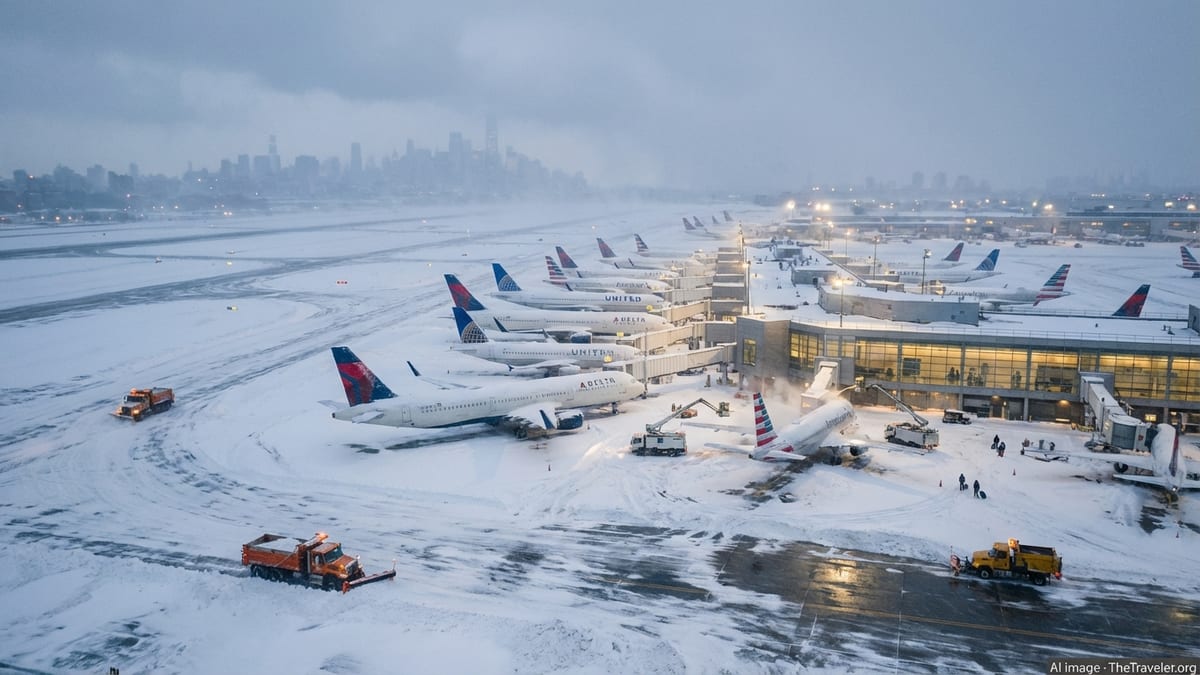
Flights Grounded as Northeastern Hubs Shut Down
By the morning of February 24, air travel across the Northeast remained in disarray after a second day of blizzard conditions, hurricane-force gusts along parts of the coast, and whiteout visibility around major airports. New York City’s John F. Kennedy, LaGuardia, and Newark Liberty in New Jersey all reported extensive cancellations and rolling delays as ground crews struggled to clear snow and de-ice taxiways in subfreezing winds.
Flight tracking data showed more than 9,000 flights canceled across the United States between February 23 and the evening of February 24, with New York, Boston, Philadelphia, Baltimore, and Washington among the hardest hit. Airlines operating at the region’s main hubs have issued broad travel waivers, allowing passengers to rebook without change fees, but available seats are scarce before midweek as carriers work to reposition aircraft and crews.
Inside terminals from New York to Boston, thousands of passengers spent the night on cots and benches as storm-related shutdowns rippled through the network. Many international visitors arriving just before the worst of the storm found themselves unable to continue on to domestic connections, with only limited hotel availability near airports and city centers due to road restrictions.
In New York, long lines formed at airline service desks as travelers sought rerouting to Midwest and Southern hubs still operating near normal levels. Staff urged passengers with flexible plans to postpone trips altogether, warning that even once runways are fully cleared, aircraft backlogs will mean disruptions could linger for several days.
Road and Rail Bans Trap Travelers Mid-Journey
On the ground, emergency travel restrictions have brought much of the Interstate 95 corridor to a standstill from Maryland through New York and into New England. Governors in New York, New Jersey, Pennsylvania, Connecticut, Massachusetts, and Maryland issued states of emergency and various road bans as Hernando intensified into a classic nor’easter and then a bomb cyclone off the Atlantic coast.
New York City and several surrounding counties temporarily prohibited nonessential vehicle travel on key expressways, including portions of the Long Island Expressway and major bridges and tunnels. In New Jersey, authorities closed stretches of the New Jersey Turnpike and Garden State Parkway to most passenger vehicles during the height of the storm, allowing only emergency and essential services to move. Similar measures were mirrored in Connecticut and Massachusetts, where coastal highways experienced drifting snow and sporadic flooding.
These restrictions left some long-distance drivers and intercity bus passengers stranded at rest areas and park-and-ride lots as conditions deteriorated faster than forecast. State transportation agencies reported using plows and National Guard vehicles to relocate motorists from exposed sections of highway to safer staging areas while winds gusted beyond 60 miles per hour in some inland locations.
Rail services have also been heavily curtailed. Amtrak suspended or limited many of its Northeast Corridor trains between Washington, New York, and Boston, citing snow-clogged switches and downed trees along exposed stretches of track. Several regional commuter rail systems around New York, Philadelphia, and Boston ran on severely reduced schedules or canceled service altogether, stranding daily commuters and visitors alike.
Power Outages and Record Snowfall Hit Tourist Hotspots
Beyond the immediate travel chaos, Winter Storm Hernando has left a trail of widespread power outages and record-breaking snowfall in several popular tourism regions. From the Mid-Atlantic coast to New England, more than 600,000 customers lost electricity at the peak of the storm as heavy, wind-driven snow brought down tree limbs and power lines, particularly in New Jersey and Massachusetts.
In New York City, snow totals rivaled some of the largest events in recent decades, with official measurements in parts of the metropolitan area exceeding two feet. Nearby, communities in New Jersey and Pennsylvania reported similar or higher amounts, while Rhode Island’s main airport recorded nearly 38 inches, setting a new local snowstorm record. Along coastal Massachusetts and Rhode Island, gusts approaching hurricane strength whipped the snow into towering drifts, complicating clearing operations.
Major tourist destinations including Manhattan, Boston’s historic districts, and coastal towns in New England saw streets transformed into deep, wind-carved corridors. Hotels reported mixed occupancy, with some fully booked by stranded travelers and others experiencing cancellations from would-be visitors deterred by the forecasts. Museums and attractions in New York, Philadelphia, and Boston largely remained closed through at least February 24, with operators evaluating damage and access conditions on a day-by-day basis.
For visitors who arrived in the days before the storm, the extreme weather offered rare, striking scenes but also practical challenges. Many found themselves unable to reach nearby ski resorts or coastal getaways as secondary roads remained impassable. Local tourism boards have shifted messaging toward safety and resilience, encouraging guests already in place to explore walkable neighborhoods and indoor venues once it is safe, while urging those yet to depart to delay until conditions improve.
What Stranded Travelers Should Expect in the Coming Days
With the storm system beginning to pull away from the Northeast on February 24, attention is turning from active blizzard conditions to cleanup and recovery. Forecasters expect lingering snow showers and gusty winds in parts of New England, but the heaviest precipitation has ended. The immediate challenge now is clearing runways, rail lines, and primary roadways quickly enough to restore at least limited travel options for the thousands still stuck.
Airports in New York, New Jersey, and Massachusetts are prioritizing de-icing and runway widening to safely accommodate heavier jets, but airline schedule planners caution that full operations may not resume for several days. Passengers holding nonessential itineraries for early to midweek are being advised to use online tools and airline apps to rebook later in the week or into next weekend, when seat availability is expected to improve.
On the roads, transportation departments across the region are deploying round-the-clock plowing and salting operations, focusing first on interstates and key freight corridors. Once winds subside and visibility improves, governors are expected to gradually lift travel bans, beginning with commercial vehicles and essential traffic. However, secondary and rural roads in upstate New York, Pennsylvania, and interior New England may remain treacherous due to packed snow, ice, and downed debris.
Rail agencies anticipate phased resumptions as crews inspect tracks for ice buildup and damage. Travelers with flexible plans are being urged to avoid same-day station ticket purchases and instead monitor official service alerts, as limited capacity trains may sell out quickly once operations restart. Travel insurers and credit card companies are reporting a surge in claims and assistance calls, particularly from international tourists unfamiliar with the scale and duration of major North American winter storms.
Practical Advice for Tourists Caught in the Blizzard
For travelers currently stranded in New York and neighboring states, officials and consumer advocates are emphasizing preparation, patience, and close communication with carriers and accommodation providers. Those stuck at airports are encouraged to register for airline text and email alerts, verify that contact information is up to date, and use official apps to rebook rather than waiting in terminal queues, which can stretch for hours during major weather disruptions.
Tourism agencies recommend that visitors secure confirmed accommodation before leaving the airport or station, especially while road restrictions remain in place. Many hotels in airport corridors and city centers are offering distressed-traveler rates, and some local authorities have opened temporary warming centers for those unable to find rooms. Travelers are also being advised to keep power banks charged, carry essential medications and a change of clothes in their hand luggage, and conserve phone battery while waiting on updates.
For those who have not yet started their journey to the Northeast, experts strongly suggest postponing travel until at least the latter part of the week. Even as skies clear, the combination of residual delays, aircraft imbalances, and continued cleanup on rail and road networks will keep conditions fragile. International visitors with tight connection windows or time-sensitive itineraries may wish to re-route through alternative hubs in the Midwest or South once airlines restore broader network flexibility.
Local tourism boards in New York, New Jersey, Pennsylvania, Connecticut, Massachusetts, and Maryland are working with hotels and attractions to extend flexible cancellation policies and rescheduling options. While Hernando has temporarily shut down much of the region’s famed winter tourism, from city breaks to ski getaways, officials stress that once transport links are safe and stable, visitors will be welcomed back with expanded winter programming and new incentives to return.