


More news on this day
Air travel across Brazil and several key international routes is facing significant disruption as LATAM, Gol, Azul, American Airlines, and United Airlines report dozens of cancellations and delays impacting major hubs such as São Paulo, Rio de Janeiro, and Brasília, along with long haul services linking the country to cities including Miami and Chicago.
Get the latest news straight to your inbox!
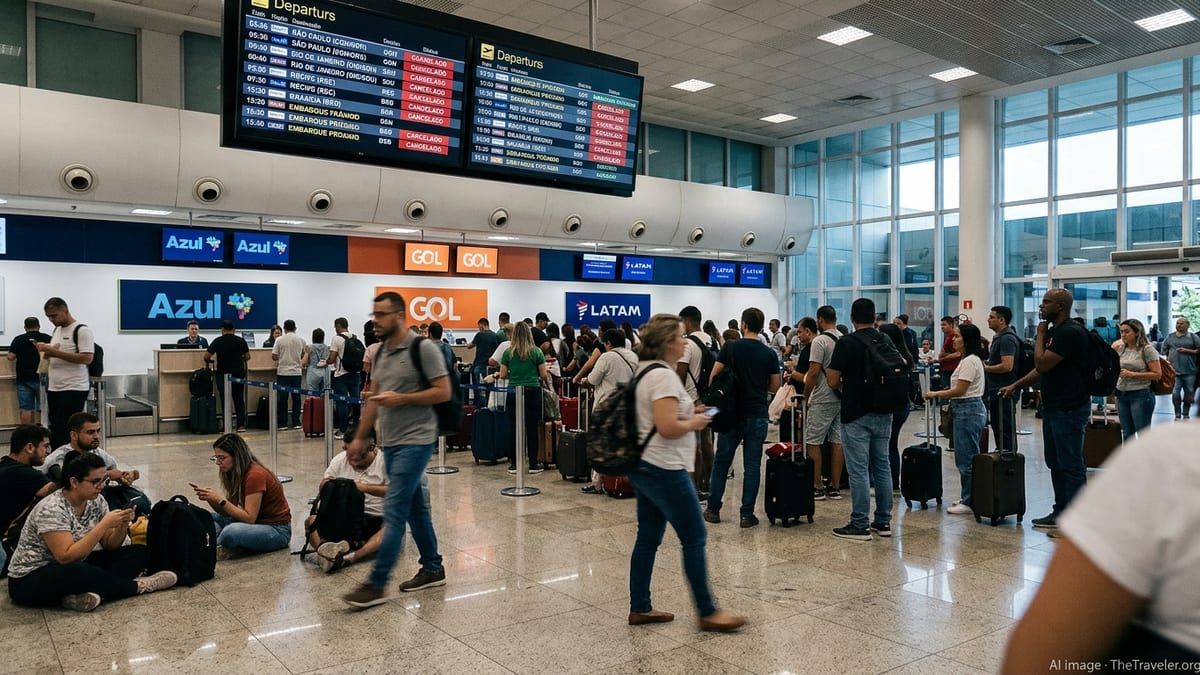
Domestic Hubs Strained as Cancellations Mount
Publicly available airport and flight-tracking data on May 10 indicate a sharp rise in disrupted services across Brazil’s core domestic network, with more than two dozen flights cancelled or heavily delayed across multiple carriers. The pattern is especially visible at São Paulo’s Guarulhos and Congonhas airports, Rio de Janeiro’s Santos Dumont and Galeão terminals, and the federal capital Brasília, where LATAM, Gol, and Azul operate dense shuttle-style schedules feeding business and leisure travel.
At Rio de Janeiro’s Santos Dumont Airport, schedules show a high concentration of departures to São Paulo and Brasília on LATAM, Gol, and Azul, highlighting how any operational issue can quickly reverberate through Brazil’s busiest corridor. Even when flights remain listed as “scheduled,” day-of-travel tracking and passenger reports suggest rolling delays, equipment changes, and last‑minute cancellations that reduce overall capacity and strand travelers between the two largest cities.
In Brasília, disruptions have been compounded by the airport’s role as a connection point for Brazil’s interior. When feeder flights on Azul or Gol are cancelled, passengers often lose onward links to São Paulo or Rio, forcing rebookings on already crowded services. This has led to growing reports of extended layovers, missed meetings, and overnight airport stays as travelers wait for available seats.
The cumulative effect is a patchwork of irregular operations rather than a neatly defined shutdown, making it difficult for passengers to anticipate which departures will operate as planned. The result is a day marked by uncertainty for domestic travelers, even when their specific flight is not among those formally cancelled.
Ripple Effects on International Routes to the United States
The disruption within Brazil is also being felt on international services, particularly routes linking São Paulo and other Brazilian gateways to Miami and Chicago. Data on current connectivity between Brazil and the United States shows that American Airlines, United Airlines, LATAM, Gol, and Azul collectively sustain a dense schedule of flights between Brazilian hubs and major US cities including Miami, Orlando, New York, Dallas, Houston, Washington, and Chicago.
When domestic legs into São Paulo or Rio are cancelled, passengers bound for the United States often miss long haul departures, even when those long haul flights operate on time. Recent reports highlight cases where travelers lost Miami-bound connections after Gol or Azul canceled feeder segments into São Paulo, leaving transcontinental seats departing half empty while would‑be passengers remained in regional airports.
Flight-status information also points to scattered cancellations and schedule changes on international services themselves. For example, a LATAM flight from Buenos Aires to Miami has been listed as cancelled in real-time trackers, underscoring how operational disruptions across South America can intersect at US gateways. While not every cancellation traces back to the same cause, the combined impact for travelers is a more fragile and unpredictable network linking Brazil to key US hubs.
For Chicago-bound passengers, the situation is similarly delicate. United maintains Brazil service through its US hubs, including Chicago, while American feeds Brazil traffic into Miami and Dallas before onward connections to the Midwest. Any cancellation on a Brazil–US sector or a missed connection in Miami can cascade into longer journeys for those ultimately headed to Chicago or connecting beyond.
Operational Pressures Behind the Irregular Operations
Airlines in Brazil are contending with a mix of structural and short‑term operational pressures that make the system more prone to disruption. Industry updates and recent coverage note that carriers such as Azul have undergone financial restructuring, while Gol and LATAM have been adjusting fleets and networks to match demand patterns and new international partnerships. These adjustments can leave little slack in aircraft and crew availability when problems arise.
Globally, airlines have been facing challenges related to fuel costs, aircraft delivery delays, and staffing constraints, and Brazil is not insulated from those trends. When an aircraft or crew is displaced by earlier weather, maintenance, or air-traffic issues, the knock‑on effect often appears hours later as cancellations or significant delays on domestic trunk routes and international services. With Brazilian carriers operating tight schedules on high‑frequency routes between São Paulo, Rio, and Brasília, even minor disruptions can reverberate quickly.
US carriers serving Brazil are also managing broader network strains. Recent months have seen American and United add or adjust routes globally, with expanded networks increasing the complexity of aircraft and crew rotations. While there is no single public explanation tying today’s specific cancellations to one cause, industry analysis consistently points to a high-utilization environment where small disruptions rapidly translate into reduced reliability for passengers.
The result for travelers is an operational landscape in which routine schedule changes, aircraft swaps, and rolling delays have become more common. When several airlines experience these issues simultaneously in a market as interconnected as Brazil–United States travel, widespread disruptions become more visible, even if total cancellation numbers remain relatively modest compared with extreme weather events.
What Travelers in Brazil and the US Are Experiencing
Reports from recent days illustrate how passengers are experiencing these irregular operations on both sides of the equator. Travelers connecting from Brazilian regional cities onto American Airlines or United transatlantic services have described sudden cancellations of domestic segments operated by partners such as Gol or LATAM, leaving them struggling to secure alternative routings on the same travel day.
Other accounts describe journeys extended by several days after multiple cancellations involving LATAM and codeshare partners, especially when travel involves complex itineraries that combine South American and European or North American legs. With popular routes between São Paulo, Rio, and US cities such as Miami already heavily booked, finding spare capacity for disrupted passengers can be challenging, particularly during peak travel periods.
At airport level, this translates into longer lines at customer service desks, competition for limited hotel vouchers, and a surge in demand for last‑minute tickets on competing carriers. Travelers report weighing whether to purchase separate tickets on rival airlines such as LATAM, Gol, or Azul at their own expense in order to salvage long haul connections booked on American or United, accepting the financial risk in exchange for a better chance of reaching their destination on time.
For those holding upcoming bookings between Brazil and US gateways including Miami and Chicago, current conditions suggest the importance of close monitoring of flight status, allowing extra connection time, and preparing contingency plans in case of last‑minute schedule changes. While operations can normalize quickly once the immediate disruptions ease, today’s pattern of cancellations across multiple carriers has highlighted the fragility of Brazil’s most important domestic and international air corridors.