


Busan has shifted from a side trip after Seoul to a headline destination in its own right. Expedia’s latest "Unpack ‘27" trends report highlights a roughly 50 percent year-on-year jump in searches for flights and stays in the city, and Busan tourism officials say they are closing in on 4 million foreign visitors a year. For first-time travelers, that surge means more hotel options, better English-language services, and also a bit more planning to make sense of this spread-out coastal city. This guide focuses on the areas, beaches, food, transport and sample itineraries that matter most on a first visit.
Get the latest updates straight to your inbox!
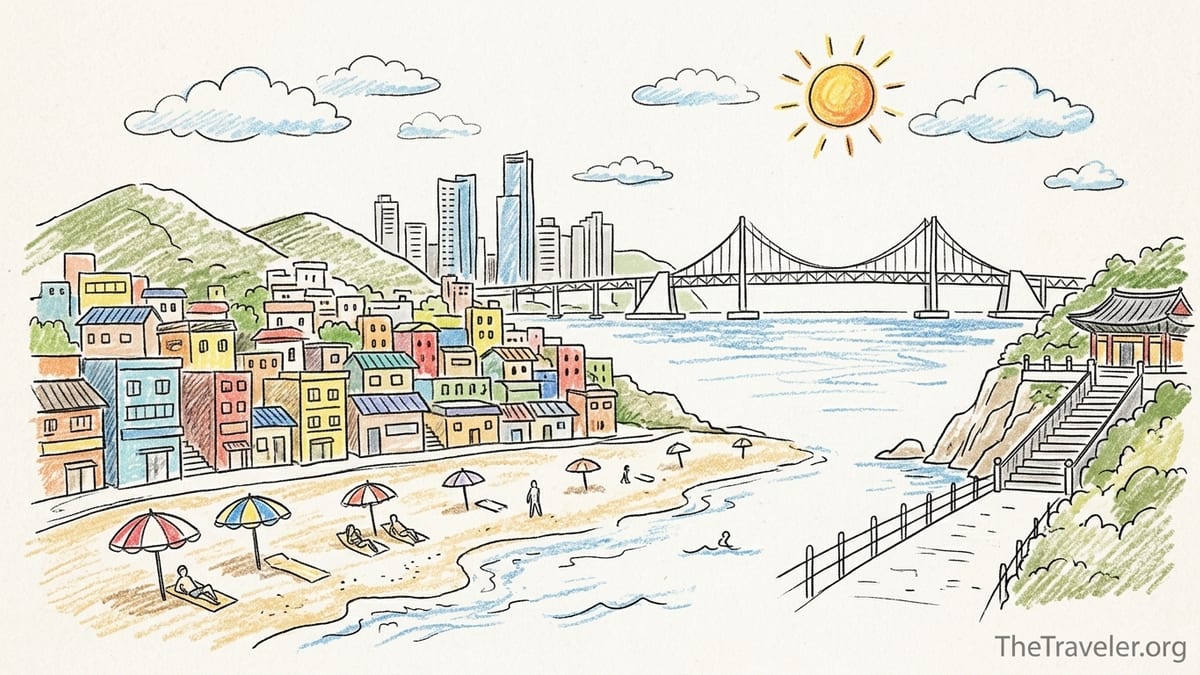
Why Busan Is Suddenly Everywhere
Busan, South Korea’s second-largest city with more than 3 million residents, has long been popular with domestic travelers for its city beaches and seafood. In 2026 it started appearing on global watchlists, earning a place in Expedia Group’s "Unpack ‘27" report as one of ten destinations to watch for 2027. Korean news outlets report that flight and hotel searches for Busan on Expedia brands are up around 50 percent compared with the previous year, putting it among the fastest-rising cities in that forecast. Local media also note that Busan is on track for close to 4 million foreign arrivals this year, illustrating how quickly it has moved into the international mainstream.
That growth is visible on the ground. Around Haeundae Beach new high-rise hotels and cafes continue to open, while the Busan Tourism Organization has invested in clearer wayfinding in English at major subway stations and attractions. The city promotes its mix of modern beachfront skylines, hillside art villages like Gamcheon Culture Village, and cliffside temples such as Haedong Yonggungsa as a compact way to experience the "sea side" of Korea that many visitors miss if they only stay in Seoul.
Tourism officials are also starting to talk about balance. With visitor numbers climbing, the city government has said it wants to focus on longer stays and better distribution of tourists, rather than just headline arrival figures. For travelers, that means more encouragement to explore beyond the best-known beaches, to places like Yeongdo’s rugged coastline or the quieter sands at Dadaepo, and to spend time in everyday districts such as Seomyeon and Jeonpo that locals actually use.
Key Neighborhoods for First-Time Visitors
Busan is larger and more spread out than it appears on a map, so choosing a base is one of the most important decisions on a first trip. For many visitors, Haeundae is the default choice. The district fronts one of Korea’s best-known beaches, with a long arc of sand backed by towers, international-brand hotels, mid-range chains and guesthouses. Staying near Haeundae Station puts you within a short walk of the beach, the Busan Sky Capsule coastal train at Mipo, and bus links toward Haedong Yonggungsa Temple and Songjeong Beach.
Seomyeon and neighboring Jeonpo suit travelers who prioritize food, shopping and easy transport over sea views. This is Busan’s main downtown area, where subway lines 1 and 2 intersect, making it easier to reach Nampo’s markets in one direction and the eastern beaches in the other. The streets around Seomyeon Station are thick with barbecue restaurants, pojangmacha-style tent bars, cosmetics shops and mid-range business hotels. Jeonpo, a short walk away, has smaller streets converted into a cafe district with roasteries, brunch spots and dessert cafes inside former low-rise housing.
Nampo and the old downtown area around Jagalchi Market are the best base for travelers interested in traditional markets and port-city history. Here you can step out of a guesthouse or modest hotel and be at Gukje Market, BIFF Square street food, and the pier for coastal cruises in a matter of minutes. The area also connects easily by bus or taxi to Songdo Beach and its cable car, and by metro to Gamcheon Culture Village via Toseong Station and a short local bus up the hill.
Two other districts round out a first-timer short list. Gwangalli, centered on Gwangalli Beach and the sweeping Gwangan Bridge, is Busan’s classic evening-beach neighborhood, lined with cafes and restaurants whose windows frame the illuminated bridge. It is a strong choice if you plan to spend your nights in one area instead of crisscrossing the city. Yeongdo, an island linked by bridges south of Nampo, has fewer big hotels but is emerging with small guesthouses and cafes around Huinnyeoul Culture Village and Taejongdae Park for travelers who prefer quieter, more local-feeling stays.
Beaches and Waterfronts to Plan Around
Haeundae Beach is the city’s flagship stretch of sand and often the first place new visitors see. It appears on national tourism lists of must-visit Korean sites and is frequently used as a backdrop in dramas and variety shows. In summer the 1.5 kilometer beach fills with parasols and families, but even in spring and autumn it remains a pleasant place to walk. Early mornings are calmer, with locals jogging and walking dogs along the promenade, while evenings bring street performers and queues for soft-serve ice cream and skewered snacks near the main entrance.
Gwangalli Beach, facing the double-deck Gwangan Bridge, offers a different mood. The sand is narrower, but the skyline is dense with glass-walled cafes, bars and restaurants. At night the bridge’s programmable lights change color and patterns, and crowds gather along the seawall with coffee or chicken-and-beer delivery from nearby chains. For example, it is common to see groups order fried chicken sets from national brands to the beach steps for around 20,000 to 30,000 won for two or three people, making it a relatively affordable night out with a view.
Travelers who prefer a quieter or more local beach scene can look toward Songjeong and Dadaepo. Songjeong, east of Haeundae, is popular with beginner surfers and has several small surf schools that rent boards and wetsuits by the hour. You can reach it from central Haeundae in roughly 15 to 20 minutes by local bus or the Donghae coastal rail line. Dadaepo, at Busan’s western edge, has broad tidal flats and sunsets over the estuary, along with a musical fountain show in warmer months. Both see fewer international tour groups than Haeundae, and their cafes and barbecue spots lean more toward local crowds and students.
Closer to the port, Songdo Beach combines an urban shoreline with several specific attractions. The Songdo Marine Cable Car runs over the bay between Songdo and a nearby hill, with round-trip tickets priced in the low tens of thousands of won for adults depending on cabin type. There is also the Songdo Cloud Trails, an elevated boardwalk partly over the water that offers views back toward downtown. Together with the older Huinnyeoul Culture Village across the water on Yeongdo, they show a more workaday side of Busan’s relationship with the sea beyond the polished new developments.
Essential Food Experiences and What They Cost
Busan’s coastal setting has shaped its food identity. Jagalchi Market, a major seafood market near Nampo, is where many visitors start. Inside the covered halls you will see tanks of live fish, crabs and shellfish. A common pattern is to choose items at a stall, have them cleaned, and then take them upstairs to be prepared in a basic restaurant space for a separate fee. Prices change with season and species, but visitors report paying the equivalent of 25,000 to 40,000 won per person for a shared spread of sliced raw fish, stews and side dishes when choosing mid-range species.
For less formal eating, the surrounding streets provide plenty of options. Along BIFF Square and Gukje Market you can find ssiat hotteok, a Busan-style sweet pancake filled with seeds and brown sugar, usually around 2,000 to 3,000 won apiece. Fish cake skewers, called eomuk, are another local staple. Chains based in Busan serve skewers from about 1,000 to 2,000 won each, along with bowls of hot broth that are welcome in colder months. Many stands allow you to stand and eat, then pay based on your empty skewers.
In Seomyeon, Jeonpo and other central districts, food options extend far beyond seafood. A basic Korean barbecue meal of pork belly, banchan side dishes and shared stew in a mid-range restaurant often comes out to around 15,000 to 25,000 won per person, depending on how much meat is ordered. Independent coffee shops charge prices similar to Seoul, with a latte or specialty drip coffee usually somewhere between 4,000 and 7,000 won. International chains like Starbucks and local brands such as Angel-in-us and Hollys are easy to find near major stations if you are more comfortable ordering in a familiar environment.
Busan’s cafe culture is also an attraction in itself, especially in Haeundae, Gwangalli and Jeonpo. Rooftop cafes overlooking Haeundae Beach or Gwangan Bridge often add a premium for the view, but many still price drinks under 10,000 won. Some have minimum-order rules per person, so two travelers may need to order two drinks or a drink and dessert to use a window seat. Watching a sunset over Haeundae with a 6,000 won americano or an 8,000 won dessert drink in hand has become one of the city’s defining travel images.
Getting Around: Metro, Buses and Taxis
Even with coastal scenery at every turn, Busan is a practical city to move around in. The Busan Metro operates four main numbered lines plus a light-rail connection to Gimhae, linking most visitor districts. According to recent information from the city and Busan Transportation Corporation, a standard adult fare on the subway is around 1,300 won when using a transportation card for trips within about 10 kilometers, with incremental increases for longer journeys. Paper single-use tickets are available from machines at stations, though using a rechargeable card such as Cashbee or T-money usually gives a small discount and faster transfers between subway and buses.
For short stays, the city offers an all-day subway pass that allows unlimited rides on the metro network for a single calendar day. Busan Transportation Corporation lists the adult price for this type of pass at 6,000 won, with a discounted youth version at 4,000 won. Visitors who plan to cover several neighborhoods in one day, such as starting in Nampo, moving to Gamcheon and then heading out to Haeundae in the evening, often find this good value compared with paying separate single fares for each leg.
Buses fill many of the gaps between subway lines and hillside destinations. City information notes that a basic local bus journey costs around 1,300 won by transportation card, with transfers discounted when completed within a specified time window. For example, it is possible to ride the subway to Toseong Station for Gamcheon Culture Village, tap out, then board a local green bus up the hill while paying only a partial or no additional fare if within the transfer period set by the city’s integrated system. Route maps and stop names are increasingly displayed in English, but it is still helpful to have your destination written in Korean or pinned on a map app.
Taxis offer a relatively affordable safety net when tired or traveling late at night. Official city information lists a standard base fare of 4,800 won for the first segment of a ride, with a modest late-night surcharge between 11 p.m. and midnight. A typical journey between central Seomyeon and Haeundae might cost the equivalent of 15,000 to 25,000 won depending on traffic, according to recent visitor reports. Ride-hailing apps connected to local taxi fleets are widely used, and many drivers are accustomed to showing the meter and destination on the screen to reduce confusion for foreign passengers.
Suggested Itineraries for 2 and 3 Days
With two full days in Busan, a good approach is to pair one day around the old downtown and port area with one focused on the beaches. On the first day, base yourself around Nampo Station. Spend the morning at Jagalchi Market and the adjacent fish market buildings, then walk through BIFF Square to Gukje Market for street snacks and browsing. In the afternoon, head up to Yongdusan Park and Busan Tower for views over the container port and bridges, or take a short taxi ride to Huinnyeoul Culture Village on Yeongdo to walk its alleys above the sea. Return to Nampo for dinner, choosing between a casual seafood restaurant near the port or a barbecue spot on one of the backstreets.
On the second day, start early for Gamcheon Culture Village. Take the subway to Toseong Station, then follow signs or a local minibus uphill. Allow two or three hours to walk the main alleys, small galleries and viewpoints. After lunch, travel across town toward Haeundae. Many visitors choose a late-afternoon walk along the main beach, followed by dinner in the nearby backstreets or at a restaurant specializing in raw fish along the waterfront. If you still have energy, ride the Haeundae Blueline Park Sky Capsule between Mipo and Cheongsapo for night views of the coastline, reserving tickets in advance during busier seasons.
With three days, you can add one more coastal or cultural zone. A popular choice is to dedicate a morning to Haedong Yonggungsa Temple, a Buddhist temple set dramatically on seaside rocks northeast of Haeundae. Buses from Haeundae Station and surrounding stops make the trip in roughly 30 to 40 minutes, followed by a short walk through a lane of food stalls selling items such as tteokbokki and fish cakes. Combine the temple with nearby Songjeong Beach for lunch at a cafe or a surf lesson. Return to Haeundae or Seomyeon for the evening.
Another option for the extra day is to travel further west to Dadaepo Beach and the Nakdong River estuary, then continue on to Taejongdae Park at the tip of Yeongdo on a different day. Taejongdae has a clifftop lighthouse, forested walking paths and sea views reachable by a road train or footpaths. Spending time in these less busy corners gives a better feel for Busan’s geography beyond the main tourist triangle of Haeundae, Gamcheon and Nampo, and can make a short trip feel more like a visit to a functioning port city than a beach resort alone.
Practical Tips, Seasons and Cultural Notes
Busan’s weather and festival calendar can shape your experience as much as your choice of neighborhood. Summers from late June through August are hot and humid, with sea temperatures supporting full beach season, umbrellas and swimming zones at Haeundae and other major beaches. Autumn, particularly late September and October, often brings clearer skies and more comfortable temperatures, though the sea can be cooler for swimming. Winter visits can still be rewarding, especially for travelers who enjoy coastal walks, hot springs near Haeundae and seasonal light festivals along the beachfront.
Crowds peak around national holidays and major events. The Busan International Film Festival, typically held in early October around the Busan Cinema Center in Centum City and Haeundae, attracts large numbers of visitors, which can push up hotel rates and make restaurant reservations near the venues advisable. On summer weekends, it is common to see traffic slow to and from the eastern beaches, so staying close to one of your main targets can save time. Booking accommodation several weeks ahead for these peak periods helps secure better prices and locations.
For everyday interactions, a few basic Korean phrases and some awareness of local etiquette go a long way. Many younger staff in hotels, cafes and larger restaurants in Haeundae, Seomyeon and Nampo can handle simple English questions, but menus in smaller neighborhood eateries may be only in Korean. Pointing at displayed dishes, using translation apps and being patient usually works. In markets and food stalls, payment is predominantly by card, and foreign-issued credit cards are widely accepted, although having some cash for smaller purchases remains useful.
Finally, consider how your visit fits into the city’s broader shift toward more sustainable tourism. Choosing locally owned guesthouses or small hotels, spending money in independent cafes in places like Jeonpo or around Pusan National University, and exploring lesser-visited sites such as Yeongdo’s coastal walks or the inland Oncheoncheon stream help spread the benefits of the current tourism boom. As Busan appears in more international rankings and search lists, thoughtful choices by first-time visitors can help the city grow as a welcoming coastal destination without overwhelming its neighborhoods.
Making Busan Your Own
Busan rewards travelers who slow down and think of the city not just as a checklist of beaches and viewpoints, but as a series of distinct neighborhoods connected by a metro map. The recent jump in interest recorded by Expedia’s data has encouraged new hotels and cafes to open and pushed the city to improve signage and services, yet it is still easy to find quiet corners in backstreets or on less-known stretches of shore. For a first visit, combining one of the main beaches with an older market district and a hillside village provides a representative snapshot of the city’s character.
Whether you base yourself in Haeundae with sea views, Seomyeon for transit convenience, Nampo for markets or Gwangalli for bridge-lit evenings, the distances within Busan are manageable with a bit of planning. A transportation card, a rough plan for each day, and a willingness to adjust based on weather and energy levels are usually all you need. As Busan’s profile keeps rising and more travelers add it to their Korea itineraries, this blend of coastal scenery, urban energy and approachable food culture is likely to be what stays with you long after you leave.