

More news on this day
Hundreds of passengers were left stranded at Cairo International Airport this week as around 190 flights were delayed and at least nine canceled, disrupting services by EgyptAir, Flynas, Nile Air and other carriers on busy routes linking Egypt with London, Dubai, Riyadh, Amman and Paris.
Get the latest news straight to your inbox!
Ripple Effects Across Regional and Long Haul Networks
Publicly available flight-tracking tallies and regional aviation coverage indicate that Cairo International Airport has emerged as one of the focal points of a wider disruption pattern affecting the Middle East and adjoining corridors between Europe, Africa and the Gulf. On one of the heaviest affected days in early April, operational summaries linked roughly 190 delays to Cairo alone, alongside at least nine cancellations involving both domestic and international services.
The impact reached far beyond Egypt’s borders. Flights to major hubs such as London, Paris and Dubai, as well as key regional cities including Riyadh and Amman, experienced extended ground holds, rolling departure pushes and late arrivals. Passengers connecting onward to North America, East Africa and South Asia from Cairo’s role as a transfer hub faced missed connections and unplanned overnight stays.
Coverage from aviation and travel outlets notes that EgyptAir, the country’s flag carrier, appeared among the most affected operators due to its concentration of services at Cairo and its extensive network of connecting routes. Low cost and regional competitors, including Saudi carrier Flynas and Egyptian airline Nile Air, also featured among the disrupted schedules, particularly on high demand links between Egypt and Gulf Cooperation Council countries.
Operational data for multiple days in the first week of April shows that triple digit delay counts at Cairo were not limited to a single incident window, but recurred as traffic volumes remained high. Travel industry commentary describes the pattern as a rolling operational strain, rather than a one off outage, intensifying the pressure on airlines and airport infrastructure.
Underlying Causes: Airspace Constraints and Capacity Strain
According to published reporting focused on regional aviation, the disruption at Cairo is closely tied to ongoing airspace restrictions and security related route adjustments across parts of the Middle East. Recent military escalations and associated airspace closures have forced many carriers to divert or reroute flights that once relied on more direct tracks over neighboring states, funneling additional overflights and diversions into Egyptian airspace.
Egypt’s role as a relatively stable corridor between Europe, Africa and parts of Asia has therefore expanded, with Cairo and other Egyptian airports absorbing traffic that might otherwise distribute across a wider set of regional hubs. Analysts cited in public coverage suggest that this shift has increased complexity for air traffic management, as controllers and airlines juggle changed routings, tight separation standards and compressed arrival and departure banks.
At ground level, Cairo International Airport is grappling with this additional burden at a time of strong passenger demand. Recent expansions of airline networks, including new long haul services from EgyptAir and sustained growth in inbound tourism, have contributed to busy terminals and high aircraft utilization. When adverse weather, late inbound aircraft or air traffic control flow restrictions intersect with already tight schedules, even relatively short delays can cascade rapidly across multiple rotations.
Industry observers note that while no single technical failure has been identified as the primary trigger for the latest wave of delays, the combination of external route pressures and local capacity constraints has left little margin to absorb disruption. As a result, minor timetable shocks more readily translate into large numbers of delayed flights, as seen in the latest Cairo figures.
Airlines’ Operational Responses and Passenger Options
In response to recent disruption episodes, EgyptAir has issued general advisories in recent weeks urging travelers to monitor their flight status closely and, where possible, allow additional time for connections. Public notices outline flexible options on some affected routes, including changes to travel dates and, in certain cases, refunds where flights have been canceled or significantly rescheduled, in line with the carrier’s conditions of carriage and applicable regulations.
Regional carrier Flynas, which operates numerous services linking Saudi cities with Cairo and other Egyptian destinations, publishes fare rules that address schedule changes and cancellations, often providing for credits or rebooking with specific conditions. While these rules are not tailored to the latest Cairo disruption alone, they frame what travelers can generally expect in terms of voluntary changes or airline initiated adjustments when services are delayed or canceled.
Nile Air, focused heavily on regional and domestic routes, highlights on its customer information channels that options such as rebooking and support may be available in the event of delay, depending on the circumstances and fare type. For passengers stranded in Cairo when onward flights to cities such as Riyadh, Amman or Dubai were pushed back repeatedly, these policies have practical implications for how quickly they can be re accommodated.
Travel rights experts frequently point out that passengers traveling to or from the European Union or the United Kingdom may, under certain conditions, fall under EC261 or UK261 protections when significant delays or cancellations occur, particularly if part of the journey is operated by an EU or UK carrier. In practice, travelers transiting Cairo to reach London or Paris may need to examine their ticketing and operating carrier details carefully to determine whether such frameworks apply.
Impact on Travelers at Cairo International Airport
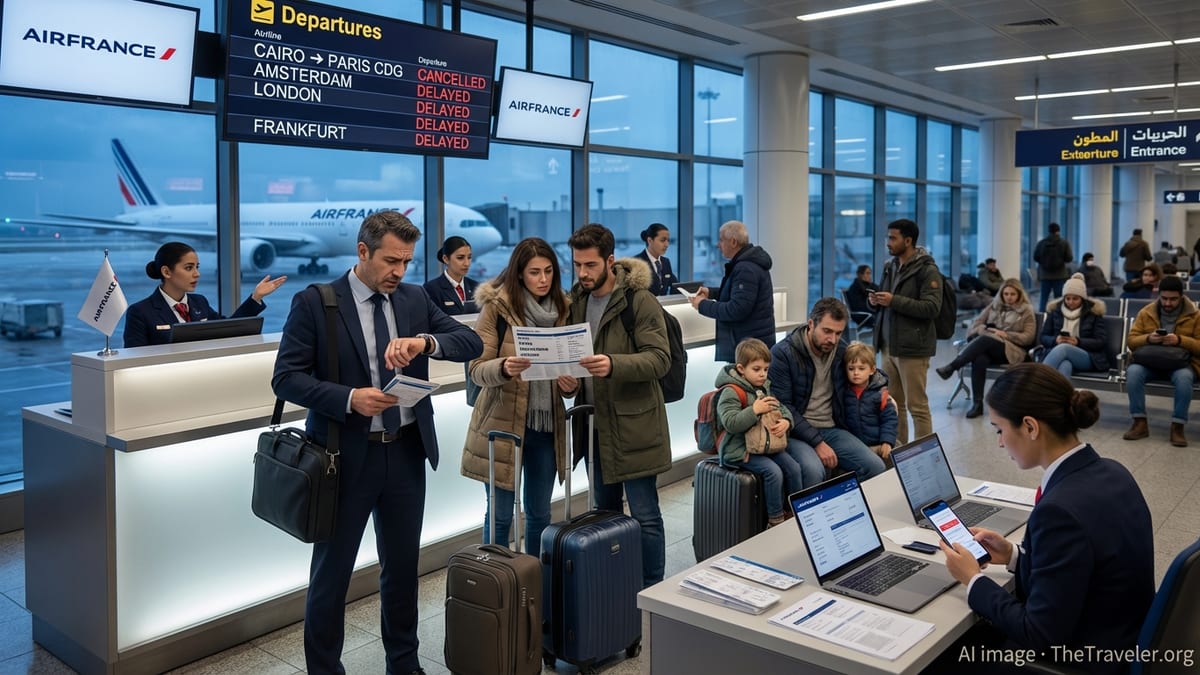
Scenes at Cairo International Airport during the height of the disruption included crowded departure halls, long check in and security queues, and improvised lines at airline service desks as travelers sought information and rebooking options. Social media posts and traveler accounts compiled by regional media describe passengers sleeping on terminal floors, scrambling to secure hotel rooms, or seeking alternative routes via other hubs such as Istanbul, Doha or Jeddah when direct flights from Cairo appeared uncertain.
The knock on effects were particularly pronounced for travelers with complex itineraries. Passengers heading to London or Paris via Cairo from secondary African or Middle Eastern cities, and those connecting from long haul services to short haul regional flights, reported disrupted onward travel plans. Missed group tours, business meetings and family events featured prominently in anecdotal accounts shared with travel press and online forums.
Families and elderly travelers were among those most affected, according to coverage that highlighted the challenges of spending extended periods in crowded terminals with limited seating and, at times, insufficient real time updates. Confusion over boarding gate changes and evolving departure times added to passenger stress, especially for those unfamiliar with the airport layout or local language.
Travel advisers monitoring the situation have encouraged passengers with upcoming itineraries through Cairo to build in longer connection windows where possible, consider travel insurance that explicitly covers delays and missed connections, and download airline and airport applications that can provide push notifications about gate changes and revised timings.
What the Disruption Signals for Egypt’s Aviation Role
The latest wave of delays and cancellations at Cairo underscores Egypt’s increasingly pivotal position in regional and intercontinental aviation at a moment of heightened geopolitical tension. With several neighboring airspaces subject to intermittent restrictions, Egypt’s corridors have become essential for maintaining viable links between Europe, parts of Asia and the African continent.
Aviation analysts quoted in recent coverage suggest that the strain now visible at Cairo may accelerate ongoing plans to upgrade infrastructure, optimize air traffic management and expand capacity at key Egyptian airports. Projects already underway to enhance terminals, streamline security and improve runway and taxiway efficiency could gain renewed urgency as policymakers seek to prevent prolonged disruption from becoming a recurring feature of regional travel.
However, the events of early April also highlight the limits of what any single hub can absorb when external pressures simultaneously drive up traffic volumes and constrain routing options. Unless broader regional airspace conditions stabilize, Cairo and other substitute corridors may continue to experience elevated risk of large scale delays, especially during peak travel periods such as summer holidays and religious seasons.
For travelers, the message emerging from the latest Cairo disruption is twofold. First, Egypt remains a vital and generally reliable gateway linking multiple regions, but journeys routed through Cairo currently require greater flexibility and contingency planning. Second, understanding airline policies on delays and cancellations, as well as any applicable passenger rights regimes, has become more important than ever for those navigating an increasingly complex Middle East aviation map.