

More news on this day
Travellers at Montreal–Trudeau International Airport faced a difficult travel day as multiple flights operated by Air Canada, Jazz, PAL Airlines and WestJet were grounded, with six departures cancelled and numerous others delayed on routes connecting the city to New York, Cancun, Washington, Quebec City, Moncton and additional destinations.
Get the latest news straight to your inbox!
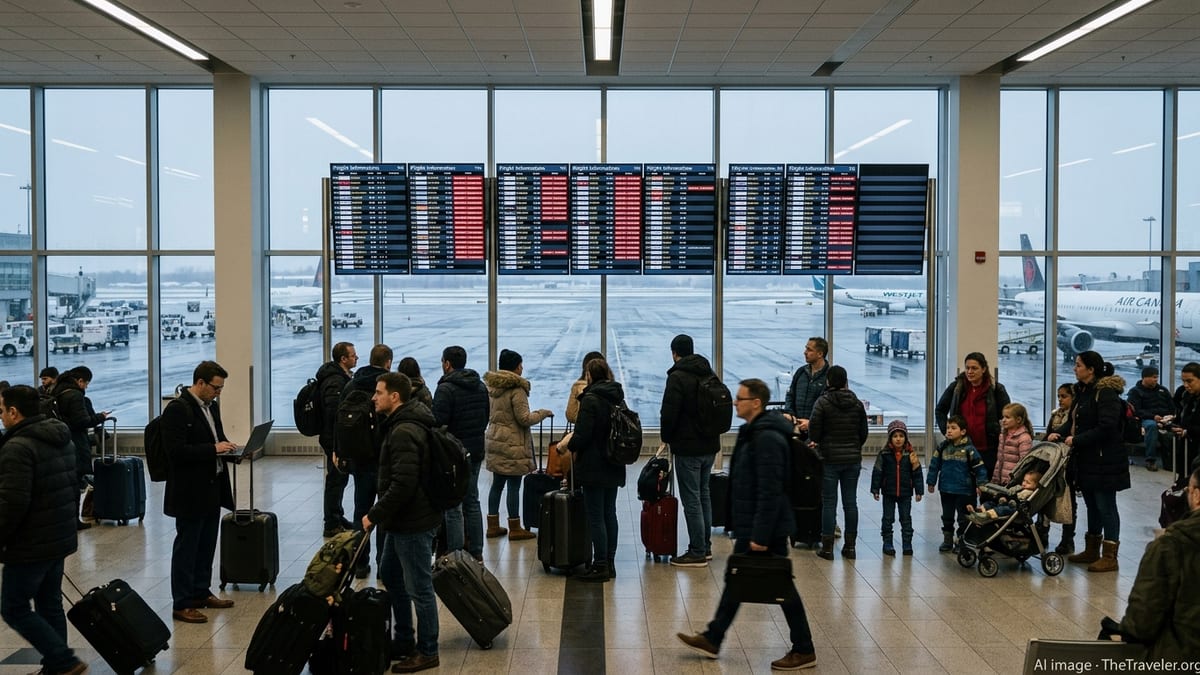
Wave of Cancellations and Rolling Delays at YUL
Publicly available flight-status boards for Montréal–Trudeau on March 20 indicate an uneven morning and afternoon of operations, with a cluster of six departures listed as cancelled across several Canadian carriers and a wider ring of delays affecting both domestic and transborder routes. The disruption has been concentrated on services marketed or operated by Air Canada and its regional partners, along with flights involving PAL Airlines and WestJet.
Departure information shows cancellations on routes linking Montreal to major hubs including New York and Washington, as well as to leisure destinations such as Cancun. Several short-haul regional services to Quebec City and Moncton were also impacted, reducing connectivity for travellers relying on Montreal as a central transfer point in eastern Canada.
While the majority of other departures from Montreal–Trudeau continued to operate, many did so behind schedule. Delays of 30 minutes to more than an hour appeared across the board, compounding the effect of outright cancellations by creating longer queues at check-in, security and customer service desks as passengers sought alternative options.
The pattern at Montreal reflects broader operational pressures on Canadian airlines in recent seasons, where weather, tight aircraft utilization and high demand have left carriers with limited flexibility when disruptions occur. Today’s cancellations and delays added a fresh layer of strain at one of Canada’s busiest international gateways.
Domestic and Transborder Routes Among the Hardest Hit
The day’s disruption at Montreal–Trudeau did not follow a single pattern of geography, affecting both domestic and cross-border flights. According to live departure data, regional links within Quebec and Atlantic Canada were among the first to show cancellations, including services involving Quebec City and Moncton. These routes are typically operated by regional partners such as Jazz or PAL Airlines on behalf of larger carriers.
Transborder services to the United States also saw interruptions. Flights on the busy Montreal–New York corridor experienced a combination of cancellations and delays, while departures to Washington were similarly affected. These routes are critical to business and connecting travel, feeding passengers into larger U.S. and international networks.
Southbound leisure traffic did not escape the disruption. At least one flight from Montreal to Cancun was listed as cancelled, with others delayed, affecting travellers heading to or returning from vacation. The Cancun route has been an important winter and spring sun destination from Montreal, and interruptions on this corridor tend to have an outsized impact as aircraft and crews are tightly scheduled.
The breadth of affected routes illustrates how quickly schedule reliability can deteriorate when aircraft or crews fall out of position. A cancellation on a regional feeder flight can ripple into missed connections on long-haul legs, while issues on a high-demand leisure route can leave few immediate alternatives for rebooking.
Air Canada, Jazz, PAL Airlines and WestJet Under Pressure
The grounded flights and extended delays involved a mix of mainline and regional operators. Air Canada and its regional affiliate Jazz form the backbone of Montreal–Trudeau’s schedule, particularly on domestic and transborder routes, and publicly available information showed several of their departures either cancelled or significantly late during the day.
PAL Airlines, which operates regional services in eastern Canada, was also linked to affected flights. In some cases, PAL operates aircraft under capacity-purchase agreements, meaning passengers ticketed with a major carrier may find their journey disrupted even when the branding on their reservation lists a different airline.
WestJet, a smaller presence at Montreal compared with its footprint in western Canada, was associated with additional cancellations and delays, particularly on routes serving other Canadian cities and select sun destinations. Recent industry discussion has highlighted WestJet’s evolving strategy in Montreal and the competitive environment at the airport, and today’s schedule shows that even a limited number of cancellations can have a visible impact when there are fewer daily frequencies to absorb displaced travellers.
The combined effect across these four airlines was a patchwork of disruptions scattered throughout the departure board. For travellers, the distinction between mainline and regional operators or codeshare partners offers little comfort when a flight is marked cancelled or significantly delayed and nearby alternative departures are already heavily booked.
Weather and System Strain Intensify Passenger Disruption
The timing of the disruptions coincided with forecasts for challenging conditions in the Montreal region, including freezing precipitation and the potential for ice accumulation. Recent travel advisories and public discussions have pointed to winter weather as a recurring trigger for ground delays, de-icing bottlenecks and extended turnaround times at major Canadian airports.
Even when runways remain open, icing conditions can slow operations considerably. Aircraft require thorough de-icing, which adds time to each departure and can create queues of aircraft waiting for treatment. As these delays build, airlines may proactively cancel selected flights in an effort to maintain some predictability on core routes and to manage crew duty-time limits.
Operational data and recent coverage of Canadian aviation trends show that airlines are also managing tight resources after several years of fleet and staffing adjustments. With limited spare aircraft and crews, carriers have less room to absorb weather or technical disruptions. This structural fragility means a single day of poor conditions at a key hub such as Montreal–Trudeau can quickly translate into a sharp rise in cancellations and rolling delays.
Passengers caught in today’s disruption at Montreal–Trudeau encountered not only altered departure times, but also the knock-on effect of missed connections, compressed holidays and disrupted business plans. For many, the challenge was compounded by high call volumes and crowded service counters as hundreds of travellers sought new itineraries at the same time.
What Travellers Can Expect and How to Navigate Ongoing Disruptions
By late afternoon, live data suggested that operations at Montreal–Trudeau were slowly stabilizing, with more flights departing closer to schedule, although residual delays remained. Travellers with bookings on Air Canada, Jazz, PAL Airlines or WestJet through the remainder of the day and into the weekend were still advised by publicly available guidance to monitor their flight status closely.
Recent experience at Canadian airports indicates that disruptions of this scale can take more than a single day to clear, as aircraft and crews are repositioned and stranded passengers are gradually accommodated on later departures. Even when the immediate cause, such as a weather system, moves on, aircraft may end up in the wrong cities and regular frequencies can take time to rebuild.
Travel experts and consumer advocates typically recommend several practical steps in such situations. Passengers are often encouraged to use airline mobile apps or websites to track real-time flight status, to check for travel advisories that may allow fee-free changes, and to consider routing flexibility through alternate hubs when available. For those already at the airport, self-service kiosks and rebooking tools can sometimes offer options more quickly than waiting in line at a service desk.
Today’s events at Montreal–Trudeau underscore the importance for travellers of building extra time into itineraries that involve connections during periods of unstable weather, and of being prepared with contingency plans when flying on routes where frequencies are limited. As airlines work to restore normal operations, passengers on impacted flights to and from New York, Cancun, Washington, Quebec City, Moncton and other cities will be watching closely to see how quickly schedules recover.