

More news on this day
Singapore Changi Airport has once again topped the global rankings, reportedly clinching the World’s Best Airport title for a record 14th consecutive year and reinforcing its status as the benchmark for passenger experience worldwide.
Get the latest news straight to your inbox!
Record-Breaking Streak Reaches New Heights
Published coverage of the latest Skytrax World Airport Awards indicates that Singapore Changi Airport has extended its record-winning run, capturing the World’s Best Airport accolade for the 14th consecutive time since 2000. The reported result cements Changi’s position not only as a regional hub in Southeast Asia but also as the most consistently decorated airport in the history of the passenger-voted awards.
Analysts note that this latest title follows a dominant decade in which Changi has repeatedly outperformed well-resourced rivals from the Middle East, Europe, and East Asia. The airport had already set a record by securing its 13th overall win in 2025; the newest recognition pushes that milestone even further, making it the first airport to move beyond the 13-win threshold under the Skytrax system.
Industry commentary highlights the symbolic weight of the 14-year streak. In a sector that has undergone dramatic shifts in travel patterns, technology adoption, and passenger expectations, Changi’s ability to remain at the top of annual rankings is viewed as a barometer of how effectively it has anticipated and responded to change.
Global Rivals Left Chasing in the Slipstream
While Changi captures headlines, the latest awards cycle underscores just how intense the race has become at the top of the global airport league. Recent rankings show Doha’s Hamad International Airport, Tokyo’s Haneda, Seoul Incheon, Hong Kong International, and major European hubs such as Paris Charles de Gaulle, Munich, and Zurich all vying for the same passenger votes that propel Changi’s success.
Reports on the 2025 awards, for example, showed Hamad International in Doha taking second place and Tokyo Haneda third, with Incheon and Narita rounding out a top tier dominated by Asian and Gulf hubs. Despite aggressive investment in airside capacity, luxury retail, and distinctive passenger amenities at these airports, none has been able to unseat Changi for more than isolated years within the broader time frame of Changi’s overall dominance.
Industry observers suggest that this widening gap is particularly striking given the scale of capital projects abroad. Multi-billion-dollar terminal expansions in Doha and new facilities in Europe and North America were widely expected to narrow the margins in passenger surveys. Instead, publicly available rankings show Changi not just surviving that competition, but expanding its medal haul across multiple subcategories, effectively leaving many of its closest competitors in its wake.
Passenger Experience: From Waterfall Icon to Seamless Journeys
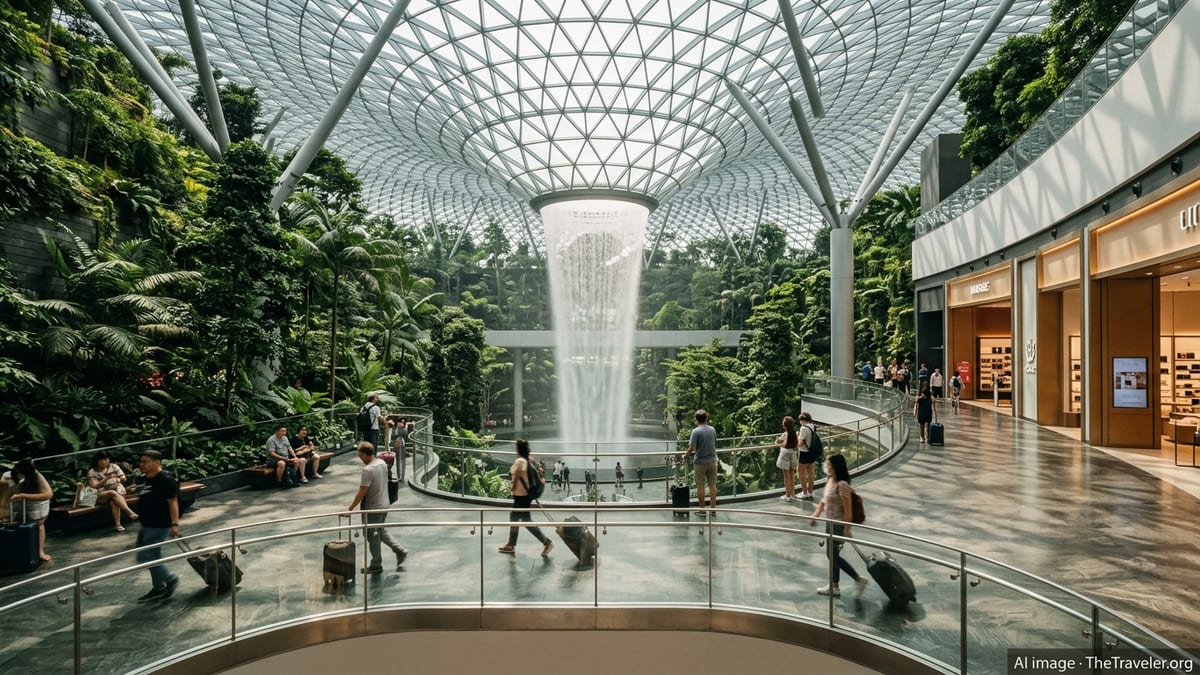
Changi’s continued success is frequently linked to its high-profile attractions, most notably Jewel Changi Airport, the forested retail and leisure complex anchored by the world’s tallest indoor waterfall. Travel features and passenger reviews describe Jewel as a destination in its own right, drawing visitors who may never even set foot on a departing flight yet still contribute to the airport’s broader brand power.
However, recent analyses of Skytrax and other rankings emphasize that Changi’s edge rests on more than a striking skyline. The airport has accumulated repeated wins in categories such as Best Airport Dining, Best Airport Washrooms, and Best Airport in Asia, reflecting a focus on the everyday details that define the passenger journey. Cleanliness scores, wayfinding, security processing, concession variety, and the reliability of amenities such as showers and rest areas are consistently highlighted as areas where Changi outperforms global averages.
Behind the scenes, commentary in aviation and infrastructure outlets points to Changi’s approach to systems engineering. Automated check-in, biometric border clearance, and extensive use of sensors and predictive analytics in baggage handling are cited as examples of how the airport aims to make complex processes largely invisible to travelers. That blend of headline-grabbing attractions and quieter operational efficiency appears to be a key reason passengers continue to rate the airport so highly.
Traffic Recovery, Expansion and Future-Terminal Ambitions
The extension of Changi’s winning streak comes as global air travel continues to recover and, in many markets, surpass pre-pandemic volumes. Public data shows that Changi handled tens of millions of passengers in 2024, with volumes rebounding strongly on both full-service and low-cost carriers. The airport’s role as a hub between Southeast Asia, Europe, and the Pacific remains central to regional connectivity, even as competition intensifies from rival hubs in the Middle East and Northeast Asia.
In parallel, the airport is pushing forward with substantial expansion plans. Preparatory work linked to the long-discussed Terminal 5 project has drawn close attention among aviation analysts, who view the new terminal as critical to sustaining Changi’s competitive advantage into the 2030s. Reports describe ambitions for more automation on the airside, additional long-haul capacity, and new rail and road links designed to reduce bottlenecks as traffic grows.
Associated developments, including new on-airport hotels and refreshed terminal spaces, also form part of the strategy. The Crowne Plaza Changi Airport, connected directly to the terminals, has itself been repeatedly named among the world’s best airport hotels, adding another layer to the hub’s appeal for transfer passengers with overnight layovers or early-morning departures.
What Changi’s Dominance Signals for the Industry
Changi’s reported 14th consecutive World’s Best Airport title is being seen by commentators as more than a trophy for a single hub. It is widely interpreted as a case study in how airports can reframe themselves as multi-use ecosystems that blend transport, retail, hospitality, and recreation under one operational umbrella.
For rival airports, the message is that high-profile architecture alone is no longer enough. The pattern in recent awards cycles suggests that travelers are increasingly rewarding consistency, reliability, and thoughtful touches that make long journeys less stressful, from intuitive terminal layouts to quiet zones, nursing rooms, children’s play areas, and wellness spaces. In that environment, Changi’s ability to deliver a polished, repeatable experience appears to resonate more than any single new attraction.
As the industry awaits official confirmation of the latest awards breakdown and prepares for future rankings, the reported outcome points to a clear narrative: even as new hubs rise and invest heavily, Singapore Changi Airport remains the standard against which others are measured. Its sustained hold on the World’s Best Airport title has turned a competitive annual race into a long-running era of dominance that, for now, shows few signs of ending.