

More news on this day
Hundreds of airline passengers have been left stranded across China as a fresh wave of disruption hits major hubs in Shanghai, Beijing, Guangzhou, Shenzhen and Changsha, with operational data pointing to at least 223 flight delays and 45 cancellations affecting leading carriers including China Eastern, China Southern, Hainan Airlines and Air China.
Get the latest news straight to your inbox!
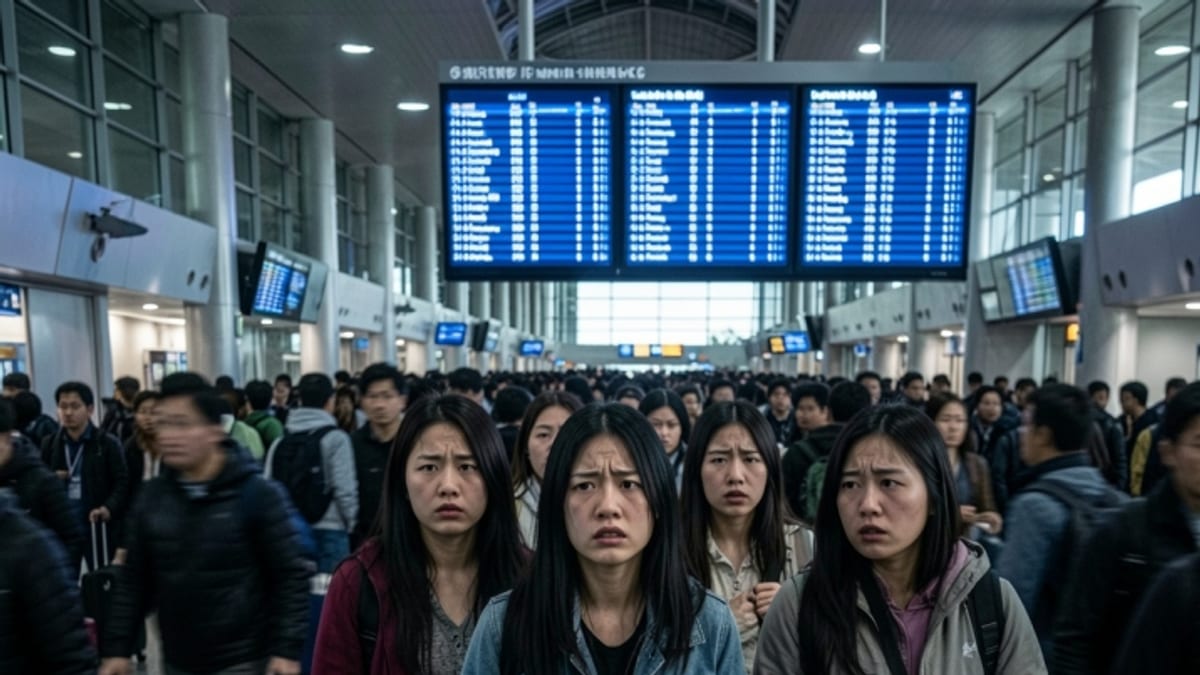
Image by Travel And Tour World
Major Chinese Hubs Grapple With Widespread Disruption
The latest bout of irregular operations has underlined how quickly congestion at key Chinese airports can ripple through the national network. Reports tracking same day performance at Shanghai’s dual-airport system, Beijing Capital and Daxing, Guangzhou Baiyun, Shenzhen Bao’an and Changsha Huanghua indicate that delays have been concentrated on busy trunk and regional routes serving the Yangtze River Delta and Pearl River Delta.
Publicly available tracking platforms show departure and arrival delays accumulating across daytime and evening banks, turning what began as routine schedule slippage into a knock-on disruption that stretched into the night. Once ground time buffers were exhausted, a growing number of rotations could no longer be completed as planned, leading to cancellations on both domestic and connecting itineraries.
Industry analyses of metroplex terminals such as the Shanghai area, which handles heavy flows shared between Shanghai Pudong and Shanghai Hongqiao, have long highlighted the sensitivity of the system to even modest capacity constraints. When arrival and departure waves fall out of sync, runway and airspace bottlenecks can quickly generate the kind of multi-hour delays now being reported at several of the country’s busiest nodes.
Flagship Carriers Among Those Most Affected
Travelers report particular disruption on services operated by China Eastern, China Southern, Hainan Airlines and Air China, four of the country’s main network airlines with extensive domestic and international schedules built around the affected hubs. Because these carriers operate dense banks of connecting flights at airports such as Shanghai Pudong, Beijing Capital, Guangzhou Baiyun and Shenzhen Bao’an, any failure to turn aircraft on time can cascade rapidly through their systems.
Operational statistics compiled in recent years have consistently shown that these airlines shoulder a large share of traffic through the country’s busiest hubs. Research into historic punctuality at Beijing Capital and Shanghai Hongqiao, for example, has documented meaningful average delay times for China Eastern, Air China and Hainan Airlines, illustrating how tightly loaded schedules can be vulnerable when conditions deteriorate.
Current disruptions appear to follow a familiar pattern: first, extended ground holds and slot restrictions slow early departures; then, late arrivals force aircraft to miss their next scheduled slot, spilling the delays onto subsequent sectors. Where crew duty limits or curfew restrictions are reached, airlines are left with little choice but to cancel later rotations, even if aircraft and passenger demand are available.
Passengers Stranded and Rebookings Under Strain
The immediate consequence for travelers has been a wave of missed connections, long queues at transfer and ticketing counters, and a scramble for accommodation and alternative transport. Social media posts and traveller forums in recent months have documented similar scenes at Chinese airports, with passengers describing overnight waits, re-routed itineraries through secondary hubs and hurried shifts from air to high-speed rail when flights were cancelled or heavily delayed.
Recent accounts from passengers flying with China Southern, Hainan Airlines and Air China on routes linking Guangzhou, Beijing, Shanghai, Shenzhen and regional cities such as Changsha describe a mix of experiences. Some travelers report being rebooked at no additional cost on later flights or partner carriers, while others say they have had to piece together their own onward journeys, sometimes purchasing last-minute rail tickets when same-day seats in the air system disappeared.
These individual stories are consistent with the strain placed on airline rebooking systems when a large number of flights are disrupted at once. Even when carriers issue involuntary refunds or propose new itineraries, hotel capacity near airports and peak-season rail seats can quickly become scarce, prolonging the impact for travellers left in terminal halls after aircraft have returned to their stands.
Structural Pressures Behind China’s Flight-Delay Pattern
Aviation specialists have frequently pointed to structural factors that make China’s busiest airports prone to bouts of disruption. Studies on metroplex terminal areas, including the Shanghai region, note that shared airspace, converging arrival flows and tight runway scheduling can leave limited margin to absorb sudden changes in weather, air traffic control restrictions or operational incidents.
Academic work on Beijing Capital and Shanghai Hongqiao has also emphasized that even in normal conditions, average delay times for major carriers can be significant, reflecting the challenge of managing dense waves of flights at airports that are close to their declared capacity during peak hours. When additional constraints arise, the system can quickly slide from routine congestion into the kind of widespread delays now being reported.
Policy moves and infrastructure expansions, such as the opening of new terminals and runways, are intended to relieve some of these pressures, yet the rapid rebound of demand on key domestic routes has often filled much of the available capacity. Travel industry analysts suggest that without more flexible airspace management and further investment in coordination tools, episodes of large-scale delay and cancellation are likely to recur during busy travel periods.
What Travellers Can Expect in the Coming Days
With hundreds of passengers already stranded and a substantial number of flights disrupted, publicly accessible aviation data suggests that residual delays may persist as airlines work through aircraft and crew repositioning. When rotations are broken in multiple cities, it can take several days for schedules to return fully to plan, particularly for carriers that operate complex domestic and international networks.
Passenger advocates and travel advisers generally recommend that travellers with upcoming itineraries involving Shanghai, Beijing, Guangzhou, Shenzhen or Changsha monitor their bookings closely, use airline apps where available, and allow additional connection time when their journeys rely on tight domestic transfers. In circumstances where long delays or cancellations occur, consumer-rights guidance encourages passengers to retain documentation of disruption and any additional expenses, which can be important when seeking refunds or compensation under applicable policies.
For now, the latest wave of delays and cancellations at China’s key hubs serves as a reminder of the fragility of tightly scheduled air transport systems. Even in an industry accustomed to managing complex operations, a few hours of disruption at the wrong moment can leave hundreds of travellers across multiple cities waiting for flights that never leave the gate.