

More news on this day
China and North Korea are resuming regular international passenger trains this week for the first time in six years, a tightly controlled reopening that could quietly reshape one of Asia’s most closely watched borders just as wars, sanctions and geopolitical rifts unsettle global travel patterns.
Get the latest news straight to your inbox!
A Historic Rail Lifeline Reopens After Six-Year Freeze
International passenger services between Beijing and Pyongyang, suspended in 2020 at the onset of North Korea’s pandemic border lockdown, are restarting on March 12, 2026. China’s state railway operator has confirmed that trains will again link the Chinese capital and the border city of Dandong with the North Korean capital, restoring a Cold War era corridor that long served traders, students and a trickle of adventurous tourists.
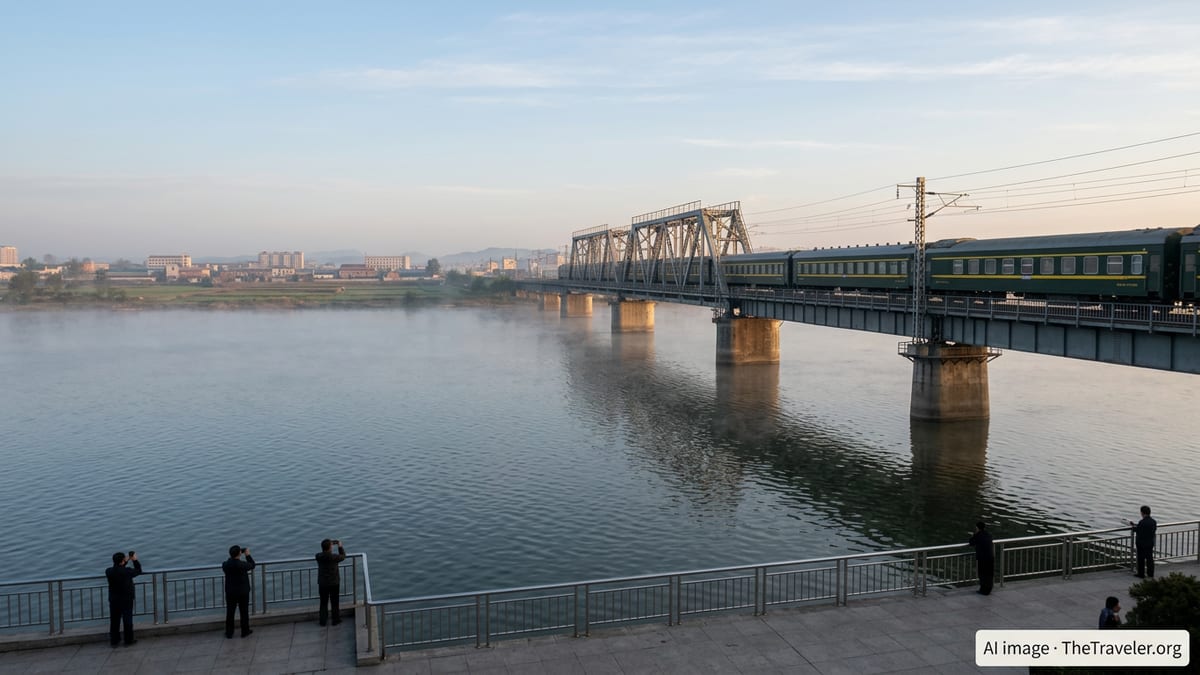
The revived timetable will see Beijing to Pyongyang trains running four times a week, while the shorter Dandong to Pyongyang route will operate daily in both directions. The carriages will once again cross the Sino Korean Friendship Bridge over the Yalu River, the symbolic and practical artery that carries the vast majority of legal trade between the two countries.
For North Korea, which has only cautiously reopened to foreign visitors since 2024, the move marks one of its most visible steps toward reconnecting with the outside world. For China, it is a signal that pandemic era disruptions to key overland routes are finally easing, even as the wider global travel industry remains buffeted by conflicts, sanctions regimes and volatile fuel prices.
Rail links between China and North Korea have existed in some form since the 1950s, and the through train between Beijing and Pyongyang gained an almost mythic status among rail enthusiasts. The six year pause was the longest interruption since the Korean War, underscoring how dramatically the pandemic and subsequent tensions isolated the North from even its closest ally.
New Era of Cross Border Travel, With Tight Controls
Despite talk of a new era of cross border travel, the first phase of the reopening will be highly restricted. Travel agents handling official ticketing in Beijing and Dandong say seats are initially limited to Chinese citizens working or studying in North Korea and North Koreans traveling for work, study or family visits. Wide open tourism is not yet on offer.
North Korea has so far welcomed back organized tourist groups almost exclusively from Russia, even though Chinese travelers accounted for the overwhelming majority of visitors before 2020. The gradual reintroduction of rail passengers suggests Pyongyang is testing capacity and health protocols before potentially loosening those limits.
On the Chinese side, passenger services will be available from major hubs including Beijing, Tianjin, Shenyang and Dandong, giving travelers in northeastern China rare direct access to one of the world’s most closed countries. Tickets are currently being sold offline only, through designated counters and state affiliated agencies, reinforcing the controlled nature of the relaunch.
Travel risk specialists caution that entry rules for North Korea remain opaque and subject to sudden change. Prospective visitors are being advised to prepare extensive documentation, including printed invitation letters and preapproved itineraries, and to accept that the service could be curtailed again at short notice if Pyongyang deems it necessary.
Tourism and Trade Hopes Along the Yalu River
In the Chinese border city of Dandong, where hotel roofs and riverside promenades overlook North Korean farmland and low rise housing across the Yalu, the announcement has stirred cautious optimism. Before the pandemic, the city marketed itself as the closest and most accessible vantage point on North Korea, with river cruises, lookout platforms and a steady flow of visitors attracted by the sense of peering into a forbidden world.
Local businesses hope that the daily Dandong to Pyongyang train will draw back domestic tourists, North Korea focused tour operators and logistics specialists who rely on predictable cross border transport. For traders shipping textiles, machine parts and foodstuffs, the restoration of passenger services sits atop an already revived freight corridor, which resumed in stages beginning in 2022.
On the North Korean side, cities such as Sinuiju and Pyongyang may see a modest boost from returning Chinese workers, technicians and students. Their spending in local hotels, restaurants and shops, while heavily managed by the state, provides a rare injection of foreign currency into an economy squeezed by international sanctions and its own prolonged self isolation.
Yet the scale of any tourism recovery is likely to be limited in the near term. International travel insurers often exclude coverage for North Korea, and many governments continue to warn their citizens against non essential trips. For now, the trains are more significant as a symbol and a lifeline than as a mass market tourism product.
Rail Reconnection Amid Global Travel Turmoil
The China North Korea rail reopening comes as global travel remains in flux. Conflicts in Ukraine and the Middle East continue to reroute air traffic and push up operating costs, while sanctions and export controls complicate aviation links to Russia and parts of Eurasia. In this environment, resilient overland corridors are gaining renewed strategic value.
For Beijing, reactivating the historic Beijing Pyongyang line complements broader efforts to secure land based connections across its periphery, from Central Asia to Southeast Asia. Trains offer a lower carbon alternative to short haul flights and, crucially in politically sensitive markets, are less exposed to airspace closures or aircraft leasing restrictions.
For Pyongyang, the resumption provides a relatively low profile way to deepen ties with its principal economic patron at a time when it is edging closer to Moscow and facing sharper rhetoric from Washington, Seoul and Tokyo. Regular rail traffic can quietly move people, aid and technical experts in ways that draw less attention than chartered aircraft or high profile delegations.
The relaunch also underscores a broader trend of partial normalization around the Korean Peninsula, even as missile tests and military exercises dominate headlines. Incremental steps such as reopening freight depots, restoring postal links and now rebooting passenger trains form the practical underpinning of any future diplomatic thaw.
What It Means for Future Travelers
For international travelers, the immediate impact of the train resumption will be most keenly felt by a niche group of rail enthusiasts, regional businesspeople and specialist tour operators. The Beijing to Pyongyang service, with its long overnight journey, slow progress across the North Korean countryside and strict onboard protocols, has long been pitched as a once in a lifetime experience rather than a casual getaway.
Industry insiders say demand from Chinese travelers curious about visiting North Korea remains strong, pent up after six years of closure. However, they expect tours to restart only gradually and in small groups, shaped by North Korean capacity limits and political calculations as much as by market appetite.
Prospective visitors from Europe, North America and other parts of Asia may face additional hurdles, including complex visa procedures routed through Beijing, limited consular support once inside North Korea and lingering uncertainty over how quickly the country will reopen beyond its immediate neighbors. Many are likely to watch how the first months of the new train era unfold before committing.
Even with those caveats, the resumption of China North Korea passenger trains represents one of the most striking reopenings on the global travel map in 2026. In a world where many borders feel more fragile than they did a decade ago, the revival of this old steel link hints at how rail can still redraw the contours of movement, connection and curiosity along one of geopolitics’ most rigid frontiers.