

More news on this day
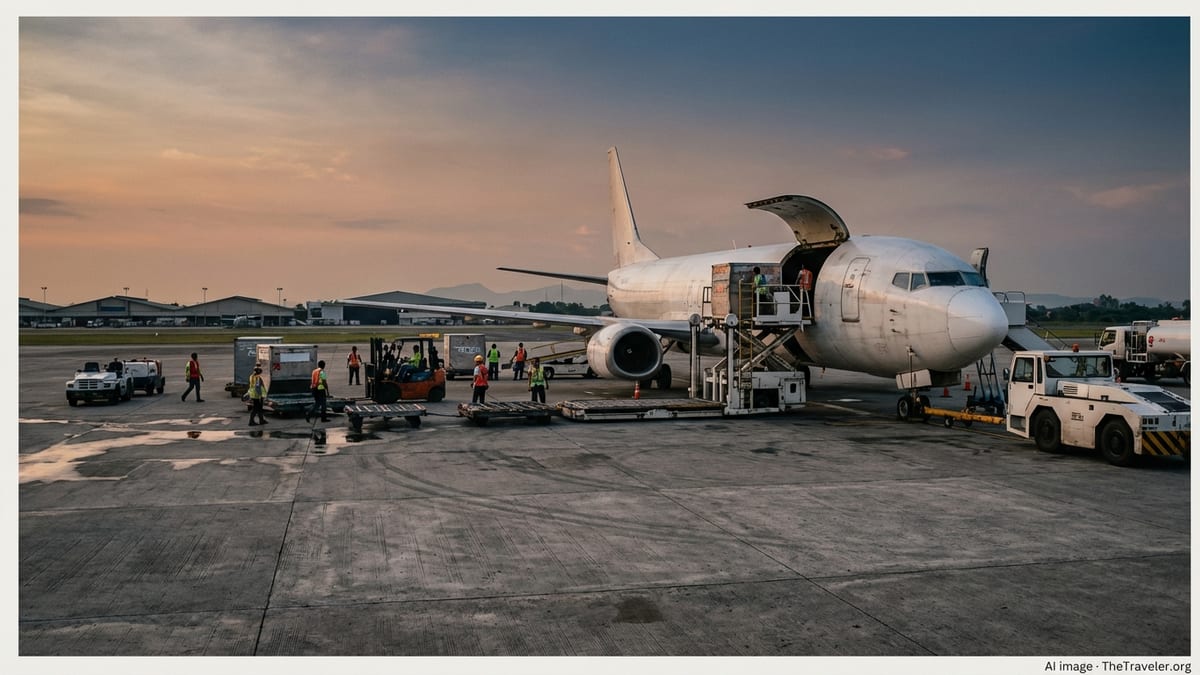
A dedicated Boeing 737-400 freighter link between Clark International Airport in Pampanga and Guangzhou in China’s Guangdong province is emerging as a pivotal new corridor in the Philippines–China aviation network, strengthening cargo flows while quietly redrawing the map for regional tourism and business mobility in North and Central Luzon.
Clark’s Cargo Boom Anchors a New China Connection
The new all-cargo operation between Clark and Guangzhou builds on a sharp rise in freight activity at Clark International Airport, which has rapidly repositioned itself as a Luzon gateway for China-focused logistics. Airport operator Luzon International Premiere Airport Development Corp. has reported triple-digit growth in cargo tonnage and a surge in flights as China-based carriers add capacity for e-commerce and manufacturing shipments.
Industry data show that Guangzhou and the wider Pearl River Delta already account for a significant share of Clark’s inbound and outbound cargo volumes, alongside Shenzhen and Hubei. By introducing dedicated 737-400 freighter operations on the Clark–Guangzhou sector, logistics players are tightening a corridor that serves as a natural bridge between factories and distribution centers in Guangdong and consumption hubs across Luzon.
The 737-400 freighter, a workhorse of short and medium-haul cargo markets, allows operators to offer higher-frequency services with payloads suited to cross-border e-commerce, electronics, fashion and perishables. At Clark, it joins a roster of freighter types ranging from 737 variants to widebody aircraft operated by global integrators, underpinning the airport’s ambition to become a regional logistics hub.
For Clark’s stakeholders in Pampanga and neighboring provinces, the Guangzhou link is more than a new line on the route map. It signals sustained confidence from Chinese and regional cargo carriers that Central Luzon can handle time-critical volumes reliably, connecting exporters and importers directly into one of China’s most dynamic manufacturing and consumption regions.
Guangdong’s Manufacturing Muscle Meets Central Luzon’s Growth Corridor
Guangzhou, through Baiyun International Airport, sits at the heart of the Greater Bay Area, a megaregion encompassing Guangdong’s manufacturing clusters and the consumer markets of Hong Kong and Macau. The new Clark–Guangzhou corridor plugs Philippine shippers straight into this ecosystem, shortening lead times for everything from components bound for Luzon industrial parks to consumer goods flowing into Philippine online marketplaces.
On the Philippine side, Central Luzon has been one of the country’s fastest-growing regions, with industrial estates, logistics parks and tourism zones clustering around the Clark Freeport and nearby cities. The dedicated freighter connection gives these zones a more predictable, point-to-point supply chain option compared with routings that rely on congested gateways farther south.
Forwarders active on the China–Philippines lane say that having a direct Clark–Guangzhou option changes how they design routings for high-value and time-sensitive cargo. Instead of trucking shipments through Metro Manila or consolidating solely in Manila’s main airport, they can now stage goods closer to origin or destination in Pampanga, Bulacan and Tarlac, trimming surface transport times and risk.
The corridor also aligns with broader regional trends. Across Asia, secondary airports like Clark are capturing new cargo routes as e-commerce and just-in-time manufacturing increase demand for more dispersed, high-frequency air links. Guangzhou’s position as a primary cargo hub makes it a natural counterpart to Clark in this evolving network.
From Freight Holds to Tourist Flows
While the new Clark–Guangzhou service is purely cargo, aviation planners and tourism officials are already eyeing its knock-on effects for passenger traffic. Historically, cargo routes have often paved the way for future passenger services when bilateral relations, demand and airport capacity align.
Guangzhou is a major outbound tourism source market, and Clark offers convenient access not only to the beaches of Zambales and La Union but also to cultural and culinary destinations in Pampanga and neighboring provinces. As load factors and trade links firm up on the cargo side, airlines evaluating new passenger routes can point to proven demand and operational familiarity on the sector.
Tourism stakeholders in Central Luzon note that improved cargo connectivity also indirectly benefits hospitality and meetings, incentives, conferences and exhibitions. Faster logistics for food products, event materials and high-value goods support hotels, resorts and convention venues that increasingly host regional business gatherings and leisure travelers flying via Clark.
For Philippine outbound travelers, stronger cargo ties with Guangzhou can lead to more competitive bellyhold capacity once passenger flights are added or expanded. That, in turn, often translates to sharper airfares and more options for travelers heading onward from Guangzhou to mainland Chinese cities or further into North Asia and Europe via connecting hubs.
Business Mobility and Supply Chains Gain Agility
The Clark–Guangzhou corridor is also reshaping business mobility patterns in subtle but important ways. Executives and technical teams who support manufacturing, retail and logistics operations frequently travel in tandem with their cargo flows, and robust freight links tend to spur more face-to-face engagement across borders.
Companies based in the Clark Freeport Zone and neighboring industrial parks are already using the new cargo connections to synchronize plant operations, inventory management and product launches with partners in Guangdong. As timetables stabilize and frequencies increase, corporate planners are likely to schedule more site visits, training sessions and vendor meetings around Clark and Guangzhou, reinforcing the corridor’s role as a business travel axis.
The presence of multiple China-based cargo operators at Clark, alongside homegrown carriers flying 737-400 freighters on domestic and regional routes, creates opportunities for interline and block-space arrangements that improve schedule choice for shippers. This networked connectivity gives Philippine exporters of electronics, garments, seafood and agricultural products more flexibility to reach buyers in southern China and beyond.
For small and medium-sized enterprises, access to dependable, moderately sized freighters like the 737-400 can be a game changer. These aircraft can support higher service frequency without the cost of filling a widebody freighter, making it easier for SMEs to move smaller, regular consignments rather than relying on infrequent bulk shipments.
A Strategic Step in the Philippines–China Aviation Relationship
The deepening aviation corridor between Clark and Guangzhou comes at a time when both the Philippines and China are recalibrating their air connectivity strategies. For Manila, spreading traffic beyond its main gateway is a policy priority, and Clark’s rising cargo profile provides a concrete example of how alternative hubs can prosper.
For Chinese carriers and logistics groups, expanding into Clark allows them to diversify away from single-hub dependence while tapping into Central Luzon’s growth story. With Guangzhou already ranking as one of Clark’s top cargo origin points, solidifying the link with a dedicated 737-400 freighter service underscores the long-term potential of the route.
Aviation analysts point out that air cargo often serves as the leading edge of economic integration, with passenger traffic following as commercial ties deepen. The Clark–Guangzhou service strengthens a latticework of routes between China and the Philippines that now spans multiple Chinese cities and Philippine gateways, confirming that the relationship is broadening beyond traditional Manila-centric flows.
As Clark continues to attract freighter operators and align its infrastructure with global standards, the new 737-400 cargo corridor to Guangzhou stands out as a strategic step in redefining how goods, people and ideas move between Central Luzon and southern China, with implications that will increasingly be felt in tourism statistics, investment flows and regional business travel patterns.