

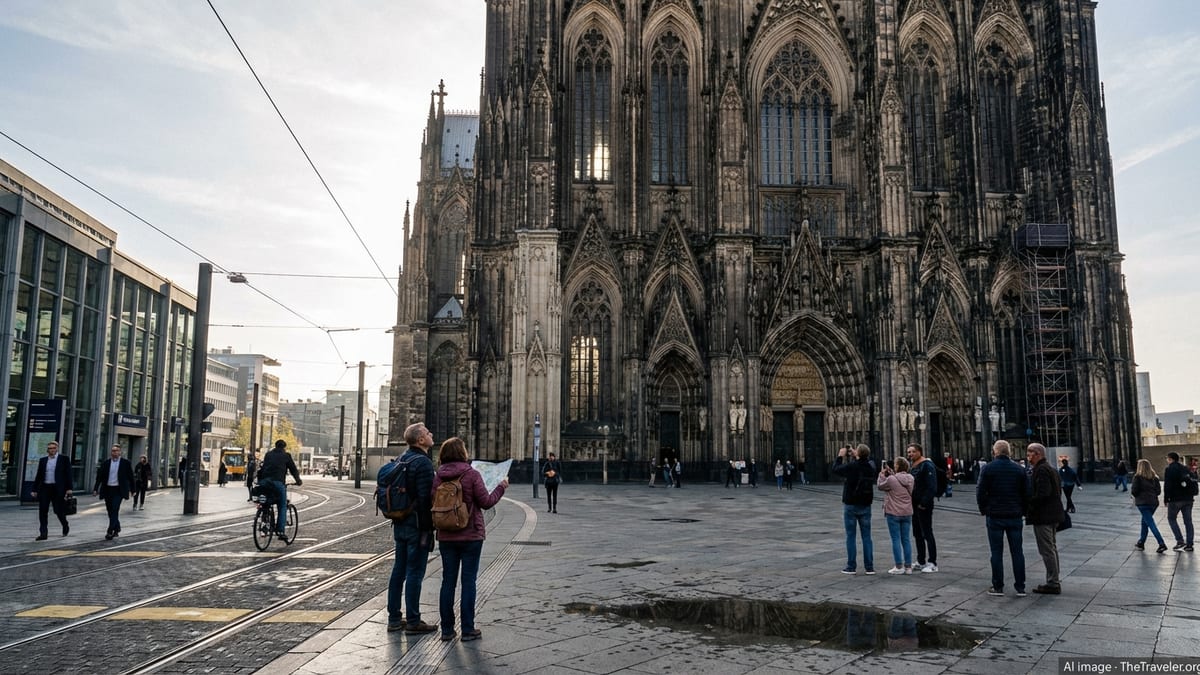
Rising above the Rhine with twin spires like stone needles, Cologne Cathedral dominates the skyline and the imagination in equal measure. At once a place of worship, a feat of medieval engineering and a symbol of the city’s resilience, this Gothic masterpiece is one of Europe’s most compelling stops for architecture lovers and casual travelers alike. This cathedral is central to the main things to do in Cologne and understanding its long history, complex architecture and practicalities of a modern visit will help you get far more out of your time beneath its soaring vaults.
The Story Behind Cologne Cathedral
Cologne Cathedral, or Kölner Dom, is inseparable from the story of the medieval city that grew rich on trade and pilgrimage. Construction began in 1248, when Cologne’s powerful archbishops and merchants set out to build a church worthy of the precious relics of the Three Kings that had arrived in the city a few decades earlier. Those relics instantly turned Cologne into a major spiritual destination, and the new cathedral was designed to rival the grandest churches in Christendom.
The builders took inspiration from the great Gothic cathedrals of northern France, especially those in Amiens and Chartres. Work advanced impressively during the 13th and 14th centuries, with the choir consecrated in 1322. Then the money, political will and technical capacity began to run short. By the 16th century, construction had effectively stopped and the cathedral stood incomplete, with a finished choir and a massive crane frozen in place on the south tower. For centuries, this half-finished silhouette was both an embarrassment and a familiar landmark.
Romantic nationalism in the 19th century finally brought the push needed to complete the church. Interest in medieval art and architecture surged, and newly unified Prussia championed the cathedral as a symbol of German identity. Remarkably, the medieval plans for the west façade and towers had been preserved, allowing 19th century builders to finish the structure true to its original vision. Work resumed in 1842 and, after an extraordinary burst of activity, was completed in 1880. At that time, Cologne Cathedral briefly held the title of the world’s tallest building.
The 20th century tested the monument’s endurance. During the Second World War, heavy bombing flattened much of Cologne, yet the cathedral, though hit by multiple bombs, remained standing. Photos of the blackened Gothic giant amid a sea of rubble became iconic images of the city’s survival. Postwar restoration has been ongoing ever since, and careful maintenance continues today, keeping this 13th century project very much a living one. This landmark plays a major role when evaluating if Cologne is worth visiting.
Understanding the Architecture
Cologne Cathedral is one of the purest and most ambitious examples of High Gothic architecture anywhere in Europe. Its external dimensions are monumental: the twin towers reach about 157 meters into the sky, and the interior nave vaults soar to roughly 43 meters. Rather than mixing styles across centuries, the church presents a remarkably unified Gothic design, thanks to the use of the original medieval plans when construction resumed in the 1800s.
The ground plan follows a Latin cross, with a long nave, wide transepts and a deep choir designed to accommodate elaborate liturgy and large numbers of clergy. Flying buttresses support the tall, thin walls, freeing them for expansive stained glass windows. Pointed arches, ribbed vaults and a forest of slender columns create the classic Gothic effect of verticality and lightness, as if the stone itself is reaching heavenward.
The west façade facing the modern station square is one of the most intricate stone frontages in Europe. The great portal is packed with sculptures of saints, prophets and biblical scenes, framed by sharp gables and delicate tracery. Above it, a lacework of pinnacles and buttresses rises into the twin towers, a stone tapestry that rewards close inspection with endless small details that many visitors rush past.
Inside, the vertical thrust of the nave is almost overwhelming at first glance. A series of pointed arches and clustered columns draws the eye instinctively toward the choir, which is encircled by an ambulatory and a ring of radiating chapels. The design is not just aesthetic; it channels crowds efficiently, separates liturgical spaces and filters daylight through stained glass in carefully controlled ways. The result is an interior that feels both immense and surprisingly coherent.
Masterpieces and Highlights Not to Miss
The single most important object in Cologne Cathedral is the Shrine of the Three Kings, located behind the high altar in the choir. This gilded reliquary, begun around 1190, is the largest of its kind in the Western world. Its tiered, house-like form is covered in intricate reliefs and studded with gems, enamel and figures of apostles and prophets. The shrine was created to hold what were believed to be the remains of the Biblical Magi, brought to Cologne from Milan in the 12th century, and it quickly turned the city into a major pilgrimage destination.
Elsewhere in the cathedral, several works of art connect visitors directly to the early Middle Ages. The Gero Cross, dating from around 970, is one of the oldest surviving large crucifixes in Europe. Carved in oak and over life-size, it shows Christ with a striking realism and pathos for its time. Nearby, the Milan Madonna, a late 13th century sculpture of the Virgin and Child, retains much of its original paint and offers a more tender, intimate glimpse into medieval devotion.
The stained glass windows are another essential highlight. Cologne Cathedral contains around 10,000 square meters of glass, ranging from early Gothic panels in the choir to later medieval and 19th century restorations. The intensity of color and intricate storytelling in these windows repay a slow, deliberate look. In the south transept, you will find a striking modern intervention: the so‑called Richter Window, installed in 2007. Composed of thousands of small, randomly arranged colored squares, it filters light into the space in a way that is abstract yet surprisingly harmonious with the older glass.
The Cathedral Treasury, located in the lower levels, is easy to overlook yet holds some of the most extraordinary objects connected to the building. Here you can see medieval reliquaries, liturgical vestments, illuminated manuscripts and metalwork that would be museum centerpieces anywhere else. The treasury’s collection traces more than a thousand years of artistic and religious history in Cologne, and for visitors with an interest in medieval craftsmanship, it is a must.
Planning Your Visit in 2025–2026
Cologne Cathedral is open every day of the year, but visiting hours depend on whether you are attending for worship or as a tourist. In general, the cathedral doors open from around 6:00 in the morning until 20:00 in the evening. Tourist visiting hours are usually from 10:00 to 17:00 Monday to Saturday, and from 13:00 to 16:00 on Sundays, with access to the tower hall often possible until 20:00 after evening Mass. Religious services always take precedence, so areas of the interior may be temporarily closed during Masses, funerals or special events.
Entry to the main cathedral interior is free, which often surprises first-time visitors. There are charges for the optional tower climb and for the treasury. As of early 2025, the official tariff for the tower is approximately 8 euros for adults, with reduced rates around 4 euros and family tickets available. Similar pricing applies to the treasury, and a combination ticket covering both the tower and treasury offers a small saving. Specific prices can change with new seasons and budgets, so it is wise to check locally once you arrive.
The tower climb is one of the most popular experiences, particularly on clear days. The south tower’s viewing platform is reached by climbing 533 steps in a spiral staircase. Expect it to take 10 to 20 minutes depending on your fitness and the crowds. There is no elevator, and the stairs are narrow and can feel confined, so anyone with mobility issues or severe claustrophobia should consider enjoying the cathedral from ground level instead. The reward for those who make the ascent is a panoramic view over Cologne, the Rhine and, on a bright day, distant hills on the horizon.
The Cathedral Treasury is typically open from around 10:00 to 18:00, with last admission about 30 minutes before closing. Allocating at least 45 minutes to an hour for the treasury is sensible if you have an interest in medieval art. Combined with exploration of the nave and choir, plus a tower climb, most visitors find that two to three hours provides a comfortable pace without feeling rushed.
Practical Tips for a Smooth Experience
Cologne Cathedral sits directly beside Cologne’s main train station, which makes arriving by rail the simplest option. Step out of the station and the west façade is immediately in front of you, a dramatic first encounter that never fails to impress. Trams, buses and regional trains all converge on this transport hub, and there are parking garages within walking distance if you are arriving by car, although driving into central Cologne can be slow at peak times.
As an active place of worship, the cathedral has a modest dress code. Visitors are expected to cover shoulders and avoid very short shorts or skirts. While enforcement is usually gentle, staff may ask those who are inappropriately dressed to cover up before entering. Large backpacks and bulky luggage are discouraged and may be subject to inspection at security checkpoints. For both comfort and safety, it is best to visit with only a small day bag and to wear non-slip footwear, especially if you plan to climb the tower.
Photography without flash is generally permitted in the main interior for personal use, but tripods, drones and commercial shoots require special permission. Flash is discouraged because it can disturb worshippers and harm delicate artworks over time. Given the number of visitors, it is courteous to keep noise to a minimum, silence phones and avoid blocking aisles during services or guided tours.
Guided tours are available in multiple languages through authorized cathedral guides, often organized via the city’s DOMFORUM visitor center. Public tours can be a good way to gain context in about an hour, and private tours are possible for groups with advance booking. Audio guides and printed brochures provide another layer of information if you prefer to explore independently at your own pace.
When to Go and How to Avoid the Crowds
Cologne Cathedral welcomes an average of around 20,000 visitors per day, which means timing can make a significant difference to your experience. Weekday mornings between 8:00 and 10:00 are generally the quietest, with a more contemplative atmosphere and easier photography. Late afternoons after 16:00 also see a gradual thinning of the crowds, particularly outside the summer high season and the run-up to Christmas.
The busiest times are usually between 11:00 and 15:00, especially in July and August, during major trade fairs and when the Christmas markets are in full swing from late November until just before Christmas. At these peak periods, queues for the tower can form, and the interior may feel crowded enough to slow your progress. If your schedule forces you to visit at midday, allow extra time and consider focusing on either the interior or the tower rather than trying to do everything at once.
Seasonally, spring and autumn offer the most comfortable balance of mild weather and manageable visitor numbers. April and May often bring pleasant temperatures and longer daylight without the heaviest tourist traffic. September and October can be particularly atmospheric, with softer light and occasional mist along the Rhine. Winter, apart from the Christmas market weeks, tends to be quieter, although shorter days and colder weather mean you will want to plan your tower climb for the warmest, brightest part of the day.
Special events can also influence your visit. During Carnival in February, Cologne fills with revelers and the city’s mood changes dramatically. The cathedral remains a place of stability and worship, but the surrounding streets may be crowded and noisy. On major church feasts and public holidays, expect changes in opening times and possible closures of parts of the interior during services. Checking the cathedral’s current schedule shortly before your visit, once you are already in Cologne, is a simple step that can prevent frustration.
Preservation, Security and Responsible Tourism
Looking up at the darkened stone of Cologne Cathedral, many visitors assume the color is simply age. In reality, the façade is constantly affected by weather and pollution, and the building is in a near permanent state of restoration. Stonemasons and conservators work year-round to replace eroded elements, clean sculptures and stabilize the tower structures. From time to time, scaffolding covers portions of the exterior or individual windows are removed for conservation. While this can limit certain photo angles, it is also a powerful reminder that the building is not a frozen relic but a living project.
Security at the cathedral has been strengthened in recent years, as at many major European monuments. Discreet bag checks are common at entrances, and there is a visible but low-key police and security presence around the square, particularly during large events. Visitors are not permitted to wander into closed or restricted areas, and attempts to climb outside the designated tower route or access the roof are treated seriously. In one recent incident, several climbers attempting an unauthorized ascent of the cathedral were detained by police after being detected by night-time surveillance.
As a visitor, you can contribute to the preservation of the site through small but meaningful choices. Avoid touching fragile stone carvings and painted surfaces, even if they seem within reach. Keep food and drink outside sensitive interior areas; a bottle of water is sensible, but picnicking inside is not. Dropping coins or other objects onto ledges and into grates causes long-term problems for maintainers. If you are moved to support the cathedral’s conservation directly, donation boxes and staffed desks inside accept contributions that go toward ongoing restoration work.
Respect for worshippers is another dimension of responsible tourism here. Daily Masses, private prayer and confessions all take place within the same spaces that draw camera-toting visitors. When you encounter areas roped off for liturgical use, respect those boundaries. If you arrive during a service, consider pausing to listen quietly or returning later to explore the building more fully, rather than pushing forward for photographs. The cathedral’s enduring power lies partly in this dual identity as both a major attraction and a living church.
The Takeaway
Cologne Cathedral rewards more than a quick glance on the way out of the train station. It is a place where centuries of faith, politics, artistry and engineering meet in stone and glass. From its 13th century foundations to its 19th century completion and 21st century restorations, the building tells a story of persistence and reinvention that mirrors the city around it.
For travelers, the combination of free entry, central location and layers of history makes it an essential stop on any German itinerary. Plan your visit with care, arrive early if you can, and allow time to climb the tower, contemplate the Shrine of the Three Kings, trace the colors in the windows and, above all, let the sheer scale of the space work on you slowly. Whether you are a student of Gothic architecture, a photographer chasing light or a visitor seeking a moment of quiet, Cologne Cathedral offers an experience that lingers long after you leave its shadow.
FAQ
Q1: Is there an entrance fee to visit Cologne Cathedral?
There is no entrance fee for the main cathedral interior, and visitors are welcome to enter free of charge. Separate tickets are required only for the tower climb and the Cathedral Treasury, which carry modest fees and optional combination tickets.
Q2: What are the typical opening hours for visitors?
The cathedral usually opens around 6:00 in the morning and closes around 20:00. Tourist visiting times are generally 10:00 to 17:00 from Monday to Saturday and 13:00 to 16:00 on Sundays, with access sometimes extended in certain areas after evening Mass. Hours can vary on holidays and during special services.
Q3: How long should I plan for a visit?
If you only walk through the nave and choir, you can see the essentials in 30 to 45 minutes. For a fuller experience that includes the tower climb and the treasury, plan on two to three hours. Visitors with a deep interest in art or architecture may easily spend longer.
Q4: Is the tower climb suitable for everyone?
The tower climb involves 533 narrow steps and no elevator, so a basic level of fitness and sturdy footwear are essential. It is not recommended for visitors with serious mobility issues, heart or breathing difficulties, or strong claustrophobia. Children should be supervised closely on the staircase and viewing platform.
Q5: Is there a dress code inside the cathedral?
There is a simple, respectful dress code: shoulders should be covered and very short shorts or skirts are discouraged. While more relaxed than in some churches, staff may ask visitors who are dressed inappropriately to cover up before entering. Hats are typically removed inside as a sign of respect.
Q6: Can I take photos inside?
Non-flash photography for personal use is usually allowed in most areas of the cathedral. Flash, tripods and commercial or staged photography are restricted and may require special permission. During services, visitors are expected to refrain from photography or to be extremely discreet so as not to disturb worshippers.
Q7: Do I need to book tickets or tours in advance?
Entry to the main cathedral does not require any booking and operates on a walk-in basis. Tickets for the tower and treasury are typically purchased on site on the day of your visit. Official guided tours, especially for groups or in specific languages, may require advance reservations through authorized organizers.
Q8: When is the best time of day to visit?
Early morning between 8:00 and 10:00 on weekdays is usually the quietest and most atmospheric time, with softer light and fewer tour groups. Late afternoon after 16:00 can also be pleasant. Midday hours, particularly between 11:00 and 15:00, tend to be the most crowded, especially in summer and around Christmas.
Q9: Is Cologne Cathedral accessible for visitors with reduced mobility?
The main interior and many surrounding areas are accessible via step-free entrances and ramps, and there is level access to much of the nave. However, the historic tower climb is not accessible because it consists only of stairs and has no elevator. Visitors using wheelchairs may still enjoy the ground-level spaces and many of the artworks.
Q10: Are there any safety or security rules I should know about?
For safety, large bags may be subject to checks and some items, such as large tripods or sharp objects, are not permitted. Visitors must stay within public areas and follow all signs and instructions from staff. Climbing or entering restricted zones outside the designated visitor routes is strictly forbidden and can result in removal from the site or intervention by security or police.