

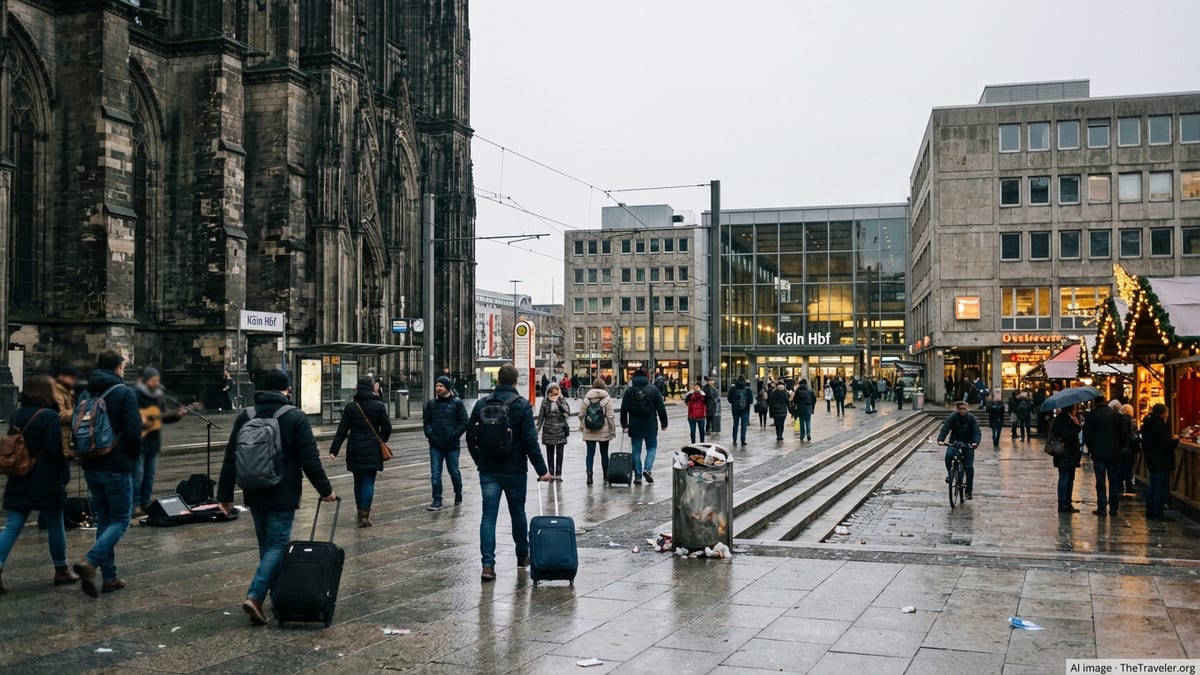
I went to Cologne with a pretty open mind and moderate expectations. I knew about the cathedral, the Christmas markets and the fact that this is a big, lived‑in city rather than a picture‑perfect medieval postcard. After several days on the ground, using the trams and trains, queuing for the Dom, walking the riverside and getting mildly lost in its neighborhoods, I came away feeling that Cologne is worth visiting, but only for a certain type of traveler and only with realistic expectations.
It is not a universally charming European city in the way many people imagine. It is a practical, friendly, somewhat rough‑around‑the‑edges place with a few highlights that can make a short stay rewarding if you know what you are getting into. If you decide to go, this guide to the best hotels in Cologne helps you choose the right base.
First Impressions: A City That Feels More Lived‑In Than Lovely
My first impression of Cologne was not love at first sight. Stepping out of the main station, the cathedral is right there and truly impressive, but everything around it felt chaotic and a bit worn. The plaza was packed, with tour groups, commuters and people just hanging around. The modern station building and the postwar concrete architecture that dominates much of central Cologne undercut the romantic Europe image a lot of travelers secretly hope for. Understanding the main things to do in Cologne makes the decision clearer.
As I walked further into the city, that impression stayed fairly consistent. Cologne is largely a rebuilt city, and it shows. There are historic fragments and a reconstructed old town area, but much of the urban fabric dates from the 1950s and 1960s. If you come expecting the intact medieval charm of somewhere like Bruges or the storybook streets of Rothenburg, you will almost certainly be disappointed. I found parts of the pedestrianized center a little bland and utilitarian, and some side streets around the station felt grimy and tired.
At the same time, I started to notice something I liked: the city felt lived in, not staged for tourists. Local people clearly outnumbered visitors outside the literal shadow of the cathedral. Corner bars were full of regulars, and small ethnic groceries sat next to bakeries. It took me a day to adjust my expectations from “beautiful old city” to “big German city with a couple of standout sights,” but once I did, I enjoyed it more. Extending your stay often depends on the available day trips from Cologne.
Cologne Cathedral: Spectacular Highlight With Some Practical Headaches
The cathedral is the obvious centerpiece of any trip to Cologne, and for good reason. From the outside, it dominates both the skyline and your memory of the city. I visited on a weekday morning and again around sunset. Even after seeing photos for years, walking up the steps from the station and coming face to face with those dark, towering spires still gave me a moment of silence. This is genuinely one of Europe’s great Gothic churches.
Going inside is free, though donations are encouraged. The opening hours typically run from early morning to early evening on most days, with slightly restricted access during services and special events. I found that arriving soon after opening was the only way to experience any sense of peace. By late morning, the nave was busy, and the aisles around the choir were clogged with tour groups listening to guides. If you hate crowds, you need to be strategic about timing; the location right next to the main train station almost guarantees a constant flow of people.
I also climbed the tower. There is a fee and a long, narrow stone staircase that feels almost endless. The practical detail that matters here is timing and fitness: the stairwell gets claustrophobic, and you need to be reasonably mobile. On my visit, the line at midday was long enough that I almost gave up. The panoramic view over the Rhine and the city is nice, but because Cologne’s skyline is not particularly dramatic, I did not find it as rewarding as climbs in other European cities. If you are short on time, I would prioritize walking around and through the cathedral over the tower climb.
Overall, the Dom met and mostly exceeded my expectations architecturally, but the experience around it was less enjoyable. The forecourt is constantly busy, and the surrounding area is saturated with chains and touristy food. I had to walk several blocks away before I found somewhere to sit that felt remotely local and quiet.
Public Transport, KölnCard and Getting Around: Efficient but Not Effortless
On paper, Cologne is an easy city to navigate. There is a dense local network of trams, underground lines and buses, plus regional trains running up and down the Rhine. During my stay, I relied heavily on public transport and tried the tourist‑oriented KölnCard, which includes local transport within the city plus discounts to museums and tours. The card is usually sold for 24 or 48 hours, and I appreciated the simplicity of not worrying about individual tickets inside the city limits.
The reality, however, was not quite as frictionless as the marketing suggests. The tram and U‑Bahn network is extensive, but at street level it can be confusing, especially where lines run both underground and on the surface. Some stations feel dated and have limited signage in English. Trams were often crowded in the morning and late afternoon, and there were a couple of minor delays that were never really explained. None of this was disastrous, but if you are not used to urban rail systems, Cologne’s network may feel overwhelming at first glance.
Beyond city limits, the national Deutschlandticket, which allows unlimited travel on most regional trains and public transport throughout Germany for a fixed monthly price, has changed the game a bit. At the time of my visit, that pass had recently increased in cost but was still a good deal if you were planning multiple train trips. For a short city break focused only on Cologne, though, I found the KölnCard sufficient. What I would do differently next time is study the lines ahead of time and use a transit app aggressively, because winging it at a busy interchange left me on the wrong platform more than once.
Old Town, Rhine Riverside and General Atmosphere: Pleasant but Patchy
The compact old town along the Rhine was the area I was most curious about, and it ended up being my most mixed experience. On the positive side, the riverfront promenade is genuinely pleasant in good weather. I spent several evenings walking along the water, watching boats come and go and sitting with a drink. Views back towards the cathedral and across to the other bank are memorable, especially at sunset. It felt relaxed and open, and for a big city it offered a surprising amount of breathing space.
Once I moved a block or two behind the river, the vibe changed quickly. Parts of the reconstructed Altstadt are cute in photos, with their colorful houses and cobblestones, but on the ground a lot of it is dominated by tourist‑orientated restaurants with similar menus and prices that felt inflated. I ate in a couple of these places and came away unimpressed with both the food and the bill. If you are particular about where you eat, it is worth doing some research and walking a little further afield into less obviously touristy streets.
In terms of everyday atmosphere, Cologne felt relaxed but sometimes a bit indifferent. I never felt unsafe, but areas around the station and some tram stops were a little scruffy, with litter and a few aggressive panhandlers. I have seen worse in other big cities, and it did not stop me from going out at night, but it chipped away at the idea of Cologne as a polished city break destination. It is functional, not glamorous, and I had to remind myself that this is a working city first, tourist destination second.
Museums, Culture and Nightlife: Strong If You Know What You Want
One of Cologne’s biggest strengths is its cultural scene. I spent a good amount of time in the city’s museums, and this is where my trip turned from “I am not sure I like this place” to “this is actually quite worthwhile.” The major art museums, like Museum Ludwig near the cathedral, are excellent, with strong collections of modern and contemporary art. The Roman‑Germanic Museum and the city’s ecclesiastical treasures give you a sense of just how long this region has been important. Entrance fees are not cheap but are in line with other major European cities, and discounts via the KölnCard helped a bit.
What did surprise me in a positive way was how uncrowded many of these museums were. Outside peak hours, I found myself walking through galleries almost alone, in stark contrast to the packed cathedral. If you are an art or history lover, Cologne can easily fill a few days without feeling like you are on the standard tourist conveyor belt. The trade‑off is that the city does not always showcase these assets clearly. Some museums close on certain weekdays or have shorter winter hours, and information was sometimes only partially translated. I had to double‑check opening times and plan around a couple of unexpected closures.
Cologne’s nightlife is famously lively, centered around its beer halls and bars serving Kölsch, the local beer. I liked the convivial atmosphere in the traditional Brauhäuser, where waiters circulate with trays of small glasses and automatically replace your drink unless you cover your glass. It is a social, informal drinking culture. That said, the noise level can be intense, and if you are not keen on smoky, crowded indoor spaces, it might not be your scene. I enjoyed one long evening in a Brauhaus and then deliberately chose quieter bars after that.
Christmas Markets and Seasonal Travel: Magical in Moments, Overwhelming in Others
I visited Cologne during the Christmas market season, which is one of the city’s major tourism draws. The markets usually open from mid or late November until just before Christmas, with some, particularly in Heumarkt, extending into the New Year period. Opening hours generally run from late morning to around 9 or 10 at night, and entry is free. The only things you pay for are food, drink, rides and any souvenirs you buy.
The Christmas markets were, at times, truly atmospheric. The setting of the main market right under the cathedral, with stalls clustered around a huge tree and a canopy of lights overhead, was one of those “this is why I travel” moments. Smaller markets like the one in the Stadtgarten felt more local and cozy, especially earlier in the afternoon before the after‑work crowd arrived. I had excellent mulled wine, tried different regional snacks and enjoyed some live music on small stages.
However, the crowds were no joke. On weekend evenings in particular, moving through the main market was slow and sometimes unpleasant. At certain chokepoints near popular stalls and exits, I felt almost stuck in a human traffic jam. I also noticed a clear difference in stall quality: some were selling thoughtful, locally made products, while others were generic or imported trinkets with prices that felt out of proportion to their quality. If you go for the markets, my honest advice is to prioritize weekday visits, aim for earlier in the day when they open, and accept that you will spend some time just queuing or shuffling along.
One more practical point: December in Cologne is cold and often damp. On my visit, some evenings were drizzly and raw, and standing around at outdoor markets became tiring after a couple of hours despite the mulled wine. A waterproof jacket, warm layers and good shoes are not optional. The markets are worth experiencing, but they are not as idyllic in real life as they appear in carefully framed photos.
Food, Prices and Value for Money: Mixed and Sometimes Underwhelming
In terms of food, Cologne did not blow me away, but it did not let me down either. Traditional dishes in Brauhäuser were hearty and filling, but nothing I ate would make my list of most memorable meals in Europe. Portions were generous, and prices in traditional beer halls were fair considering the central locations. Outside those, I found a good variety of international options, from Turkish and Middle Eastern food to Asian restaurants and bakeries. These often provided better value and more flavor than the tourist‑oriented spots in the old town.
One frustration was how samey the menus felt in many central venues. Schnitzel, sausages, burgers and a handful of salads or pasta dishes appeared everywhere. If you like straightforward pub food, this is not a problem. If you are chasing culinary discoveries, Cologne might feel tame unless you research specific places and are prepared to travel a bit further out of the most central zones. I had a couple of meals that felt like I had paid premium prices simply for the location rather than the quality.
Overall costs in Cologne were what I expected for a major German city. Accommodation near the center can be pricey during major events, trade fairs and December market season. Public transport is relatively good value, especially if you use the KölnCard or a regional ticket smartly. Museum entrance fees add up but are not outrageous. I did not feel ripped off, but I did sometimes feel that for the same money I could have had a more obviously charming city experience in a smaller town along the Rhine or in another region.
Who Cologne Is (and Is Not) For: My Honest Verdict
After several days in Cologne, I did not fall in love with the city, but I did develop a respect for it. The key for me was approaching it as a functional, culturally rich urban hub rather than a classic romantic destination. If you are passionate about Gothic architecture, modern art, or German beer culture, Cologne can absolutely be worth your time.
The cathedral alone is a world‑class sight, and the museum offerings give real substance to a short trip. Add in the Christmas markets at the right time of year, and you have a set of experiences that feel distinctly local rather than generic. Travelers often compare nearby cities, especially when weighing Cologne vs Düsseldorf.
On the other hand, if your top priority is picturesque streets, sweeping viewpoints and a feeling of being transported into a fairy‑tale Europe, Cologne is probably not your best choice. The postwar architecture and sometimes scruffy streets mean that the city never fully delivers on that fantasy. I would not recommend Cologne as a first or only destination in Germany for someone who has always dreamed of cobbled lanes and half‑timbered houses; there are simply better options for that.
Personally, I am glad I went, but I would not build an entire trip around Cologne alone. I would combine it with other towns along the Rhine or in the wider North Rhine‑Westphalia region, using Cologne as a transport hub and cultural anchor rather than the whole story. If I returned, it would likely be for a specific exhibition, event or a brief Christmas market visit with a clear, focused plan instead of an open‑ended stay. Many visitors consider guided experiences when choosing Cologne tours worth booking.
The Takeaway
Cologne is not the prettiest city in Germany, and it does not try to be. What it offers instead is a powerful cathedral that really does live up to the hype, a rich and varied museum scene, straightforward access by train, and a local culture that feels unpretentious and welcoming once you tune into its wavelength. There are frustrations to manage: crowds at the Dom and Christmas markets, occasionally confusing public transport, unremarkable but expensive tourist‑zone food, and some drab, workaday streets that are hard to romanticize.
Yet, taken on its own terms, Cologne is still worth visiting. It is particularly suited to travelers who value substance over surface: people who want to spend time in museums, who are curious about how a major German city lives day to day, and who do not mind trading postcard beauty for authenticity. It is also a good choice if you are already in the region or passing through by train, and you can afford to dedicate a couple of days to exploring without expecting to be dazzled at every turn.
If you go with calibrated expectations, a bit of planning around opening times and seasonal crowds, and a willingness to look beyond the immediate station area and tourist streets, Cologne will probably not become your favorite city in Europe, but it will add texture, history and a few memorable moments to your trip. For me, that made it a worthwhile stop, even if it did not become a place I feel compelled to rush back to.
FAQ
Q1: How many days do I really need in Cologne?
For my style of travel, two full days felt about right: one focused on the cathedral and nearby museums, and another for exploring the Rhine riverside, old town and perhaps a second museum or neighborhood. If you are there for the Christmas markets, you might add an extra evening, but I did not feel I needed a full week.
Q2: Is Cologne a good base for exploring the Rhine region?
I found Cologne to be a practical base because of its excellent rail connections, even if it is not the most scenic town on the river. It works well if you want to take day trips to smaller, more picturesque Rhine villages or to other cities in North Rhine‑Westphalia, then return to a place with plenty of accommodation and evening options.
Q3: Did I feel safe walking around Cologne at night?
Generally yes, though I stuck to well‑lit central areas and the main routes along the river. Around the station and some tram stops, the atmosphere could be a bit rough, with some loitering and occasional aggressive behavior, but I never felt directly threatened. As with any big city, normal caution and awareness are important.
Q4: Are the Christmas markets in Cologne worth planning a trip around?
They can be, if you love that kind of festive atmosphere and are prepared for serious crowds. I enjoyed the markets most on weekday afternoons and early evenings, when it was possible to move and actually see the stalls. If you only visit on a December weekend evening, you might come away more stressed than enchanted.
Q5: How accessible did I find Cologne for non‑German speakers?
I managed fine with minimal German. Most people in hospitality and tourism spoke at least some English, and signage at major attractions was often bilingual. On trams and in smaller shops the language support dropped off a bit, but nothing was insurmountable with a bit of patience and a translation app.
Q6: Was the KölnCard worth it for me?
For the way I traveled, the KölnCard was useful because I used public transport multiple times a day and visited several museums that offered discounts. If you are staying very centrally and walking most places, or you only plan to visit one attraction, you might find it cheaper to buy individual transport tickets and pay standard museum admission.
Q7: How did Cologne compare to other German cities I have visited?
Compared with places like Munich or smaller romantic towns along the Rhine, Cologne felt less visually appealing but more grounded and everyday. It reminded me more of other large, somewhat industrial German cities, where the attractions are specific sites and cultural institutions rather than the cityscape as a whole.
Q8: Is Cologne suitable for kids and families?
I noticed plenty of families around, and there are family‑friendly elements like the zoo, chocolate museum and seasonal events such as ice rinks and children’s programs at the Christmas markets. That said, central Cologne can be crowded and noisy, so parents should be ready for busy streets, packed trams and some long days on foot.
Q9: What would I do differently if I visited Cologne again?
I would book accommodation slightly away from the immediate station area, schedule the cathedral and main museums early in the day to avoid the worst crowds, and do more research into food options in local neighborhoods instead of defaulting to places around the old town. I would also limit my stay to a focused two or three days combined with other destinations.
Q10: Who would I honestly recommend Cologne to?
I would recommend Cologne to travelers who are interested in architecture, art and beer culture, who are comfortable navigating big‑city transport, and who do not need every street to look like a postcard. If you approach it as a cultural stop and transport hub within a wider German or Rhine itinerary, it can be a worthwhile and enjoyable part of your trip.