

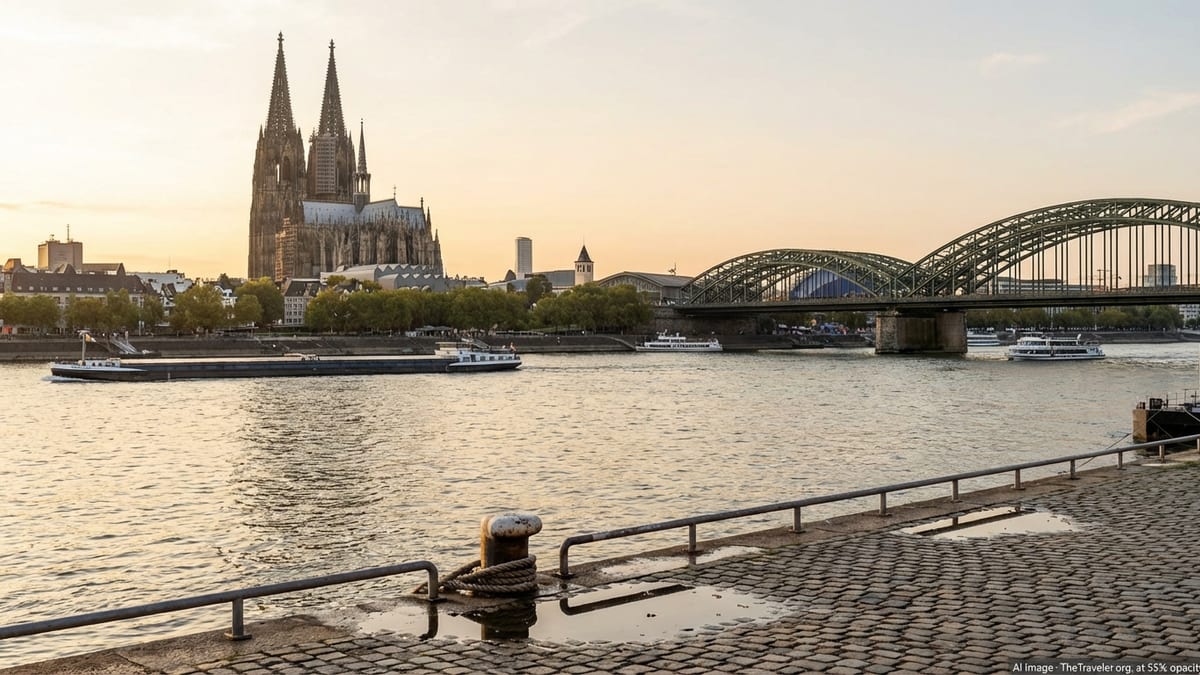
Cologne is often summed up in a single image: the twin spires of its cathedral rising over the Rhine. Yet behind that postcard view lies a city whose story runs from Roman frontier outpost to medieval powerhouse, from industrial hub to media capital. Understanding Cologne means tracing how history, culture and geography combined to make this river city one of the most influential places in Germany, and why it still matters far beyond its skyline.
From Roman Colony to Medieval Powerhouse
Cologne’s origins reach back more than two millennia. Around 39 BC, the Roman general Agrippa resettled the Germanic Ubii tribe on the left bank of the Rhine, establishing the Oppidum Ubiorum, both a frontier garrison and a trading settlement. In the year 50, the town gained special status when Julia Agrippina, born here and now empress as the wife of Claudius, successfully petitioned to have her birthplace elevated to a Roman colony. The new name, Colonia Claudia Ara Agrippinensium, gave the city its enduring identity: “Colonia” would later become “Köln” or “Cologne.”
As the capital of the Roman province of Germania Inferior, Cologne grew into a major urban center with paved streets, a forum, temples and a sophisticated water supply drawn from the Eifel aqueduct, one of the longest in the Roman Empire. Archaeological finds reveal a city of mosaicked townhouses, workshops and riverfront warehouses that channeled trade up and down the Rhine. For Roman administrators, Cologne was a strategic hinge between Gaul and the Germanic frontier, a place where imperial power met the fluid world beyond the border.
After the collapse of Roman authority in the 5th century, Cologne passed into the hands of the Ripuarian Franks, but unlike many Roman towns that dwindled into villages, it remained continuously inhabited. By the early Middle Ages, the city had become a key ecclesiastical center under powerful archbishops. Its location at a major Rhine crossing made it a natural hub for long-distance trade, and by the High Middle Ages Cologne ranked among northern Europe’s largest cities, with tens of thousands of inhabitants thriving behind new defensive walls that dwarfed the old Roman circuit.
Medieval Cologne was a place of both commerce and craftsmanship. Merchants sent goods along routes that linked the North Sea to Italy, while goldsmiths and artisans created religious treasures now held in church treasuries and museums. The city’s wealth funded monumental construction, including the foundation of twelve Romanesque churches and, above all, the soaring cathedral that came to dominate the skyline and define Cologne’s spiritual and political ambitions. Once you understand the background, it becomes easier to judge whether Cologne is worth visiting.
War, Ruins and Reinvention
Cologne’s fortunes have risen and fallen with European history. In the early modern period, the city lost some of its political autonomy and economic primacy as trade patterns shifted and nearby rivals such as Amsterdam and Hamburg drew maritime commerce away. Yet Cologne remained an important regional center on the Rhine, its identity shaped by Catholic tradition in a patchwork of Protestant and Catholic territories.
The 19th century brought dramatic change. Incorporated into Prussia after the Napoleonic era, Cologne was absorbed into an industrializing state that saw strategic value in its Rhine location. Railways converged on the city, bridges spanned the river and factories clustered around the port districts. Population growth was explosive. At the same time, romantic nationalism and historicism converged on the unfinished medieval cathedral, whose construction had stalled for centuries. Work resumed in the 1840s, and the building was finally completed in 1880, turning Cologne’s most famous monument into a symbol of German unity as much as religious devotion.
The 20th century brought catastrophe. During the Second World War, Cologne was a primary target of Allied bombing campaigns. Air raids devastated large swathes of the urban fabric, particularly the medieval old town. By 1945, much of the city lay in ruins, and only the skeletal but still-standing cathedral offered a visual anchor amid the rubble. Postwar photographs of the untouched twin spires surrounded by devastation became an enduring icon of both survival and loss.
Reconstruction in the 1950s and 1960s reshaped Cologne in concrete, glass and asphalt. Urban planners prioritized rapid rebuilding and modern mobility, replacing many historic streetscapes with broad roads and functionalist blocks. Yet they also preserved key monuments and archaeological layers. Roman remains were excavated and protected, medieval churches painstakingly restored and the cathedral repaired. The result was a hybrid city: part modern Rhine metropolis, part palimpsest of 2,000 years of urban life.
A Cathedral and a River: Symbols That Still Matter
Few European landmarks are as instantly recognizable as Cologne Cathedral. Begun in 1248 to house the relics of the Three Kings, the Gothic masterpiece took more than six centuries to finish. Its twin spires, among the tallest church towers in the world, dominate the city and have long served as a navigational beacon for those approaching by river, rail or air. For residents, the cathedral is less a tourist sight than a constant reference point, visible from bridges, parks and high-rise offices.
The cathedral’s significance today is layered. It is a UNESCO World Heritage site, a national symbol and an active place of worship. It also functions as a civic living room, surrounded by a busy square where commuters cross paths with pilgrims and street performers. Renovation never truly ends, with teams of stonemasons and conservators continuously repairing weathered sculptures and tracery. This perpetual maintenance underlines how Cologne’s most famous monument is also one of its biggest ongoing cultural projects.
If the cathedral is Cologne’s vertical axis, the Rhine is its horizontal one. The river has defined the city from its earliest days as a Roman port to its current status as a logistics and transport hub. Bridges such as the Hohenzollern and Deutz connect neighborhoods and frame classic views of the skyline. Freight barges, cruise ships and passenger ferries share the waterway, while promenades on both banks give residents a linear park at the water’s edge.
The Rhine also shapes the city’s vulnerabilities. Floods have repeatedly threatened low-lying districts, prompting Cologne to invest heavily in flood defenses, riverbank reinforcement and monitoring systems. Climate change is sharpening these concerns, as more extreme weather patterns raise questions about the future of river levels and navigability. In this sense, Cologne’s long relationship with the Rhine illustrates how historic river cities must adapt to new environmental realities without severing ties to the waterways that built them.
Cultural Capital of the Rhineland
Cologne has carved out a reputation as one of Germany’s liveliest cultural centers. Its museums, galleries and theaters draw audiences from across Europe, and its calendar is packed with festivals that mix high culture with street-level energy. Institutions such as the Museum Ludwig, best known for its collection of modern and contemporary art, and the Romano-Germanic Museum, which preserves the city’s Roman heritage, anchor a museum landscape that stretches from classical antiquity to experimental installations.
The city’s reputation as a media and creative hub grew rapidly after the Second World War. Public broadcasters established major studios here, and private channels and production companies followed. Today, Cologne is one of Germany’s most important television and film centers, with studios, post-production houses and training institutions clustered on both sides of the Rhine. This media infrastructure has helped nurture a broader creative ecosystem that includes design, advertising, music and digital startups.
Cologne’s performing arts scene is equally dynamic. The city supports a major opera house, a renowned philharmonic orchestra and numerous theaters that range from classical stages to fringe venues. Music students flock to the city’s conservatories, and jazz clubs, independent venues and electronic music nights provide a constant flow of live sounds. Festivals dedicated to literature, photography and documentary film further reinforce Cologne’s role as a place where artistic disciplines intersect. This cultural context helps explain the most popular things to do in Cologne.
What sets Cologne apart is not just the quantity of cultural offerings but their integration into everyday life. Exhibition openings, readings and concerts spill over into bars and public spaces, while the city’s dense urban fabric makes it easy to move from a museum visit to a riverside walk or a late-night gig. For travelers, this means that even a short stay can coincide with significant cultural events, provided they scan the city’s busy listings before arrival.
People, Neighborhoods and Everyday Life
Cologne is Germany’s fourth-largest city, with well over a million residents, but it often feels more like a patchwork of villages than a single metropolis. Each Veedel, or neighborhood, has a distinct character, shaped by history, migration and local traditions. The compact medieval core draws most visitors, yet much of the city’s contemporary life unfolds in districts slightly beyond the cathedral’s shadow.
The Belgisches Viertel, or Belgian Quarter, is known for its cafés, boutiques and creative offices, a magnet for students and young professionals. Ehrenfeld, once an industrial suburb, has reinvented itself as a multicultural, artsy area where former factory halls now host concerts, street art and coworking spaces. On the “wrong” side of the Rhine, Deutz and the right-bank neighborhoods combine residential streets with trade fair grounds and some of the best skyline views back toward the old town.
Cologne’s population is notably diverse, with residents tracing their roots to Turkey, Italy, eastern Europe, the Middle East and beyond. This diversity is reflected in the city’s food, from traditional Rhineland pubs serving hearty dishes to family-run eateries offering everything from mezze to ramen. Street markets and small grocery stores bring global ingredients into daily cooking, while the city’s beer halls remain strongholds of local culinary identity.
Above all, Cologne is defined by a distinctive local mentality often described as open, humorous and informal. The city’s dialect, Kölsch, still colors everyday speech, and local sayings celebrate tolerance and joie de vivre. While such self-images should be approached critically, visitors often remark on a relaxed, approachable atmosphere that contrasts with stereotypes of German formality. For many residents, Cologne is less a place they live in than a community they belong to.
The Spirit of Carnival and the City’s Identity
No discussion of Cologne’s culture is complete without Carnival. Each year in the weeks leading up to Lent, the city stages one of Europe’s most famous street festivals, culminating in the “crazy days” around Rose Monday. Parades, costumed parties, political satire and spontaneous street gatherings transform streets, trams and bars into one sprawling stage. For locals, Carnival is both tradition and safety valve, a chance to invert hierarchies and defy winter gloom.
Carnival shapes the city’s identity far beyond a single week. Clubs and societies plan events year-round, and local music written for the season becomes part of the city’s shared songbook. The humor is often sharp, poking fun at politics, social issues and the city’s own shortcomings. In a region marked by layers of history and past divisions, Carnival’s unifying effect is not trivial. For many residents, it reaffirms a collective sense of belonging that transcends neighborhood, profession or background.
At the same time, Cologne’s major events calendar extends beyond Carnival. The city hosts one of Europe’s largest pride festivals, reflecting its prominent LGBTQ+ communities and long-standing role as a center of queer life. Trade fairs draw global visitors in fields such as gaming, food, furniture and photonics, temporarily swelling the city’s population and filling its hotels. From Christmas markets to summer riverbank festivals, public celebrations punctuate the year and continually reshape how people use and perceive urban space.
These events are not just colorful extras. They generate significant economic activity for hotels, restaurants, transport providers and local shops. They also serve as soft power, projecting an image of Cologne as open, playful and outward-looking. For a city competing with Berlin, Munich and Hamburg for global attention, such cultural branding has real weight.
Economic Engine and Knowledge Hub
Cologne’s economy rests on a mix of traditional strengths and newer sectors. Its position on the Rhine, intersected by major rail and motorway routes, keeps logistics and trade at the heart of local industry. The port and freight terminals handle goods moving between seaports, inland markets and neighboring countries. This transport infrastructure has helped attract distribution centers, automotive suppliers and manufacturers that rely on efficient access to both German and European networks.
Beyond logistics and industry, Cologne has emerged as a key media, communications and technology center. Major broadcasters and publishing houses base large operations in and around the city, creating demand for advertising agencies, production studios and digital service providers. The presence of trade fairs devoted to games, digital media and technology underscores Cologne’s role in these sectors, strengthening ties between local firms and international partners.
Higher education and research provide another pillar of the city’s importance. The University of Cologne, one of Germany’s largest and oldest universities, draws tens of thousands of students and hosts significant research in fields from economics to life sciences. Technical colleges and specialized institutions add engineering, arts and applied sciences to the mix. This academic density generates a steady flow of skilled graduates and fosters collaboration between universities and industry.
For travelers, these economic and educational roles are not always visible, yet they shape everyday experience. A strong student presence keeps certain districts youthful and experimental. Business travelers fill hotels during trade fairs and conferences, sometimes making leisure trips more expensive or crowded on specific dates. The city’s wealth supports a broad range of restaurants, cultural venues and public services that benefit residents and visitors alike.
Cologne in a Changing Europe
Cologne’s story has always been entwined with broader European currents, and that remains true today. As part of the populous state of North Rhine-Westphalia and nestled between Belgium, the Netherlands and France, the city sits at the heart of one of Europe’s densest cross-border regions. High-speed trains link Cologne to Brussels, Paris and Amsterdam, while regional services tie it to the industrial Ruhr and the financial centers of Frankfurt and Luxembourg.
In this context, Cologne functions as both a regional anchor and a bridge. It is large enough to sustain its own cultural and economic gravity, yet close enough to neighboring hubs to participate in shared labor markets and cross-border projects. European institutions, non-governmental organizations and multinational firms maintain offices here, using the city as a base for operations that span multiple countries.
Cologne also faces the same challenges as many European cities. Housing affordability is a major concern as demand outstrips supply in attractive neighborhoods. Debates over urban development, from high-rise projects to green space conservation, regularly surface in local politics. Environmental policy has become especially pressing, with discussions about low-emission zones, public transport expansion and cycling infrastructure reflecting a broader shift toward more sustainable urban living.
In dealing with these issues, Cologne draws on a long tradition of reinvention. The same city that rose from Roman military camp to medieval trading giant, and from war-torn ruins to modern media center, is now testing how to balance growth with livability. The answers it finds will matter not only to its own residents but also to the wider region that depends on Cologne as a key node in European networks of transport, culture and commerce.
The Takeaway
Cologne’s importance cannot be reduced to a single factor. It is not just the cathedral, not just the Rhine, not just Carnival or media companies or universities. Rather, it is the cumulative effect of two thousand years of strategic location, economic adaptation and cultural layering. Few European cities combine such deep historical roots with such a present-tense sense of energy.
For travelers, Cologne offers more than a checklist of sights. It is a place where Roman foundations lie beneath shopping streets, where a Gothic cathedral towers over contemporary art museums, and where a riverside walk can end in a neighborhood bar packed with students, families and visitors. Experiencing the city means sensing how past and present coexist in everyday life.
In the wider European picture, Cologne matters as a stable, creative and connected hub, a city that has repeatedly absorbed shocks and emerged with a renewed sense of itself. Its story illustrates how urban centers can survive war, economic shifts and cultural change, not by freezing their identity but by constantly reshaping it. That ongoing transformation is precisely what makes Cologne worth watching, and worth visiting, today.
FAQ
Q1: Why is Cologne considered an important city in Germany?
Cologne is important because it is a major economic and transport hub on the Rhine, a leading media and cultural center, and home to one of Germany’s largest universities, all built on a history that stretches back to its days as a Roman provincial capital.
Q2: What makes Cologne Cathedral so significant?
The cathedral is significant for its monumental Gothic architecture, its role as a symbol of the city and the nation, its status as a UNESCO World Heritage site and its function as a living place of worship that has shaped Cologne’s skyline and identity for centuries.
Q3: How old is Cologne as a city?
Cologne’s roots go back to a Roman settlement established in the first century BC, and it became a formal Roman colony in the year 50, giving the city a documented urban history of nearly two thousand years.
Q4: What is special about Cologne’s location on the Rhine?
Its location on the Rhine gives Cologne easy access to inland and seaport trade routes, connects it to a dense network of rail and road corridors and positions it as a gateway between western Europe and the interior of Germany.
Q5: How did the Second World War change Cologne?
Heavy bombing during the war destroyed much of the historic center, leaving the cathedral standing amid ruins, and the postwar rebuilding replaced many old streetscapes with modern structures, permanently reshaping the city’s appearance and layout.
Q6: What role does Carnival play in Cologne’s culture?
Carnival is central to local identity, bringing parades, costumes and satire to the streets each year, reinforcing a tradition of humor, openness and community that many residents see as defining the Cologne way of life.
Q7: Is Cologne mainly a historic city or a modern one?
Cologne is both: Roman remains and medieval churches coexist with contemporary museums, media studios and modern infrastructure, creating a cityscape where different eras are visibly layered on top of each other.
Q8: Why is Cologne a media and creative hub?
The city became a media hub through the concentration of broadcasters, production companies and publishing houses, which in turn attracted advertising agencies, designers, musicians and digital startups that now form a broad creative ecosystem.
Q9: How diverse is Cologne’s population?
Cologne has a notably diverse population, with residents of many different national and cultural backgrounds, and this diversity is reflected in its neighborhoods, food scene, religious life and public festivals.
Q10: What should a first-time visitor not miss in Cologne?
First-time visitors should not miss the cathedral and its surroundings, a walk along the Rhine, a visit to at least one major museum, time in a neighborhood such as the Belgian Quarter or Ehrenfeld and, if the timing is right, experiencing either Carnival or one of the city’s major festivals.