

More news on this day
Colombian aviation and law enforcement authorities have opened an investigation after suspected bullet damage was discovered on an American Airlines Boeing 737 MAX that had operated a routine flight between Miami and Medellín, raising fresh concerns over ground security around one of the country’s busiest international gateways.
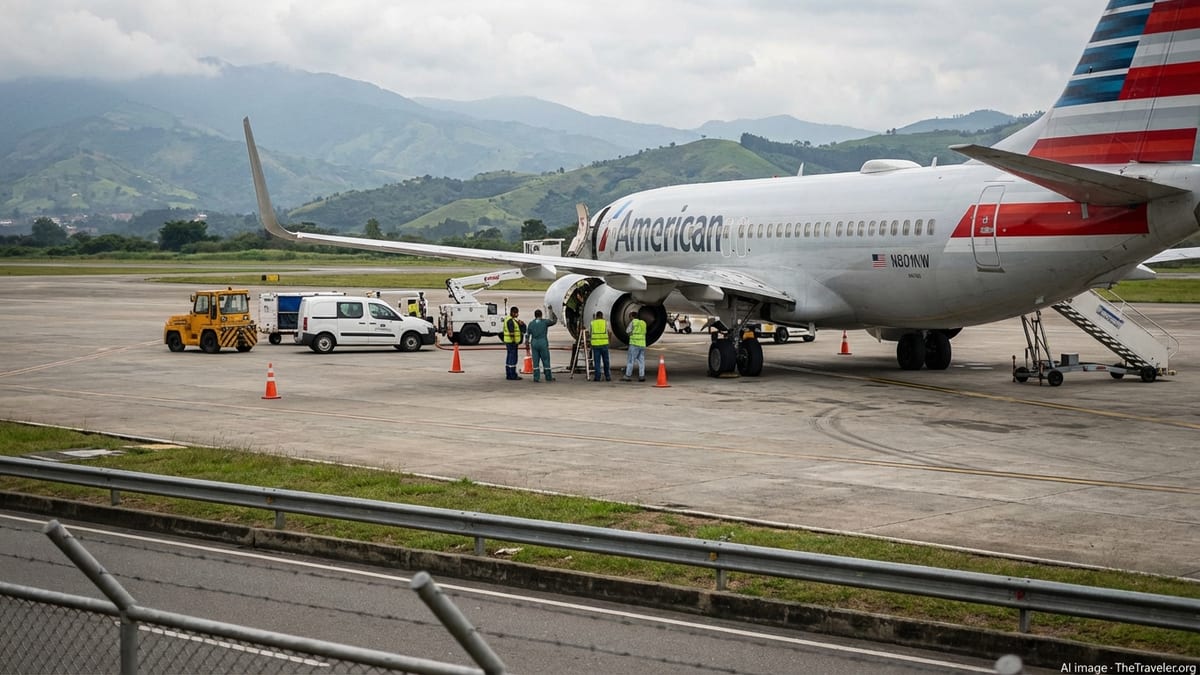
Damage Found After Miami–Medellín Rotation
The incident centers on an American Airlines 737 MAX 8 that flew from Miami International Airport to Medellín’s José María Córdova International Airport on Sunday, February 22, as flight AA923. Ground staff in Colombia later reported a small puncture in the aircraft’s right aileron, a critical control surface on the wing that helps manage roll and lateral balance. The aircraft subsequently returned to Miami on Monday without incident, where the damage was again documented during post flight checks.
According to multiple aviation and news reports citing preliminary internal documents, the puncture appeared consistent with a bullet strike, with evidence of an entry hole and corresponding deformation on the opposite side of the aileron. There were no reports of unusual noises, pressurization problems, or control issues during either leg of the journey, and passengers and crew were unaware of any anomaly in flight.
American Airlines confirmed that a puncture was found on the exterior of one of its aircraft during a routine inspection in Medellín. The airline said the jet was immediately removed from commercial service for detailed inspections and repairs and that it is cooperating with all relevant authorities as they work to determine when and where the damage occurred.
Colombian Authorities Lead Security-Focused Inquiry
Officials in Colombia have launched a formal inquiry into the episode, treating the puncture as a suspected firearms incident affecting civil aviation. Early statements from Colombian authorities indicate that investigators’ working theory is that the aircraft was struck at low altitude or while on approach to land at José María Córdova on Sunday night, rather than during its time in U.S. airspace or at Miami.
Authorities have said they are focusing on the possible involvement of a criminal group operating in the region, though investigators caution that the probe is in its early stages and that no definitive conclusion has been reached. Forensic work will include analysis of metal fragments, examination of the trajectory of the puncture, and a review of surveillance coverage and ground activity near the approach path to Medellín’s airport.
The case has also prompted questions about notification procedures. While airline statements suggest that inspections in Medellín identified the damage, Colombia’s civil aviation regulator initially reported that it had not yet received formal notification from either the airline or foreign counterparts. Clarifying the sequence of reports and communications is expected to form part of the broader investigation into how such an incident was handled.
Aircraft Grounded for Repairs in Dallas
After the Miami–Medellín–Miami rotation, the 737 MAX 8 was flown without passengers to American’s maintenance base at Dallas Fort Worth, where it remains grounded for structural assessment and permanent repairs. Temporary patches were reportedly applied to stabilize the affected section of the aileron before the repositioning flight to Texas, where specialized engineers are now performing detailed inspections of the wing assembly and related systems.
Experts note that while localized damage to an aileron may not immediately compromise an aircraft’s ability to fly, any penetration of a primary control surface or nearby systems, including control cables or fuel lines, is treated as a serious matter. Engineers in Dallas are expected to evaluate not only the visible puncture but also any potential secondary effects on internal structures, wiring, and hydraulic components.
American Airlines has emphasized that at no point were safety margins eroded during passenger operations and that the crew experienced no handling anomalies. However, the carrier has not provided a timeline for when the aircraft will return to service, underscoring the conservative approach airlines typically adopt when firearms damage or other unexplained structural impacts are suspected.
Renewed Spotlight on Airport Perimeters and Low Altitude Risk
The suspected bullet strike in Colombia comes amid heightened global attention to security risks around airports, particularly in regions where criminal activity or armed groups are active near approach and departure corridors. Aviation analysts point out that while such incidents remain extremely rare, previous cases of aircraft being hit by stray gunfire during takeoff or landing in other countries have led to temporary flight suspensions and reinforced ground security measures.
In Medellín, the focus now turns to the environment surrounding José María Córdova International Airport, which sits in a valley outside the city and is bordered in places by residential and semi rural areas. Investigators are expected to map the aircraft’s precise flight path and altitude during its arrival and departure, cross referencing that data with terrain lines of sight and any known hotspots of illegal weapons activity.
Security specialists say one priority for authorities will be determining whether the damage was the result of indiscriminate gunfire from the ground or a targeted act. At present, officials have stressed that there is no evidence suggesting an organized attempt to bring down the aircraft, but they also acknowledge that even stray rounds pose an unacceptable risk when they intersect with busy air corridors.
What the Incident Means for Travelers
For passengers flying between the United States and Colombia, the discovery is unsettling but, according to experts, does not signal a systemic safety failure. Commercial aircraft are designed with multiple redundancies, and airlines regularly conduct detailed inspections that can reveal even minor exterior anomalies. In this case, the flight segments operated normally, and the issue was identified on the ground rather than following an in flight emergency.
Travelers booked on American Airlines services to Medellín and other Colombian cities have not faced widespread disruption as a result of the investigation, with the affected aircraft swapped out for another jet in the carrier’s fleet. American has reiterated that it is cooperating with Colombian authorities and international regulators to clarify the circumstances and that flight operations continue as scheduled.
Nonetheless, the episode is likely to feed into broader discussions about risk management on certain routes and about how quickly local and national authorities are alerted when potential attacks on aircraft are suspected. As the investigation in Colombia progresses in the coming days, airlines, regulators, and frequent flyers alike will be watching closely for answers on how a routine flight ended with a modern passenger jet grounded over apparent bullet damage.