

More news on this day
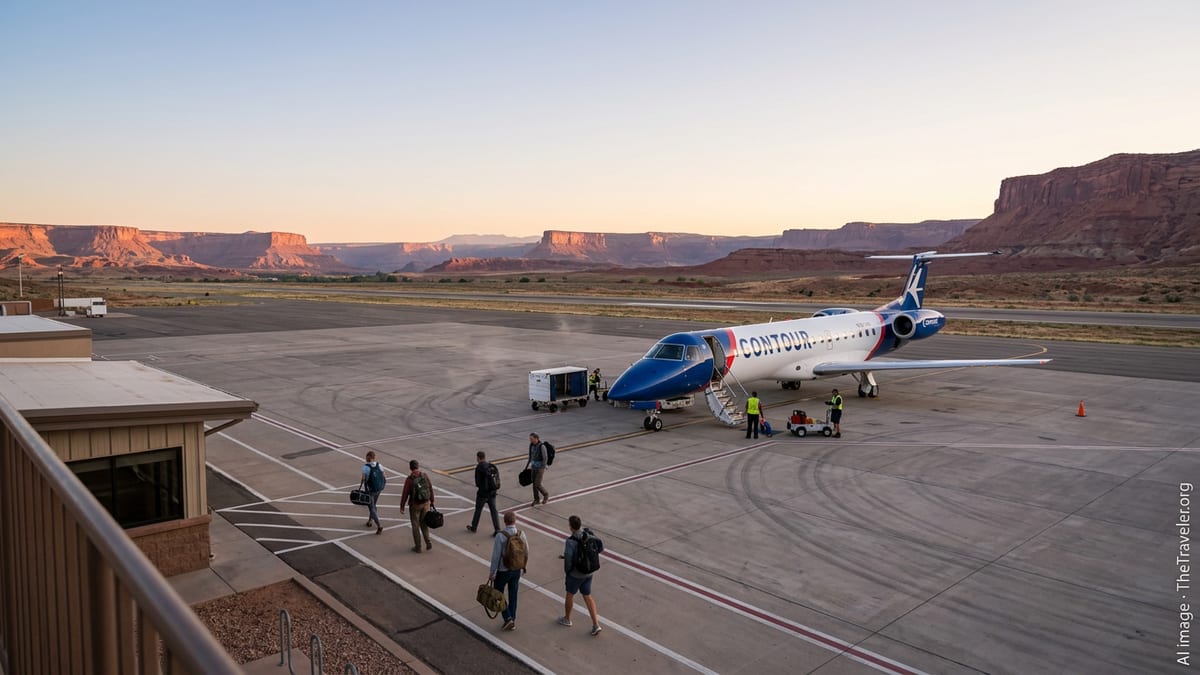
Contour Airlines is strengthening air access to Moab’s red-rock country this spring, adding more nonstop flights from Denver and Phoenix to Canyonlands Regional Airport during the peak travel months of April and May 2026.
Expanded Spring Schedule Links Moab With Denver and Phoenix
The regional carrier announced it will operate 7 weekly flights between Moab and Phoenix and 12 weekly flights between Moab and Denver, for a total of up to 19 weekly departures serving Canyonlands Regional Airport. The added frequencies are scheduled to run through April and May 2026, a period that coincides with one of Moab’s busiest tourism windows.
The move builds on Contour’s existing role as the primary provider of commercial air service to Moab, following earlier launches of nonstop flights connecting the southeastern Utah destination with both Denver International Airport and Phoenix Sky Harbor International Airport. With the latest schedule adjustment, travelers will see more options across the week, including additional midweek departures that can better accommodate flexible itineraries.
Company executives framed the expansion as a direct response to sustained demand for access to Moab’s national parks and public lands. They noted that the airline’s performance on the route since its initial launch has demonstrated consistent interest from both leisure travelers and local residents who rely on connections through Denver and Phoenix to reach the broader domestic and international network.
The additional flights also reflect a broader trend in regional aviation, in which carriers are focusing on high-value outdoor destinations and smaller gateways that can feed traffic into major hubs. By concentrating capacity at Canyonlands Regional Airport during the spring period, Contour is positioning Moab as a more easily accessible entry point to Utah’s canyon country.
Supporting Moab’s Tourism Economy at Peak Season
Local tourism and airport officials have long emphasized the importance of reliable air links in sustaining Moab’s visitor economy, which depends heavily on spring and fall travel seasons. The enhanced schedule is expected to support higher hotel occupancy, longer stays and stronger business for outfitters, guide services and restaurants as travelers secure more convenient flight times.
The spring months typically see a surge of visitors drawn to Arches National Park, Canyonlands National Park and the surrounding public lands at a time when temperatures are milder and outdoor conditions are especially favorable. Added frequencies from Denver and Phoenix are likely to appeal to travelers who might previously have considered driving several hours from larger airports or opting for alternative destinations with more direct service.
Regional planners say better air connectivity can help distribute visitor arrivals more evenly across the week rather than concentrating them on weekends, easing pressure on local infrastructure and attractions. With more daily options, visitors may be inclined to start their trips midweek, potentially alleviating congestion at park entrances and on popular trailheads during the busiest days.
Businesses in Moab’s hospitality sector are also watching the expansion closely, as reliable shoulder-season air service can encourage repeat visitation and support growth in segments such as meetings, small group tours and adventure travel packages. The expectation is that easier access from two major hubs will help Moab maintain its competitiveness against other national park gateway communities in the region.
Improved Connectivity Through Denver and Phoenix Hubs
By increasing service to Denver and Phoenix, Contour is deepening Moab’s connectivity to two of the western United States’ most important aviation hubs. From Denver International Airport, passengers can connect to a wide array of domestic destinations in the Midwest, East Coast and Mountain West, while Phoenix Sky Harbor International Airport offers strong links across the Southwest and to key cities in California and Mexico.
The Moab flights are operated on regional jets configured for shorter-haul markets, which allows the airline to match capacity with demand while still offering a level of comfort suited to leisure travelers. Contour’s product includes complimentary checked baggage on many fares and onboard snack and beverage service, features that can be attractive to visitors carrying outdoor gear or luggage for extended stays in the area.
For international travelers, the enhanced schedule may help simplify itineraries that previously required long drives or multiple connections to reach Moab. Additional daily options can reduce layover times and provide more flexibility when pairing long-haul flights into Denver or Phoenix with regional segments to Canyonlands Regional Airport.
Travel advisors and tour operators that package Moab with other western destinations, such as Salt Lake City, Las Vegas or Colorado’s mountain resorts, are expected to benefit from the added reliability and frequency. More predictable schedules can make it easier to design itineraries that move visitors efficiently through a multi-stop circuit in the Intermountain West.
Local Response and Infrastructure Readiness
Officials at Canyonlands Regional Airport and within the Moab tourism community have welcomed the expanded schedule, describing it as a vote of confidence in the destination’s long-term appeal. The airport has been working to align its operations with growing passenger volumes, including ground handling, security screening and ground transportation connections into town.
Shuttle operators and rental car agencies serving Canyonlands Regional Airport are preparing for heightened demand during the spring months, with some adjusting schedules and inventory to match the new flight patterns. Increased service can translate into more frequent pick-up times and a wider range of arrival windows for guests heading into Moab’s lodging districts.
Local leaders also highlight the role of marketing partnerships and cooperative funding arrangements in supporting air service. Contributions from tourism boards and destination marketing organizations have helped promote Moab flights in origin markets such as Denver and Phoenix, where travelers may now see more advertising emphasizing direct access to the region’s outdoor recreation and scenic landscapes.
At the same time, community stakeholders continue to balance the benefits of increased access with ongoing discussions around sustainable tourism and resource management. As Moab’s profile continues to rise, expanded air service is seen as one piece of a broader strategy to manage visitor flows while preserving the natural and cultural assets that draw travelers to the area.
Strategic Positioning in the Regional Airline Market
The decision to bolster Moab’s links to Denver and Phoenix underscores Contour Airlines’ broader strategy of focusing on underserved small and mid-sized communities with strong tourism or business demand. By concentrating on point-to-point routes that may not attract large mainline carriers, the airline has carved out a niche in connecting travelers to secondary destinations with limited alternative options.
Industry observers note that regional carriers are increasingly targeting outdoor recreation hubs, capitalizing on the sustained interest in national parks, hiking, cycling and adventure travel. Destinations like Moab, which offer year-round appeal but particularly strong peak seasons, can provide a stable base of demand when supported by effective marketing and reliable operations.
For Moab, the enhanced spring schedule represents both an immediate boost in capacity and a signal that air service could continue to evolve in step with visitor trends. Should the additional flights perform well, they could lay the groundwork for future seasonal expansions or adjustments to match demand during fall, another prime period for exploring the high desert.
In the near term, the increased number of weekly flights to and from Denver and Phoenix gives travelers more ways to reach Moab at a time when interest in the region shows little sign of slowing, reinforcing the town’s status as a key gateway to some of the American Southwest’s most iconic landscapes.