

More news on this day
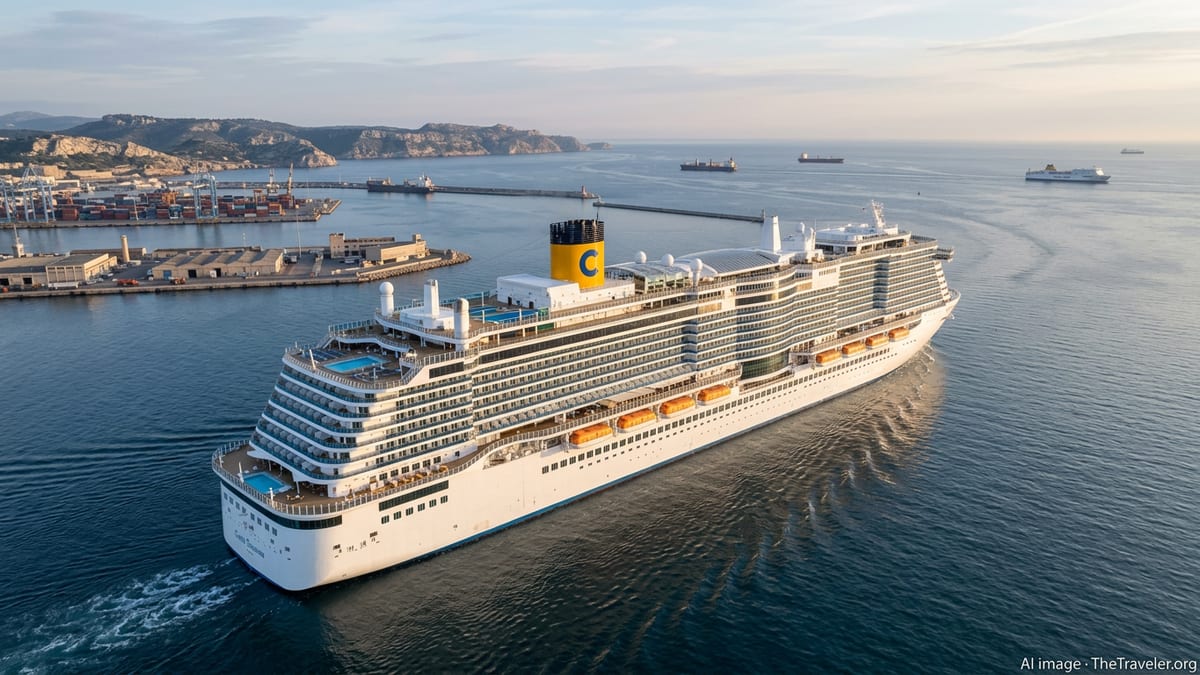
Costa Cruises’ flagship Costa Toscana is scrapping its much‑trailed Dubai and wider Middle East deployment for winter 2025–2026 and doubling down on the Western Mediterranean instead, following a quiet but significant technical and cosmetic overhaul at a French shipyard.
Get the latest news straight to your inbox!
From Dubai Darling to Mediterranean Mainstay
The 2021‑built Costa Toscana, one of the largest LNG-powered cruise ships in Europe, had long been positioned as Costa’s standard bearer in the Arabian Gulf, with brochures and trade promotions highlighting a full winter 2025–2026 season from Dubai and calls across the United Arab Emirates and Oman. Industry deployment schedules and earlier marketing material pointed to the ship leaving the Mediterranean in mid-November 2025 for a high-capacity program in the region.
That strategy has now been decisively reversed. Publicly available cruise line updates and specialist cruise media report that Costa has cancelled Toscana’s Middle East program, including repositioning voyages to and from Dubai, citing a fluid and unpredictable security environment impacting the Red Sea and adjacent waters. Instead, the ship will remain in the Mediterranean through the 2025–2026 winter, operating a mix of seven-night and longer itineraries across Southern Europe and North Africa.
The move places Costa Toscana at the center of a broader redeployment pattern among major European brands, several of which have recently withdrawn or scaled back seasonal Gulf operations. The decision effectively concentrates more big-ship capacity in the Western Mediterranean at a time when demand for close-to-home cruising from European source markets remains robust.
Shipyard Reset in Marseille Sets Stage for New Role
The strategic pivot is closely linked to a recent technical milestone for Costa Toscana. According to cruise industry coverage and ship-tracking reports, the vessel underwent its first major scheduled maintenance period at Chantier Naval de Marseille in early 2026, after nearly five years of continuous service. The yard stay included mandatory class and technical work as well as a series of “soft” refurbishments to passenger-facing spaces.
Reports from the yard period describe hull work, pool recoating and fresh exterior paint, alongside new carpeting, refreshed flooring and detail upgrades in public areas and hotel services. While not a radical redesign, the overhaul represents a significant refresh for a ship that has been heavily marketed and intensively deployed since delivery. It also aligns Toscana with evolving brand standards and guest expectations in the highly competitive Mediterranean family and fly-cruise market.
Following completion of the yard work, Costa Toscana reentered service in mid-February 2026 on short Western Mediterranean sailings from major homeports including Genoa, Savona, Marseille and Barcelona. The swift return to operations, combined with the cancellation of the upcoming Gulf season, signals an intention to keep the ship highly visible and accessible to European guests year-round.
Security Concerns Reshape Middle East Cruise Calculus
The cancellation of Costa Toscana’s Dubai deployment comes against a backdrop of ongoing maritime security concerns along key access routes to the Gulf. Shipping advisories, naval operations and risk assessments over the past two years have highlighted heightened tensions in the Red Sea and surrounding corridors, complicating both repositioning voyages and regular cruise operations.
Industry analyses suggest that rising insurance premiums, the need for extended detours to avoid high-risk areas and the potential for last-minute itinerary changes have eroded the commercial appeal of seasonal Gulf deployments for some operators. For a high-capacity, LNG-fueled vessel like Costa Toscana, the additional challenge of ensuring reliable fuel logistics in a still-developing Gulf bunkering network adds another layer of operational complexity.
By opting to keep the ship in the Mediterranean, Costa reduces exposure to these uncertainties while leveraging a mature LNG infrastructure already established across key Western Mediterranean ports. The redeployment is being interpreted by analysts as a risk-management decision as much as a commercial opportunity, reflecting how geopolitical dynamics can rapidly reconfigure global cruise maps.
Expanded Mediterranean Reach and New Themed Sailings
With Costa Toscana committed to the region beyond the traditional summer season, Costa Cruises is reshaping its Mediterranean portfolio. Winter 2025–2026 programs highlighted in trade documentation and consumer brochures point to a schedule of seven-night Western Mediterranean loops paired with longer, more immersive itineraries extending to Morocco and other North African destinations. These voyages are positioned as “destination-rich” alternatives to long-haul sun-seeking cruises.
Coverage of the shipyard work in Marseille also references new onboard concepts being introduced alongside the refresh, including astronomy-focused “Sea of Stars” sailings that make use of clear night skies at sea. Such themed cruises are designed to differentiate Toscana within a crowded Med market, where multiple major brands field similarly sized vessels on overlapping routes.
For Mediterranean port cities, the year-round presence of a ship of Toscana’s scale promises a measurable boost in winter tourism, particularly in turnaround hubs like Genoa, Savona and Marseille. Local tourism bodies are expected to benefit from a more even seasonal spread of hotel stays and ancillary spending, offsetting the traditional low-season lull.
What the Shift Means for Travelers and the Region
For travelers who had booked or planned on Gulf cruises aboard Costa Toscana in late 2025 and early 2026, the redeployment means rebooked itineraries or alternative ships in other regions. Consumer reports and online forums indicate that some guests have already been offered Mediterranean options or other winter programs within the Costa network following the schedule changes.
At the same time, the decision underscores a broader recalibration of how major cruise brands approach politically sensitive or logistically challenging regions. Analysts note that while the Gulf remains an important source of future growth, operators are increasingly ready to pivot capacity back to core markets such as the Mediterranean and Caribbean when risk profiles shift.
For Costa Cruises, concentrating its latest-generation flagship in the Western Mediterranean, fresh from a comprehensive shipyard tune-up, positions the brand to reinforce its historical stronghold. It also sets up Costa Toscana as a linchpin of the company’s strategy to anchor more of its premium hardware close to its core European customer base, at least for the coming seasons.