

More news on this day
Escalating conflict around the Strait of Hormuz has triggered a wave of cruise cancellations across the Arabian Gulf, stranding thousands of passengers, immobilising ships in Dubai and Doha, and forcing operators to abruptly end their winter seasons in one of the world’s fastest-growing cruise regions.
Get the latest news straight to your inbox!
Cruise Seasons Cut Short as Tensions Escalate
The rapid deterioration of security conditions in the northern Arabian Sea and Strait of Hormuz since late February has upended the cruise season in the Gulf just as it was entering its peak. Regional military alerts, warnings to commercial vessels and soaring war-risk insurance premiums have led cruise lines to suspend operations, citing the need to protect guests and crew.
Saudi Arabia’s Aroya Cruises has confirmed it is ending its inaugural Arabian Gulf season weeks ahead of schedule, cancelling all remaining voyages from ports including Dubai, Abu Dhabi and Doha. The line’s single ship, Aroya, had only arrived in the region in late February and was scheduled to operate week-long itineraries through early May before the conflict escalated.
Other operators with a winter presence in the Gulf, including European and German brands, have similarly scrapped their final departures or repositioned ships. Itineraries once marketed around convenient fly-cruise packages, short sailings and guaranteed sunshine have instead become emblematic of how quickly regional instability can disrupt modern cruise tourism.
The cancellations underscore the vulnerability of cruise schedules in narrow maritime chokepoints. With the Strait of Hormuz now effectively impassable to many commercial operators, the Gulf’s emerging role as a winter alternative to the Mediterranean and Caribbean has been thrown into sudden uncertainty.
Ships Immobilised in Dubai and Doha
At the centre of the disruption are vessels that have been unable to safely exit the Gulf. Greek operator Celestyal Cruises has confirmed that two of its ships, Celestyal Discovery and Celestyal Journey, remain alongside in Dubai and Doha respectively, with upcoming European itineraries cancelled while the vessels wait for a viable route out of the region.
Celestyal has already called off the remaining Arabian Gulf departures that were scheduled from Qatar and the United Arab Emirates, and has now extended cancellations to short Aegean cruises from Athens later in March because the affected ship cannot leave Dubai. Travel agents report a surge in calls from guests whose spring sailings in the eastern Mediterranean have been scrapped as a direct consequence of the Gulf crisis.
German-focused TUI Cruises has also cancelled remaining Gulf departures for its Mein Schiff vessels that had been operating roundtrip sailings from Dubai and Doha. Some departures at the end of February and in early March were first modified and then dropped altogether as the security picture deteriorated and regional authorities tightened controls.
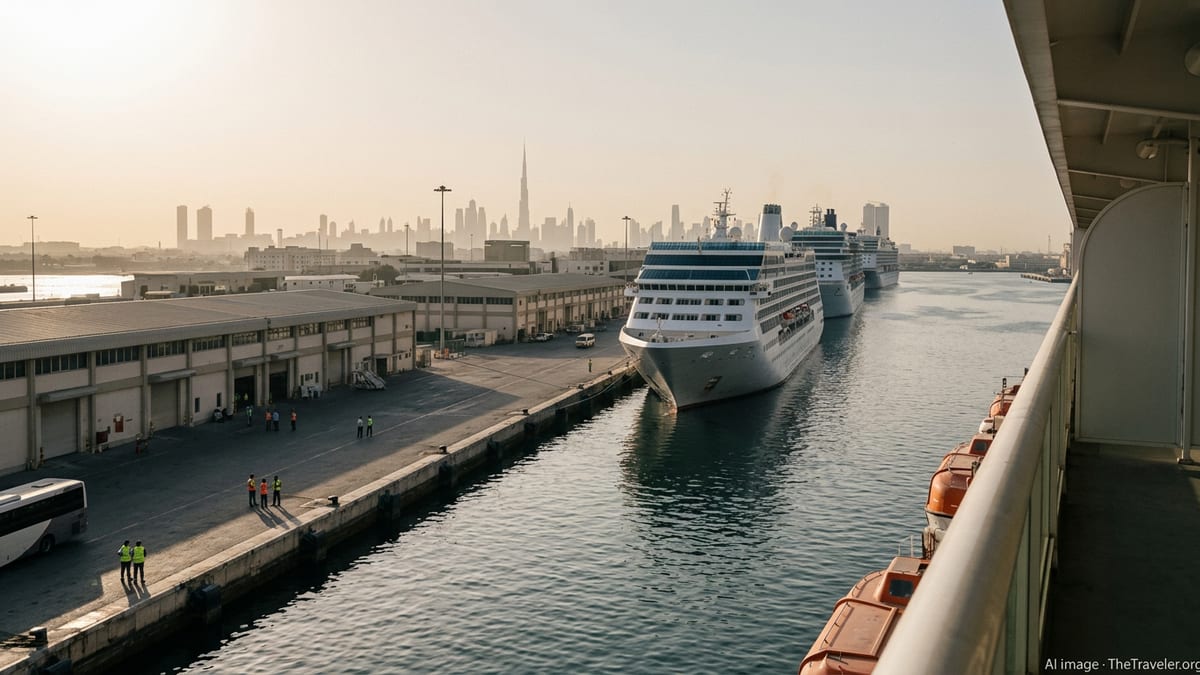
Local tourism stakeholders say the sight of large cruise ships lying idle at Dubai’s Port Rashid and Doha’s Grand Cruise Terminal has become a visible symbol of the wider maritime standstill. Hotels near the ports have seen a short-term spike in demand from displaced guests, even as longer-term uncertainty weighs on bookings for the 2026–27 season.
Passengers Stranded and Repatriation Efforts Underway
The abrupt nature of the cancellations has left thousands of holidaymakers in limbo. Many travellers who boarded Gulf itineraries in late February and early March expected standard port calls in the United Arab Emirates, Qatar, Oman and Saudi Arabia. Instead, they have found themselves confined to ships that rarely left port, or transferred unexpectedly to hotels while cruise lines arranged alternative transport home.
Operators have been working with airlines and charter companies to organise repatriation flights from Dubai and Doha, a logistical challenge compounded by widespread flight cancellations and airspace restrictions across several Gulf states. Industry updates indicate that some cruise lines have already flown more than 1,500 guests out of the region in recent days, with further departures planned as aircraft and routes become available.
Passengers have reported a mix of frustration and relief: disappointment at missing long-planned sailings, but also appreciation for safety-focused decisions and compensation packages that typically include full refunds and future cruise credits. Travel insurers are fielding a spike in claims linked to conflict-related disruptions, although coverage depends heavily on policy wording and when bookings were made.
For guests booked on future Gulf cruises later in March and April, the picture remains fluid. Many are receiving rolling updates as lines review voyages on a departure-by-departure basis, balancing security assessments with the practicalities of moving ships and crew through constrained sea lanes.
Geopolitical Flashpoint at the Strait of Hormuz
The cruise cancellations are the tourism-facing edge of a much wider maritime crisis. Following a sharp escalation in tensions between Iran, the United States and regional allies, shipping companies report aggressive radio warnings, drone and missile incidents and a growing reluctance by insurers to cover transits through the Strait of Hormuz, the narrow passage that connects the Arabian Gulf with the Gulf of Oman and the wider Indian Ocean.
While there has been no formal, internationally recognised closure of the strait, commercial traffic has thinned dramatically as shipping firms reroute vessels and naval forces increase patrols. For cruise ships, which are highly visible and carry thousands of civilian passengers, the risk calculus is particularly acute. Even a low probability of miscalculation is viewed as unacceptable in an industry built on perceptions of safety and leisure.
The current crisis follows several years in which maritime security in nearby waters, including the Red Sea and Gulf of Aden, has been challenged by attacks on tankers and cargo ships. Although many container lines had only recently resumed more regular use of the Suez Canal and adjoining sea lanes, the new flashpoint around Hormuz has once again forced operators to rethink their routing strategies, this time with direct consequences for cruise tourism in the Gulf.
Analysts note that the suspension of cruise operations is a logical early casualty when tensions flare in such a strategic corridor. Unlike energy or essential goods shipments, leisure sailings are among the easiest activities for governments and companies to pause while they assess the risk of further escalation.
Regional Tourism and Cruise Industry Face Uncertain Outlook
The Arabian Gulf has been one of the cruise sector’s most ambitious growth frontiers, with Dubai, Doha and Saudi ports investing heavily in terminals, marketing campaigns and visa reforms to position the region as a winter cruising hub. The current disruptions threaten to stall that momentum just as new ships and brands were entering the market.
Tourism officials in the Gulf states have been keen to stress that most onshore attractions, hotels and shopping districts remain open. However, the loss of scheduled port calls removes a predictable source of visitor arrivals and spending, particularly on shore excursions, retail and dining. Local tour operators, guides and small businesses that rely on cruise turnarounds are among the most exposed to the sudden stop in traffic.
For cruise lines, the immediate priority is operational: reposition ships to safer waters, manage refunds and future bookings, and reassess deployment plans for late 2026 and 2027. Some vessels originally slated for Gulf deployments may shift to the Red Sea, Mediterranean or Canary Islands if security conditions allow, but such changes ripple through global fleet planning and marketing calendars.
Travel advisors say the episode is likely to alter how some guests view itineraries that depend on narrow sea lanes and politically sensitive regions. While demand for warm-weather winter cruising is expected to persist, future Gulf seasons may hinge on improved security guarantees, clearer multinational coordination and more flexible contingency planning from both governments and cruise operators.