

More news on this day
International cruise lines are racing to adapt itineraries and security protocols across the Red Sea, Arabian Gulf and Strait of Hormuz, as heightened military tensions and missile threats turn some of the world’s busiest sea lanes into closely monitored security zones.
Get the latest news straight to your inbox!
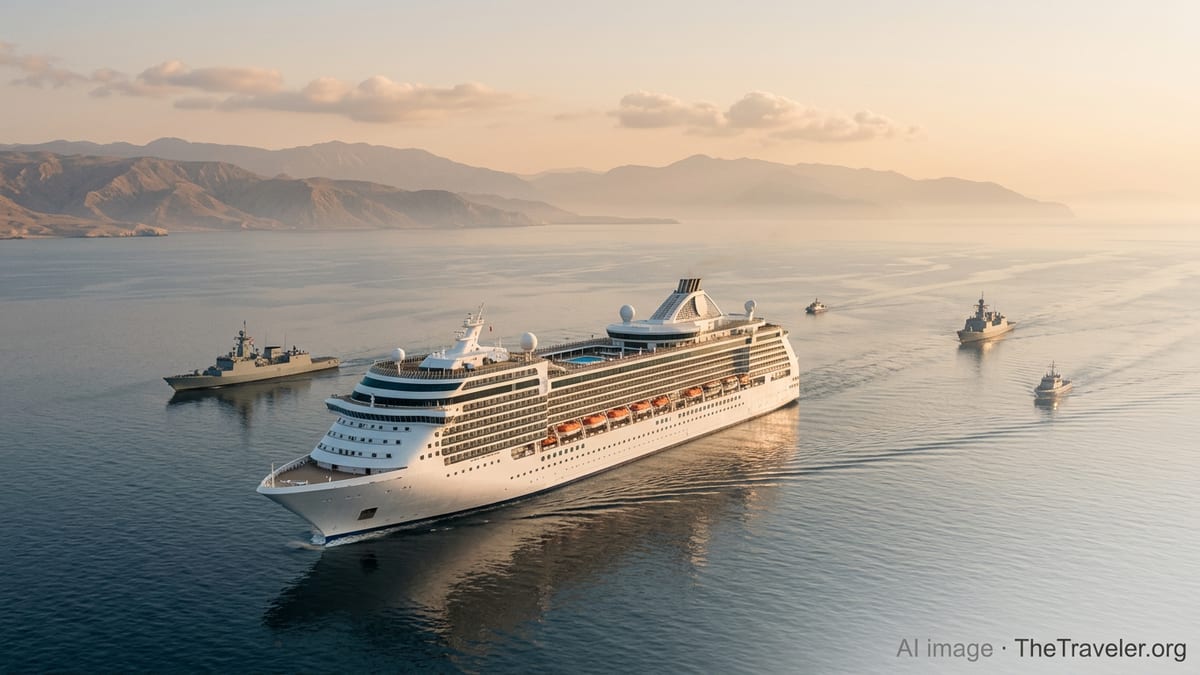
Gulf Flashpoints Turn Holiday Routes Into High-Risk Corridors
What were once exotic waypoints on winter sun cruises are now sitting at the edge of an unfolding security crisis. In recent weeks, risk assessors have warned that commercial vessels in the Gulf of Oman, the Strait of Hormuz and the wider Persian Gulf face a critical risk of attack from drones, missiles and other weapons, prompting shipowners to reassess every transit through the chokepoint that links Gulf ports with the Indian Ocean.
The escalation comes amid reports that Iran has announced temporary closures and live-fire exercises in the Strait of Hormuz, and as regional tensions spill over into maritime domains already unsettled by years of conflict in Yemen and along the Red Sea. Shipping advisories issued this month speak of a sharp contraction in vessel movements, as operators steer clear of the narrow waterway despite the absence of a formal, internationally recognised closure.
The impact on people at sea is increasingly visible. The United Nations and regional officials have highlighted that an estimated tens of thousands of seafarers, along with many thousands of cruise passengers, are currently stranded in Gulf waters after companies ordered ships to seek shelter rather than risk crossing contested stretches of water. For leisure travellers, the shift underscores how quickly a postcard-perfect itinerary can be overtaken by geopolitics.
Cruise Brands Scrap Seasons and Redraw Itineraries
Cruise operators with a strong footprint in the Middle East have moved fastest to unwind their programs. Industry reports this week confirm that MSC Cruises has cancelled the remainder of its 2025–26 season in the Arabian Gulf, citing the deteriorating security picture and close consultation with maritime and national authorities. The move affects sailings that were due to run through early April, cutting short a winter deployment that typically brings thousands of international guests to Dubai, Abu Dhabi, Doha and other Gulf ports.
German-based TUI Cruises, which has two vessels positioned in the region, has also confirmed that sailings are being cancelled or heavily modified, again pointing to regional operational considerations and real-time security assessments. Carnival Corporation brands that had scheduled late-season Gulf departures have followed suit, prioritising what they describe as guest certainty and crew safety in an increasingly fluid environment.
These decisions build on a pattern established since the Red Sea crisis first disrupted east–west shipping routes in late 2023 and 2024. At that time, MSC cancelled repositioning voyages through the Red Sea, while other major players, including Royal Caribbean and Marella Cruises, quietly reworked world cruise and repositioning itineraries to avoid transiting near Yemen’s coastline, instead opting for longer routes around the Cape of Good Hope.
For passengers, the changes mean abrupt alterations to bucket-list trips, with overland hotel packages, charter flights and future cruise credits offered in lieu of marquee calls at Gulf and Red Sea ports. For the lines, the cost is measured not only in fuel and logistics but also in the broader question of when it will once again be commercially viable to market cruises through these strategic waterways.
Naval Patrols and Security Levels Shape Route Planning
Behind the corporate statements, a complex security architecture now frames every cruise itinerary anywhere near the Gulf. Since late 2023, Operation Prosperity Guardian, a United States-led maritime coalition, has deployed warships, aircraft and surveillance assets to protect merchant shipping in the Red Sea and Gulf of Aden after a wave of missile and drone attacks attributed to Yemen’s Houthi movement. The European Union’s Operation Aspides has added further naval capacity, particularly for European-flagged tonnage.
Those missions are coordinated with the long-standing Combined Maritime Forces and its Red Sea-focused task force, which together provide information sharing, convoy coordination and rapid-response capability. For cruise lines, the presence of allied warships and maritime patrol aircraft is a prerequisite for even considering transits in higher-risk areas, and security directors work closely with flag states and classification societies to interpret daily threat updates.
Recent advisories from classification bodies and maritime security centres have urged ship operators to raise onboard security postures across the Arabian Gulf, the Strait of Hormuz and the adjoining Arabian Sea. Recommended measures range from enhanced watchkeeping and restricted deck access to pre-planned evasive manoeuvres and close liaison with naval coordination centres before entering designated risk zones.
While these heightened protocols are more familiar to cargo and tanker operators than to the cruise sector, they now feature in voyage planning for any ship carrying civilians through contested waters. For some brands, the conclusion is that no level of onboard hardening or naval escort can fully offset the strategic risk, tipping the balance in favour of wholesale rerouting.
Passenger Communication and Insurance Scrutiny Intensify
As itineraries are rewritten, the industry has shifted into crisis-communications mode. Cruise lines are issuing rolling updates to booked guests and travel advisors, explaining that route changes are precautionary and anchored in third-party security assessments rather than any direct threat to individual ships. Frequently asked questions now address why a voyage might suddenly avoid the Suez Canal or bypass a marquee Gulf city for a lower-profile port on the Indian Ocean rim.
Travel insurers are also adjusting to the new reality. Many policies treat declared war zones and government travel advisories differently from general security risks, and underwriters are scrutinising whether ports such as Dubai, Doha and Muscat can still be classified as standard cruise destinations while airspace closures and missile alerts ripple across the region. Industry consultants say that some group policies for charter and incentive cruises are being re-priced, while others now specifically exclude transits near designated high-risk areas without prior approval.
Onboard, captains and hotel directors are stepping up briefings to reassure passengers, emphasising that any decision to divert or delay is taken in consultation with naval authorities and that the ship will not enter contested waters without clear assurances. Port lectures that once focused on shopping and sightseeing now include references to maritime chokepoints, security corridors and the role of international coalitions in keeping trade and travel flowing.
Regional Tourism Hopes Collide With Security Reality
The security squeeze comes at an awkward moment for Gulf states that have invested heavily in positioning their ports as winter cruising hubs. Saudi Arabia, the United Arab Emirates, Qatar and Oman have all poured funds into new terminals, shore power facilities and destination marketing campaigns designed to lure more homeporting and transit calls from major lines. The current disruption not only stalls that growth but also risks denting the region’s image as a safe, seamless stop on global cruise circuits.
Tourism officials remain hopeful that naval operations and diplomatic efforts will restore enough stability to salvage future seasons. However, maritime analysts caution that as long as drone and missile threats linger around key chokepoints, cruise deployment planners will favour alternative routes through the Mediterranean, Indian Ocean and Pacific, where operational risks are more predictable.
For now, the strategic waterways that knit together Gulf cityscapes and Indian Ocean archipelagos are under closer watch than at any time in recent cruising history. How long that vigilance will be required, and when leisure ships can once again move freely between them, will depend less on the appetite of travellers and more on the shifting currents of regional security and high-stakes diplomacy.