

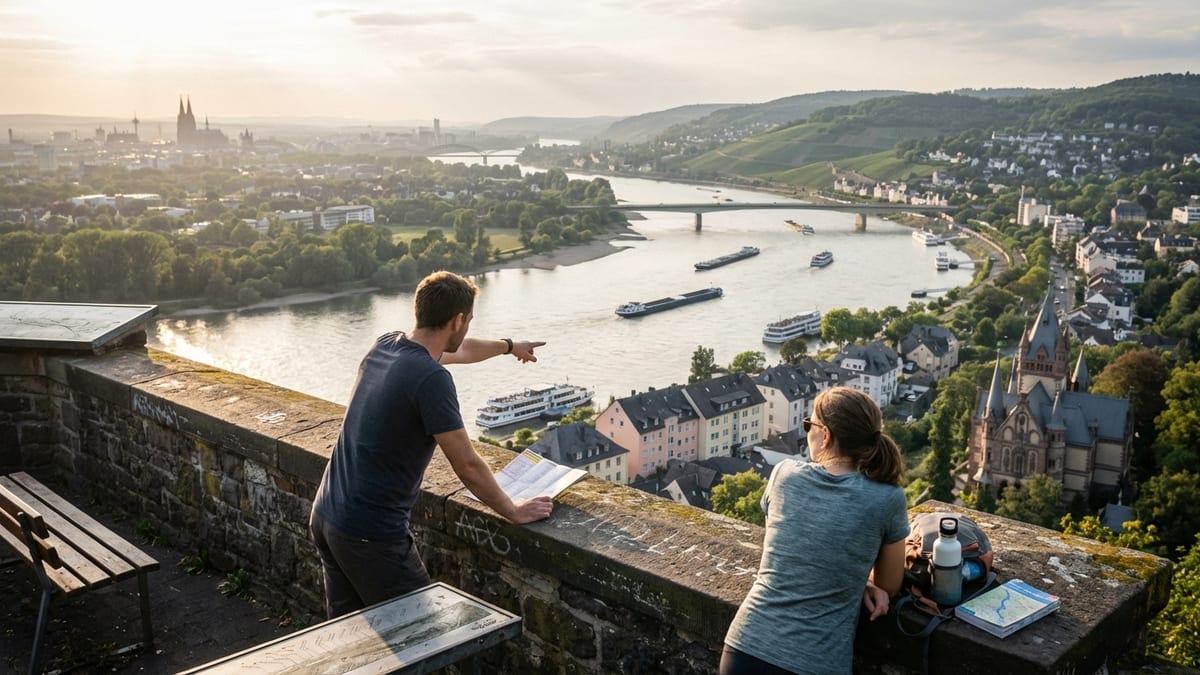
Cologne sits at a strategic bend of the Rhine, with castles, wine villages, university towns, forests and spa resorts all within an hour or two. Efficient trains, frequent riverboats and simple regional tickets make it one of Germany’s best bases for day trips. From the dramatic Rhine Gorge to Beethoven’s Bonn and the slowly reborn wine slopes of the Ahr Valley, you can leave after breakfast, be immersed in a completely different landscape by mid‑morning and still be back in Cologne in time for a late Kölsch.
Planning Day Trips from Cologne
Before you start plotting castles and cable cars, it helps to understand how transport and tickets work in and around Cologne. The city is a major rail hub with direct connections up and down the Rhine, as well as into the Eifel hills and neighboring North Rhine‑Westphalia cities.
River cruise operators add seasonal boat services between April and October, giving you an easy way to combine train, tram and ship in a single day. Trip planning often depends on whether Cologne is worth visiting for more than a day.
Cologne’s central station is right beside the cathedral, so most day trips start within sight of the twin spires. High‑speed ICE trains can whisk you to larger cities like Bonn and Koblenz in under an hour, while slower regional trains stop at small riverside towns.
On the water, companies such as Köln‑Düsseldorfer run scheduled services between Cologne and Mainz with more than 30 possible landing stages along the way during the main season, typically early April to mid‑October. These boats are ideal for seeing the Rhine scenery without worrying about road traffic or parking. Most excursions work best after covering the main things to do in Cologne.
Key Transport Basics
Most visitors rely on a mix of regional trains, local trams and riverboats. The Rhine rail line runs on both banks between Cologne, Bonn and Koblenz, so check which side of the river your target town is on and choose trains accordingly. Services are frequent, and even many smaller places like Königswinter and Linz have direct regional connections.
From roughly April to October, scheduled Rhine boats operate on individual sections of the river. A typical pattern sees ships covering Cologne to Linz and Koblenz to Mainz, allowing you to board at one town, cruise a scenic stretch and return by train. Commentary in multiple languages on board helps you understand the castles, basalt cliffs and vineyards you are passing, making these sailings especially attractive for first‑time visitors.
Tickets and Costs
Regional day tickets are widely available in North Rhine‑Westphalia and neighboring Rhineland‑Palatinate, and they can be excellent value if you are traveling with others. These passes generally cover regional and local trains, trams and many buses for a full day within a defined area, but they do not include long‑distance ICE trains or private tourist railways.
Riverboat tickets are sold separately at pier kiosks and online. You can often choose between short round‑trips of one to two hours, point‑to‑point tickets that let you hop off in another town, or full‑day passes for unlimited travel on a given section. Booking in advance is recommended on weekends in summer and during wine festivals, but on ordinary weekdays you can usually just walk up and buy a ticket before departure.
- Regional day passes often become especially cost‑effective for two or more people.
- Check whether your ticket covers both banks of the Rhine if you plan to combine towns on opposite sides.
- Boat services are highly seasonal; outside April to October, schedules are very limited or non‑existent.
Bonn: Beethoven, Politics and Riverside Promenades
Just south of Cologne, Bonn offers a gentler, more compact contrast to its larger neighbor. The former capital of West Germany is still home to ministries and embassies, but its atmosphere today is that of a leafy university town spread along the Rhine. Its biggest draws include a rich Beethoven heritage, a cluster of major museums and riverside paths that invite slow strolling or cycling.
Fast trains cover the 30 kilometers between Cologne and Bonn in as little as 20 minutes, and regional services are even more frequent. This makes Bonn one of the easiest and most flexible day trips from Cologne, suitable for everything from a half‑day culture hit to a full day combining museums, cafés and riverside walks.
Beethoven’s Bonn
The most evocative stop in Bonn is the Beethoven‑Haus, the composer’s birthplace and one of the world’s most important music museums. The core of the institution is the 18th‑century house on Bonngasse where Ludwig van Beethoven was born in December 1770. Behind its baroque façade you can step through a series of rooms that trace his early life, family background and rise as a composer, surrounded by original manuscripts, instruments and personal items. The neighboring buildings hold a research center, archive and chamber music hall, underscoring Bonn’s ongoing role as a hub for Beethoven scholarship.
The museum underwent a major renewal of its permanent exhibition in recent years, adding multimedia elements, a vault for precious manuscripts and a music room for concerts on period instruments. As a result, even travelers who have visited previously often find enough new material to justify a return. Advance booking for timed tickets is strongly advised during peak periods, particularly around Beethoven‑related events and school holidays.
Federal Quarter and Museums
South of the old town, Bonn’s former government district has reinvented itself as a cultural spine along the river. The Bundeskunsthalle and the neighboring Haus der Geschichte anchor a museum cluster that explores both art and the political history of the Federal Republic. Exhibitions cover postwar reconstruction, the Cold War era and reunification, making this area particularly engaging for visitors interested in how modern Germany evolved.
Walking between these institutions, you pass landscaped parks, office buildings that once housed ministries and stretches of riverbank where locals picnic in summer. It is a reminder that Bonn’s years as capital left an infrastructure of meeting halls and cultural venues that still shape the city’s identity, even after the main seat of government moved to Berlin.
Beethovenhalle and Riverside Walks
Another landmark on the Rhine is the Beethovenhalle, the city’s principal concert hall. The current building, designed in the 1950s and completed in 1959, has long been recognized as a key work of postwar architecture in the young Federal Republic. After a lengthy and much‑discussed restoration, the hall reopened in December 2025, once again giving the Beethoven Orchester Bonn a permanent home. Its role is not just cultural; the building hosted presidential elections and major political gatherings during Bonn’s capital years and is widely regarded as part of Germany’s democracy story.
Even if you do not attend a performance, the area around the Beethovenhalle is pleasant for a stroll. Green spaces slope down to the river, and walking paths lead you north toward the old town or south past the university to the museum district. On fine days, this riverside route is one of the most attractive urban walks in the region, with views across to the opposite bank and passing freight barges and cruise ships.
Rhine Valley North: Königswinter, Drachenfels and the Siebengebirge
Just beyond Bonn, the Rhine bends between the volcanic peaks of the Siebengebirge, a low mountain range that has inspired poets and painters for centuries. The most famous summit is Drachenfels, a steep hill topped with the ruins of a medieval castle and wide views along the river. Towns like Königswinter at the foot of these hills make easy, family‑friendly excursions from Cologne, combining forest walks, a cog railway and scenic river cruising.
Regional trains from Cologne reach Königswinter in roughly 45 to 60 minutes, often via Bonn. In the main season, Rhine boats also call here on services between Cologne and Linz, giving you the option to arrive by rail and return by ship, or the other way round.
Königswinter and the Drachenfelsbahn
Königswinter stretches along the right bank of the Rhine with a small old town backed by steep vineyards and forested slopes. Its most distinctive attraction is the Drachenfelsbahn, a historic rack railway that climbs from the town up through the woods toward the summit of Drachenfels. The line dates from the late 19th century and still uses electric rack cars that push or pull visitors to viewpoints far above the river.
At intermediate and upper stations, you can get off for short hikes, panoramic terraces and cafés. Many visitors ride up on the train and walk at least part of the way down on well‑marked forest paths. The route is especially atmospheric in spring, when the woods are fresh and green, and in autumn, when foliage colors the hillsides above the vineyards.
Drachenfels Castle Ruins and Schloss Drachenburg
Near the top of the mountain, the hexagonal ruins of the medieval Drachenfels castle cling to a rocky outcrop. Legend has it that a dragon once lived in a cave here, and the site has long been woven into German folklore. Today, the ruins serve mainly as a platform for far‑reaching views: upriver toward Bonn and Cologne on clear days, and downriver toward the narrower bends of the Middle Rhine. Information panels outline the history of the fortress and its strategic importance controlling river traffic.
Lower down the slope, Schloss Drachenburg offers a very different kind of castle experience. Built in the late 19th century as a lavish private villa, it is often described as a Rheinromantik fantasy, with turrets, terraces and richly decorated interiors. The building has been carefully restored in recent years, and its parkland grounds provide additional lookout points over the river valley. Combined with the ruined fortress above, it gives you two distinct eras of Rhine castle architecture within a short walk.
Hiking and River Cruising in the Siebengebirge
The Siebengebirge is crisscrossed with marked hiking trails of varying difficulty, from short family loops to longer ridge walks connecting several peaks. Many paths start directly in Königswinter or nearby towns such as Bad Honnef, and they are well signposted. A classic option is to ride the Drachenfelsbahn up, then follow a longer route back down to the river via forest viewpoints and small chapels.
After a few hours in the hills, many day‑trippers return to Cologne by boat. Seasonal liners link Königswinter with Bonn and Cologne, often with on‑board commentary highlighting local legends and landmarks. Sitting on the open deck with the Siebengebirge rising behind you and barges sliding past at water level provides a satisfying finale to a day in this northern stretch of the Rhine Valley.
Rhine Valley South: Koblenz and the Upper Middle Rhine Castles
Further south, the Rhine squeezes between steep, vineyard‑covered slopes in a section officially recognized as the Upper Middle Rhine Valley World Heritage Site. While the most famous castles and rock formations cluster between Koblenz and Bingen, you can experience a generous sample of this scenery on a day trip from Cologne that combines Koblenz with a short cruise or a visit to nearby castle towns.
Fast trains from Cologne reach Koblenz in about an hour, and regional services are only slightly slower. From Koblenz, boats head downstream into the heart of the World Heritage stretch, and regional trains run along both banks of the river, allowing flexible one‑way hikes between castle villages.
Koblenz and the Deutsches Eck
Koblenz occupies a strategic position where the Mosel flows into the Rhine at the point known as the Deutsches Eck, or German Corner. A vast equestrian statue overlooks the confluence, with long promenades along both rivers and a sweeping view of barges, excursion boats and passing long‑distance cruise ships. It is an excellent place to grasp how central these waterways have been to trade and movement for centuries.
Across the Rhine, the Ehrenbreitstein Fortress crowns a high bluff. A modern cable car spans the river from near the Deutsches Eck up to the fortress plateau, providing one of the most memorable urban viewpoints in western Germany. Once on top, you can explore bastions, museums and cafés, or simply walk the ramparts and gaze down on the curves of the Rhine and Mosel below.
Boat Trips into the Upper Middle Rhine
Koblenz is a natural departure point for exploring the vine‑clad gorge that stretches south toward Boppard, St. Goar and Rüdesheim. Scheduled day‑trip boats run from spring through autumn, and many itineraries allow several hours of leisurely cruising past castle after castle. Typical downriver segments from Koblenz to central villages such as St. Goar or Boppard take roughly two to three hours by boat, with faster regional trains available for the return journey.
Along the way you pass landmarks like the Marksburg above Braubach and the fabled Loreley rock further south. Even on a short cruise, you get a strong sense of why this section of the Rhine has been romanticized in literature and art since the 19th century. Commentary on board highlights stories of robber barons, customs posts and rival principalities that once controlled different bends of the river.
Practical Combinations from Cologne
With an early start from Cologne, it is realistic to spend your morning in Koblenz exploring the Deutsches Eck and Ehrenbreitstein, then board a midday boat for a two‑hour cruise and return to Cologne by train in the evening. Alternatively, you can ride directly by train to a smaller wine town such as Boppard, enjoy a short hike or chairlift ride to a viewpoint, then catch an afternoon boat back north toward Koblenz as the light softens on the vineyards.
Given the length of this itinerary compared with closer day trips like Bonn, it is wise to check cruise timetables in advance and reserve boat seats if traveling during peak summer weekends, especially if you want to sit on the open upper deck. Weather can significantly influence how enjoyable the day feels; on bright days, the reflections off the river and whitewashed villages are stunning, while low clouds and rain make the atmosphere moodier but less photogenic.
Ahr Valley: Reborn Wine Country Beyond the Rhine
East of the Rhine and south of Bonn, the Ahr Valley cuts a deep gorge through slate hills, lined with some of Germany’s most distinctive red wine vineyards. In July 2021, catastrophic flooding devastated towns and infrastructure along the river, destroying bridges, rail lines, wineries and homes. In the years since, the region has mounted a determined recovery that has combined flood protection with more sustainable tourism and viticulture.
Today, visitors who venture beyond the Rhine find an Ahr Valley that is visibly rebuilding, with reopened hiking routes, partially restored bike paths and wineries welcoming guests again. It remains a more contemplative, less polished excursion than the classic Rhine cruise, but for many travelers that is part of the appeal.
Bad Neuenahr‑Ahrweiler and Wine Villages
The twin towns of Bad Neuenahr and Ahrweiler form the heart of the valley. Bad Neuenahr developed as a spa resort around mineral springs, while Ahrweiler is a walled medieval town with half‑timbered houses and narrow lanes. Both were badly affected by the floods, and reconstruction has been an ongoing process, balancing historic preservation with new flood defenses and greener infrastructure.
Wineries along the Ahr have played a central role in the recovery, with many estates rebuilding cellars, terraces and tasting rooms. The valley is known particularly for Spätburgunder, or Pinot Noir, which thrives on the steep, south‑facing slopes. A growing number of vintners offer guided tastings that explain not only grape varieties and soil but also how they are adapting to climate change and higher river levels, an awareness sharpened by the 2021 disaster.
Hiking and Cycling the Rebuilt Routes
Before the floods, the Ahr‑Radweg cycling trail and numerous riverside paths were among the region’s main draws. Large sections were destroyed, including bridges and tunnels. By mid‑decade, authorities and local groups had rebuilt many stretches, often with new designs that combine leisure use with flood management. Some bike paths are now elevated and constructed with permeable materials, and they incorporate flood sensors to help monitor water levels and respond more quickly to future events.
For walkers, terraces above the vineyards provide routes that were less directly affected by the floods and offer broad views into the gorge. Waymarked trails link villages, viewpoints and chapels, and in several places you can descend to a winery or guesthouse for a tasting before catching a regional train or bus back to your starting point. The mix of visible scars, new infrastructure and old stonework makes hiking here a very different experience from the polished promenades along the Rhine.
Rail and Access Considerations
The 2021 floods also severely damaged the rail line that once ran the length of the Ahr Valley, including tunnels that filled with water and debris. Reconstruction of these tracks has been a complex, multi‑year effort, with partial reopening in some sections and ongoing work elsewhere. Authorities have set ambitious targets for restoring service, but travelers should check the latest status of trains and any replacement buses before setting out, as conditions can change with each construction phase.
From Cologne, you typically reach the valley via Bonn or Remagen, then transfer to local trains or buses that follow the Ahr upstream. Given the evolving infrastructure and the region’s focus on sustainable, lower‑impact tourism, it is worth planning a slightly slower day here, allowing time for delays and unhurried walks rather than trying to tick off multiple villages in quick succession.
Small Town Gems Near Cologne
Beyond the well‑known destinations of Bonn, Königswinter and Koblenz, a ring of smaller towns and riverside communities offers quieter alternatives for day trips. Many can be reached on local trains in under an hour, yet they feel a world away from Cologne’s crowds. These places excel in simple pleasures: half‑timbered streets, local bakeries, small museums and short walks with sweeping views.
Linz am Rhein
Downriver from Bonn on the right bank, Linz am Rhein is often called the “colourful town” thanks to its vividly painted facades and well‑preserved medieval core. Cobbled squares, a 14th‑century church and fragments of town walls all cluster close to the riverfront, making it easy to explore on foot. The compact size means you can wander without a fixed plan, ducking into cafés and small galleries as you go.
Linz also serves as a practical interchange point between trains and riverboats. During the sailing season, many Rhine liners stop here on their way between Cologne and Koblenz, allowing you to craft a triangle route: train from Cologne to Linz, boat along a scenic segment of the river, and train back from a different town. For travelers who want river scenery but prefer a smaller, more intimate base than Bonn or Koblenz, Linz is a strong candidate.
Remagen and the Bridge Museum
Just north of Linz on the left bank, Remagen is forever associated with the World War II bridge that once crossed the Rhine here. The Ludendorff Bridge’s capture by Allied forces in March 1945 and its collapse shortly afterwards made international headlines at the time. Today, the surviving bridge towers on the west bank house a peace museum that explores the broader history of war and reconciliation along the Rhine.
Beyond its wartime story, Remagen offers river promenades, a small old town and access to the rolling hills that lead toward the Ahr Valley. Paths along the river and up into the countryside make it easy to combine history with gentle walking. Frequent regional trains connect Remagen to Bonn and Cologne, making it one of the most straightforward low‑stress excursions from the city.
Brühl and the UNESCO Palaces
While not directly on the Rhine, Brühl lies just southwest of Cologne on main rail lines and offers a powerful dose of baroque architecture in a compact package. The Augustusburg and Falkenlust palaces, linked by an avenue through landscaped gardens and woodland, form a UNESCO World Heritage Site. Built for the prince‑electors and archbishops of Cologne in the 18th century, they showcase elaborate stucco work, grand staircases and formal gardens that blend French and German influences.
Because Brühl is so close to Cologne, it is easy to pair the palaces with another stop, such as an evening meal back in the city or a short hop onward to Bonn. For travelers more interested in architecture and interiors than in hiking or river views, this may be the most satisfying “soft” day trip of all, with relatively little travel time and a clear focus.
The Takeaway
Staying in Cologne opens up a surprisingly rich menu of day trips. In one direction you can be standing in Beethoven’s modest birthplace or the sleek foyers of Bonn’s newly reopened concert hall; in another you can ride a cog railway up through forests to a ruined castle overlooking the Siebengebirge. A little further and the full drama of the Upper Middle Rhine unfolds around Koblenz, with castles, cable cars and boats tying the story together.
Turn away from the main river and the picture changes again: the Ahr Valley’s patched‑together bridges and rebuilt bike paths tell a story of resilience and adaptation, while small towns like Linz, Remagen and Brühl show how much variety is packed into a relatively small area. The common thread is ease of access. With frequent trains, well‑timed boat services in season and a straightforward ticketing system, you can improvise according to weather and mood.
If you give yourself three or four days in Cologne, consider dedicating at least two of them to these surrounding landscapes. The city’s cathedral, museums and bars are reason enough to visit, but it is the combination of urban culture and river‑valley excursions that makes this corner of Germany particularly rewarding. Whether you are chasing wine tastings, castle silhouettes at sunset or the quiet hum of a regional train along the Rhine, the best of the region is rarely more than ninety minutes away.
FAQ
Q1: What is the easiest day trip from Cologne for first‑time visitors?
Bonn is the easiest and most flexible option. Trains between Cologne and Bonn run frequently and take about 20 to 30 minutes, and the city’s main sights, including the Beethoven‑Haus and the riverfront, are within walking distance of the station.
Q2: When is the best time of year to take Rhine boat trips from Cologne?
Scheduled riverboats typically operate between early April and mid‑October, with the most frequent services in late spring and summer. Outside this period, sailings are limited, so if a cruise is a priority, plan for the warmer months.
Q3: Can I visit the Upper Middle Rhine castles on a day trip from Cologne?
Yes. With an early departure, you can reach Koblenz by train in about an hour, continue by boat or local train to castle towns such as Boppard or St. Goar, and return to Cologne in the evening. You will only see a portion of the World Heritage stretch, but it still makes for a full and satisfying day.
Q4: Is the Ahr Valley fully rebuilt after the 2021 floods?
No. Reconstruction is ongoing and some infrastructure remains under repair, but many wineries, walking routes and sections of the cycling path are open again. The region is welcoming visitors, and you will see a mix of restored areas, new defenses and still‑visible flood damage.
Q5: Do I need to book Rhine river cruises in advance?
Advance booking is strongly recommended for weekends, holidays and peak summer dates, especially if you want guaranteed seating on open decks. On ordinary weekdays outside high season, it is often possible to buy tickets at the pier shortly before departure.
Q6: Are regional day tickets valid on both trains and boats?
Most regional day tickets cover local and regional trains, trams and many buses, but not riverboats. Boat trips are usually operated by separate companies and require their own tickets, which you can buy online or at landing stages.
Q7: How much walking is involved in visiting Drachenfels and the Siebengebirge?
If you use the Drachenfelsbahn rack railway, you can minimize steep climbing, but there is still some walking between stations, viewpoints and castle ruins. Visitors who enjoy hiking can extend this into several hours on forest trails; those with limited mobility can focus on shorter walks around the stations and terraces.
Q8: Is Koblenz worth visiting if I am not taking a boat cruise?
Yes. The confluence at the Deutsches Eck, the cable car to Ehrenbreitstein Fortress and the riverside promenades make Koblenz appealing even without a cruise. You can easily fill a few hours with views, museums and café stops.
Q9: Can I combine Brühl’s palaces with another destination in one day?
Because Brühl is very close to Cologne, many travelers visit Augustusburg and Falkenlust in the morning and then continue to Bonn, Königswinter or back to Cologne for the afternoon and evening. The short distances make such combinations quite manageable.
Q10: Do I need a car for these day trips from Cologne?
In most cases, no. Trains and, in season, riverboats cover all of the destinations described, and local buses or trams fill the remaining gaps. A car can be useful for more remote parts of the Eifel or for flexible winery touring, but it is not necessary for Bonn, the Siebengebirge, the main Rhine Valley towns or the Ahr Valley’s core villages.