

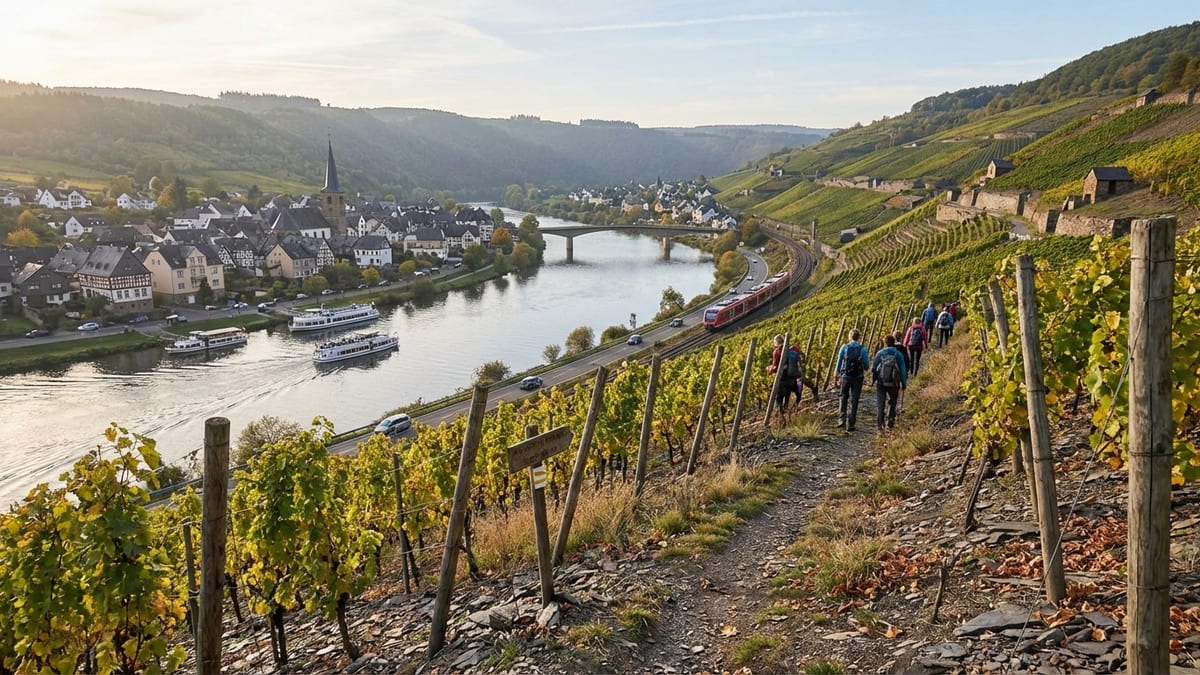
The Moselle Valley stretches east from Trier in a sweep of steep vineyards, medieval villages and river bends that look almost theatrical in the right light. With efficient rail and boat connections, historic side valleys and a dense network of trails among the vines, it is one of Germany’s easiest regions for slow, rewarding day trips.
Most excursions work best after covering the main things to do in Trier. Using Trier as a base, you can string together half-day excursions, full-day vineyard hikes or relaxed cruises that show very different faces of this famous wine landscape.
Planning Your Moselle Day Trips from Trier
Before choosing specific destinations, it helps to understand how the valley is laid out and how best to move through it from Trier. The city sits at the western end of the German Moselle, close to Luxembourg, with the river then meandering northeast toward Koblenz. Trains, regional buses, river boats and bike paths largely follow the water, which makes independent day trips straightforward even without a car.
Rail services connect Trier with key Moselle towns such as Cochem and Bullay, and branch south along the Saar River to Saarburg. Local public transport in the Trier region is coordinated by the Verkehrsverbund Region Trier, and for longer regional journeys leisure travelers often rely on day tickets such as the Rheinland Pfalz Ticket, valid on most regional trains and many buses across the federal state and neighboring Saarland. These options keep costs predictable over a full day of exploring.
Boats ply the river between late spring and autumn, linking towns such as Trier, Bernkastel Kues and Cochem. Timetables tend to be more limited outside peak months, so it is worth checking seasonal services and planning outward and return legs around the latest departures. Many travelers take the train one way and then sail back in the afternoon when the light softens on the vineyards.
Finally, think practically about pacing. Roads in the Moselle Valley are narrow and occasionally busy, and the scenery encourages frequent stops. Two substantial stops in a day, or one major destination plus a brief detour, is usually more satisfying than trying to tick off every village along the river.
Classic Moselle Villages Within Easy Reach of Trier
The lower-middle Moselle between Trier and Bernkastel Kues offers some of the most accessible wine villages for a relaxed day trip. These settlements cluster at the base of near vertical slopes, with half timbered houses, church spires and river promenades that hardly seem to have changed in decades. Most have at least one signed walking route into the vineyards and several family run wine estates where you can taste Riesling at the source.
Bernkastel Kues
Bernkastel Kues, roughly an hour by train and bus from Trier, is often the first Moselle village visitors encounter. Bernkastel lies on the right bank, Kues on the left, joined by a bridge that frames a photogenic view of the marketplace and the pointed tower of the town hall. Above the settlement, the ruins of Landshut Castle sit on a hilltop, a short but steep walk rewarded by widespread views along a looping stretch of the Moselle.
The medieval core of Bernkastel is compact and easy to explore in a few hours. Narrow lanes push up from the main square toward terraced vines, while riverfront promenades are lined with cafés and wine taverns. This is a good place to take an introductory Moselle tasting flight, as many local estates own parcels in prestigious surrounding slopes and pour several styles of Riesling by the glass.
Traben Trarbach
Traben Trarbach lies further downstream on one of the Moselle’s tightest loops and is best reached from Trier by train via Bullay. The town is known for its art nouveau architecture, a legacy of the era when it rivaled Bordeaux as a wine trading hub. Many former merchants’ villas and warehouses still stand along the river, giving the town a stylish, slightly grand atmosphere.
The hills above Traben Trarbach are honeycombed with historic wine cellars, some of which now host guided tours and tasting events. Walking paths rise from the bridgehead to the Grevenburg castle ruins, where you can watch barges and pleasure boats negotiate the sharp bend in the river far below. The town’s scale suits a full day: time for a riverfront stroll, a vineyard hike and an unhurried late lunch on a terrace.
Beilstein
Beilstein, often described as a fairytale village, sits on a tight meander of the Moselle and is typically reached from Trier by train to Cochem and then a short boat ride or bus journey. Its lanes are remarkably preserved, with stone stairways zigzagging between houses draped in vines and flowers. The atmosphere is smaller and quieter than in Bernkastel, particularly outside peak summer weekends.
Above the village, the ruins of Metternich Castle overlook the river. The climb is short but steep, twisting through terraced vineyards, and the view from the ramparts is one of the most iconic on this part of the Moselle. Beilstein works well when paired with a few hours in Cochem, giving a contrast between a larger resort town and a pocket sized, romantic village.
Piesport and Surrounding Wine Villages
Between Bernkastel Kues and Trier, villages such as Piesport, Leiwen and Klüsserath sit in classic amphitheater like curves of the valley. Piesport, a major winegrowing center on the right bank, is framed by broad, gently rising slopes planted almost entirely with vines. Quiet riverfront streets and a handful of wine estates make it an appealing stop for travelers seeking a more low key scene.
Nearby Leiwen and Klüsserath are also surrounded by extensive vineyards and have signed hiking routes leading to viewpoints over the river. These villages are less oriented toward tour groups than the larger towns, so opening hours for tasting rooms and restaurants can be more limited outside weekends and harvest season. It is worth confirming ahead if you hope to visit a specific winery or dine in the village rather than back in Trier.
Cochem and the Upper Moselle by Train
Cochem, roughly 90 minutes by regional train from Trier, is one of the best known towns on the Moselle and an easy full day outing. The journey itself is part of the appeal, following the river as it narrows into deeper bends, with views of terraces cut into sometimes impossibly steep slopes. Using regional day tickets allows flexible departure times in both directions, which is valuable if you choose to stay into the evening.
Cochem Old Town
The old town of Cochem huddles around a riverside square with a market fountain and a lattice of narrow streets climbing into the hillside. Fachwerk houses, small boutiques and wine taverns fill the core, and a promenade traces the riverbank in both directions. Although it is firmly on the tourist map, especially on summer weekends and during river cruise season, the town retains a lived in feel away from the central lanes.
Cochem works well as a base for first time Moselle visitors who want a view of both the valley and a castle in a single frame. From the train station, it is a short walk into the old town, and most of the key sights, including the castle, can be comfortably explored on foot during a day trip from Trier.
Reichsburg Cochem
Perched on a spur high above town, Reichsburg Cochem is one of the most recognizable castles in the region. Although it owes its current form largely to a 19th century reconstruction, its setting above the river, circled by steep vineyards, is unquestionably dramatic. Visitors can walk up through residential streets in 20 to 30 minutes or take a shuttle during busier months.
Guided tours provide access to the interior halls and terraces, while the outer grounds offer expansive views in both directions along the Moselle. Many travelers time their visit for late morning or mid afternoon light, when the town and river below photograph particularly well. The castle’s hilltop position also helps you grasp the topography of the valley and the effort historically required to farm the surrounding slopes.
Side Trips from Cochem
Cochem also serves as a launch point for shorter excursions further along the river. Boats and local buses link the town with Beilstein, allowing a half day loop of castle, village and river scenery before returning to Trier by train. Upstream, smaller villages with limited accommodation but high scenic value can be reached for lunch or a tasting and then left behind as you continue along the valley by rail.
When planning, keep an eye on the timing of the last convenient train back to Trier, particularly outside high summer when evening services may be less frequent. Combining one direction by boat and the other by train helps compress more scenery into the same time frame without adding stress to the journey home.
Saarburg and the Saar Loop
Southwest of Trier, the Saar River offers a quieter counterpart to the Moselle, with dense forests, sandstone ridges and a scattering of small towns. The most appealing day trip target here is Saarburg, a compact town with a striking waterfall at its center and ruins on the hill above. Regular regional trains connect Trier and Saarburg in around 25 minutes, making it an easy change of scene.
Saarburg Old Town and Waterfall
Saarburg’s most unusual feature is a small river that drops as a waterfall right through the middle of the old town before joining the Saar. Terraces and footbridges surround the cascades, and cafés make the most of the sound and coolness of the water. Narrow streets radiate outward, with pastel façades and small shops lending the town a relaxed, holiday feel during warmer months.
In addition to the waterfall precinct, Saarburg has a compact network of lanes leading down to the Saar promenade, where towpaths and bike routes follow the river. Short river cruises typically operate in season, giving passengers a different angle on the surrounding vineyards and the wooded heights beyond.
Saarburg Castle and Vineyards
Above the town center, the ruins of Saarburg Castle occupy a strategic hilltop that has been fortified in various forms since the Middle Ages. A gently graded path from the center of town, or a slightly steeper stair route, leads to the walls, where you can walk along sections of rampart and climb a tower for wide views of the Saar valley. The outlook takes in vineyards that unfold along the slopes and the wooded plateau rising behind them.
For those interested in wine, the Saar is part of the broader Moselle region and produces high acid, mineral driven Rieslings from cooler, sometimes wind exposed parcels. Several local estates in and around Saarburg offer tastings by appointment or through seasonal wine taverns. Advance planning is advisable, as many are small, family run operations with limited regular opening hours.
The Saar Loop at Cloef
With a car or careful connection by bus and train, it is possible to combine Saarburg with a visit to the famous Saar loop viewing point at Cloef near Orscholz in a long summer day. From the Cloef lookout, the Saar describes a perfect horseshoe meander far below, encircled by forested slopes and narrow riverbanks. Walking trails follow the rim and drop to the valley floor for those who want a more demanding hike.
Given the extra travel time beyond Saarburg, this combination is best tackled in good weather and with early departures from Trier. Those without their own vehicle may find it most practical to focus on either Saarburg town and castle or the loop hike in a single day rather than both.
Short Trips in Trier’s Immediate Wine Country
Not every outing from Trier needs to involve an hour or more on a train. The city is already surrounded by vineyards and small wine villages in districts such as Olewig and along the Ruwer valley. These make for half day trips by city bus, bicycle or even on foot directly from Trier’s historic core, and they are particularly attractive during shoulder seasons when longer boat schedules may be limited.
Trier Olewig and the Wine Culture Path
Directly above Trier’s Roman amphitheater, the Wine Culture Path threads for around 1.6 kilometers through the Olewig vineyards. Information panels explain local grape varieties, soil types and vineyard work over the seasons, and the route opens up generous views over Trier, the Moselle and the surrounding hills. The path is freely accessible year round and typically takes about an hour at a relaxed pace.
Olewig itself is a traditional winegrowers’ quarter with several seasonal taverns and estate tasting rooms. After walking the Wine Culture Path, many visitors descend into the village for a glass of Riesling and a simple regional meal before heading back into central Trier by bus or on foot. This makes an easy, low logistics introduction to the wine landscape without committing to a full day excursion.
Ruwer Valley Villages
North of Trier, the Ruwer River flows through a series of small wine villages that give their name to one of the historic subregions of the Moselle. Places such as Eitelsbach, Mertesdorf, Kasel and Waldrach have long produced distinctive Rieslings from steep, slate based slopes. Remnants of Roman wine culture are scattered through the valley, including reliefs and archaeological finds that testify to centuries of cultivation.
Local buses link Trier with many Ruwer villages, and quiet country roads and bike paths make the valley well suited to cycling. Several renowned estates occupy old manor houses or former monastic properties set among the vines. As with many small winegrowing communities, it is wise to confirm opening times for tastings or plan for a pre booked visit, particularly outside peak tourism months.
Fell Exhibition Slate Mine and Roscheider Hof
East of Trier near the villages of Fell and Thomm, a former slate mine operates as an exhibition site, offering a glimpse into the region’s industrial heritage. The mine consists of two historic roof slate workings, stacked one above the other and now connected for visitors by a stairwell. From roughly April to October, guided tours lead underground to show original galleries and explain the physically demanding work of miners in the early 20th century.
Closer to Trier in the town of Konz, at the confluence of the Moselle and the Saar, the Roscheider Hof open air museum presents rural cultural history from the surrounding border region. Farmhouses, workshops and village streets have been reconstructed on the museum grounds, illustrating everyday life over the last two centuries. Both sites can be combined in a car based or bus assisted day trip from Trier for travelers interested in local history beyond wine and castles.
Practical Tips for Transport, Seasons and Tasting
Well planned logistics and realistic expectations about seasons can turn a pleasant day trip into a memorable one. While the Moselle Valley is welcoming year round, the rhythm of boats, opening hours and vineyard work shifts markedly between winter, spring, summer and autumn. A little preparation ensures that you arrive in villages when they feel alive rather than shuttered.
Using Regional Trains and Tickets
Regional trains are the backbone of day trip travel from Trier along both the Moselle and the Saar. Services typically run at least hourly to hubs such as Cochem, Bullay and Saarburg, with additional departures in commuter periods. For most leisure travelers, regional day tickets that cover an entire federal state or partnership area offer strong value, especially for couples or small groups traveling together.
These tickets are usually valid from morning until late at night on the day of use and can be used on most local trains and many buses but not on long distance services. They are sold at ticket machines and counters at main stations. When planning multiple hops along the river in a single day, check whether your itinerary remains entirely within one ticket’s geographic coverage to avoid unexpected surcharges.
Boats, Bikes and On Foot
From late spring into autumn, river boats add a scenic layer to Moselle travel. Timetables often favor midday and afternoon departures, aligning with tourist flows, so it can be efficient to travel out by train in the morning and then return by boat or vice versa. Capacity for bikes on board is usually limited and sometimes requires a supplement, so cyclists should check details ahead of time.
The Moselle Valley is also one of Germany’s most popular cycling regions, with a continuous riverside bike path that traces the water’s curves. Gradients are gentle, and rental outlets exist in many larger towns. For walkers, signposted trails climb from almost every village into the vineyards, connecting lookout points, chapels and forest tracks along the ridges. Footpaths can be steep and exposed, so sturdy footwear, sun protection and plenty of water are essential in warm weather.
Seasonal Considerations and Wine Tasting Etiquette
High season on the Moselle typically runs from late May to early October, when boats operate their fullest schedules, many wine taverns open daily and harvest festivals fill weekend calendars in the villages. Spring and autumn shoulder periods have milder temperatures and fewer crowds but may see more limited opening hours, particularly midweek. Winter brings a quieter, sometimes contemplative atmosphere, suited more to walks, city based stays in Trier and selective tastings with larger estates that keep year round hours.
When tasting, it is courteous to book ahead with smaller wineries or check whether they operate a seasonal tavern. Many family estates close at lunchtime or in the early evening and may be unavailable during peak harvest. Expect to pay a modest fee for a structured tasting, often waived if you purchase bottles. Spitting or pouring away part of a sample is normal practice for those driving or pacing themselves, and staff will not be offended.
For all seasons, moderate expectations and flexibility go a long way. If a particular estate is closed, another may be open nearby, and the real constant is the landscape itself, which rewards even a simple walk along the riverbank or a climb to a modest chapel above the vines.
The Takeaway
Trier sits at the threshold of a river landscape that condenses Roman history, wine culture and small town charm into easy, day sized portions. Whether you head east toward Cochem’s hilltop castle, drift among half timbered alleys in Bernkastel Kues, escape south to Saarburg’s waterfall or simply climb from the city into the Olewig vineyards, each excursion offers a distinct angle on the Moselle world.
Efficient regional trains and boats make it simple to craft itineraries that match your pace, from unhurried village strolls to ambitious loops that combine valleys and viewpoints. The key is to allow time for the rhythm of river life: a late breakfast in a market square, a slow walk between vines, an hour on a terrace with a glass of Riesling as barges slide past below.
Trip planning often depends on whether Trier is worth visiting for more than one day. From a base in Trier, you can return each evening with the sense that you have stepped into a different landscape and time, yet always within the same overarching valley. Over several days, these short journeys stitch together into a deeper understanding of a region that rewards both first impressions and repeat visits.
FAQ
Q1: How many days should I allow in Trier to explore the Moselle Valley on day trips?
For a meaningful introduction, three to four full days in Trier works well, allowing one day for the city itself and two or three dedicated to different sections of the Moselle and Saar, such as Cochem, Bernkastel Kues and Saarburg.
Q2: Is it necessary to rent a car for Moselle day trips from Trier?
A car offers flexibility, especially for reaching smaller villages and viewpoints, but it is not essential. Regional trains, buses, and seasonal boats easily connect Trier with major Moselle towns and Saarburg, making car free day trips very feasible.
Q3: When is the best time of year to visit the Moselle Valley from Trier?
Late May to early October offers the broadest choice of boat services, open wine taverns and festivals, with September and early October especially attractive for harvest atmosphere and autumn colors in the vineyards.
Q4: Can I visit multiple towns in one day, such as Cochem and Beilstein?
Yes, combining a larger town and a nearby village is realistic if you start early and keep transfers efficient, for example pairing Cochem with Beilstein or Bernkastel Kues with a short stop in a nearby wine village.
Q5: Are Moselle Valley boat trips included in regional train day tickets?
No, river boats are operated separately and require their own tickets. You can, however, combine a regional train day ticket for rail and bus travel with individually purchased boat tickets in a single itinerary.
Q6: Is it possible to do wine tastings without an appointment?
In larger towns and at bigger estates, walk in tastings are often possible, especially in high season, but smaller family wineries frequently require or strongly prefer advance appointments to ensure someone is available.
Q7: How child friendly are Moselle day trips from Trier?
Many Moselle towns are very family friendly, with riverside playgrounds, gentle bike paths and short walks to castles or viewpoints, though parents should be cautious on steep vineyard paths and at unfenced overlooks.
Q8: What should I wear for vineyard walks and castle visits?
Comfortable, closed footwear with good grip is important for steep and sometimes uneven vineyard paths, along with layers for changing weather, sun protection in summer and a light rain jacket in shoulder seasons.
Q9: Can I combine the Moselle and Saar valleys in a single day trip?
It is possible but ambitious; most travelers will have a more relaxed experience focusing on one valley per day, for example dedicating one outing to Cochem and another to Saarburg and the Saar valley.
Q10: Are Moselle Valley towns accessible in winter?
Yes, trains and buses run year round, and larger towns like Cochem and Bernkastel Kues remain accessible, but boat services are limited or paused and some smaller wine taverns and guesthouses may close in the off season.