


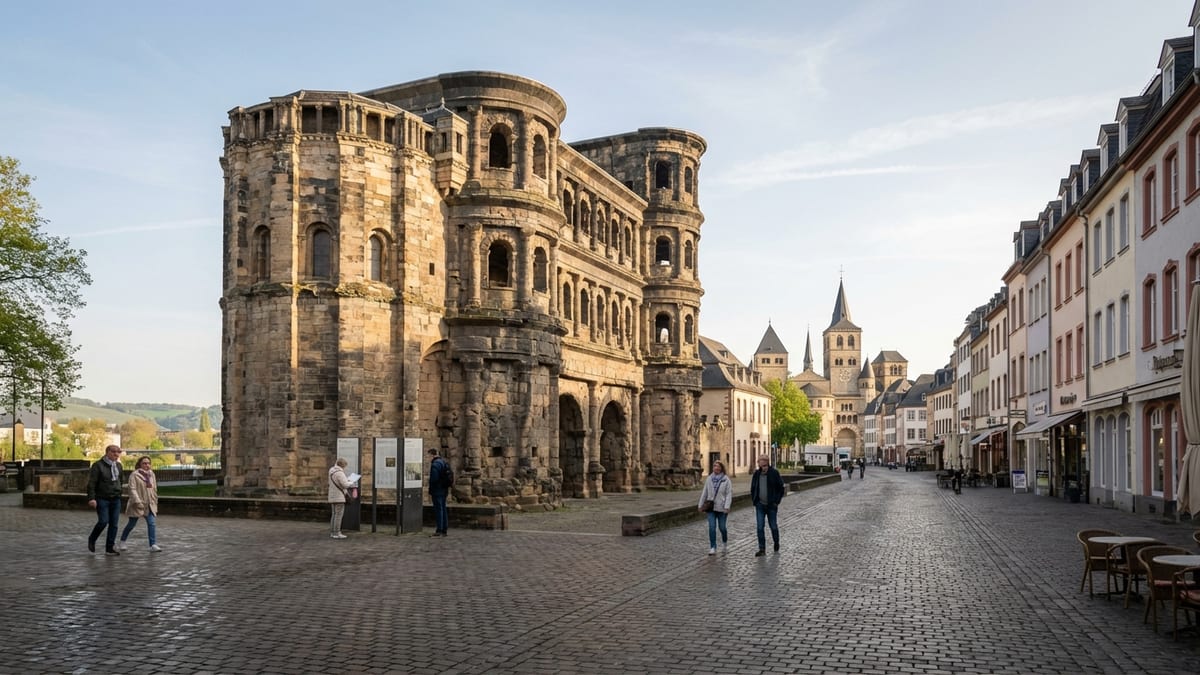
Trier is often introduced as Germany’s oldest city, but that tagline barely hints at the extraordinary concentration of Roman remains woven into its modern streets. From monumental stone gates and imperial bathhouses to an intact basilica and a working Roman bridge, the former Augusta Treverorum still wears its imperial pedigree in full view.
For travelers who care about history, this is one of Europe’s most rewarding urban stops, and planning time around its Roman sights is essential. Knowing where attractions are located helps when choosing among the best hotels in Trier.
Understanding Trier’s Roman Heritage
Before you set off from sight to sight, it helps to understand why Trier’s Roman legacy is so unusually rich. In late antiquity, Trier was more than a provincial town. It rose to become an imperial residence and administrative capital for much of the Western Empire, particularly in the 3rd and 4th centuries.
Emperors used the city as a base for campaigns along the Rhine frontier, and they left behind buildings that matched their ambitions. Some sites are best experienced through knowledgeable Trier guided tours.
Several of these structures, along with the cathedral and Church of Our Lady, form a UNESCO World Heritage ensemble officially recognized for its exceptional preservation and historical importance. Massive bath complexes, a spacious amphitheater, and the unmistakable outline of a triumphal gate still structure the cityscape. Many continue to evolve as visitor attractions, with media guides, new exhibition spaces, and combined tickets that make it easier to see multiple sites in a single visit. If you are unsure what to prioritize, this breakdown of Trier worth visiting provides context.
If you are planning an itinerary focused on Roman Trier, the key is to group sights by location and to use integrated passes such as the AntikenCard, which bundles major monuments and the archaeological museum into one ticket. That approach lets you appreciate how the city functioned as a coherent whole instead of as isolated ruins scattered around a modern town.
Porta Nigra: The Iconic Northern Gate
No Roman monument in Trier is more instantly recognizable than the Porta Nigra, the looming stone gate that anchors the northern edge of the old town. Its name, “Black Gate,” comes from the darkened patina the sandstone acquired over centuries, but its origins are firmly second century. Once part of a larger defensive wall, it now stands nearly alone, a massive reminder that this was once a fortified, strategic city on the empire’s frontier.
Today, the Porta Nigra is both an emblem of Trier and a working monument: you can go inside, climb its levels, and contemplate views across the city’s rooftops. To appreciate it properly, it is worth understanding how its role changed over time and why it survived when so many other Roman city gates disappeared.
Exploring the Gate’s Interior
From the outside, the Porta Nigra impresses with raw bulk, but the interior reveals the sophistication of Roman military architecture. Once you pass the ticket point and head up into the structure, you move through barrel-vaulted stairways, guard rooms, and open galleries that show how soldiers would have patrolled and defended the gate.
The upper levels offer sweeping views over the pedestrian zone and toward the cathedral complex. From here you get a sense of how the gate related to the rest of the Roman city. Look back at the stonework: the gate was built without mortar, using precisely cut blocks held together with iron clamps. Many original clamps were long ago stripped, which partly explains some of the weathering and missing pieces you see today.
From City Gate to Church and Back
The Porta Nigra survived the Middle Ages largely because it ceased to be just a gate. In the 11th century it was converted into a church dedicated to Saint Simeon. Upper floors were enclosed, and new openings were cut to serve liturgical functions. A collegiate complex grew up around it, embedding the ancient stones in a Christian precinct.
This unusual afterlife helped preserve the building. Only in the early 19th century, under French rule, were many of the medieval additions stripped away in an effort to reveal the Roman core. Yet subtle traces of the church period remain if you know where to look, such as altered window forms and interior niches. When you walk through today, you are not moving through a frozen second-century time capsule, but a structure that carries visible layers of adaptation across nearly two millennia.
Practical Tips for Visiting Porta Nigra
The Porta Nigra stands at the top of Trier’s main pedestrian axis, which makes it extremely easy to incorporate into any walking tour. Plan at least 45 minutes if you intend to climb, more if you join a themed guided tour such as costumed centurion walks that are offered seasonally. Interior staircases are relatively steep and narrow, so this is not an accessible monument for all visitors.
Light is best in the morning when the façade facing the square catches the sun, ideal for photography before crowds build. If you are using an AntikenCard, the Porta Nigra is one of the core attractions included, making entry seamless when combined with other Roman sites on the same day.
Baths and Leisure: Inside Trier’s Roman Thermae
Roman baths in Trier were not mere hygiene facilities. They were social centers, engineering showcases, and status symbols, each reflecting a different phase of the city’s history. Several complexes are preserved or excavated around the city, demonstrating how bathing culture evolved from the height of imperial prosperity to late imperial grandeur. Among them, the Imperial Baths and the Barbara Baths stand out as highlights you should prioritize.
Walking these ruins brings you face to face with heating systems, underground service corridors, and the scale of public amenities that supported Roman urban life. Modern signage and, at some sites, media installations explain how hot and cold pools, exercise areas, and ancillary buildings were assembled into sprawling leisure machines.
Imperial Baths (Kaiserthermen)
Located just southeast of the old town core, the Imperial Baths are both hauntingly incomplete and astonishingly grand. Construction began in the early 4th century, during the reign of Constantine the Great, when Trier functioned as an imperial residence. The design envisioned a monumental complex with vast vaulted halls, hot water pools, and a sophisticated system of hypocausts and sewer channels.
The complex was never finished as a bathhouse. Political shifts and priorities meant the structure was later repurposed, including use as a fortified complex in the Middle Ages. You can still read these changes in the masonry, from blocked arches to later defensive modifications.
Visitors today walk through skeletal brick walls that still rise impressively high, as well as through the extensive underground passageways originally intended for maintenance staff. These tunnels give a striking sense of the hidden infrastructure required to keep such a bathhouse operating, from furnace rooms to water management systems.
Barbara Baths (Barbarathermen)
Down toward the Moselle river, the Barbara Baths represent an even earlier expression of Roman bathing culture in Trier. Dating from the 2nd century, they were once among the largest bath complexes north of the Alps, with a footprint often compared to several football fields. Only parts are visible today, but what you see is enough to convey the sheer scale.
Raised walkways and platforms allow you to look down on exposed foundations, brick pilae of the hypocaust system, and remnants of walls that once enclosed warm and hot rooms. Information panels reconstruct the original layout so you can imagine changing from the palaestra to the frigidarium and on through the caldarium in a typical bathing sequence.
Although less visually imposing above ground than the Imperial Baths, the Barbara Baths are crucial for understanding how thoroughly Roman lifestyles penetrated this corner of the empire during its heyday. They are quieter than other major sights, rewarding visitors who prefer to linger in relative calm with time to absorb the details.
Balancing Both Bath Sites in Your Itinerary
If you have a full day in Trier, it is realistic to visit both the Imperial Baths and the Barbara Baths along with other major monuments, especially if you plan a logical route. One effective strategy is to start at the Porta Nigra, walk through the old town to the cathedral and basilica, then continue to the Imperial Baths and onward downhill to the Barbara Baths and riverfront.
Comfortable footwear is essential, given uneven surfaces and periods of standing while reading interpretive panels. Weather plays a role as well: much of what you see at the baths is outdoors or only partially sheltered, so a light waterproof layer or sun protection, depending on the season, will make the experience more pleasant.
Aula Palatina (Basilica of Constantine): Power in Brick
While Trier’s baths and gates express civic life and infrastructure, the Aula Palatina, also known as the Basilica of Constantine, speaks directly to imperial authority. From the outside, it is a long, austere brick hall with a semicircular apse at one end. Inside, it opens into a single vast space that would once have framed the emperor seated on his throne, receiving envoys and administering justice.
Built in the early 4th century, the hall’s survival in near-complete form is remarkable. It remains one of the best-preserved examples of a Roman audience hall anywhere and later became a church, a function it still serves today. For visitors, it is one of the most immediate ways to sense the scale and atmosphere of imperial presence in Trier.
Experiencing the Interior Space
Entering the Aula Palatina, you are struck by the volume of the interior and the regular rhythm of its high windows. Even without original wall decoration or the imperial furnishings that once filled it, the building exerts a powerful effect. The acoustics are notable, too; sound carries cleanly along the nave, which is why the space is often used for concerts and events.
Remnants of the ancient heating system are visible under the floor level, evidence of a hypocaust intended to keep this vast hall comfortable year-round. Exhibits and signage typically explain how the hall fit into a larger palace complex that stretched toward the present-day electoral palace and gardens, areas that have been reconfigured over the centuries.
Historical Layers and Later Uses
Like the Porta Nigra, the Aula Palatina owes its survival partially to its adaptation into a church in late antiquity and the Middle Ages. It has also suffered and recovered from damage, including wartime bombing. Careful reconstruction returned it to a largely Roman silhouette, with brickwork that makes the building’s age and original technique legible.
Because it remains a place of worship, some areas or times may be reserved for services or rehearsals. Visitors are generally welcome outside of these slots, and the atmosphere can vary from contemplative quiet to lively when music is in rehearsal. When planning your visit, allow time not just to look, but to sit, absorb the scale, and imagine the hall in its fourth-century pomp.
Trier Amphitheater and the Roman City Walls
In Roman times, entertainment and defense were interlinked with the city’s layout, and nowhere is that clearer than at Trier’s amphitheater. Set into a slope at the eastern edge of the ancient city, this arena formed part of the city wall system while hosting the spectacles that defined public life: gladiatorial contests, animal hunts, and staged executions.
Today, the amphitheater is a grassy, open oval surrounded by tiered seating remains, with an evocative network of subterranean rooms beneath the arena floor. It is one of the most atmospheric of Trier’s Roman sites, inviting quiet exploration rather than hurried box-checking. A visit here complements the more architectural experience of the baths and basilica with a sense of lived, if violent, entertainment.
Walking the Arena and Subterranean Levels
Visitors typically enter through arched passageways that would once have channeled crowds into their seating sections. As you step into the arena, the slope of the surrounding stands and the enclosing walls give a strong sense of enclosure, even though the original superstructure is largely gone.
Stairs or ramps lead down to the underfloor service areas, where animals and prisoners were once held before emerging into the light. The cool damp of these spaces contrasts sharply with the open air above, reinforcing how they functioned as both literal and psychological staging grounds for the spectacles that followed.
Interpretive materials often explain the capacity of the amphitheater, which could seat an audience in the tens of thousands, and the logistics of crowd control, set dressing, and combat. Standing at the center, it is easy to visualize the roar of a packed crowd echoing off the stone.
Amphitheater Events and Seasonal Programming
Although large Roman-themed festivals that once drew big audiences have been scaled back or discontinued in recent years, the amphitheater still serves as a venue for historical reenactments, concerts, and special events, particularly in warmer months. These programs can bring the site to life with costumed performers, mock battles, and demonstrations of Roman military and civilian life.
Outside event times, the amphitheater is generally a quieter stop than central monuments, and many visitors appreciate the relative serenity. If your schedule allows, consider visiting in the early evening when light angles emphasize the relief of the seating tiers and the surrounding greenery softens the outlines of the ruin.
The Roman Bridge and Moselle Riverfront
While monumental gates and bathhouses tend to dominate guidebooks, Trier’s Roman bridge demonstrates a subtler side of imperial infrastructure. Spanning the Moselle with massive stone piers, it was vital for commerce and communications, linking the city to routes westward into Gaul and eastward along the river corridor. Remarkably, it still carries modern traffic, making it one of the oldest bridge structures in continuous use north of the Alps.
A walk across the bridge and along the riverbank connects you with a working landscape that has supported trade, travel, and wine production for nearly two millennia. It is a reminder that Roman Trier was not just an administrative center, but also a node in wider economic and cultural networks.
Reading the Structure of the Roman Bridge
The most ancient elements of the bridge are the heavy stone piers rising from the river. These date from the 2nd century and demonstrate the Romans’ confidence working with swift currents and variable water levels. The upper roadway has been rebuilt more than once, including in the Middle Ages and modern period, but the core foundations remain Roman.
As you cross, take time to look upriver and downriver to appreciate the strategic logic of the site. The Moselle curves here in a way that made the bridge naturally defensible and easy to incorporate into broader fortifications. It also offered convenient access to riverside warehouses and landing stages that once served the city’s merchants.
Combining the Bridge with a Riverside Stroll
Many visitors incorporate the Roman bridge into a longer riverside walk, perhaps after visiting the Barbara Baths or the lower part of the city. In good weather, this is one of Trier’s most pleasant, low-intensity historical experiences. You can watch river traffic, take in views of the city skyline, and consider how goods such as wine, ceramics, and building materials once traveled similar routes.
The bridge area provides numerous vantage points for photography, especially at golden hour when the city’s towers and hillsides are softly lit. Even without formal interpretation panels at every turn, awareness that you are crossing a structure rooted in the 2nd century adds depth to what might otherwise feel like a simple stroll.
Roman Collections at the Rheinisches Landesmuseum
No matter how many monuments you visit, understanding Roman Trier fully requires time indoors with the artifacts that everyday life and elite culture left behind. The Rheinisches Landesmuseum, the regional archaeological museum, provides that context. Its collections range from prehistory to the Baroque era, but the Roman galleries are the centerpiece and among the most important in Germany.
Here you find sculpture, mosaics, inscriptions, and everyday objects that link directly back to the sites you have walked through. Combined with reconstructed models and multimedia presentations, they allow you to visualize how Augusta Treverorum looked and functioned at its peak. Including the museum in your itinerary transforms a series of ruins into a coherent urban story.
Roman Mosaics and Domestic Luxury
One of the museum’s strongest areas is its collection of Roman mosaics, many lifted from villas and townhouses in and around Trier. These floors, with their geometric designs and mythological scenes, speak to the tastes and aspirations of the local elite. Some are expansive enough that you can stand at a distance and appreciate their full composition, from hunting scenes to elaborate borders.
Look closely at the tesserae, or small stone pieces, and you see the level of craftsmanship involved. Subtle color gradations create shading and movement, especially in depictions of animals, foliage, and chariot races. Information panels often highlight the original contexts of these mosaics, many of which came from dining rooms, reception halls, or bath suites in private residences.
The Trier Gold Hoard and Everyday Objects
Another signature exhibit is the Trier Gold Hoard, a late Roman cache of more than 2,600 gold coins discovered in the 1990s. Arranged in secure display cases, the coins glitter under museum lighting and offer a tangible link to the financial anxieties and political disruptions of the late 4th century. Each coin bears the image of an emperor, and together they form a compressed visual catalog of rulers in a turbulent era.
Alongside such prestige finds, the museum devotes ample attention to everyday objects: pottery, glassware, tools, religious offerings, and funerary monuments. Tombstones and reliefs from nearby sites portray merchants, soldiers, artisans, and families, often with inscriptions that provide names, professions, and ages. These pieces ground the grand narrative of imperial politics in ordinary human lives.
Making the Most of Your Museum Visit
The Rheinisches Landesmuseum rewards unhurried exploration, and many travelers underestimate how much time they will want to spend here. Plan for at least two hours, more if you are particularly interested in Roman art or numismatics. The museum usually offers audio guides and explanatory texts in multiple languages, making the displays accessible even if you are not already familiar with Roman history.
If you have visited the major monuments first, try to identify artifacts that connect directly back to them, such as sculptures from the baths or architectural fragments from the basilica complex. Conversely, if you begin your stay in Trier at the museum, use the scale models of the Roman city to plan how you will walk the archaeological landscape later in your trip.
Cathedral Complex and Early Christian Trier
While the focus of a Roman-themed visit naturally falls on secular monuments, Trier’s cathedral complex embodies the transition from imperial residence to Christian center. The High Cathedral of Saint Peter incorporates substantial Roman masonry from a 4th-century palace-church, making it both Germany’s oldest cathedral and a physical bridge between pagan and Christian Trier.
Adjacent to the cathedral, the Church of Our Lady stands as one of the earliest Gothic churches in the country. Together, these structures complement the Aula Palatina and other Roman buildings, demonstrating how late antique and medieval communities repurposed imperial architecture to serve new religious and civic needs.
Roman Masonry in a Medieval Cathedral
As you approach the cathedral, pay attention to blocks of brickwork that differ from later stone additions. These sections represent the surviving core of the 4th-century church commissioned under Constantine. Inside, the floorplan reflects later expansions and stylistic changes, but the vertical massing of the central nave still owes much to the late Roman original.
The cathedral’s treasury and side chapels house relics and artworks accumulated across centuries, including pieces associated with early Christian worship in the region. Even when your interest centers on the Roman era, it is worth considering how this continuity of religious use helped preserve portions of the ancient fabric that might otherwise have been quarried away.
Linking the Cathedral to the Wider Roman City
Step outside into the cloister and courtyards, and then look outward toward the rest of Trier. You are standing at a node where Roman political, religious, and urban priorities converged and were later reshaped. From here it is a short walk to the Aula Palatina, the Imperial Baths, and the medieval market square, making the cathedral an ideal anchor point for exploring both Roman and post-Roman layers.
If you are pressed for time, even a brief visit to the cathedral’s main space, combined with a quick circuit of the exterior to view the Roman brickwork, will enrich your understanding of how deeply the empire’s building traditions penetrated local culture and how long they remained visible.
The Takeaway
Experiencing Trier through its Roman sights is less about ticking off isolated ruins and more about reading an entire city as an archaeological text. The Porta Nigra introduces you to the fortified frontier town, the baths immerse you in daily routines and engineering genius, the Aula Palatina and cathedral speak to power and faith, the amphitheater and bridge reveal public spectacle and infrastructure, and the museum pulls it all together with objects that once animated these spaces.
Whether you have a single packed day or several slower ones, prioritize a mix of open-air monuments and interpretive spaces. Visitors short on time often compare Trier vs Cologne before finalizing plans. Use combined tickets to streamline logistics, wear shoes suited to cobbles and uneven ground, and leave room in your schedule simply to stand in these ancient structures and imagine the city that once thrived here. Trier rewards that effort with one of the most complete and compelling portraits of Roman urban life available anywhere north of the Alps.
FAQ
Q1. How much time do I need to see Trier’s main Roman sights?
Most travelers can visit the headline monuments in one very full day, but two days is ideal. With two days you can explore the Porta Nigra, baths, amphitheater, Aula Palatina, Roman bridge, cathedral, and the Rheinisches Landesmuseum without feeling rushed.
Q2. Is the AntikenCard good value for visiting Roman Trier?
Yes, the AntikenCard usually offers access to several key Roman monuments along with the archaeological museum at a combined price that is lower than separate tickets. It is particularly worthwhile if you plan to see at least three or four major sites over one or two days.
Q3. Are Trier’s Roman sites suitable for children?
Many children enjoy the tactile, exploratory nature of Trier’s Roman sites, especially the Porta Nigra, amphitheater, and the underground corridors of the baths. Parents should be prepared for stairs, uneven surfaces, and open edges, and may want to use guided tours or activity booklets where available to keep younger visitors engaged.
Q4. When is the best season to visit Trier for Roman sightseeing?
Late spring through early fall offers the most comfortable weather and the fullest schedule of guided tours and events. Summer brings longer opening hours but also more crowds, while shoulder seasons like May or September balance milder temperatures with somewhat fewer visitors.
Q5. Are the major Roman monuments accessible for visitors with limited mobility?
Accessibility varies. Exterior areas of some sites, such as portions of the baths and the museum, are relatively accessible, but interiors with steep staircases, like the Porta Nigra and amphitheater, can be challenging. It is advisable to check current accessibility information for each site and to prioritize those with ramps, lifts, or level access.
Q6. Do I need a guided tour to appreciate Trier’s Roman history?
A guided tour is not essential but can add depth, especially if you are new to Roman history. Many visitors combine a general walking tour covering the main monuments with independent exploration using information panels and audio guides for a flexible yet informative experience.
Q7. Can I visit the Roman sites in Trier on a day trip from another city?
Yes, Trier works as a day trip from nearby hubs in western Germany, Luxembourg, and parts of Belgium, provided you start early. Rail and road connections are good, but a day trip will limit how many sites you can enter. If possible, an overnight stay allows a more relaxed, in-depth visit.
Q8. Are there special events that bring Trier’s Roman past to life?
Throughout the year, various sites host themed tours, living history demonstrations, concerts, and occasional reenactments, particularly in the amphitheater and at the baths. Event schedules change annually, so it is worth checking local listings or the tourism office for current programming before you travel.
Q9. Is English widely available in signage and tours at the Roman monuments?
Yes, most major Roman sites in Trier offer bilingual signage in German and English, and audio guides or printed materials are often available in additional languages. Guided tours in English run regularly during busier seasons, though advance booking may be needed for specialized tours.
Q10. What should I wear and bring for a day focused on Roman Trier?
Wear comfortable walking shoes suitable for cobblestones, gravel, and uneven ground, and dress in layers to adapt to changes between cool interiors and warm outdoor spaces. A small daypack with water, sun protection or a light rain jacket depending on the forecast, and a notebook or phone for reference will make a full day among the monuments more enjoyable.