


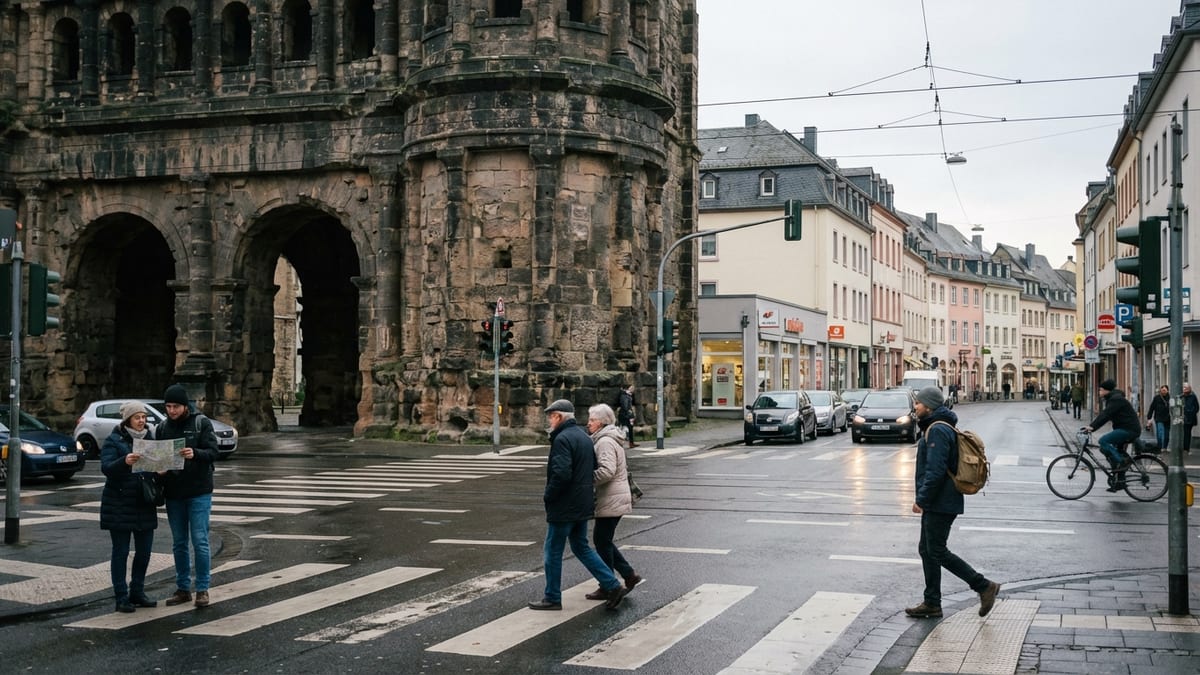
I went to Trier because every guidebook and half the internet seemed to agree it was one of the great Roman cities north of the Alps, a must for history lovers and an easy cultural side trip in western Germany. After a few days on the ground, walking between ruins, nursing coffees in the compact old town, and wrestling a bit with German rail, I came home with a more nuanced feeling.
Trier is interesting, sometimes impressive, occasionally frustrating, and probably not the city everyone imagines when they see glossy photos of the Porta Nigra. Whether it is worth visiting really depends on what you want from a trip. If you decide to go, this guide to the best hotels in Trier helps you choose a convenient base.
First Impressions: A Small City With Big Claims
I arrived by regional train using a Rheinland Pfalz Ticket, the flat day pass that covers local trains and regional transport across the state. As of early 2026, a single traveler pays just under 30 euros, which made getting to Trier from elsewhere in Rhineland Palatinate relatively affordable.
The journey itself was pleasant but not especially fast, and like much of regional German rail now, minor delays were part of the experience rather than an exception. None of it was disastrous, but it did mean I reached Trier a bit later and more tired than I would have liked.
Stepping out of the station, the city felt surprisingly ordinary. There is no grand riverfront arrival or dramatic skyline. Instead, I walked past a fairly standard cluster of shops and traffic before the old town slowly emerged. The Porta Nigra appears almost suddenly at the edge of the pedestrian zone, looming dark and slightly incongruous over a busy intersection. It was at this moment I understood Trier’s vibe: a workaday regional city into which layers of extraordinary history have been folded rather than a fully preserved museum town.
That contrast is part of Trier’s charm, but it also means expectations matter. If you are picturing a pristine, pedestrian-only Roman theme park, you will be disappointed. The city center is nice rather than stunning, compact rather than grand, and it reveals itself in stages. I needed a full day of wandering before I felt any real affection for the place.
The Roman Monuments: Impressive, Fragmented, and Sometimes Underwhelming
The Roman remains are the main reason most people, myself included, come to Trier. UNESCO status looks great in brochures, and there is a certain thrill in knowing you are seeing some of the best-preserved Roman architecture in Germany. However, the actual experience on the ground is more fragmented than I expected and a bit heavy on imagination.
The Porta Nigra is by far the most striking monument. Climbing up through the interior, with its stairs, narrow passages, and elevated views back over the square, was genuinely atmospheric. I could see and touch the stone, understand the scale, and feel the transition from defensive gate to later church and then historical icon. It felt worth the admission and the time. The downside was that interpretive material, while present, did not always tie everything together as clearly as I hoped, especially if you are coming in with only a casual interest in Roman history.
Other sites were more of a mixed bag. The Kaiserthermen, the imperial baths, are mostly foundations and walls. Walking through them, I appreciated the engineering and scale, but I had to constantly refer to diagrams and my own imagination to picture what they once looked like. The same applied to the Barbara Baths and the amphitheater. If you are used to the monumental ruins of Rome, these feel like scattered, evocative remains rather than showstoppers. They are historically important, but not necessarily visually spectacular.
The practical side of visiting these sites was mostly straightforward. Opening hours in winter and shoulder seasons tend to be limited, and several places close by late afternoon, so I had to plan the day carefully. I found it easy to underestimate how much time I would spend at the first site and then realize I was racing to reach the next before last entry. It is possible to buy combination tickets for multiple Roman monuments, which does save a bit of money, but only if you are realistic about how many places you will actually reach before they shut.
Museums and the Story Behind the Stones
Where Trier really redeemed itself for me was in the museums, especially the Rheinisches Landesmuseum. As of January 2026 it typically opens from 10:00 to 17:00, Tuesday to Sunday, with last admission at 16:30, and I would strongly recommend blocking out several hours. Inside, the sheer quantity and quality of Roman artifacts surprised me. Intricate mosaics, sculpted tomb monuments, everyday objects, and large-scale stonework all filled in the gaps left by the ruins scattered across town.
The Landesmuseum gave me the context I was missing when I walked through the baths and the amphitheater. Audio guides in English were available at no extra charge when I visited, which was a welcome detail. What let the experience down slightly was the wayfinding. The galleries sometimes felt like a maze, with thematic groupings that were not always intuitive if you were tired or short on time. Still, if you are serious about understanding why Trier matters historically, this museum is essential.
I also visited the city’s cathedral-related museums. The Museum am Dom, just off Trier Cathedral, keeps more limited hours, typically 9:00 to 17:00 on most days except Mondays, and shorter on Sundays and holidays. It focuses on Christian art and liturgical objects. I found it thoughtful and quiet, but it requires some interest in ecclesiastical history to feel truly engaging. The Karl Marx House, located in the philosopher’s birthplace, offered a completely different side of Trier’s story. Its opening hours during my visit were split between morning and afternoon, with a short midday closure, which is easy to miss if you are not paying attention to the schedule.
Overall, the museums in Trier are strong but time-consuming. You can easily lose half a day in the Landesmuseum alone, and there is a real risk of museum fatigue if you try to stack everything back to back. I made that mistake and found my appreciation dwindling even though the content was excellent. If I returned, I would consciously limit myself to one major museum per day and leave room to simply wander.
The Old Town: Pleasant Enough, Not Quite Magical
Trier’s old town sits around the Hauptmarkt and cathedral, and it is where I spent most of my non-museum time. The main square is handsome and lively, framed by pastel façades and dominated by the market fountain. It feels distinctly German but also a bit generic if you have already seen places like Bamberg or Regensburg. During the day, it filled with shoppers, schoolchildren, and small tour groups, while by evening it quieted down quickly, especially outside peak seasons. Understanding the main things to do in Trier makes the decision clearer.
The cathedral itself is monumental, and stepping inside was one of the highlights of my visit. The space is free to enter, with the usual discretionary donation boxes, and its blend of Roman and later architecture gives it a unique character. I appreciated that it opens early, often from 6:30 in the morning, which allowed me to experience the interior almost alone. On the other hand, special chapels and the cloister can have more restricted access, and during services large parts of the building are understandably off-limits to tourists. I had to time my return visits around those realities.
Wandering the pedestrian streets, I found a mixture of chain stores and more local businesses. It is easy to get a decent coffee or a casual lunch, but this is not a culinary destination. The most atmospheric parts of the old town are relatively small, and it does not take long to walk from one end of the center to the other. That compactness is convenient, but it also means you can run out of novel corners to explore if you stay for more than two days.
In the evenings I had mixed feelings. The city felt safe and calm, which I appreciated, but it also felt a bit sleepy. If you are expecting a vibrant nightlife scene or a packed calendar of late events, you may find yourself back at your hotel earlier than planned. There are bars and a student presence thanks to the university, but nothing that would make me travel here for nightlife alone.
Logistics: Transport, Tickets, and Seasonal Realities
From a practical standpoint, Trier is not difficult to reach but also not as well connected as some other German cities of similar size. Long-distance train options are patchier than they once were, and there has been local political debate around limited Intercity connections and the need to restore more robust service. In reality, I found myself relying on regional trains, which the Rheinland Pfalz Ticket covered nicely but which added time and some uncertainty with delays and transfers.
Once in town, I barely used public transport because the center is so compact. Most major sights are walkable from each other within 10 to 20 minutes. This is a big advantage if, like me, you prefer to avoid figuring out local bus systems for short stays. There are buses if you stay further out or plan day trips along the Mosel, but inside Trier itself I did not feel they were necessary.
Seasonality makes a difference. I visited outside the peak summer season and noticed shorter opening hours at several sites. For example, large museums generally maintained their 10:00 to 17:00 pattern, but some outdoor Roman monuments and smaller museums closed earlier than I expected or had reduced winter schedules. The tourist information center near the Porta Nigra was helpful for confirming up-to-date hours, but it closes around 17:00 as well, so you need to gather that information earlier in the day.
I also underestimated how much planning it would take to string together multiple paid sites without wasting time in transit or waiting for opening times. The monuments and museums are not far apart, but they each have slightly different hours, and the cumulative ticket costs add up if you simply walk into everything without prioritizing. If I went again, I would map out a loose schedule built around a couple of anchor sites per day, rather than trying to hit everything in a single marathon. Extending your stay often depends on the available day trips from Trier.
Costs, Crowds, and Value for Time
In terms of budget, Trier felt moderate by German standards. Museum admission is not cheap, but it is not extortionate either. A ticket to the Rheinisches Landesmuseum, for example, was around 10 euros for adults when I visited. Travelers often compare Trier vs Cologne. Other Roman sites and church-related museums each charged their own separate fees. After a couple of days, I noticed that my museum and monument spending was rivaling what I might pay in a larger city, without quite the same density of world-famous showpieces.
Food was similarly average. I paid a little more than in smaller towns but less than in major cities like Munich. Finding casual meals or bakeries was easy, but discovering memorable local cuisine required more effort and research than I actually put in. It is possible to eat cheaply if you stick to bakeries and supermarkets, but if you sit down for full dinners both nights, it will noticeably increase the trip cost given how much of the daytime budget already goes into admissions.
On the positive side, crowds were far more manageable than in many better-known European destinations. Even at the Porta Nigra, there were visitors but no crushing lines. The Landesmuseum had moments of busyness but never felt overwhelming. I never had to pre-book timed tickets weeks in advance or fight for a spot in front of displays. For anyone who is tired of shoulder-to-shoulder tourism in bigger cities, this is a pleasant change.
When I weighed what I spent against what I saw, my conclusion was mixed. Trier is rich in history, but its most important stories are spread across multiple modestly sized sites, each with its own ticket. If your main interest is ticking off big visual icons, you might feel the cost to payoff ratio is less favorable than, say, visiting a single large site in Rome or exploring a compact old town elsewhere on the Mosel. If you truly enjoy digging into context and visiting several complementary museums, the value starts to look better.
Who Will Love Trier, and Who Might Be Disappointed
By the time I left Trier, it was clear to me that this is a destination that rewards certain types of travelers more than others. If you are deeply into Roman history, enjoy archaeological sites even when they require imagination, and are happy to spend multiple days moving between ruins and museums, you will probably get a lot out of the city. The combination of Porta Nigra, the baths, the amphitheater, the Landesmuseum, and the cathedral offers a layered view of how a Roman city evolved through late antiquity and the Christian era.
If, however, you travel mainly for atmosphere and aesthetics, Trier might not hit as hard as you hope. Many visitors consider expert-led experiences when choosing Trier guided tours.
The old town is pleasant, but it is not as postcard-perfect as some other German cities, and the Roman sites are more powerful when you understand their backstories than when judged solely on visual impact. I found moments of beauty and intrigue, but not the kind of immediate, immersive charm I sometimes felt in smaller Mosel valley towns or in well-preserved medieval centers elsewhere in the country.
Families with children who like to climb and explore might enjoy the towers of the Porta Nigra and the open spaces of the amphitheater, but a long string of museum visits could quickly become too abstract or demanding. Short, focused visits with plenty of breaks would likely work better. Travelers with limited mobility should be aware that several historic sites involve stairs, uneven ground, or long walks between them, though many museums have made a visible effort to be more accessible.
Personally, I was glad I visited, but I also felt that Trier is better as a focused short stay or a base for exploring the surrounding Mosel region than as a destination you build an entire extended trip around. With that mindset, it can be satisfying rather than overwhelming or underwhelming.
The Takeaway
So, is Trier worth visiting? My answer is yes, with qualifications. I would not call it an essential stop for every traveler to Germany, but it can be very rewarding if your interests line up with what the city actually offers rather than what its marketing suggests. I arrived with high expectations shaped by phrases like “Germany’s oldest city” and “northern Rome” and had to adjust those quickly. Trier is not a Roman theme park, and much of its ancient past exists in fragments, foundations, and museum cases.
What Trier does provide is a dense concentration of historically significant sites within a very walkable area. The Porta Nigra and cathedral alone make a powerful pairing of Roman and Christian heritage. The Rheinisches Landesmuseum pulls the story together with artifacts that make abstract dates and emperors feel more human. The city’s relaxed pace, moderate crowds, and relatively reasonable transport options via regional trains make it approachable, especially if you are already in western Germany or along the Mosel.
If I did it again, I would spend two full days in Trier, not three. I would dedicate one day to the Roman monuments and another to the Landesmuseum and cathedral area, leaving extra time on each day to sit in cafés rather than sprinting between every possible site. I would also treat Trier as part of a broader Mosel itinerary, using it as a historical anchor before heading to smaller wine towns for scenery and atmosphere.
In the end, I left with a quiet respect for Trier rather than breathless enthusiasm. For travelers who care about history and are willing to look past uneven ruins and ordinary modern streets to see the stories underneath, it is worth the detour. For those chasing quick visual drama or postcard perfection, it may feel like more effort and expense than it is worth. Approach Trier with realistic expectations and a bit of curiosity, and the city will likely reward you in a measured, satisfying way.
FAQ
Q1: How many days do I really need in Trier? I found two full days enough to see the main Roman monuments, the cathedral, and at least one major museum without burning out. A third day only makes sense if you want a slower pace or plan day trips along the Mosel.
Q2: Is Trier easy to reach by train? It is reachable but not as well connected as some similar cities. I mostly used regional trains covered by the Rheinland Pfalz Ticket, which kept costs down but meant slower journeys and occasional delays.
Q3: Are the Roman ruins as impressive as those in Rome or southern Europe? No, not in a purely visual sense. Trier’s ruins are important and interesting, but many are fragmentary and require imagination. The overall experience is more about layered history than jaw-dropping architecture.
Q4: Are museums in Trier worth the admission fees? For me, the Rheinisches Landesmuseum absolutely was, because it explained and enriched everything else I saw. Other smaller museums are more of a maybe, depending on your specific interests and how much time you have.
Q5: Is Trier a good destination for families with children? It can be, but only if you keep visits short and varied. Kids may enjoy climbing the Porta Nigra and exploring the amphitheater, but long stretches in museums and among ruins that require a lot of reading might test their patience.
Q6: What is the best time of year to visit Trier? Shoulder seasons like late spring and early fall balance milder weather with fewer crowds. In winter, shorter opening hours and grey weather can dull the experience a bit, while summer brings more visitors but also more outdoor events.
Q7: Do I need a car to explore Trier and the surrounding area? Inside Trier itself, no. The center is walkable. For exploring smaller Mosel valley villages and vineyards beyond the main rail line, a car or carefully planned regional transport can make things easier, but it is not strictly essential.
Q8: Is English widely spoken in Trier? I was generally able to get by in English, especially at major museums, tourist information, and larger restaurants. In smaller shops or more local spots, German was more common, but people were usually patient and helpful.
Q9: How expensive is Trier compared to other German cities? I found it mid-range. Accommodation and food were not bargain-basement cheap but less pricey than big cities like Munich or Hamburg. What adds up are the individual admissions to multiple historic sites and museums.
Q10: Would I return to Trier? I would, but probably as part of a wider Mosel or Rhineland trip rather than a stand-alone destination. Now that I know what to prioritize, I would focus on a few key sites and then spend more time enjoying the surrounding region.