

More news on this day
Passengers at Hartsfield-Jackson Atlanta International Airport are facing a difficult travel day as a fresh wave of operational disruptions triggers 20 flight cancellations and around 200 delays, rippling across major U.S., European and Caribbean routes operated by Delta Air Lines, Spirit, Southwest, American Airlines and other carriers.
Weather and Congestion Combine to Hit a Critical Hub
Atlanta, the world’s busiest passenger airport, is once again feeling the strain of being a central transfer point in the U.S. air network. Today’s disruptions come as carriers across the country continue to recover from a powerful winter storm system in the Northeast earlier in the week, which forced thousands of cancellations and created a backlog of passengers and aircraft across multiple hubs.
While conditions in Atlanta itself have improved compared with earlier in the week, airlines are still juggling aircraft rotations and crew schedules that were knocked out of sync. That is translating into a higher-than-usual number of delayed departures and arrivals, even as most flights are still operating.
Flight-tracking data indicate that the bulk of today’s interruptions at Hartsfield-Jackson involve late-arriving aircraft from weather-affected airports along the East Coast and Midwest. Those knock-on effects are now spilling into Atlanta’s tightly timed banks of connecting flights, where a delay of 30 to 60 minutes on an inbound leg can cascade across several subsequent departures.
Airport officials say operations are continuing on all runways and that safety margins are not being compromised, but they are urging passengers to arrive early, monitor airline apps and be prepared for last-minute gate changes.
Delta, Spirit, Southwest and American Among Hardest Hit
As the dominant carrier in Atlanta, Delta Air Lines is bearing a significant share of the disruption. Delta controls the majority of departures from Hartsfield-Jackson, so even a modest uptick in delays can translate into hundreds of affected passengers, particularly during peak morning and evening connection periods.
Full cancellations, while relatively limited at around 20 flights, include a mix of regional domestic legs and select longer-haul services that airlines have chosen to consolidate. Some carriers are proactively trimming frequencies on routes where they can rebook most passengers on later flights the same day, instead of operating with heavily delayed or under-utilized aircraft.
Low-cost carriers are also feeling the squeeze. Spirit Airlines has reported delays on a number of its point-to-point services from Atlanta into Florida and the Caribbean, where tight turnaround times leave little buffer for disruption. Southwest, which links Atlanta to secondary U.S. cities, is contending with schedule knock-ons tied to weather and crew positioning at other airports in its network.
American Airlines and other legacy carriers with smaller but still important presences in Atlanta, including United and JetBlue, have seen scattered delays on both domestic and international legs. For passengers, the outcome is similar regardless of airline: longer lines, rolling departure times and crowded gate areas as travelers wait for updated information.
Transatlantic and Caribbean Travelers Face Missed Connections
One of the most visible impacts of today’s disruptions is on passengers traveling between Europe, the Caribbean and secondary U.S. cities via Atlanta. With international arrivals timed to connect to banks of domestic departures, even moderate delays can cause missed connections and force same-day rebookings or overnight stays.
Transatlantic flights from major European gateways such as London and Amsterdam, many of them operated or codeshared by Delta and its partners, are operating but in some cases running behind schedule. When those flights arrive late into Atlanta, passengers connecting onward to cities across the Southeast, Midwest and West Coast are at greater risk of misconnecting, particularly when minimum connection times are tight.
Caribbean routes are facing a similar squeeze. Atlanta’s links to vacation destinations in the Bahamas, Mexico and the wider Caribbean region are highly seasonal and often fully booked on peak days. A delayed inbound aircraft can easily push a departure into a time window where crew duty limits or air traffic flow programs force further schedule adjustments, leaving holidaymakers with extended waits before reaching the beach.
Airlines are encouraging affected travelers to use digital self-service tools to secure alternative routings where available, including rebookings through other hubs such as Dallas-Fort Worth, Miami, New York or Chicago, in order to keep long-haul itineraries intact.
Passengers Confront Crowds, Long Lines and Limited Options
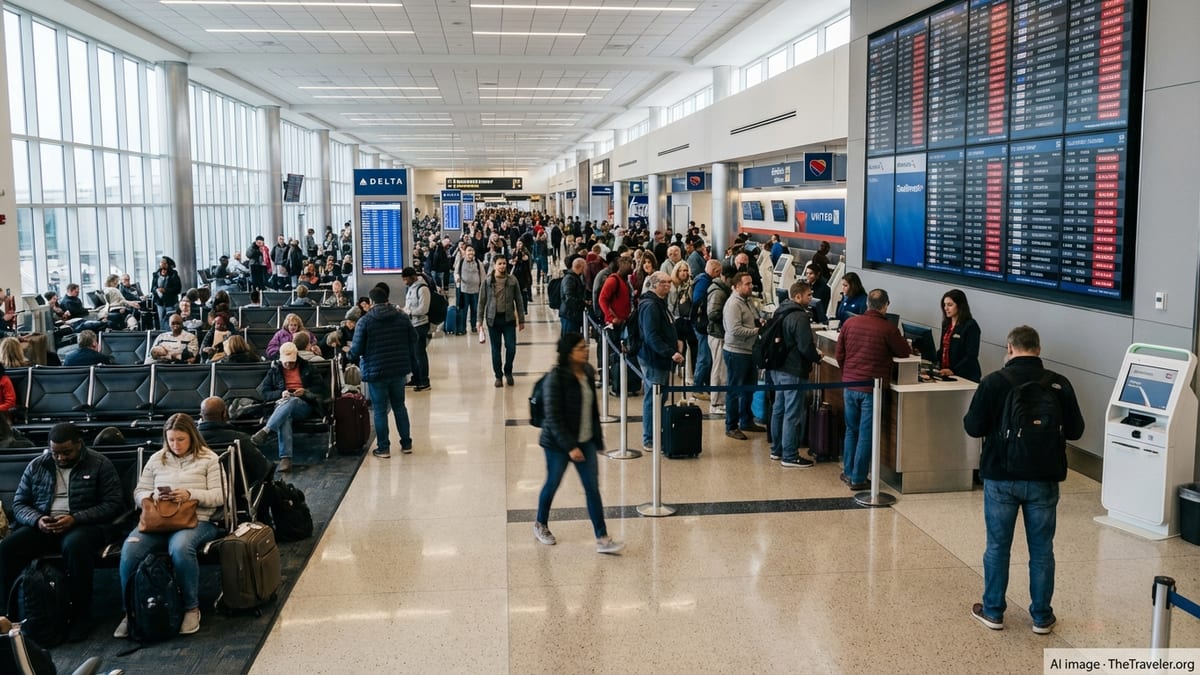
Inside Hartsfield-Jackson’s concourses, the operational strain is particularly visible at security checkpoints, ticket counters and customer service desks. Although the Transportation Security Administration is processing passengers at normal capacity, a higher proportion of travelers are arriving earlier than usual or spending more time in the terminal due to delays, stretching crowd levels throughout the day.
Rebooking lines at airline service counters have grown intermittently as clusters of flights post new departure times. Many passengers are opting to handle changes through airline apps, but those traveling in groups, with complex itineraries or using paper tickets still rely heavily on in-person assistance.
Food courts and seating areas near busy gates are also under pressure as travelers wait out delays. Airport staff and concessionaires are working extended shifts to manage the surge, while overhead announcements regularly remind passengers to keep walkways clear and to listen closely for gate and boarding changes.
For some travelers, the biggest frustration is uncertainty. With many delays fluctuating between 30 minutes and more than an hour, it can be difficult to decide whether to stay near the gate, relocate to a quieter area of the terminal or attempt to switch to a different routing entirely.
Airlines Offer Fee Waivers and Urge Flexible Plans
To ease the disruption, several major carriers serving Atlanta have activated travel waivers for affected dates and routes, allowing customers to change flights without standard change fees or fare differences in certain booking classes. These waivers are particularly helpful for travelers who can shift their plans by a day or adjust their departure times to avoid the busiest peaks.
Delta, American, Southwest and others are also advising passengers booked on tightly timed connections to build in extra buffer or, where possible, choose earlier departures to reduce the risk of misconnection later in the day. Online tools and mobile alerts are being emphasized as the fastest way to receive real-time updates on gate changes, boarding times and baggage information.
Industry analysts note that while today’s numbers at Hartsfield-Jackson are disruptive, they are still well below the mass cancellations seen during major nationwide meltdowns in past years. The current pattern is more consistent with a system regaining equilibrium after a major storm, with one of its key hubs absorbing a disproportionate share of the adjustment.
With more stable weather expected in the coming days, airlines are hopeful that schedules at Atlanta and across the national network will gradually normalize. In the meantime, travelers passing through the Georgia hub are being urged to check their flight status frequently, remain patient with frontline staff and prepare for the possibility that their trip may take longer than planned.