


More news on this day
Mounting disruption at some of Europe’s busiest airports is being linked to what critics describe as a fundamental design flaw in the European Union’s new high-tech border control regime, as reports of hours-long queues and missed flights continue to surface at the height of the summer travel season.
Get the latest news straight to your inbox!
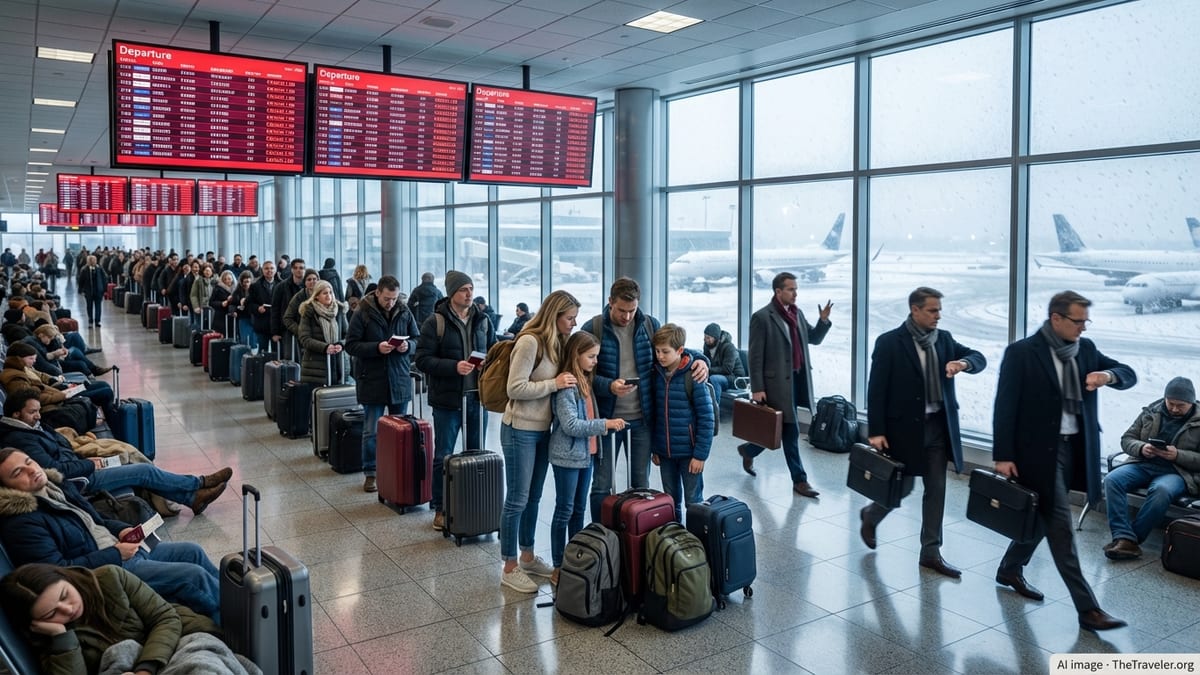
Biometric border upgrade collides with peak summer demand
The European Union is rolling out a new Entry/Exit System, known as EES, that replaces passport stamps with a centralized biometric register for most non-EU travelers. The system records fingerprints and facial images on first entry, then verifies them on subsequent trips. Publicly available information shows that the project has been years in the making, billed as a way to tighten external borders and reduce fraud while speeding up future crossings.
In practice, its early stages appear to be colliding with record passenger volumes and uneven airport staffing. Published coverage and traveler accounts describe queues stretching for hours at several major hubs as border officers enroll passengers one by one at kiosks before carrying out traditional document checks. At some airports only a fraction of available booths have reportedly been staffed, compounding the strain on the new hardware.
Border infrastructure was already under pressure from post-pandemic demand and changing travel patterns. The additional biometric step, which can take several minutes per traveler unfamiliar with the process, has introduced a new bottleneck just as leisure and business traffic climbs back to or above pre-2020 levels.
Industry groups and passenger advocates have warned for months that installing complex technology at fixed border checkpoints without extensive live testing risked severe disruption. The current wave of delays is now being cited as evidence that those warnings were not fully reflected in operational planning.
Critics point to ‘design flaw’ in passenger flow and staffing model
The most pointed criticism centers on what commentators describe as a structural design flaw in the way EES is being implemented at airports. Rather than decoupling biometric registration from the moment of border inspection, many terminals appear to funnel all first-time registrations through the same narrow choke points used for traditional passport control.
According to recent reporting, this has created a system in which every non-EU traveler who has not previously enrolled must complete a biometric capture before any immigration decision can be made. When combined with limited staff and malfunctioning kiosks, the result has been gridlock at times, even when overall passenger numbers are manageable for the physical space available.
Observers also highlight a mismatch between the sophistication of the technology and the resources allocated to operate it. High-throughput biometric systems rely on dense staffing, rapid triage of problematic enrollments and robust contingency plans when hardware fails. Where only a handful of officers are available or when dozens of kiosks stand idle due to technical issues, the promised efficiency gains evaporate.
Some analysts argue that this operational model amounts to building fragility into the system. Any disruption, such as one closed lane or a temporary software fault, can cascade quickly into multi-hour delays, leaving passengers stranded landside and airlines managing missed connections and rebookings.
Travelers bear the brunt in missed flights and frayed nerves
For travelers, the consequences are immediate and personal. Social media posts and online forums are now filled with accounts of families arriving three or four hours ahead of departure, only to watch departure times come and go while still stuck in border-control queues. In several widely shared cases, passengers reported spending most of a day in line and ultimately missing flights despite having been at the airport long before the recommended cutoff.
These experiences are not uniform across Europe. Some airports report relatively smooth processing, particularly where additional officers have been deployed and where ground staff actively direct travelers to available machines. Yet the uneven picture has left many passengers unsure of what to expect, prompting some to arrive at terminals six or seven hours early or to avoid certain hubs altogether when booking complex itineraries.
Airlines are also feeling the impact through knock-on disruption. When dozens of passengers miss a single departure because they were unable to clear border controls in time, rebooking and compensation costs mount quickly. Carriers have begun issuing updated guidance urging customers to allow significantly more time for border formalities, an unusual step in an era when check-in and security wait times have become more predictable.
Consumer groups warn that the uncertainty could deter higher-spending long-haul visitors who are less willing to risk complex, multi-stop journeys if a single bottleneck at an EU entry point might derail an entire trip.
Pressure builds on EU and member states to rethink the rollout
The mounting complaints are now feeding a broader debate over how Europe manages its external borders. According to published analysis, the EES regulation sets an overall framework, but member states are responsible for staffing, equipment procurement and the practical layout of passport-control areas at individual airports, ports and land crossings.
That division of responsibilities is drawing scrutiny. Critics argue that a system dependent on national investment and local design choices was always likely to produce highly inconsistent passenger experiences. In their view, labeling current problems as purely local management failures overlooks deeper questions about whether the architecture of the scheme sufficiently prioritized real-world passenger flow.
There is also growing discussion about contingency options as the scheme moves toward full deployment. Proposals aired in policy forums include shifting more first-time biometric enrollments away from peak arrival banks, expanding pre-registration at consulates or commercial centers, and creating dedicated EES zones separated from traditional border queues so that technical issues in one channel do not paralyze the entire checkpoint.
Observers note that any significant redesign would require coordination between EU institutions, national governments, airport operators and airlines, a process that typically moves slower than the rapid pace of peak-season travel demand.
What travelers can expect for the rest of the season
In the short term, publicly available guidance suggests that travelers from outside the EU should continue to build extra time into their itineraries for border checks at key hubs. Travel advisories from tourism bodies and airlines increasingly emphasize early arrival at departure airports, especially for morning and evening waves when long-haul flights coincide with intra-European services.
Some airports have begun making real-time updates on queue conditions available through terminal displays and social channels, allowing passengers to adjust their movements once inside the building. However, these measures only partially offset the structural constraints that critics associate with the current design of the EES rollout.
For now, the new system remains a work in progress, and its reputation is being shaped not by technical specifications but by the lived experiences of travelers navigating passport control during the busiest months of the year. Whether authorities choose incremental fixes or a more ambitious rethink of how and where biometric data is collected is likely to determine if this summer’s chaos becomes a one-off shock or a recurring feature of European border crossings.