

More news on this day
Thousands of travellers were stranded in Doha on February 28 after Qatar’s sudden airspace closure, triggered by US and Israeli strikes on Iran, unleashed a cascade of flight delays and cancellations across the Gulf’s busiest transit hub.
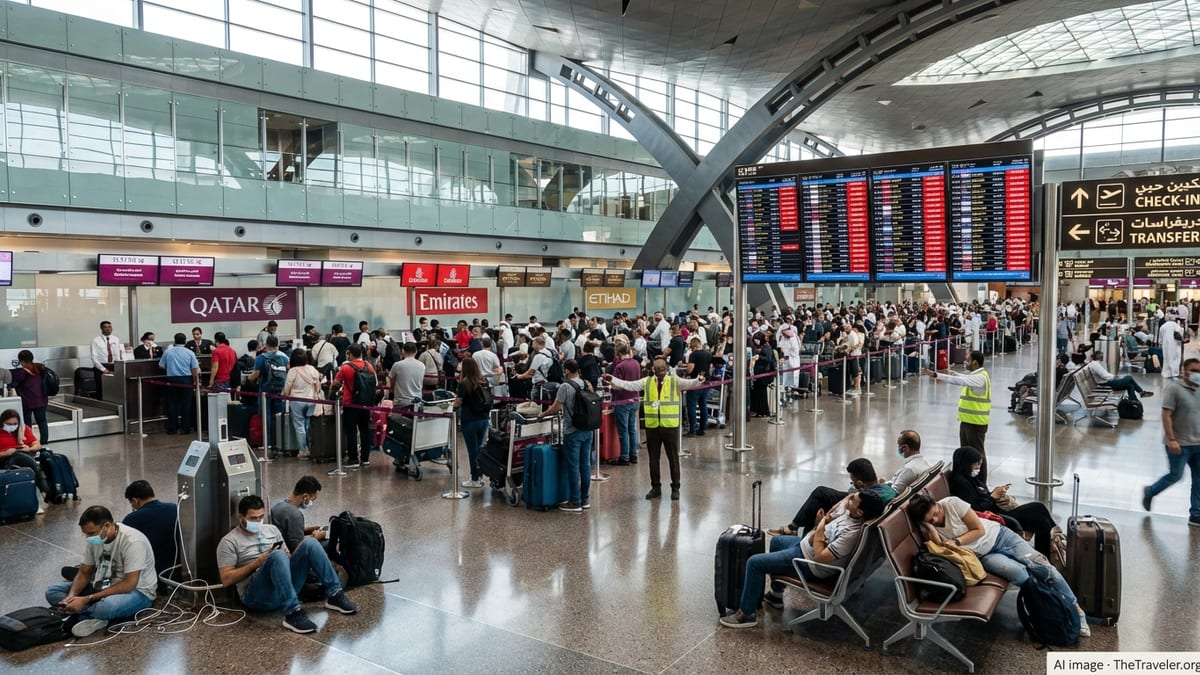
Severe Disruptions at Hamad International Airport
Hamad International Airport, a key connector between Europe, Asia and Africa, ground to an abrupt halt as Qatar suspended all inbound and outbound flights. Airport displays showed wave after wave of delays and cancellations, with 151 services reported delayed and at least 60 cancelled as the shutdown rippled through airline schedules.
Terminal halls that would normally see a steady flow of transiting passengers instead filled with long queues at airline service desks. Travellers slept on benches, improvised makeshift camps near power outlets, and lined up for meal vouchers as ground staff struggled to manage an ever-growing backlog of disrupted itineraries.
Airport authorities confirmed that operations were paused as a precaution following the latest escalation in the Iran–US–Israel confrontation, which has turned swathes of Middle Eastern airspace into active conflict zones. Officials said safety considerations and regional coordination left “no choice” but to suspend commercial traffic until the risk assessment improved.
While local officials stressed there was no immediate security threat inside the terminal, flight maps showed one of the world’s busiest corridors virtually empty as airlines rerouted or cancelled services that would normally overfly Iran, Iraq and the Gulf.
Qatar Airways, FlyDubai and Gulf Carriers Forced to Ground Fleets
Qatar Airways, the dominant carrier at Doha, confirmed a broad suspension of flights to and from its hub, with operations limited to essential positioning and diversion movements. The airline said its priority was to rebook stranded passengers and provide accommodation where possible, warning that knock-on delays would persist even after airspace restrictions ease.
The disruption was not limited to Qatar’s flag carrier. Regional operators including flydubai, Gulf Air and several other Gulf and regional airlines reported extensive schedule upheaval as they were forced to avoid closed or restricted air corridors. Services linking Doha with Dubai, Manama, Kuwait City and other Gulf cities were heavily affected, breaking key short-haul connections that feed long-haul routes.
Airlines began the painstaking process of building contingency schedules, weighing the safety and cost of longer rerouting options around the affected zone. Many carriers opted to cancel outright rather than send aircraft on significantly extended detours that would upend crew rosters and aircraft rotations for days.
Industry analysts warned that even a short-lived closure of Qatari and associated Gulf airspace could reverberate globally. Routes between Europe and South or Southeast Asia, as well as traffic between Africa and East Asia, are heavily reliant on Gulf transit hubs, meaning delays in Doha, Dubai and neighboring airports inevitably cascade through distant networks.
Passengers Face Uncertainty, Long Waits and Limited Options
For travellers caught in transit, the sudden suspension left many with little clarity about when they would be able to move on. Passengers reported receiving rolling text updates announcing new departure times, only for those flights to be delayed again or quietly removed from departure boards.
Families on long-haul itineraries from Europe to Asia through Doha described spending hours in customer service lines seeking rerouting options. With hotel capacity around the airport under strain, some travellers said they were given overnight accommodation while others were offered meal vouchers and asked to remain in the terminal until more information was available.
Travel advisors urged passengers with upcoming journeys routed through Doha or other major Gulf hubs to check their flight status before heading to the airport, and to be prepared for multi-day disruptions. Those with flexible tickets were encouraged to explore alternative routings via Istanbul, major European hubs or South Asian gateways still operating around the restricted airspace.
The situation also exposed gaps in some travellers’ insurance coverage. Policies that do not explicitly cover war, conflict or government-ordered airspace closures may offer limited assistance, leaving many reliant on airline goodwill policies and statutory refund rules in their country of departure.
Regional Airspace Closures Echo Across the Middle East
Qatar’s airspace shutdown formed part of a wider pattern of restrictions across the region, as Iran, Iraq, Kuwait, Bahrain and the United Arab Emirates imposed full or partial closures following the strikes on Iranian targets. Combined, the measures sharply reduced available air corridors over the Gulf and northern Middle East, forcing airlines to redraw routing maps almost in real time.
Data from global flight-tracking services indicated that hundreds of flights were either cancelled, delayed or diverted within hours of the first announcements, with some long-haul services turning back mid-route. Aircraft already en route to Doha were in many cases diverted to alternative airports, adding to congestion at secondary hubs that abruptly found themselves handling unscheduled widebody arrivals.
Aviation security specialists said that operators were erring on the side of caution, given the heightened risk of miscalculation in crowded skies near active conflict zones. Airlines must weigh the commercial impact of halting flights against the reputational and safety consequences of operating close to potential military activity.
Observers noted that the latest upheaval comes on top of existing long-haul detours caused by the closure of Russian and Ukrainian airspace since 2022. With yet another region effectively off limits, airlines face increasing pressure on fuel costs, crew duty times and schedule reliability.
What Travellers Should Expect in the Coming Days
With no firm timeline for the full reopening of Qatari and neighboring airspace, airlines and airports in the region have prepared for prolonged disruption. Carriers have activated crisis response teams, expanded call center capacity and brought in additional ground staff to manage queues and assist vulnerable passengers, including unaccompanied minors and those with medical needs.
Travel industry experts expect rolling schedule adjustments to continue at least through the weekend, even if some restrictions are eased, as airlines reposition aircraft and crews and work through the backlog of stranded passengers. Travellers are being advised to monitor airline apps and notifications closely, allow extra time for connections, and keep essential items in carry-on bags in case checked luggage becomes temporarily inaccessible during rebooking.
For those considering new bookings through Doha or other Gulf hubs, agents recommend looking for fully flexible fares and confirming that contact details are correctly registered with airlines to receive real-time alerts. Many carriers have also introduced temporary change fee waivers for flights touching affected airports, enabling passengers to defer travel or reroute without penalty.
While officials in Qatar have emphasized that conditions on the ground remain stable, the shock closure of one of the world’s premier transit hubs has underscored how quickly geopolitical tensions can reshape global travel patterns. Until airspace across the Gulf is fully reopened and airlines restore regular schedules, passengers connecting through Doha should brace for a volatile and fast-changing travel landscape.