

More news on this day
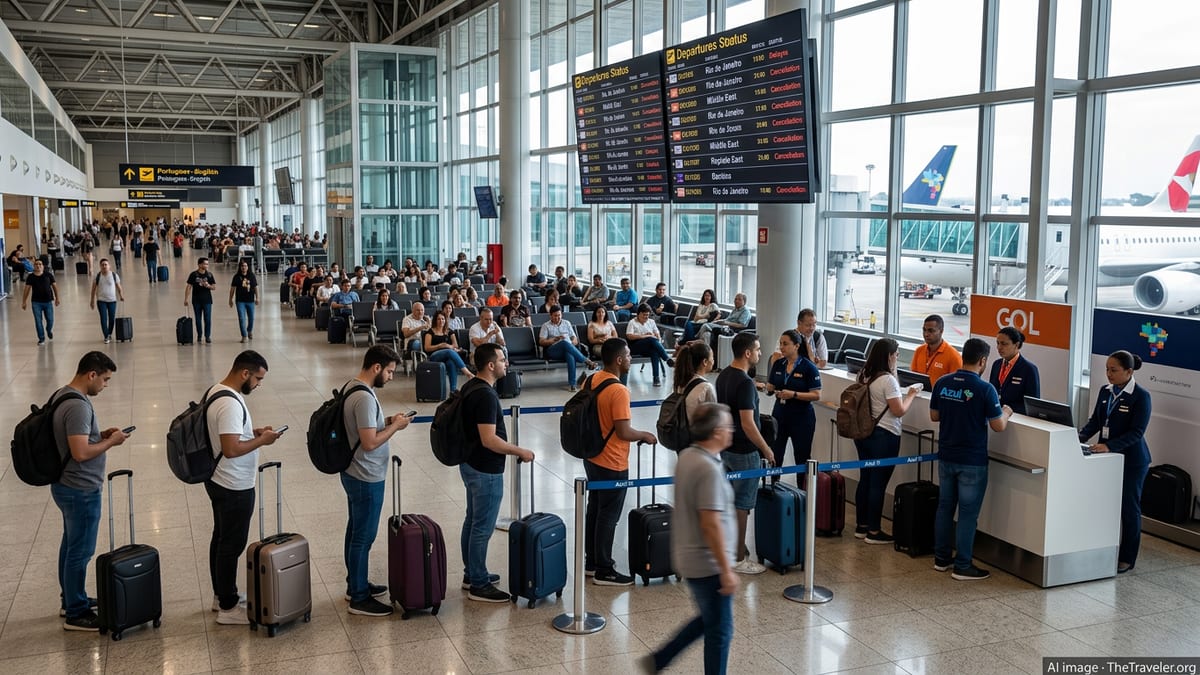
Hundreds of passengers traveling through Brazil’s busiest air hubs in São Paulo and Rio de Janeiro faced significant disruption today as at least 76 flights were delayed and 7 were cancelled, impacting services operated by GOL Linhas Aéreas, Azul, Qatar Airways, Emirates, Aerolineas Argentinas and several other carriers.
Ripple Effects From Global Airspace Turmoil Hit Brazil
Operational challenges at São Paulo’s Guarulhos and Congonhas airports and Rio de Janeiro’s Galeão and Santos Dumont terminals came as airlines around the world continued to grapple with a volatile global airspace situation. In recent days, a series of airspace restrictions and corridor adjustments affecting long-haul routes between the Middle East, Europe and South America has forced carriers to retime or reroute flights, compressing already tight schedules.
According to Brazilian aviation observers, long-haul services operated by airlines such as Emirates and Qatar Airways into São Paulo and Rio have been particularly vulnerable. Extended flight times, fuel stop adjustments and crew duty-hour limits have reduced scheduling flexibility, making it harder to recover when earlier sectors are delayed. When these aircraft arrive late into Brazil, they often knock on to departure delays or last-minute cancellations for onward legs.
The disruption is not limited to international widebody operations. Domestic networks operated by Brazilian carriers GOL and Azul are heavily interconnected with long-haul arrivals at Guarulhos and Galeão. When international flights miss their slots or arrive outside planned connection windows, domestic banks of departures must be reshuffled, leading to a cascade of delays across popular routes linking São Paulo, Rio and regional capitals.
Industry sources note that, while weather conditions in southeastern Brazil have been generally manageable, the combination of congested airspace, tight turnaround times and heavy passenger loads at the tail end of the Southern Hemisphere summer travel period has left airlines with minimal margin for error.
GOL and Azul Struggle With Knock-On Delays
GOL Linhas Aéreas and Azul, two of Brazil’s largest domestic operators, accounted for a significant share of today’s delayed movements at São Paulo and Rio airports, according to preliminary monitoring by local tracking services. Many of the affected flights were short-haul shuttles between the country’s primary business corridors, where frequency is high and aircraft utilization is intense.
At Guarulhos and Congonhas in São Paulo, GOL flights linking the metropolis to cities such as Belo Horizonte, Curitiba and Cuiabá saw departure times pushed back as inbound aircraft arrived late from earlier rotations. Azul reported similar challenges across its network, with aircraft arriving behind schedule on feeder routes and then turning around late for heavily booked onward sectors.
The delays have come at a time when both GOL and Azul continue to emphasize cost discipline and high aircraft utilization to maintain profitability in a competitive market. That model relies on tight turnarounds and dense scheduling, which leave airlines exposed when a single disruption early in the day ripples across multiple subsequent flights.
Airport staff in São Paulo and Rio reported longer-than-usual lines at check-in counters and boarding gates for these carriers, as rebookings, seat reassignment and baggage handling all slowed under the pressure of revised departure times. While most flights eventually operated, the cumulative effect of multiple short delays added up to hours of inconvenience for many passengers.
Middle Eastern and Regional Carriers Adjust Operations
International operators serving Brazil, notably Emirates, Qatar Airways and Aerolineas Argentinas, were also among those registering delays and a handful of cancellations. These carriers are navigating a complex web of airspace restrictions and corridor adjustments across the Middle East and surrounding regions, which has altered flight planning and extended block times on some long-haul services.
For Gulf-based airlines like Emirates and Qatar, Brazil is a key long-haul market connecting South America with Asia, Africa and onward destinations. Disruptions on trunk routes to and from their hubs put pressure on their carefully orchestrated global bank structures and, in turn, on their South American schedules. When aircraft and crews arrive late into São Paulo or Rio, turnarounds are frequently compressed or departure slots must be renegotiated, triggering further delays.
Aerolineas Argentinas, which operates important regional links between Argentina and Brazil, has also been impacted by the congestion. Operations at Buenos Aires airports have faced their own schedule pressures, and any delay at origin can cascade into missed slots at São Paulo or Rio, where runway capacity is tightly managed during peak hours.
While today’s seven cancellations represented a small fraction of total movements at the four main airports, they disproportionately affected travelers on long-haul and cross-border services, where alternative flights are less frequent and re-accommodation options more limited.
Passengers Face Long Queues and Uncertain Itineraries
For travelers on the ground, the disruption translated into long queues, rushed rebookings and uncertain itineraries. At Guarulhos, Brazil’s largest international gateway, passengers bound for Europe, the Middle East and neighboring South American countries described extended waits at airline service desks as staff worked to reissue tickets and secure seats on later departures.
Families returning from holidays and business travelers with tight schedules were among those hardest hit. Some reported missed connections in São Paulo or Rio after early morning departures from smaller Brazilian cities left late and arrived after their onward flights had closed. Others found themselves stuck overnight when the few available later flights were already fully booked.
Airport authorities reiterated that airlines are responsible for providing assistance in cases of significant delay or cancellation, including meals, communication support and, when necessary, accommodation. Consumer advocates nevertheless urged passengers to document all expenses and keep boarding passes and delay notifications, in case they choose to pursue compensation or file complaints with Brazil’s civil aviation regulator.
Ground staff at São Paulo and Rio said additional customer service agents were brought in to support affected travelers, but noted that sudden spikes in demand are challenging to manage, especially when multiple carriers are dealing with schedule disruptions at the same time.
Airlines and Regulators Urge Travelers to Plan Ahead
Airlines operating at São Paulo and Rio de Janeiro airports advised passengers to arrive earlier than usual for check-in while disruptions continue to ripple across global networks. Carriers recommended that travelers monitor their flight status closely through official channels and enable notifications, given that departure times are subject to change at short notice.
Brazil’s aviation authorities and consumer agencies reiterated that, under national rules, passengers facing long delays or cancellations are entitled to information, care and, in certain cases, rebooking or refunds. They encouraged travelers to seek assistance directly from their airlines at the first sign of disruption rather than waiting until boarding time, when options may already be limited.
Aviation analysts expect that while the peak of today’s disruption should ease as aircraft and crews return to position, residual delays could persist in the coming days, particularly on long-haul routes linked to the Middle East and Europe. With aircraft and crew rosters still out of their normal rhythm, on-time performance at São Paulo and Rio may remain fragile if further weather or airspace complications arise.
For now, travelers planning to use Brazil’s busiest airports are being urged to build extra time into their itineraries, avoid tight self-made connections and keep contingency options in mind, as airlines and regulators work to stabilize operations after a turbulent day for air travel across the country’s main gateways.