

Delaware may be one of the smallest states in the United States, but its highways carry a steady stream of beach traffic, East Coast commuters, and commercial vehicles. Whether you are crossing the First State on Interstate 95 or cruising State Route 1 to the beaches, understanding the local driving rules, toll system, and typical road conditions will make your trip smoother, safer, and less stressful.
Understanding Delaware’s Driving Culture and Road Network
Delaware’s compact size can be misleading for travelers who assume they will pass through in minutes. The state sits on a heavily traveled corridor between major metropolitan areas, and many of its roads carry both local and long-distance traffic. Interstate 95, State Route 1, U.S. 13, and the newer U.S. 301 toll corridor are key arteries that connect beach towns, suburban communities, and neighboring states. Congestion is common around Wilmington and Newark, particularly during commuter peaks and holiday weekends, while beach routes can slow to a crawl in summer.
Driving culture in Delaware tends to reflect a mix of regional habits. You will encounter out-of-state plates from up and down the East Coast, meaning a wide range of driving styles. Most local drivers respect posted limits in town centers and school zones, but speeds on open highways can creep above the limit, especially where the road is straight and visibility is good. As in any unfamiliar state, visitors should commit to defensive driving, allow extra following distance, and avoid trying to match the fastest drivers in heavy traffic.
One advantage of driving in Delaware is relatively straightforward navigation. Signage is generally clear, with advance notice of exits and toll plazas. However, interchanges around I-95 near Wilmington can be complex, and last-minute lane changes are a factor in many crashes. A navigation app with real-time traffic can help you anticipate congestion and lane shifts, especially where major construction projects are underway.
Because several of Delaware’s primary corridors are toll roads, it is wise to think about payment before your trip begins. While you can usually pass through without cash and receive an invoice later, the costs for pay-by-plate are higher, and missing a bill can lead to added penalties. E-ZPass is widely accepted, and Delaware promotes its own E-ZPass system with discounts that reward frequent users.
Key Traffic Laws Every Driver Should Know
Delaware’s traffic code is broadly similar to neighboring states, but there are a few rules that visitors often overlook. Seat belt use is mandatory for all drivers and passengers, and law enforcement agencies conduct regular enforcement campaigns focused on belt compliance. Police can stop a vehicle solely because someone is not buckled, and fines can escalate when children are unrestrained. Child restraint requirements follow age, weight, and height guidelines, so families should ensure they have appropriate car seats or boosters before traveling.
Distracted driving is a particular concern on Delaware roads. The state bans the use of handheld electronic devices while driving, prohibiting drivers from holding a phone to talk, text, email, or browse. The law applies to all drivers, not just teens. Fines start around one hundred dollars for a first offense and increase for subsequent violations, and enforcement has intensified during focused crackdowns. Using a hands-free system, or better yet stowing your phone in the glove box, is the safest approach.
Delaware also has a Move Over law that requires drivers to change lanes or slow down when approaching stationary emergency vehicles, tow trucks, or certain service vehicles with flashing lights on the shoulder. When possible, you must move to a non-adjacent lane; if that is not safe, you must significantly reduce your speed. Police frequently stress this requirement after crashes that injure roadside workers, and ignoring it can result in fines.
Right turns on red are generally permitted after a complete stop unless posted otherwise, and you must always yield to pedestrians in crosswalks. School zones and residential areas often have lower speed limits that are strictly enforced, especially during arrival and dismissal times. Delaware also enforces impaired driving laws aggressively, with roadside checkpoints at high-risk times such as holiday weekends and major events.
Navigating Delaware’s Evolving Toll System
Despite its size, Delaware relies heavily on toll revenue to fund transportation infrastructure, and recent years have brought several toll adjustments. The main toll facilities within the state are the I-95 Delaware Turnpike near the Maryland line, State Route 1 between Christiana and the beaches, and the U.S. 301 corridor bypassing Middletown. On top of those, drivers frequently cross the Delaware Memorial Bridge at the state’s northern gateway, although that facility is operated separately from Delaware’s own toll roads.
In August 2025, tolls increased on I-95, U.S. 301, and State Route 1. For a typical two-axle passenger vehicle, the I-95 toll at the Newark plaza rose from four dollars to around five dollars. U.S. 301’s mainline toll climbed for E-ZPass users and even more sharply for toll-by-plate transactions, while State Route 1 tolls at Biddles Corner and Dover increased, with higher weekend rates aimed at capturing peak beach traffic. Delaware’s transportation officials have been open that these higher rates are designed to sustain road maintenance and fund new projects after nearly a decade without increases.
Delaware’s toll system now emphasizes E-ZPass more than ever. Motorists who use Delaware E-ZPass accounts generally pay lower tolls on State Route 1 and U.S. 301 compared with cash or out-of-state E-ZPass users. Discounts are especially noticeable on weekends and for frequent users. At the same time, toll-by-plate has become a standard option for vehicles passing through E-ZPass lanes without a tag: instead of an immediate violation, drivers receive an invoice for the basic toll and only face penalties if it is unpaid after a set period. This helps keep traffic flowing while still collecting revenue.
For visitors planning a road trip, the most economical approach is to obtain an E-ZPass transponder, either through Delaware or your home state, before traveling. Delaware has at times offered free transponders for new E-ZPass accounts for limited periods, and even when promotions are not active, the long-term savings can be substantial if you use toll roads frequently. Because toll rates and discount structures can change, travelers should check the latest published rates and, if desired, use an online toll calculator to estimate costs for their specific route and vehicle type.
How and Where You Will Pay Tolls
Most drivers encounter Delaware tolls on four main facilities: State Route 1, the I-95 Delaware Turnpike, U.S. 301, and the Delaware Memorial Bridge. On State Route 1, the two main plazas at Biddles Corner and Dover collect tolls based on day of week and payment method. Weekday rates for Delaware E-ZPass users are lower than weekend rates, while cash and non-Delaware E-ZPass customers pay higher amounts, particularly on busy weekends. This structure reflects the highway’s dual role as both a commuter and tourist route.
The I-95 toll plaza at the Maryland line charges a flat rate in each direction for standard passenger vehicles. While recent increases brought the price to approximately five dollars for a two-axle car, the toll is still a single charge for a key stretch of interstate that avoids more congested alternatives. Southbound drivers pay soon after entering Delaware from Pennsylvania, and northbound motorists pay before crossing back into Maryland. Signage provides multiple warnings so you can choose an appropriate lane for E-ZPass or cash.
U.S. 301, a relatively new limited-access corridor designed to ease congestion in and around Middletown, uses mainline and ramp toll gantries. Tolls vary by vehicle class and direction, with E-ZPass users typically paying significantly less than toll-by-plate users. The road is particularly popular for long-distance drivers seeking a faster, safer alternative to older local routes. For those crossing between Delaware and New Jersey, the Delaware Memorial Bridge charges its own toll, which is collected southbound into Delaware. E-ZPass customers from Delaware and New Jersey receive a preferred rate compared with cash or out-of-region E-ZPass accounts.
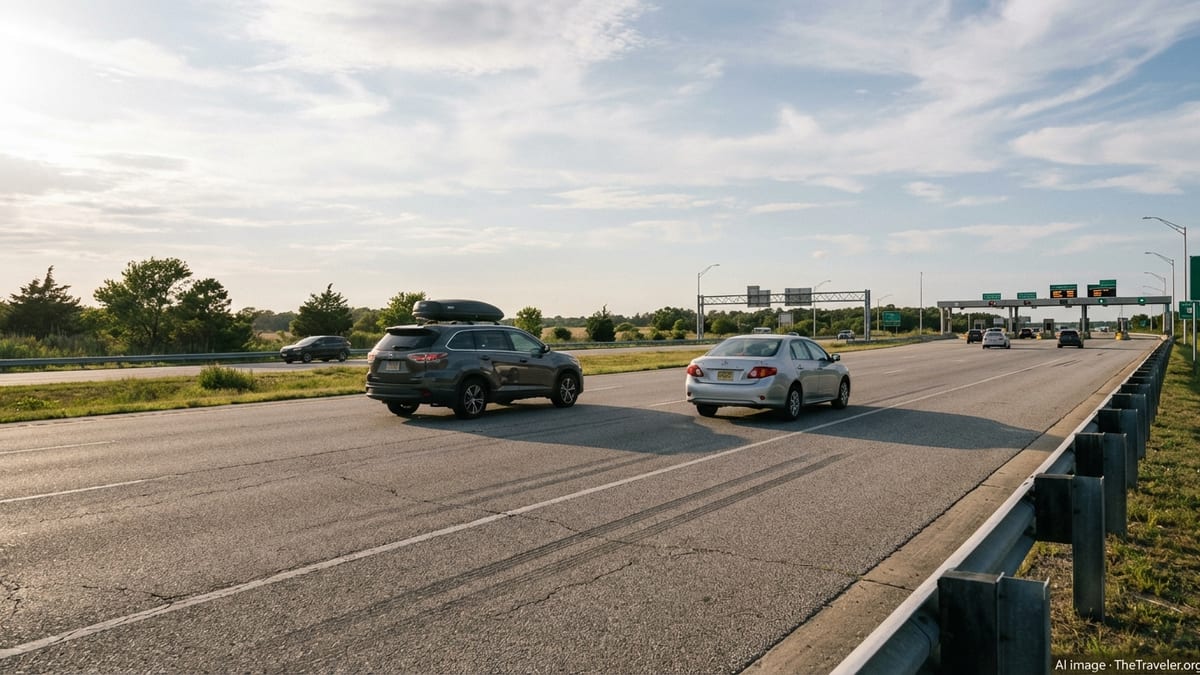
For all of these facilities, drivers should pay close attention to lane markings as they approach toll collection points. Dedicated E-ZPass lanes allow traffic to continue at highway speed, while mixed-use or cash lanes require slowing or stopping. Cutting across lanes at the last second is both dangerous and a common cause of minor crashes. If you realize too late that you are in the wrong lane, it is better to proceed and sort out payment later than to attempt a risky lane change through dense traffic.
E-ZPass Discounts, Tiers, and Out-of-State Drivers
Delaware actively encourages the use of E-ZPass by making it both convenient and cost effective. As of early 2026, Delaware E-ZPass customers are automatically enrolled in frequent-user plans for State Route 1 and U.S. 301. These plans reward drivers who make approximately thirty or more qualifying trips on the same roadway within a rolling 30-day period by discounting a portion of those tolls, often by about half compared with the standard E-ZPass rate. The discounts apply primarily to individual two-axle vehicles, and trips must be recorded by the transponder rather than by license plate image.
Commercial E-ZPass accounts receive a different set of discounts on certain roads. For example, on some segments of State Route 1, vehicles with three or more axles using E-ZPass qualify for an automatic percentage discount, recognizing their frequent use and the importance of freight movement. These savings can add up quickly for regional carriers shuttling goods between ports, warehouses, and distribution centers along the East Coast.
Out-of-state E-ZPass users benefit from the interoperability of the system but may not always receive the same preferred rates or frequent-user benefits that Delaware-based accounts enjoy. On certain Delaware facilities, non-Delaware E-ZPass accounts and cash customers pay a higher toll than Delaware E-ZPass users, particularly during peak travel periods. However, out-of-state drivers still come out ahead when using E-ZPass compared with toll-by-plate, which typically carries the highest rates due to additional administrative costs.
Because discount structures and promotions can evolve, anyone who expects to make repeated trips through Delaware’s toll system should review the current offerings when setting up or updating their E-ZPass account. Ensuring that your vehicle information is correct and that your license plate is properly linked to your transponder helps avoid misreads, misbilled trips, and potential violation notices.
Seasonal Road Conditions and Weather Hazards
Delaware’s climate produces a wide range of driving conditions over the course of a year. Winters can bring snow, freezing rain, and significant ice, while summers often see heavy thunderstorms and intense downpours that reduce visibility. Coastal areas may be affected by tropical storms or nor’easters, which can flood low-lying roads and cause closures. Because of the state’s flat topography, water can pond on road surfaces quickly, creating hydroplaning risks even on major highways.
The Delaware Department of Transportation (DelDOT) issues advisories when winter storms or extreme cold make roads hazardous. During severe cold snaps, officials warn that standard road salt becomes less effective, particularly when temperatures fall below about twenty degrees Fahrenheit. In those conditions, even treated roads can refreeze, and bridges, overpasses, and shaded stretches are especially prone to black ice. Drivers are urged to reduce speed, lengthen following distance, and avoid sudden braking or lane changes.
DelDOT maintains an extensive network of traffic cameras and travel information tools that allow drivers to check real-time conditions on major routes. These resources can be invaluable before setting out in winter weather or during major storm systems. In addition to monitoring highway conditions, the agency deploys plows, spreaders, and tree crews to handle snow, ice, and downed branches, but drivers should understand that secondary roads and rural areas may take longer to clear than heavily traveled corridors.
In coastal Sussex County and along inland bays, flooding is a recurring issue during heavy rain and storms. Some low-lying roads can become impassable, and law enforcement may close them with barricades. It is never safe to drive through floodwater, which can be deeper than it appears and can conceal washed-out pavement. Visitors heading to or from Delaware’s beaches should monitor local forecasts and be prepared to delay travel if a major storm or extreme high tide is expected.
Construction Zones, Enforcement, and Safe Driving Tips
With toll revenues and additional funding, Delaware has accelerated road and bridge projects aimed at reducing congestion and improving safety. That means drivers are likely to encounter work zones on I-95, State Route 1, U.S. 13, and secondary highways. Construction zones often feature narrowed lanes, shifted alignments, reduced shoulder widths, and lower speed limits. Fines for speeding or other violations can be higher in active work areas, especially when workers are present.
Drivers should pay careful attention to orange warning signs that signal lane closures or upcoming changes. When a lane is ending, merging early and allowing others to merge smoothly helps prevent sudden braking and rear-end crashes. Tailgating large trucks in work zones is especially risky, because your forward visibility is limited and stopping distances are long. Patience is essential, particularly during peak travel seasons when both construction and vacation traffic combine to slow traffic.
Enforcement on Delaware’s highways is shared by state and local police agencies, as well as highway safety campaigns that focus on specific behaviors. Speeding, impaired driving, aggressive driving, and distracted driving receive particular attention, and targeted enforcement periods are often announced during national campaigns or major holidays. Mobile patrols and stationary details along high-crash corridors are common, and the presence of law enforcement tends to increase near busy interchanges and toll plazas.
For visitors, a few basic practices dramatically reduce the risk of a citation or collision. Keep to the right except when passing, especially on multi-lane highways like I-95 and State Route 1. Use turn signals consistently, maintain a safe following distance, and avoid abrupt lane changes. If you miss an exit, continue to the next one rather than cutting across lanes or stopping on the shoulder. Above all, stay focused: put your phone away, avoid eating or grooming behind the wheel, and delegate navigation duties to a passenger if possible.
The Takeaway
Driving in Delaware is manageable and often enjoyable, provided you take a few minutes to understand the state’s rules, toll structure, and prevailing road conditions. The combination of busy interstate traffic, seasonal beach crowds, and an expanding toll network can surprise first-time visitors, but well-maintained highways, clear signage, and robust traveler information resources make it easier to plan ahead.
By respecting core traffic laws like the seat belt and hands-free requirements, paying attention in work zones, and adapting your speed to weather conditions, you can significantly reduce your risk on Delaware roads. Considering an E-ZPass transponder, especially if your travels involve I-95, State Route 1, or U.S. 301, may save you both time and money, particularly as toll rates and discount structures evolve.
Ultimately, Delaware is a state that many drivers cross quickly yet come to appreciate for its efficient highway network and access to beaches, historic towns, and nearby cities. A little preparation goes a long way: check conditions before you go, know where tolls are located, and give yourself extra time in peak seasons. With those steps, your experience driving in the First State is likely to be smooth, safe, and stress-free.
FAQ
Q1. Do I need an E-ZPass to drive on Delaware’s toll roads?
E-ZPass is not strictly required, but it is the most convenient and often the cheapest way to pay tolls on I-95, State Route 1, and U.S. 301. Without E-ZPass, you will typically pay higher toll-by-plate or cash rates where available.
Q2. Are handheld cell phones completely banned while driving in Delaware?
Yes. Delaware law prohibits drivers from using handheld phones or similar devices to talk, text, email, or browse while operating a vehicle. Hands-free use is allowed, but it is still safer to limit calls and avoid all distractions.
Q3. How strictly are speed limits enforced on Delaware highways?
Speed limits are actively enforced, especially on I-95, State Route 1, and in work zones, school zones, and residential areas. Drivers can expect targeted enforcement during holidays, summer beach season, and safety campaigns.
Q4. What should I know about winter driving in Delaware?
Winters can bring snow, ice, and freezing rain, and DelDOT warns that road salt becomes less effective in very low temperatures. Drivers should slow down, increase following distance, and check road conditions and forecasts before traveling.
Q5. Where are the main toll roads located in Delaware?
The primary toll facilities are the I-95 Delaware Turnpike near the Maryland line, State Route 1 between Christiana and Dover and south toward the beaches, the U.S. 301 corridor near Middletown, and the Delaware Memorial Bridge connecting to New Jersey.
Q6. Does Delaware have a Move Over law?
Yes. When you approach a stopped emergency, law enforcement, tow, or service vehicle with flashing lights, you must move to a non-adjacent lane if possible or slow down significantly if changing lanes is unsafe.
Q7. Are seat belts required for all passengers?
Seat belts are required for drivers and all passengers, and child passengers must be secured in appropriate car seats or boosters based on age, weight, and height. Police can stop vehicles solely for seat belt violations.
Q8. How can I check real-time road and traffic conditions in Delaware?
DelDOT operates a statewide traveler information system, including traffic cameras and incident reports, that allows drivers to see current conditions on major highways before and during trips.
Q9. What happens if I accidentally go through an E-ZPass lane without a transponder?
If you pass through an E-ZPass lane without a tag, cameras will capture your license plate and you will typically receive an invoice for the toll amount by mail. If you fail to pay by the due date, additional fees and violations may apply.
Q10. Are Delaware’s roads especially busy during certain seasons?
Yes. Traffic is heaviest during summer beach season, holiday weekends, and commuting peaks around Wilmington and Newark. Leaving early, allowing extra travel time, and using navigation apps to monitor congestion can reduce delays.