

Renting a car in Hawaii opens up coastal drives, rainforest valleys and small-town detours that tour buses never reach. It also places visitors into a road environment that mixes relaxed island pace with narrow highways, sudden weather changes and local customs that may be unfamiliar. Understanding how to share the road safely and respectfully is just as important as choosing the right rental car or planning your route.
Understanding Hawaii’s Road Rules
Hawaii follows the same basic traffic principles as the rest of the United States, but visitors are often surprised by how quickly conditions can change from multilane freeways to single-lane rural roads. All standard rules apply: drive on the right, obey posted speed limits, come to complete stops at stop signs and red lights, and yield to pedestrians within crosswalks. On the islands, many crosswalks sit near beaches, schools and bus stops, so drivers should be ready for people to cross even where there are no traffic signals.
Seat belts are mandatory for all occupants, and children must be secured in appropriate child safety seats or booster seats according to their age and size. Authorities across the islands conduct regular enforcement campaigns, particularly during holiday periods and school breaks when visitor numbers rise. Rental car drivers are not exempt from any regulations, and failure to comply can lead to fines or, in serious cases, court appearances that quickly derail a vacation.
A key difference for some international visitors is the right turn on red after a complete stop, which is generally allowed unless a sign says otherwise. Drivers must first yield to oncoming traffic and pedestrians before proceeding. At busy intersections in resort areas, this can require patience, as people often step into crosswalks late in the signal cycle. Allowing extra time in your schedule helps you avoid the temptation to rush through yellow or red lights.
Hawaii treats speeding and reckless driving seriously, with fines that can be higher than many visitors expect. Speed limits drop quickly when highways pass through towns, and local police regularly monitor these transition zones. Many serious crashes occur when drivers misjudge curves, ignore speed reductions or overtake where sight lines are limited. Staying within the limit is not only the law but also the safest way to enjoy the scenery.
Distracted Driving, DUI and Safety Enforcement
All counties in Hawaii prohibit the use of handheld mobile electronic devices while driving. That means you may not hold a phone to talk, text, scroll or input navigation while operating a vehicle. If you need to use maps or music apps, set them up before you start driving and use a hands-free mount or in-car system. Enforcement efforts have increased in recent years, and fines for a first offense can be substantial, with higher penalties in school or construction zones.
Texting while driving is treated as particularly dangerous behavior. State transportation and police agencies routinely highlight distracted driving during public awareness campaigns and traffic safety crackdowns. Visitors caught violating these laws may face on-the-spot fines, possible court costs and points or notations that can follow them back to their home state or country through information-sharing agreements.
Driving under the influence of alcohol or drugs is illegal, and enforcement on the islands is strict. Blood alcohol concentration limits mirror those on the mainland, but roadside checkpoints and saturation patrols are common, especially on weekends, during festivals and in nightlife districts such as Waikiki. Penalties can include license suspension, steep fines, mandatory education programs and potential jail time, even for first-time offenders.
Hawaii’s law enforcement agencies have also increased focus on speeding, aggressive lane changes and failure to yield to pedestrians, partly in response to a recent rise in traffic fatalities. Drivers can expect to see marked and unmarked police vehicles monitoring major corridors, particularly on Oahu’s freeways and along popular visitor routes such as Maui’s Hana Highway and Big Island’s Queen Kaahumanu Highway. The safest strategy is simple: put the phone away, limit in-car distractions, avoid alcohol if you plan to drive and allow plenty of time to reach your destination.
Sharing the Road: Local Etiquette and “Driving with Aloha”
Beyond formal laws, driving in Hawaii is guided by an unwritten code often described as “driving with aloha.” On many roads, especially outside urban Honolulu, the flow depends on courtesy as much as pavement markings. Locals often let another car merge ahead with a quick wave of thanks, allow left turns from side roads during gaps in traffic and maintain steady, moderate speeds rather than constant braking and acceleration. Visitors who match this cooperative approach tend to find their drives more relaxed and enjoyable.
Honking is relatively rare and usually reserved for urgent safety needs rather than everyday impatience. Leaning on the horn in traffic, cutting in abruptly or tailgating is viewed as disrespectful and creates tension in communities that already see heavy visitor traffic. If you miss a turn, simply continue to a safe place to turn around rather than stopping suddenly or making a risky maneuver. Local drivers value calm, predictable behavior more than saving a few seconds at an intersection.
Many residential streets near beaches or scenic lookouts are signed for local traffic only or have limited parking. Visitors are expected to respect these restrictions, avoid blocking driveways and keep noise to a minimum, especially early in the morning or late at night. In some neighborhoods, residents rely on street parking themselves, so out-of-state rental cars that ignore posted rules can quickly strain community relations and attract enforcement attention.
Pedestrians, cyclists and moped riders are part of everyday traffic on the islands. It is common to encounter joggers along coastal routes, surfers crossing the road barefoot with boards under their arms and bicyclists riding near the edge of narrow shoulders. Give them more space than the minimum required whenever possible, slow down when passing and be prepared for sudden movements, particularly where shoulder widths change. Treating everyone on the road with patience and respect embodies the spirit of aloha and helps keep both locals and visitors safe.
Island Conditions: Terrain, Weather and Wildlife
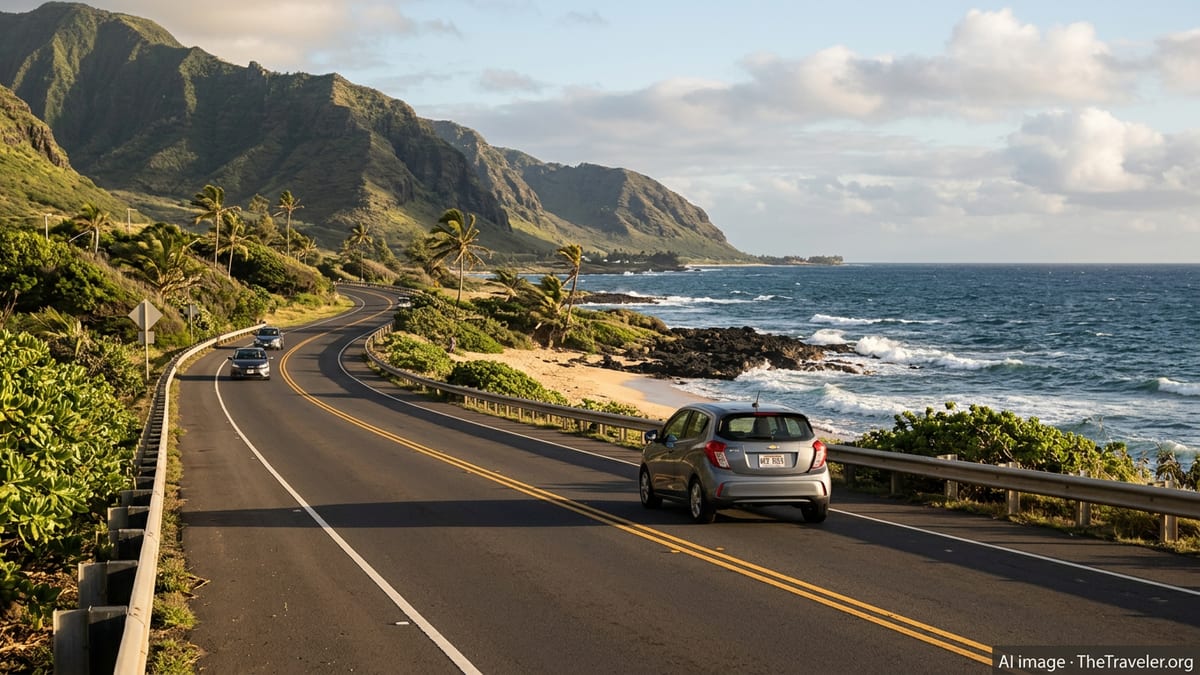
Hawaii’s varied landscapes create driving conditions that can shift quickly over short distances. On a single day you might move from dry lava fields to rain-soaked mountain passes and into crowded resort corridors. Many rural roads follow the natural contours of the land, with tight curves, blind corners and limited shoulders. Popular scenic routes such as Maui’s Road to Hana or parts of Kauai’s North Shore can feel intimidating to drivers used to wide, straight highways.
Rain showers move across the islands frequently, and downpours can be heavy even if they last only a short time. Road surfaces may become slick, especially after dry periods when oil and debris accumulate. In higher elevations on Maui’s Haleakala or Big Island’s Saddle Road, fog and low clouds can reduce visibility dramatically. Using headlights in rain or low light, keeping a safe following distance and reducing speed on wet curves are essential precautions.
Rockfalls and debris are occasional hazards along cliffside routes and near steep slopes. After strong storms, authorities may temporarily close sections of road to clear fallen trees or rocks or to assess landslide risks. Visitors should pay attention to local news, state transportation updates and hotel or rental host guidance about current closures or detours. Ignoring barricades or attempting to drive around closed signs can be extremely dangerous and may lead to fines.
Wildlife and livestock also come into play on some islands. You may encounter feral chickens, pigs, goats or cattle near rural highways, particularly on Kauai and the Big Island. At night, animals can be difficult to see until they are very close. Slowing down after dark, especially on unlit roads, and scanning the shoulders can reduce collision risk. If an animal crosses in front of you, it is usually safer to brake in a straight line than to swerve into oncoming traffic or off the roadway.
Emergency Vehicles, Disasters and What To Do
Hawaii requires drivers to yield the right of way to emergency vehicles by pulling to the side and stopping when it is safe to do so. When police, fire, ambulance or other authorized vehicles approach with lights and sirens, slow down, signal and move toward the shoulder or lane edge, allowing them a clear path. On many island roads, traffic may part to create a corridor in the center if there is no true shoulder, so watch what surrounding drivers are doing while still maintaining control of your vehicle.
The state also enforces a Move Over law to protect personnel working on the roadside. When you approach a stopped emergency vehicle, tow truck or certain state and county vehicles displaying flashing lights, you are required to slow to a safe and prudent speed and, if possible, move to a non-adjacent lane. On two-lane roads where shifting lanes is not possible, significantly reducing speed and passing with caution is expected. Violations can result in fines and place already vulnerable responders at greater risk.
Hawaii regularly prepares for natural hazards such as heavy storms, flash flooding, wildfires and tsunamis. Tourism and public safety officials advise visitors not to immediately jump into their vehicles during an emergency unless directed by authorities. In some recent events, rushes to the road created gridlock that complicated evacuation and emergency responses. If sirens sound or alerts appear on your phone, pay attention to official guidance from local agencies, resort staff or emergency broadcasts before deciding whether to move.
If you encounter rapidly changing conditions while already driving, such as flooded roadways, falling ash, thick smoke or lava-related closures, the safest choice is often to turn around or seek shelter in a safe location rather than trying to push through. Never drive through standing water if you cannot see the road surface, and do not ignore detours set up by police or transportation crews. Your rental vehicle contract does not exempt you from Hawaii’s laws, and recovery operations in remote areas can be lengthy and costly.
Rental Cars, Parking and Practical Logistics
Most visitors to Hawaii rely on rental cars to explore beyond resort areas, and demand can be strong during school holidays and peak travel seasons. Booking early gives you more choice of vehicle size, ground clearance and fuel efficiency. For rural island driving, especially on Big Island and Maui, a vehicle with good brakes, modern safety systems and enough power for hills is more important than luxury features. Always inspect the car for existing damage and photograph it at pickup and drop-off.
Parking rules vary between islands and municipalities, but a few principles apply almost everywhere. Observe all posted signs about time limits, resident-only zones and paid parking requirements. Popular beach parks may restrict parking hours, and overnight parking can be prohibited or limited to certain lots. Never leave valuables visible inside the car, even in trunk areas that can be accessed through rear seats; petty theft from vehicles does occur in some tourist hotspots.
Many scenic pullouts along highways and coastal routes are small and fill quickly. If a viewpoint area is full, continue to the next safe location rather than parking partially in the travel lane or on soft shoulders where your car could become stuck. On narrow roads, be careful not to block traffic when you stop for photographs. Using your hazard lights briefly can help signal that you are stopped, but only where parking is allowed and your vehicle is fully out of the flow of traffic.
Fuel availability is generally good in urban and resort areas, but rural stretches on the Big Island, Maui and Molokai can be long. If you plan a day trip into remote areas or across high-elevation roads, top up the tank before leaving town and carry water and snacks in the car. Mobile coverage may be limited in some valleys and coastal sections, so having maps downloaded offline and basic supplies in the vehicle provides an extra layer of security if you experience delays or breakdowns.
Driving Famous Scenic Routes Responsibly
Some of Hawaii’s most iconic experiences are road trips: circling Oahu, driving Maui’s Road to Hana, exploring Kauai’s North Shore or tracing the volcanic landscapes of the Big Island. These routes attract heavy visitor traffic, and local residents often use the same roads for everyday errands, school runs and work commutes. Responsible driving helps preserve both safety and goodwill along these beloved corridors.
On the Road to Hana and similar narrow, winding roads, drivers encounter one-lane bridges, tight hairpin turns and limited passing opportunities. Basic etiquette calls for taking turns at one-lane bridges, alternating directions when multiple vehicles are waiting. Pull over only in designated areas, not on vegetation, and avoid stopping in the lane for quick photo opportunities. If a line of cars builds up behind you, look for a safe turnout where you can let faster traffic pass.
On the Big Island’s high-altitude roads and coastal highways near lava fields, changing weather and limited lighting can make even straight segments more challenging than they appear in daylight. Drivers should respect signage that restricts rental vehicles from certain unpaved or rough roads, both for safety and insurance reasons. Attempting to reach remote trailheads or viewpoints by unauthorized back roads can lead to damage, stranding or conflicts with landowners.
Across all islands, sunrise and sunset drives are especially popular. The low angle of the sun, however, can create glare that obscures pedestrians, cyclists and signs. Good sunglasses, clean windshields and reduced speeds near populated areas help mitigate this risk. Night driving requires extra caution due to limited street lighting outside urban centers and the presence of wildlife or livestock. Planning your schedule so that most unfamiliar rural driving happens in daylight can significantly reduce stress.
The Takeaway
Driving in Hawaii can be one of the most rewarding parts of a visit, turning a simple transfer between attractions into a journey past cliffs, fields, waterfalls and local neighborhoods. With that privilege comes responsibility: to follow local laws, respect community norms and adapt to island-specific terrain and weather. Most serious problems arise when visitors underestimate distances, overestimate their skills on unfamiliar roads or allow distraction to creep in behind the wheel.
By building in extra time, resisting the urge to rush, staying sober and distraction free, and embracing the local spirit of driving with aloha, you can explore the islands confidently and safely. Treat emergency vehicles, roadside workers, pedestrians and neighbors with the same care you would in your own hometown, and Hawaii’s roads will feel more welcoming. A thoughtful approach behind the wheel helps protect fragile landscapes, reduces strain on local communities and ensures that your memories of island driving are filled with beauty rather than close calls.
FAQ
Q1. Do I need an international driver’s permit to drive in Hawaii?
Most visitors with a valid driver’s license from their home country or U.S. state can drive in Hawaii without an international permit, though some renters may request a passport as additional identification.
Q2. Is it legal to use my phone for navigation while driving?
You may use navigation if the phone is in a mount and you operate it hands free, but holding or manually using the phone while driving is prohibited and can lead to fines.
Q3. How strict is Hawaii about speeding?
Speed limits are actively enforced, especially where highways pass through towns or school zones, and fines can be higher than many visitors expect, so it is wise to stay at or below the posted limit.
Q4. Can I turn right on a red light in Hawaii?
In most locations you may turn right on red after a complete stop if there is no sign forbidding it, but you must first yield to oncoming traffic and all pedestrians in the crosswalk.
Q5. What should I do if an emergency vehicle is behind me on a narrow road?
Signal, slow down and move as far to the side as safely possible, stopping if needed, and follow the flow of surrounding drivers to create a clear path for the emergency vehicle.
Q6. Are there special rules for the Road to Hana and other scenic drives?
Formal laws are the same, but there is strong emphasis on courtesy: take turns at one-lane bridges, use only designated pullouts and let faster traffic pass when a safe turnout appears.
Q7. Is parking at beaches and lookouts generally free?
Some beach parks and lookouts offer free parking, while others charge fees or reserve spaces for residents, so always read posted signs and be prepared for pay stations in popular areas.
Q8. How dangerous is night driving on the islands?
Night driving can be challenging on unlit rural roads due to curves, wildlife and limited shoulders, so reducing speed and avoiding long unfamiliar routes after dark is recommended.
Q9. What happens if I get a traffic ticket in a rental car?
Tickets are usually your responsibility, and rental companies may add administrative fees or charge your card directly if notices are sent to them, so resolving any citation promptly is important.
Q10. Should I drive during a tsunami or severe weather alert?
You should not get in your car solely to flee unless directed by authorities; instead, follow official instructions, listen to local updates and avoid adding to unnecessary traffic and congestion.