


More news on this day
Dubai International Airport has logged 31.5 million passengers in the first half of 2026, a key recovery milestone that highlights both the scale of the regional disruption earlier this year and the speed at which traffic is now rebuilding through one of the world’s busiest hubs.
Get the latest news straight to your inbox!
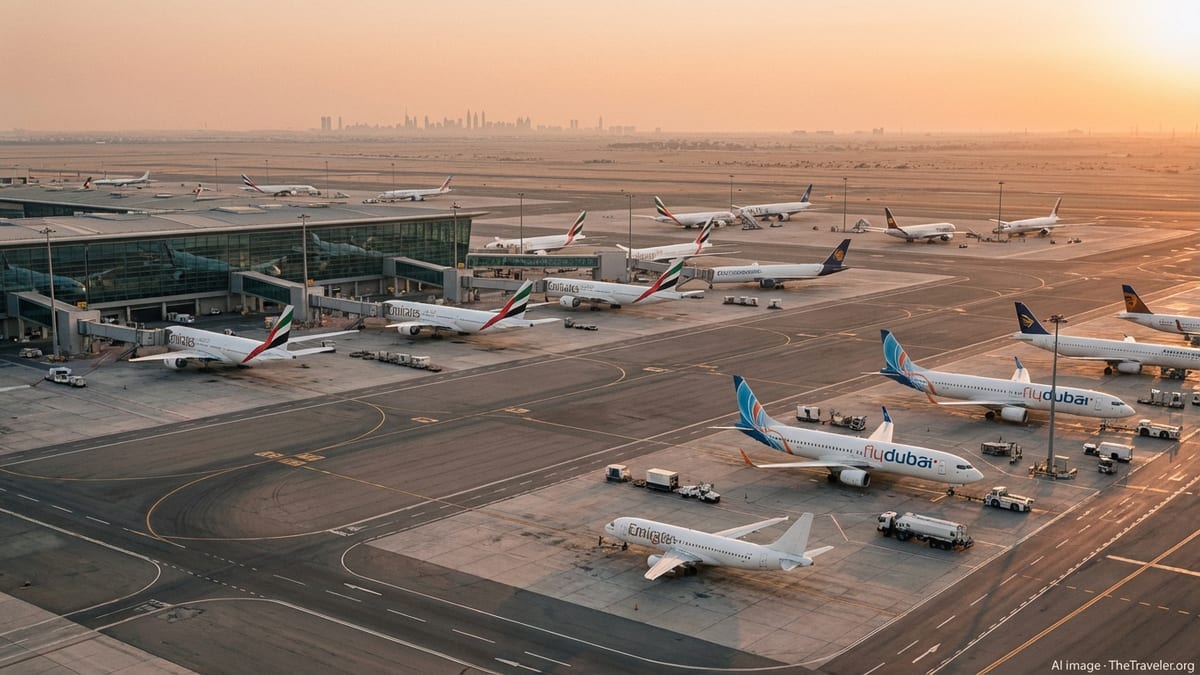
Traffic Rebounds After One of DXB’s Toughest Periods
Publicly available figures show Dubai International Airport (DXB) handled 31.5 million passengers between January and June 2026, following what the operator has described as one of the most challenging operating environments in the hub’s history. Regional airspace restrictions and a sharp rerouting of long-haul traffic weighed heavily on volumes in the early months of the year, reversing several years of strong growth.
Data released this week indicates that first half traffic was 31.3 percent lower than the same period in 2025, underlining how severely schedules were cut as airlines diverted away from affected airspace and trimmed frequencies across the Gulf. Despite the setback, DXB remained among the world’s busiest international airports, serving tens of millions of travelers and maintaining broad connectivity across key long-haul markets.
Aviation publications and regional business outlets note that the 31.5 million passenger figure now serves as an important reference point for the recovery phase, marking the point at which traffic stabilized and began to climb again after the initial shock of the regional conflict on air travel patterns.
Industry commentary frames DXB’s performance as a test of resilience for the wider Middle East aviation ecosystem, with the airport’s results closely watched by airlines, tourism authorities and investors tracking how demand responds as flight capacity gradually returns.
Second Quarter Momentum Builds, Month by Month
While the headline number for the first half of the year reflects a significant year on year decline, the underlying monthly data points to a clear upward trajectory through the second quarter. According to multiple aviation and business reports, passenger volumes at DXB rose from around 3.5 million in April to 4.5 million in May and 5 million in June, as airlines restored capacity and travelers adjusted to new routings.
In total, Dubai International handled approximately 13 million passengers in the second quarter alone, lifting the cumulative figure to 31.5 million for the first six months of 2026. Analysts note that this sequential growth is particularly significant given the lingering impact of regional airspace constraints and the continued presence of alternative routings that bypass parts of the Middle East.
International airport industry coverage highlights that load factors improved alongside passenger numbers, suggesting that additional seats put back into the market were quickly absorbed by demand. This pattern supports broader forecasts that once operational restrictions ease, DXB is positioned to regain traffic at a faster pace than many peer hubs, helped by its role as a global connecting point between Europe, Asia and Africa.
The month by month rebound is also seen as a confidence signal for airlines using Dubai as a transfer and destination gateway, helping carriers plan schedules and fleet deployment for the busier winter travel season and major events in the Gulf region later in the year.
Capacity Returns as Carriers Restore Networks
Reports on the latest figures from Dubai Airports indicate that nearly 50 international airlines were operating at DXB by the end of the first half of 2026, connecting travelers to more than 200 destinations across close to 100 countries. This breadth of service has been a critical factor in supporting the recovery, even as overall passenger numbers remain below the peak levels reached before the recent disruption.
Aviation sector analyses describe how carriers progressively rebuilt their networks into Dubai through the second quarter, reinstating suspended routes, adding back frequencies and in some cases upgrading aircraft types to meet returning demand. The renewed schedules have been particularly visible on trunk routes linking Dubai with major markets such as India, Europe and North America.
Several industry outlets point out that transfer traffic remains a central pillar of DXB’s business model, and that the hub’s ability to aggregate flows from multiple origin and destination points has helped offset weaker demand on some point-to-point routes. As airlines align their timetables to maximize connectivity over Dubai, passenger volumes are expected to benefit from more convenient connection windows and improved onward options.
Market commentary also notes that the recovery of cargo and belly freight operations alongside passenger flights is contributing to improved economics for airlines serving DXB, reinforcing their incentives to rebuild capacity through the airport rather than diverting traffic permanently to alternative hubs.
Investment Push Targets Smoother Journeys and Higher Capacity
Alongside the traffic numbers, Dubai Airports is pressing ahead with a wide-ranging investment program designed to improve passenger experience and expand effective capacity at DXB. According to government and industry news reports, the program includes upgrades to guest facilities, the rollout of a consolidated remote departures experience and the expansion of self-service options such as check in kiosks and automated bag drops.
Published information also highlights the continued evolution of biometric systems used at the airport, with a focus on enabling smoother, faster processing at key touchpoints including border control and boarding. These technologies are intended to support higher passenger throughput without a corresponding increase in processing times, a critical consideration as DXB prepares for a stronger second half of the year.
Airport industry coverage further notes planned enhancements to operational systems to improve passenger flow, from more advanced demand forecasting tools to smarter gate and stand management. The goal is to reduce bottlenecks and improve on time performance, especially during peak connecting waves that define the hub’s daily rhythm.
These investments build on Dubai Airports’ pre existing forecasts, which projected DXB traffic to approach or exceed pre disruption record levels over the coming years. While the events of early 2026 have altered the near term outlook, analysts suggest that sustained capital spending on infrastructure and technology keeps the airport well positioned to recapture traffic once regional conditions normalize.
Outlook: Fragile Recovery with Stronger Second Half in View
With 31.5 million passengers already recorded in the first half, DXB is now looking ahead to what many observers expect to be a stronger second half of 2026. Business media and aviation commentators report that the airport is preparing for higher traffic levels as airline networks continue to rebuild, travel advisories ease in key source markets and seasonal demand increases.
Forward looking statements referenced in regional coverage point to a recovery driven by a combination of returning point to point demand into Dubai and rising transfer flows between Asia, Europe and Africa. The hub’s established role as a long haul connector, combined with the Gulf’s tourism and business appeal, is seen as a key advantage as global travelers adjust itineraries around evolving geopolitical risks.
At the same time, analysts caution that the recovery remains sensitive to developments in regional security and airspace access. The first half data underscores how quickly volumes can be affected by route changes, and how important diversified connectivity is for a hub airport that depends heavily on overflight rights and stable corridors.
For now, the 31.5 million passenger milestone stands as both a reminder of the shock experienced earlier in 2026 and a marker of renewed momentum. If the current trajectory of month on month growth continues and operating conditions remain stable, DXB could enter 2027 with traffic levels once again approaching the long term growth path set out before the latest disruption.
Dubai Government Media Office: DXB enters stronger second half as capacity returns
Khaleej Times: Dubai airport passenger traffic rebounding after 31% drop in H1 2026
International Airport Review: Dubai Airport monthly traffic climbs to 5 million