


Landing at Velana International Airport in the Maldives is often the moment the long-haul fatigue gives way to turquoise-water excitement. Yet your first couple of hours on the ground still involve practical steps: clearing immigration, collecting bags, passing customs, finding your resort counter, sorting out money and mobile data, and making your onward transfer by boat, seaplane, or domestic flight. This guide walks you through the current 2026 arrivals process, with realistic timing estimates and on-the-ground examples so you know exactly what to expect.
Get the latest updates straight to your inbox!
Before You Land: IMUGA, Visas and Documents
All travelers entering the Maldives, including tourists, must submit a Traveller Declaration via the official IMUGA system within 96 hours of arrival. In practice, most visitors fill it in the day before their flight using their flight details, passport information, and accommodation confirmation. The form generates a QR-style code or confirmation page that immigration officers may ask to see alongside your passport.
Tourist visas are typically issued on arrival for up to 30 days for most nationalities, provided you have a valid passport, onward or return travel, and proof of accommodation such as a resort booking or local-guesthouse confirmation. Many resorts send guests a combined confirmation letter that includes transfer details, which is useful to have printed or saved offline to show immigration and your transfer staff if mobile data is patchy.
If you forget to complete the IMUGA form in advance, you will not be turned around immediately, but you may be pulled out of the immigration line to complete it at one of the airport kiosks. Recent travelers report this can easily add 20 to 40 minutes in busy periods, especially if several other passengers are doing the same thing. To avoid starting your trip at what some visitors jokingly call the “laptop of shame,” complete IMUGA before boarding your final flight to Malé.
On the health and customs side, requirements may change, but as of mid-2026 most tourists simply need standard travel health insurance and must comply with usual customs limits on alcohol and items like drones. Alcohol brought in personal luggage is generally not allowed and can be confiscated, so do not count on using duty free from your departure country for your resort stay.
Disembarkation and Immigration: What Really Happens
Velana International Airport’s main international terminal is modern but compact, so the walk from your aircraft gate to immigration is usually 5 to 10 minutes. You will follow overhead signs in English pointing to “Arrivals” and “Immigration.” Elevators are available if you are traveling with strollers or if anyone in your group prefers to avoid escalators.
Immigration processing times vary widely depending on how many widebody flights land at once. When a single morning flight from, say, Doha or Dubai arrives, many visitors clear immigration in 15 to 25 minutes. In the afternoon bank, when flights from Europe, the Middle East, and Asia arrive within a short window, lines can snake toward the escalators and 45 to 60 minutes is more realistic. During peak holiday periods such as late December, it is wise to assume you might be in line for up to an hour, especially if you are near the back of the plane.
At the counter, the officer will typically ask for your passport, may confirm your resort or guesthouse name, and might ask about the length of your stay and your onward flight. Having your IMUGA confirmation ready on your phone screen or as a printout helps avoid fumbling. Families with children can generally approach the counter together, which speeds things up compared with some large hub airports where every adult must queue separately.
If you have a tight onward connection on a domestic flight or seaplane, inform airline staff or a resort representative as soon as you land if they are meeting you at the gate. In some cases they can coordinate to move you faster through the flow, but this is not guaranteed. Tour operators that handle large groups sometimes arrange assistance services or CIP (Commercially Important Person) handling, where dedicated staff escort you through a separate channel for a fee, trimming a typical 60-minute arrival process down to closer to 20 to 30 minutes.
Baggage Claim and Customs: From Carousel to Arrivals Hall
Once you pass immigration, you will enter the baggage claim area. For most widebody arrivals only two or three carousels are in operation, and screens show your flight number and origin city, such as “QR from Doha” or “SQ from Singapore.” Bags often begin arriving within 10 to 20 minutes after the first passengers reach the carousel. For full flights during peak season, total wait time from landing to collecting bags is commonly in the 40 to 70 minute range when you include queuing at immigration.
If your luggage is delayed, there is a dedicated lost-luggage desk shared by the ground handlers and operating airlines. Staff will normally ask for your baggage tag, resort name, and rooming details so they can forward your bag directly by speedboat or domestic flight once it arrives on a later aircraft. For example, if your suitcase from a London flight misses the connection, it might follow you later the same evening on an Emirates or Qatar Airways service and be taken by resort staff on the last boat of the day.
Customs screening at Velana is generally straightforward but strictly enforces rules on alcohol and some restricted goods. All passengers pass through a final x-ray or screening point before exiting. If you have camera equipment, drones, or large amounts of electronics, pack them neatly and be ready to explain that they are for personal use. Travelers bringing diving gear or photography housings usually have no issues, but trying to slip in bottles of wine or spirits for personal consumption is unlikely to work and can cause significant delay.
Allow around 10 minutes to move from baggage claim through customs and into the public arrivals hall when it is quiet, and up to 25 minutes if there are inspections or if several flights arrive back-to-back. Combining immigration, baggage, and customs, many travelers report a door-to-door time of 45 minutes on a quiet morning up to 90 minutes on a congested afternoon.
The Arrivals Hall: Resort Counters, Transfer Desks and Meeting Points
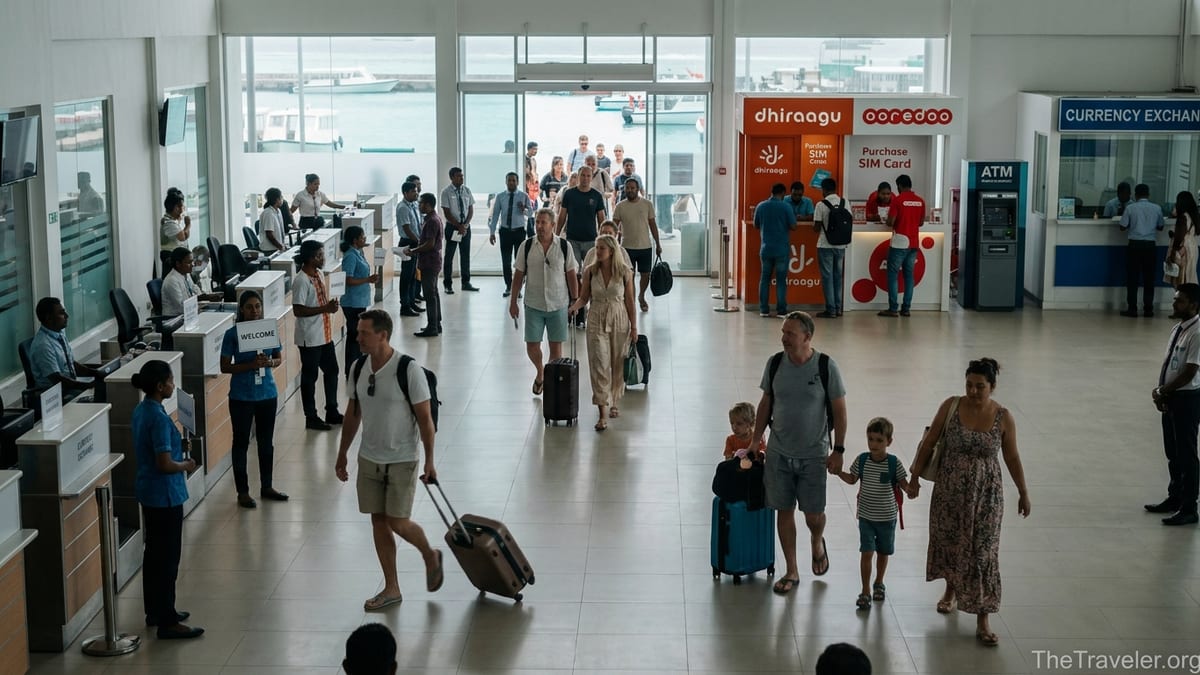
The moment you pass customs doors you step into Velana’s compact arrivals hall, often your first crowded snapshot of the Maldives. Straight ahead and to your right, you will see rows of resort and hotel counters with illuminated signs. These are typically grouped by operator and resort brand, with numbers that may be noted in your pre-arrival email, such as “Counter 12” for a specific island resort group. Representatives usually wear resort uniforms and hold tablets or signs with guest names during peak flight times.
For example, a guest staying at a well-known Indian Ocean brand might receive an email stating, “Our airport team will meet you at Counter 17 in the arrivals area.” After exiting customs, you would walk 20 to 30 meters along the line of counters until you see the number and logo, then check in with staff who will verify your booking, confirm your transfer type, and escort you to the correct pier, seaplane check-in, or domestic terminal. Large resort groups such as Crown & Champa Resorts or certain international chains often have dedicated lounges not far from the counters, where you can wait with refreshments before your transfer.
If you are staying on a local island guesthouse that does not maintain a permanent counter, your host may send a staff member to meet you in the arrivals hall holding a sign. It is common for them to coordinate by messaging apps, so having at least temporary data or airport Wi-Fi access helps. In some cases, especially for budget travelers heading directly to Malé or Hulhumalé, you will not have anyone waiting. In that case, you can walk outside to the ferry pier, taxi rank, or public bus stop following the overhead signs to “Ferry” or “Taxi.”
Passengers connecting to same-day domestic flights within the Maldives, for example to Gan or Maafaru, either follow a representative from their resort or head to the domestic terminal check-in counters a short walk away. The domestic terminal is adjacent to the main building, roughly a 5 to 10 minute walk depending on luggage and crowds. Some resorts arrange for staff to push airport trolleys and shepherd guests through, especially for families with children or older travelers.
Mobile Connectivity and SIM Cards: Getting Online Quickly
Two main operators provide mobile service across the Maldives: Dhiraagu and Ooredoo. Both maintain branded kiosks in the international arrivals area, generally visible as soon as you step into the hall. These counters focus heavily on tourist SIM packages that bundle data with local calls and sometimes messaging app allowances. Staff are used to setting up phones for short-stay visitors and can typically have you online in under 10 minutes.
Recent visitors in 2026 report that popular tourist packages for one to two weeks start around the equivalent of 20 to 30 US dollars for roughly 15 to 30 GB of data, with some offers including local voice minutes. Exact prices change frequently, but the difference between buying at the airport and visiting a city shop in Malé is usually only a few dollars, which many travelers consider worth paying for the convenience of being connected as they leave the terminal.
If you prefer to keep your physical SIM for your home number, ask specifically for an eSIM where supported. Both Dhiraagu and Ooredoo have been gradually expanding eSIM availability, especially for newer smartphones. Airport staff can usually scan a QR code onto your phone so you keep your primary SIM active for banking or two-factor authentication while using a Maldivian eSIM for local data. Make sure your phone is unlocked before you travel, as local staff cannot override carrier locks from your home country.
Coverage at resorts is generally strong around reception, restaurants, and main beaches, given how heavily Maldivian tourism relies on online bookings and communication. However, on more remote islands or sandbanks you may drop to slower speeds or lose signal altogether. Guests planning to work remotely should confirm with their resort whether they rely mostly on Wi-Fi or if mobile data is a reliable backup, and pick a larger data package at the airport if they expect to tether laptops for video calls.
Money, ATMs and Currency Exchange in the Arrivals Area
The local currency is the Maldivian rufiyaa (MVR), though US dollars are widely accepted at resorts and for organized transfers. In the arrivals hall you will find ATMs from banks such as Bank of Maldives and Habib Bank. These machines almost always dispense MVR, and some travelers have noted that one Bank of Maldives ATM near the domestic terminal is among the few that can provide US dollars, useful for tipping or settling small extras where card machines are unreliable.
Withdrawal fees for foreign cards are often around the local equivalent of 5 to 7 US dollars per transaction, on top of any charges from your home bank. For that reason, many visitors make one larger withdrawal instead of several small ones. If most of your stay is at a resort that accepts card payments for everything from spa services to excursions, you may only need a small amount of cash for incidental expenses in Malé or local islands, such as cafe meals, small ferries, or souvenirs.
Next to the ATMs you will usually find a Bank of Maldives exchange counter where you can swap major currencies like US dollars, euros, or pounds for MVR. Airport exchange rates tend to be less favorable than in town, but since most tourists spend little time in Malé itself, convenience often wins. An example pattern many travelers follow is withdrawing or exchanging the equivalent of 100 to 200 US dollars in MVR, which comfortably covers taxi fares, snacks, and small tips for a few days on local islands.
Almost all four and five star resorts now accept major credit cards including Visa and Mastercard, and many also take American Express. Still, system outages do happen on small islands, so carrying at least some backup cash in US dollars is sensible. Keep in mind that any departure taxes or environmental levies such as the Green Tax are usually incorporated into your nightly room rate rather than collected at the airport on arrival.
Transfers: Speedboats, Seaplanes and Domestic Flights
Your onward transfer from Velana to your resort or guesthouse is one of the defining elements of your arrival experience. Resorts within the North and South Malé Atolls typically use speedboats, while islands further afield rely on a combination of domestic flights or seaplanes and then a shorter boat ride. Almost always, your resort or guesthouse either packages the transfer or provides clear instructions on which counter to report to and how the transfer will work.
Speedboat transfers for resorts close to Malé, such as those within about an hour’s ride, can operate well into the evening and sometimes 24 hours a day depending on the property. For example, a resort 20 kilometers from Velana might have scheduled shared speedboat transfers every 1 to 2 hours during the day and early evening, with private charter options later at night. In that case, even passengers landing after 21:00 can usually reach their villa the same night, though a private late-night boat can be significantly more expensive than a daytime shared transfer.
Seaplane transfers, typically operated by Trans Maldivian Airways or Manta Air, are more time-sensitive. They operate under daylight-only conditions, so effective operational hours run from early morning until late afternoon. Many resorts advise guests to arrive at Velana by around mid-afternoon, often citing 15:00 to 15:30 as a preferred latest landing time, to comfortably catch the last seaplane flights of the day. Travelers landing at, for example, 14:45 from Europe will need to move efficiently through immigration and baggage to make a 16:00 seaplane, and even then resort staff sometimes advise booking a first-night stay in Malé or Hulhumalé if any delay is likely.
Domestic flights use conventional aircraft to connect Velana with regional airports across the Maldives. These flights depart from the domestic terminal and often have more flexible schedules than seaplanes, including after dark. A common pattern for remote atolls is: land at Velana, clear formalities, meet your resort or local-agent representative, check in for a domestic flight of 30 to 60 minutes, then take a short speedboat to your final island. Because domestic flight schedules can also change, resorts usually tie your flight booking to your international arrival and automatically rebook if your incoming plane is delayed.
How Long the Whole Airport Process Really Takes
For planning purposes, most tour operators now recommend assuming at least 90 minutes from scheduled landing to reaching the arrivals hall during normal busy periods, especially in the afternoon. This includes deplaning, immigration, baggage claim, and customs. On a quiet morning with off-peak flights you might be through in 45 to 60 minutes, but building in extra buffer time avoids stress, especially if you have a seaplane to catch.
Once you are in the arrivals hall, the time to reach your transfer point depends entirely on your onward mode. Meeting a resort representative and walking to a nearby speedboat pier often takes about 10 to 20 minutes, including a short wait for other guests from the same flight. If the resort uses an airport lounge, you might sit for 30 to 60 minutes while they coordinate shared transfers, during which you can shower, have a snack, and adjust to the humidity.
When a seaplane is involved, add another 30 to 60 minutes to transfer by shuttle to the seaplane terminal, check in, and wait in the lounge before boarding. Many visitors arriving around midday report that they are walking onto their resort island between 2 and 4 hours after landing at Velana, depending on queues and flight loads. Those booked on domestic flights to distant atolls might find that their resort-arranged itinerary allows for several hours of buffer at the airport, which keeps connections safe but can make the day feel long.
The shortest realistic end-to-end arrival scenario is about 45 minutes, where a lightly loaded morning flight lands on time, immigration is empty, bags arrive quickly, and you are heading to a nearby resort by private speedboat. At the other extreme, a delayed evening arrival that misses the last seaplane or domestic connection can mean an unplanned overnight in Malé or Hulhumalé and a new early-morning transfer, effectively extending your total airport-related process to 12 hours or more spread over two days.
Practical Tips to Smooth Your Arrival
A few simple habits make a disproportionate difference to your Velana arrival experience. First, treat the IMUGA declaration like online check-in for your flight: complete it as soon as the 96-hour window opens, take a screenshot of the confirmation, and save it offline in your phone’s photo gallery and email. This avoids relying on airport Wi-Fi if your mobile data is not yet active when an officer asks to see it.
Second, pack a small “airport survival” pouch in your cabin bag with a pen, a printed copy of your resort confirmation, a change of lightweight clothing, and basic toiletries. If your checked luggage is delayed, you can still comfortably continue to your resort while the bag follows. A surprising number of islands have well-stocked boutiques where you can buy essentials like swimsuits or flip-flops if needed, but sizes and prices may not match what you are used to at home.
Third, think about your arrival time in relation to your transfer type when booking flights. If your dream resort requires a seaplane, favor itineraries that land in Malé between late morning and early afternoon rather than in the early evening. For speedboat-accessible properties, a late-night arrival is workable, but you will likely be tired and may not see much scenery on the dark boat ride. Some travelers deliberately book one night in a hotel in Hulhumalé to recover from jet lag, then take a late-morning transfer to their resort when the sun is high and water at its most photo-friendly.
Finally, avoid over-scheduling your first day. Even if everything runs smoothly, the combination of overnight flights, time-zone change, tropical humidity, and multiple transfers is exhausting. Plan for a light first evening at your resort rather than a tight timetable of spa appointments or excursions. That way, any small delays during the arrival process become minor inconveniences rather than trip-ruining problems.
FAQ
Q1. How long does it usually take to clear Velana International Airport on arrival?
Most travelers take between 60 and 90 minutes from landing to exiting into the arrivals hall, depending on immigration queues and baggage delivery. In quiet periods it can be closer to 45 minutes, while busy holiday afternoons can stretch the process to around 90 minutes.
Q2. When should I complete the IMUGA Traveller Declaration form?
You must submit the IMUGA form within 96 hours of your arrival time in the Maldives. Completing it 24 to 48 hours before your flight works well for most people and reduces the risk of having to step out of the immigration line to fill it in at the airport.
Q3. Can I buy a local SIM card at Velana Airport, and how much does it cost?
Yes. Dhiraagu and Ooredoo counters in the arrivals area sell tourist SIMs and, in many cases, eSIMs. Typical short-stay data packages start around the equivalent of 20 to 30 US dollars for roughly 15 to 30 GB of data, with prices varying by promotion and season.
Q4. Do I need Maldivian rufiyaa on arrival, or are US dollars enough?
US dollars are widely accepted at resorts and for pre-arranged transfers, so many visitors use cards and dollars for most expenses. Having some rufiyaa is useful for local ferries, cafes and small purchases on local islands, which you can obtain from ATMs or the Bank of Maldives exchange counter in the arrivals hall.
Q5. How early should my flight land if my resort requires a seaplane transfer?
As a rule of thumb, aim for your international flight to land before mid-afternoon, often no later than about 15:00 to 15:30, to comfortably catch a same-day seaplane. Later arrivals may still connect in some cases, but resorts increasingly recommend an overnight in Malé or Hulhumalé if schedules are tight.
Q6. Where do I find my resort representative after customs?
After customs you will enter the arrivals hall and see a row of resort counters and staff holding signs. Your resort’s pre-arrival email usually lists a counter number or instructs you to look for staff wearing a particular uniform. If you do not see them immediately, stay in the main arrivals area and they will typically locate you based on your flight details.
Q7. Are there ATMs and currency exchange services in the arrivals area?
Yes. There are ATMs from local and regional banks that dispense Maldivian rufiyaa, and at least one nearby Bank of Maldives machine may provide US dollars. A Bank of Maldives exchange counter in the arrivals hall also lets you swap major currencies for local cash, though rates are not as favorable as in town.
Q8. What happens if my checked luggage is delayed or lost?
If your bag does not appear on the carousel, report it immediately to the baggage services or airline desk in the arrivals area. Staff will record your resort details and typically forward the bag to you by later flight and speedboat or domestic transfer. Resorts are used to handling delayed luggage and can often provide temporary toiletries or help you buy basic clothing from the island boutique.
Q9. Can I make a same-day connection from an international flight to a domestic flight within the Maldives?
Yes, many travelers do this, especially when heading to distant atolls. Resorts and local agents usually book the domestic sector to match your arrival time and include buffer for immigration and baggage. A practical minimum is about 2 to 3 hours between scheduled landing and domestic departure, though more buffer is advisable during peak seasons.
Q10. Is it better to stay a night in Malé or Hulhumalé before going to my resort?
It depends on your arrival time and energy levels. If you land late in the evening or risk missing the last seaplane or domestic connection, an overnight in Malé or Hulhumalé allows you to rest and catch a morning transfer in daylight. If you arrive around midday and your resort is reachable by speedboat or afternoon seaplane, most visitors prefer to continue directly to the island.