

More news on this day
Dubai’s sudden airspace shutdown and suspension of flights at both of its major airports have unleashed a wave of global disruption, with European carrier airBaltic among the first to halt services as airlines worldwide scramble to reroute thousands of passengers around a rapidly widening Middle East conflict.
Airspace Closures Ripple Across the Gulf
The United Arab Emirates confirmed a temporary partial closure of its airspace after U.S.-Israeli strikes on Iran and subsequent retaliatory actions raised the risk to civilian aviation across the region. That decision effectively shut down operations at Dubai International Airport and Al Maktoum International, two of the world’s most critical long-haul hubs that together handle tens of thousands of connecting passengers each day.
The shutdown in Dubai came as a cascade of airspace restrictions swept across the Middle East. Iran, Israel, Iraq, Qatar, Kuwait, Bahrain and parts of Syria all imposed closures or severe limitations, leaving flight-tracking maps showing an unprecedented void over one of the world’s busiest aviation corridors. Regulators have warned of a high risk to civil aviation amid active military operations and the potential for further missile or drone activity.
Traffic data from industry analytics firm Cirium highlights the scale of the disruption. Emirates, Qatar Airways and Etihad, which depend on Gulf hubs to link Europe, Africa, Asia and the Americas, have cancelled hundreds of flights, affecting an estimated 90,000 connecting passengers per day. With Dubai now effectively offline as a transit point, the shock is being felt far beyond the region.
Authorities in the UAE have not indicated how long the restrictions will remain in place, describing the situation as fluid and dependent on the evolving security picture. Aviation experts expect a phased reopening of corridors once military planners can guarantee safe separation between commercial and defense operations, but warn that even a short closure can create days of knock-on disruption.
airBaltic Among First European Carriers to Suspend Dubai Flights
Latvian airline airBaltic has emerged as one of the early European carriers to proactively suspend flights into Dubai, underscoring how quickly the fallout from the Middle East crisis has spread across the continent’s aviation network. The airline, which has steadily expanded its long-haul reach via codeshares and seasonal Dubai services, announced the temporary halt as airspace closures made previously routine routings impossible or unsafe.
In a statement, airBaltic said safety considerations and the rapidly changing operational environment left it with no choice but to pause operations to the United Arab Emirates while it evaluates alternative routings and awaits clearer guidance from regulators. Passengers booked on Dubai-bound flights are being offered rebooking on later dates or refunds, with the carrier warning of extended call-center wait times as its teams work through backlogs.
airBaltic’s move is part of a broader wave of suspensions and diversions by European and Asian airlines. Carriers including Lufthansa, British Airways, Air France, KLM and Turkish Airlines have either cancelled services into the Gulf and wider Middle East or reconfigured long-haul routes to avoid closed skies. Some have publicly stated that flights will be re-routed over safer southern tracks, often via Saudi Arabian airspace, adding hours to journey times and inflating fuel burn.
For smaller and mid-sized European airlines like airBaltic, which operate lean fleets with tight utilization, a prolonged closure of Dubai and surrounding airspace threatens to disrupt aircraft rotations, crew scheduling and revenue planning. Analysts say these carriers are likely to take a conservative stance on returning to affected routes, prioritizing operational resilience over short-term market opportunities.
Passengers Stranded as Global Networks Unravel
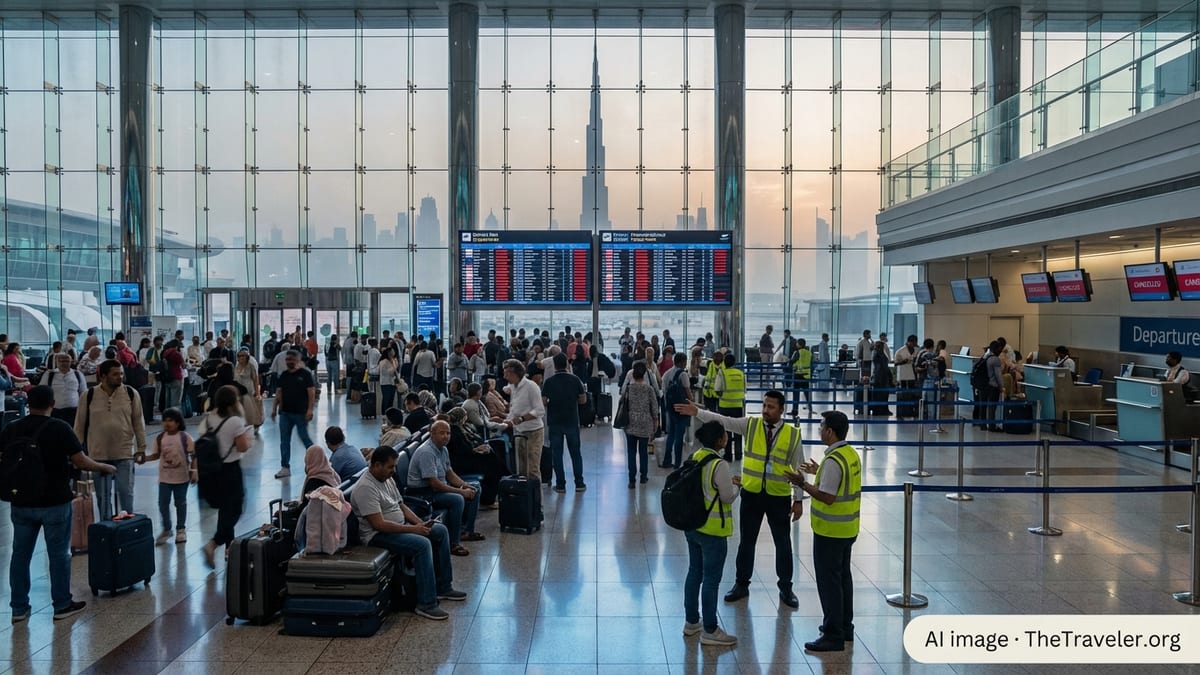
The abrupt shutdown in Dubai and widespread Middle East airspace closures have left hundreds of thousands of travelers stranded or delayed from Asia to North America. At Dubai International alone, passengers awoke to departure boards filled with cancellations, as Emirates and flydubai halted all services to and from the emirate. Similar scenes played out in Abu Dhabi and Doha, where Etihad Airways and Qatar Airways also scaled back or suspended large parts of their schedules.
Travelers en route to the region found their flights diverted to secondary airports or turned back to their origin cities. Long queues formed at airline transfer desks and customer service counters from European gateways to major South Asian hubs as passengers sought rebookings, hotel vouchers and updated onward connections. For many, it was the second or third itinerary change in fewer than 24 hours.
Data from global flight trackers show thousands of delays and more than two thousand cancellations worldwide over the weekend, as aircraft and crews fell out of their planned positions. With Dubai acting as a crucial bridge between Europe, Africa, India and Southeast Asia, the sudden loss of that hub has disproportionately affected migrant workers, family visitors and long-haul leisure travelers who rely on multi-leg itineraries through the Gulf.
Airport authorities outside the Middle East are attempting to absorb the shock. In India, airports such as Ahmedabad reported clusters of Middle East-bound flights delayed, rerouted or put on hold, prompting local help desks and special passenger advisories. European and Asian hubs are bracing for several days of irregular operations as airlines rebuild schedules around alternative routings.
Rerouted Flights, Longer Journeys and Rising Costs
With broad swathes of Middle Eastern airspace now effectively off limits, long-haul carriers have begun to redraw established flight paths, particularly on traffic flows between Europe and Asia. Many flights that previously crossed Iran, Iraq or the Gulf are being sent south, over the Arabian Sea and Saudi Arabia, or north on lengthy detours that skirt the edge of the conflict zone.
These diversions can add anywhere from thirty minutes to several hours of flight time, depending on the route. For airlines already contending with restricted Russian airspace in the wake of the war in Ukraine, the new constraints further squeeze the narrow band of viable corridors, increasing congestion and complicating air traffic management. Industry experts warn that such inefficiencies erode aircraft productivity and require additional buffers in schedules to absorb delays.
Longer routes translate directly into higher fuel consumption at a time when carriers are only beginning to stabilize finances after the pandemic. War-risk insurance premiums are also expected to rise, and airlines may need to keep more spare aircraft and crews available to respond to sudden changes in routing. While ticket prices are unlikely to spike overnight, analysts say sustained disruption would almost certainly feed through into higher fares, especially on heavily impacted Europe to Asia and Asia to North America markets.
For now, airlines are trying to shield passengers from the worst of the turmoil by offering flexible rebooking policies and waiving change fees on affected itineraries. But with thousands of travelers competing for scarce alternative seats, those stuck mid-journey or awaiting departure may still face overnight delays, extended layovers and unexpected stopovers far from their original plans.
Uncertain Timelines and a Cautious Industry Response
As of Sunday, authorities across the region had given no firm timeline for reopening closed airspace or restoring full operations at Dubai’s airports. Aviation safety agencies in Europe and elsewhere have issued conflict zone bulletins advising airlines to avoid affected skies, and most carriers are expected to continue erring on the side of caution until the threat of further attacks subsides.
Industry consultants note that commercial aviation has become increasingly adept at navigating regional conflicts by dynamically adjusting routings, but emphasize that the combination of Middle East closures and existing bans over Russia creates an unusually tight environment for global traffic flows. Extended closures around Dubai in particular would test the resilience of hub-and-spoke networks that rely on predictable transit through the Gulf.
For passengers, the immediate advice is clear: check flight status frequently, register for airline alerts, and prepare for potential schedule changes even if flights remain nominally confirmed. Travelers with nonessential trips to or through the region are being urged by many carriers to consider postponement or to opt for routings that avoid the Middle East entirely where possible.
airBaltic, along with other European and Asian airlines, has framed its Dubai suspensions as temporary and subject to continuous review. Yet with the crisis still unfolding and military operations ongoing, there is growing recognition across the industry that the Middle East’s role as a dependable global aviation crossroads has entered one of its most uncertain periods in recent history.