


More news on this day
Air travel across Dubai and the wider Middle East is entering a volatile new phase as the United States and Iran move toward a landmark peace agreement that could reopen key air corridors yet leave carriers navigating persistent security and geopolitical risks.
Get the latest news straight to your inbox!
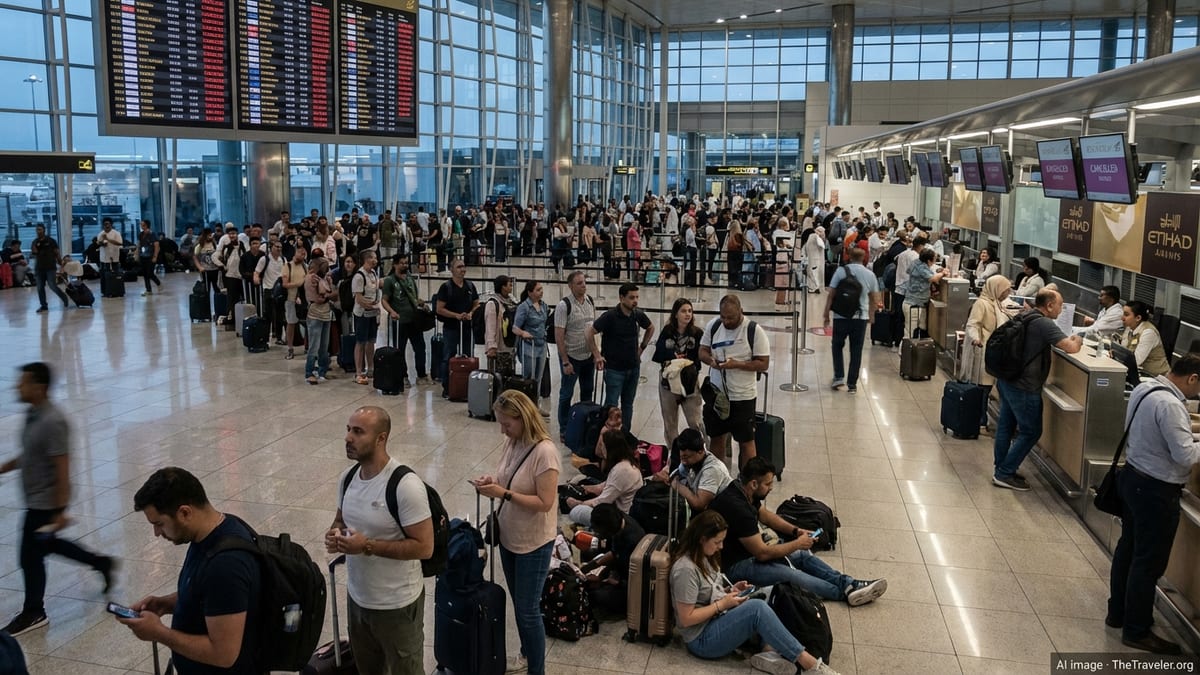
Shifting skies over the Gulf aviation hub
Dubai’s position at the crossroads of Europe, Asia and Africa has made it especially sensitive to every twist in the conflict between the United States and Iran. Over recent days, as public information has pointed to an interim peace framework and digital signatures on an agreement, Middle East hubs have faced a patchwork of delays, diversions and precautionary scheduling changes.
Published coverage from regional outlets indicates that some airlines transiting Iranian airspace have continued to route flights more conservatively, maintaining detours around the Strait of Hormuz and parts of the Gulf while operational risk assessments catch up with the latest political developments. Longer routings have added time and fuel costs to certain services linking Europe and North America with South and Southeast Asia.
At Dubai International and Dubai World Central, passenger disruption so far appears to be concentrated in selected long haul departures that would normally overfly Iranian territory or closely adjacent airspace. Publicly available flight tracking data shows isolated delays rather than wholesale cancellations, but analysts in the Gulf aviation sector caution that schedule stability will depend on how quickly airspace restrictions are formally relaxed.
Industry observers note that Dubai’s main carriers built substantial contingency capacity during the height of the conflict, including flexible crew rostering and reserve aircraft. That has helped limit visible disruption to passengers even as planners continue to adjust routings day by day in response to changing security guidance and the evolving peace timetable.
Airspace restrictions and gradual reopening
The anticipated US Iran agreement is closely tied to the partial reopening of the Strait of Hormuz and surrounding sea lanes, which in turn influence aviation risk assessments. According to widely circulated diplomatic summaries, the framework foresees a phased relaxation of military restrictions and maritime controls, with key milestones linked to the formal signing expected later this week.
While commercial overflights are not explicitly grounded by these maritime provisions, civil aviation authorities typically mirror military de escalation with updated notices to air missions, or NOTAMs, that define which routes are considered acceptable. So far, publicly available NOTAM summaries suggest that many of the most restrictive warnings issued at the peak of the crisis remain in place, reflecting caution while ceasefire terms are tested in practice.
Security analysts in Europe and the Gulf say that even once airspace advisories are softened, some airlines are likely to maintain more southerly or northerly tracks for a transitional period. Carriers headquartered outside the region, in particular, may opt for conservative routings until there is clear evidence that risks from stray missiles, air defense activity or miscalculation have materially diminished.
For Dubai, that means the current pattern of marginally longer flight times on select routes may persist beyond the formal signing of any peace deal. Aviation specialists point out that a similar lag occurred after previous regional flare ups, when schedules normalized only gradually as insurers, regulators and security teams updated their risk models.
Operational challenges for Gulf and global carriers
The prospect of a peace deal brings opportunities for airlines, but also complex near term operational challenges. According to business and energy media, global markets have already reacted to the easing of war risk premiums, with shipping and oil traders positioning for a more open Strait of Hormuz. Airlines, by contrast, must grapple simultaneously with crew duty limits, aircraft rotation and airport slot constraints when rerouting around sensitive areas.
In Dubai, large connecting banks of flights are particularly vulnerable to knock on effects if even a small number of long haul services arrive late. Aviation analysts say that hub carriers have been prioritizing passenger connections with the smallest buffers, occasionally holding departures to preserve key itineraries while rebooking travelers from more flexible journeys.
Some airlines serving the Middle East from Europe and Asia have issued general advisories about potential delays and schedule adjustments, citing the fluid security environment and the expected reconfiguration of airspace corridors once peace terms take effect. Travel industry consultants recommend that passengers flying through Dubai and other Gulf hubs in the coming days monitor their bookings closely and allow extra time for connections where possible.
Aircraft leases, maintenance windows and crew layover patterns are also being revisited. If Iranian airspace becomes reliably available again, carriers could shorten flight times and free up capacity for additional frequencies or new routes. Until that shift is confirmed in official guidance, however, planners are likely to remain conservative, prioritizing resilience over aggressive schedule expansion.
Passenger demand and confidence in the wake of conflict
The drawn out conflict and naval blockade in and around the Strait of Hormuz had already tempered demand for some Middle East itineraries, particularly among leisure travelers from North America and parts of Europe. As headlines about a peace agreement circulate, early signs from booking platforms and travel agencies suggest a modest uptick in interest for winter season travel that routes through Dubai and other Gulf hubs.
Market strategists following airline stocks have interpreted the likely easing of the crisis as broadly positive for the sector, especially for carriers with heavy exposure to fuel costs and long haul intercontinental networks. However, several research notes published this week caution that demand recovery could be uneven, with some passengers remaining wary of itineraries that cross or approach Iranian territory even after a formal deal is signed.
Corporate travel managers contacted via industry surveys report a gradual return of business itineraries involving the Gulf, though many companies are still requiring additional internal approvals for trips that involve overnight stays in certain Middle East cities. Insurance conditions and duty of care obligations mean that institutional travelers may move more slowly than individual tourists in adjusting their risk thresholds.
For Dubai, which relies heavily on its reputation as a stable, high connectivity hub, perceptions will be almost as important as the legal terms of the US Iran agreement. Tourism officials and airlines are expected to highlight improved security assessments once they are reflected in international aviation advisories, seeking to reassure both regional and long haul travelers.
What to watch as the peace deal moves toward signing
As the United States and Iran prepare for a formal signing ceremony, currently indicated for later this week, several developments will be critical for the aviation sector. The first is the precise language of any public annexes related to airspace, missile deployments and air defense postures in and around the Gulf, which will inform subsequent security assessments.
The second is how quickly civil aviation regulators in the United States, Europe and key Asian markets update their own guidance to airlines regarding overflights of Iranian territory and adjacent waters. In past crises, such advisories from agencies in Washington, Brussels, London and other capitals have strongly influenced routing decisions, even for carriers based far from those jurisdictions.
A third factor will be the behavior of other regional actors, including Israel and non state groups in Lebanon and elsewhere, whose actions could influence risk perceptions independent of US Iran relations. Analysts note that any renewed missile exchanges or cross border clashes could slow or complicate the normalization of air routes, even if the core peace deal between Washington and Tehran holds.
For travelers contemplating itineraries through Dubai and the wider Middle East, the coming days are likely to bring a mix of reassurance about de escalating conflict and persistent practical uncertainty about schedules and routings. The region’s airlines, long accustomed to operating in a volatile geopolitical environment, are once again being tested on their ability to adapt their networks in real time to fast moving events.