


More news on this day
Dubai’s property market is entering 2026 in notably firmer shape than many global peers, as record tourism inflows, sustained population growth and a deep pipeline of hospitality projects help anchor real estate prices and investment appetite across the United Arab Emirates.
Get the latest news straight to your inbox!
Tourism Outperforms Even as Global Risks Mount
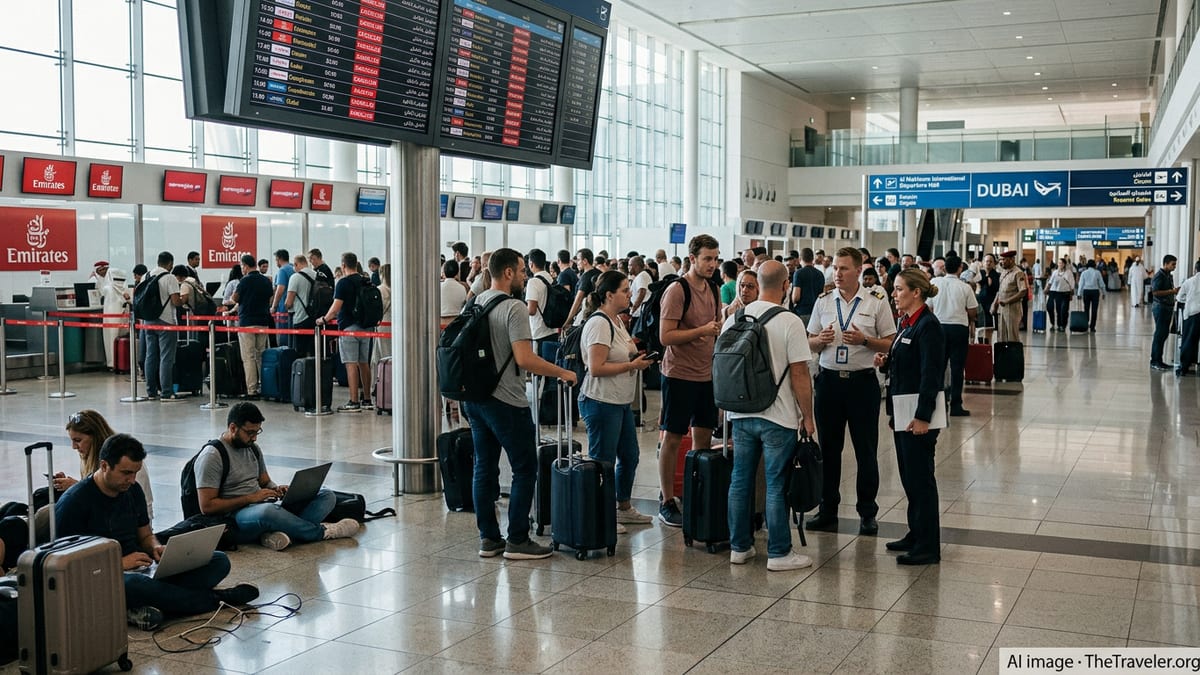
While many destinations are wrestling with softer visitor demand amid geopolitical tensions and slower global growth, Dubai continues to post record-breaking tourism numbers that are feeding directly into real estate performance. Government tourism data and international rankings show the emirate welcomed close to 19.6 million international overnight visitors in 2025, marking a third consecutive year of record arrivals and building on the 18.7 million visitors recorded in 2024. International observers note that this places Dubai among the world’s most visited cities, with visitor spending that ranks near the top of global charts.
Passenger traffic through Dubai International Airport underscores the same momentum. Published coverage indicates the hub handled around 95 million passengers in 2025, a new high that reflects both its role as a key connector between Europe, Asia and Africa and the city’s pull as a tourism and business hub. That mix of leisure and corporate travelers has helped keep hotels busy and supported demand for short-term rental properties and branded residences tailored to affluent visitors.
At the broader UAE level, recent national tourism statistics for 2024 point to roughly 28 million international overnight visitors and tens of billions of dollars in tourism revenue, with the sector’s direct contribution to GDP approaching 12 percent and its wider contribution estimated at more than 15 percent. Dubai accounts for the majority of those arrivals, underlining how the emirate’s visitor economy has become a central pillar of the country’s growth story and a stabilizing force for property income streams.
Analysts highlight that this tourism outperformance is taking place against a backdrop of higher borrowing costs, weaker property cycles and political uncertainty in other regions. The contrast is reinforcing perceptions of the UAE, and Dubai in particular, as a relatively insulated and well-managed safe haven for international capital seeking both yield and lifestyle benefits.
Real Estate Resilience Built on Robust 2024–2025 Gains
The tailwind from tourism has fed through clearly into Dubai’s residential and commercial metrics over the past two years. A 2025 real estate predictions report from a global consultancy pointed to a roughly 20 percent rise in average residential sales prices in 2024, alongside a nearly similar jump in rental rates. Prime office rents also climbed by double digits, with occupancy rates among the highest globally as multinational firms and regional headquarters expanded their presence.
Independent market updates for 2024 and 2025 describe record transaction volumes across off-plan and ready properties. One Dubai-focused analytics group estimated that total Dubai Land Department transactions reached more than 260,000 in 2025, up almost a fifth from 2024, with apartments still dominating activity but villas capturing a growing share of deals as buyers sought more space and community amenities. That depth of activity has helped underpin valuations even as policymakers and lenders introduced measures to cool speculative heat.
Real estate consultancies say the office and hospitality sectors are posting similarly resilient numbers. Research from international brokers shows Dubai’s office occupancy approaching the mid-90 percent range in some prime districts by late 2025, while hotel performance indicators such as occupancy and revenue per available room continue to rise on the back of the tourism surge. These conditions have encouraged new development launches in mixed-use districts that blend hospitality, residential and flexible office space closely tied to tourism corridors.
Market commentators widely characterize the shift underway in 2026 as a move from rapid price acceleration to more sustainable growth. With interest rates still relatively high globally and affordability stretched for some local households, analysts expect annual price gains in the mid-single to high-single digits rather than the double-digit increases seen immediately after the pandemic. Even so, yields in mid-market areas remain ahead of many competing global cities, sustaining investment interest from regional and international buyers.
Tourism-Led Demand Shapes Residential and Hospitality Segments
Much of the current stability in Dubai’s property market is rooted in how tourism influences demand for both homes and hospitality assets. Visitor numbers now comfortably exceed pre-pandemic levels, and hotel occupancy has hovered around or above the 80 percent mark through much of 2025, according to industry reports. That performance has emboldened developers to roll out more hotel-branded residences and serviced apartments aimed at investors who want exposure to tourism-linked rental income.
The short-stay and holiday-home segment has also deepened. Platforms tracking licensed holiday homes in Dubai point to steady growth in inventory, particularly in beachfront and central districts such as Dubai Marina, Jumeirah Beach Residence, Downtown and Business Bay. Tourism operators report that average daily visitor spending in Dubai is among the world’s highest, supporting premium nightly rates that filter back into valuations for buildings catering to high-spend visitors and business travelers.
Across the UAE, emirates such as Abu Dhabi and Ras Al Khaimah are pursuing similar tourism-led repositioning, emphasizing cultural attractions, theme parks and coastal resorts. Real estate research covering the wider UAE market notes that these strategies are creating new nodes of hospitality and residential demand while relieving some pressure from Dubai’s core districts. Nevertheless, Dubai remains the primary magnet for regional events, conferences and entertainment, ensuring that tourism-led demand there remains at the center of many investment decisions.
Developers and portfolio managers are increasingly tailoring projects to these tourism patterns. Mixed-use waterfront schemes, destination malls integrated with hotels, and transit-oriented communities near the airport and cruise terminals are all benefiting from higher footfall. In parallel, the long-stay tourism trend, supported by remote work and flexible residency visas, is encouraging more visitors to transition into medium- and long-term rentals, tightening occupancy in popular residential communities.
Population Growth and Policy Support Underpin 2026 Outlook
Tourism is only one side of the demand story. Demographic data compiled from Dubai’s statistics authorities and private-sector research suggest the emirate’s resident population surpassed 4 million in 2025, with net growth of around 200,000 people in a single year. Analysts emphasize that this influx has come from a combination of skilled professionals drawn by job creation in finance, technology and logistics, as well as entrepreneurs and high-net-worth individuals attracted by the city’s tax framework and lifestyle.
Population growth has tightened rental markets even as new supply is delivered. Data collated from tenancy contract registries indicate hundreds of thousands of active rental contracts in early 2026, with cancellations trending lower year on year. While rental growth has moderated from the sharp increases of 2022 and 2023, especially for apartments, net absorption remains positive in most segments, and mid-income communities continue to post some of the strongest gross yields.
Policy initiatives have played a visible role in sustaining confidence while tempering excesses. The UAE’s golden visa schemes, long-term residency options for investors and professionals, and the expansion of free-zone ecosystems have supported steady inflows of capital and talent. At the same time, macroprudential steps, including higher down-payment requirements for some mortgage borrowers, have sought to curb speculative leverage. Market observers say this mix has helped shift the tone of Dubai’s property cycle in 2026 toward stability rather than boom-and-bust.
Forward-looking supply indicators suggest a significant but manageable pipeline. Research drawing on Dubai Land Department and planning data points to roughly 100,000 residential units scheduled for delivery between 2025 and 2028, with a noticeable concentration in master-planned communities along new transport links. Analysts note that while any short-term oversupply in specific submarkets could pressure prices, the combination of ongoing tourism strength and population growth is expected to absorb much of the new stock over the medium term.
Safe-Haven Status Amid Global Economic Uncertainty
The resilience of Dubai and the wider UAE property market in 2026 is increasingly framed against a global backdrop marked by geopolitical flashpoints, uneven post-pandemic recoveries and tighter financial conditions. Publicly available coverage of cross-border capital flows shows international investors continuing to allocate to Dubai real estate, often citing the emirate’s relative political stability, business-friendly reforms and pegged currency as key attractions.
Data compiled by transaction trackers and brokerage houses indicate that foreign buyers accounted for a significant share of high-value deals in 2025, including in ultra-prime villa communities and branded apartment towers. Investment inflows have come from a diversified range of countries in Europe, Asia and the wider Middle East, helping to reduce reliance on any single source market at a time when sanctions regimes and capital controls are reshaping global wealth flows.
At the same time, research on the economy of Dubai highlights how real estate is now supported by a broader base of activity spanning aviation, tourism, logistics and financial services. This diversification has helped cushion the sector from commodity price swings and sector-specific shocks that previously weighed on Gulf property markets. As a result, even if global growth slows further in 2026, many analysts expect Dubai’s real estate values to adjust gradually rather than undergo abrupt corrections.
Market reports stress that risks remain, from potential interest-rate volatility to regulatory changes in key investor source markets. However, the combination of record tourism, expanding population, ongoing infrastructure investment and measured policy oversight has so far allowed Dubai’s property market to defy some of the global tensions facing real estate. For now, the city’s tourism-fueled momentum looks set to continue underpinning prices and transaction volumes across the UAE as 2026 unfolds.