

More news on this day
Thousands of travelers across Egypt, Lebanon, Saudi Arabia, the UAE and beyond are facing cancellations, diversions and long delays after EgyptAir abruptly suspended dozens of regional flights in response to fast-expanding airspace closures triggered by the latest military escalation in the Middle East.
EgyptAir Halts Key Regional Routes as Crisis Deepens
EgyptAir, the Egyptian flag carrier, has temporarily suspended services from Cairo to a wide swath of Middle Eastern destinations, cutting off direct links to major hubs in the Gulf and Levant. The carrier initially halted flights to 13 cities, including Dubai, Abu Dhabi, Sharjah, Doha, Kuwait, Bahrain, Muscat, Amman, Dammam, Qassim, Erbil, Baghdad and Beirut, as neighboring states shut their skies amid intensifying conflict.
In updated notices issued between February 28 and March 1, 2026, the airline confirmed it would continue suspending flights to at least 11 of these destinations until further notice, with Cairo connections to Dubai, Abu Dhabi, Sharjah, Beirut, Doha, Amman, Dammam, Bahrain, Baghdad, Erbil and Kuwait all remaining off the schedule. The carrier has activated its Integrated Operations Control Center crisis room in Cairo to monitor developments around the clock and coordinate with civil aviation authorities.
EgyptAir has stressed that the decision is rooted in safety and regulatory constraints rather than aircraft or crew shortages. With airspace over Iran, Israel, Iraq, Jordan, Qatar, Kuwait and the UAE either fully or partially closed, many of the airline’s traditional corridors for reaching Gulf and Levantine cities have become inaccessible or subject to rapidly changing restrictions.
Passengers holding tickets on the affected routes have been urged to review their bookings through call centers or sales offices. However, with no firm timeline for resuming services, many travelers are choosing to cancel outright and seek refunds, while others are scrambling to rebook via alternative hubs that are themselves under mounting strain.
Grounded Travelers Face Disruptions in Cairo, Beirut, Dammam and Dubai
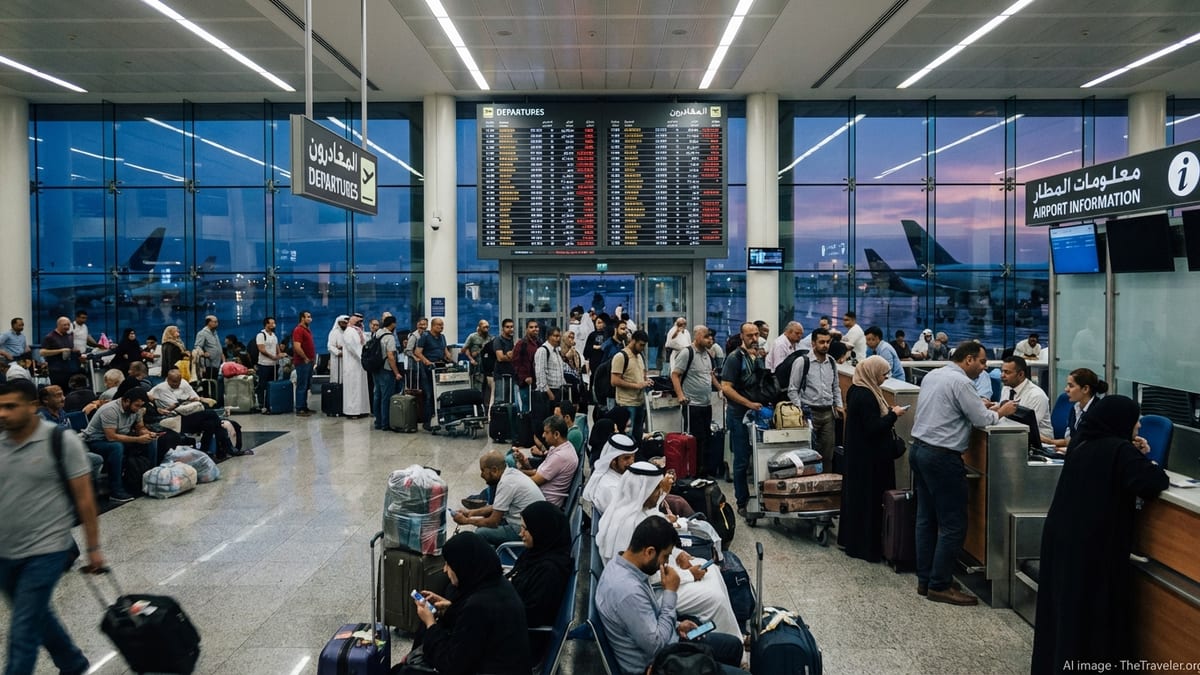
At Cairo International Airport, the immediate impact has been visible in crowded departure halls, snaking rebooking queues and clusters of stranded passengers camped near information desks. Egypt’s Ministry of Civil Aviation reported that on March 1 alone, 47 flights from Egypt to Arab Gulf destinations were cancelled out of 116 scheduled movements, underscoring the scale of the disruption to outbound and transit traffic.
In Beirut, where EgyptAir has suspended its Cairo link, Rafic Hariri International Airport has seen a mix of cancellations and diversions as multiple carriers navigate the same airspace constraints. Travelers who relied on Cairo as a primary transfer point to Africa and Europe have been particularly hard hit, facing long waits before they can secure new itineraries through alternative hubs such as Istanbul or European gateways.
Saudi Arabia’s Dammam and other Gulf airports are also contending with the fallout. While domestic and certain regional services continue, the loss of EgyptAir’s Cairo connections and similar moves by other regional airlines have sharply reduced options for passengers attempting to travel onward to North Africa. Many are being routed on complex multi-stop journeys that add hours, if not days, to travel times.
Dubai, traditionally one of the most resilient and well-connected hubs in global aviation, has been among the hardest hit by the broader wave of airspace closures. Authorities there temporarily suspended all flights at Dubai International and Al Maktoum International, forcing carriers to cancel or return flights mid-route. For EgyptAir customers, the shutdown of Cairo to Dubai services effectively severs one of the busiest corridors between North Africa and the Gulf.
Airspace Closures Redraw Regional Aviation Map
The EgyptAir suspensions are part of a far larger upheaval sweeping through Middle Eastern aviation following coordinated US and Israeli strikes on Iran and subsequent retaliatory missile and drone attacks. In response, Iran, Israel, Iraq, Jordan, Qatar, Kuwait and the UAE have all temporarily closed portions of their airspace, eliminating critical east-west flight paths and forcing airlines into costly and time-consuming reroutes.
With Russian airspace already heavily restricted for many Western carriers due to the war in Ukraine, the sudden loss or reduction of key Middle Eastern corridors has intensified pressure on remaining routes. Airlines that typically rely on Gulf hubs for Europe-Asia connectivity now face longer track miles, additional fuel burn, higher insurance premiums and complex operational planning to keep services running.
Industry analysts note that the immediate effect is an aviation gridlock centered on Gulf and Levant hubs, where cancellations ripple outwards to affect flights that do not even cross the conflict zone. For EgyptAir, whose regional network is heavily oriented toward Gulf traffic, the closure of nearby airspace has left little room to operate safely without extensive diversions that would undermine both schedules and commercial viability.
Regulators have heightened warnings as well. The European Union Aviation Safety Agency has flagged a high risk to civil aviation in affected airspace and advised carriers to avoid several conflict-adjacent flight information regions. Many airlines have interpreted this guidance conservatively, opting for sweeping suspensions rather than piecemeal rerouting that could be upended by further military activity.
Egypt’s Airports Turn Into Emergency Transit Nodes
Even as EgyptAir’s regional network has contracted, Egyptian airports have taken on a new role as emergency transit nodes for foreign airlines seeking safe diversion points. Civil aviation officials say that Egyptian airports received at least 22 diverted international flights on February 28 and March 1, including 12 into Cairo and another 10 spread across Sphinx, Alexandria, Hurghada, Sharm El Sheikh and Luxor.
These diverted flights have injected sudden surges of passengers into terminals not fully geared for long-haul transit disruption, straining ground handling resources, immigration desks and hotel capacity in nearby districts. Authorities say they are coordinating closely with carriers and tourism stakeholders to manage accommodation, onward travel and basic services for travelers forced into unexpected layovers.
For Egypt, the situation presents both a logistical challenge and a strategic opportunity. With its own airspace still open and operating normally, the country has positioned itself as a relatively safe corridor on the edge of the crisis zone. However, the benefits of additional diverted traffic are tempered by the reality that EgyptAir itself has lost key regional routes and that uncertainty over the trajectory of the conflict could quickly alter current patterns.
Officials emphasize that safety remains the overriding priority. Any consideration of restoring Cairo’s suspended links to Dubai, Beirut, Dammam and other hubs will depend on the reopening of neighboring airspaces, stabilization of military activity and updated guidance from international aviation bodies.
Passengers Navigate Waivers, Rebookings and Rising Uncertainty
As the disruption stretches into its fourth day, travelers across the region are confronting a messy patchwork of airline waivers, schedule changes and rolling cancellations. EgyptAir is allowing affected customers to review bookings and seek alternative travel dates or refunds, but specific conditions vary by ticket type and point of purchase, leaving some passengers confused about their options.
Other carriers serving the Middle East, including major Gulf and European airlines, have issued their own travel waivers as they suspend or reduce services to cities such as Dubai, Doha, Amman and Beirut. In practice, this means that a single multi-leg itinerary can involve several different policies, complicating attempts by stranded travelers to chart new routes home.
Travel agents across Cairo, Beirut and Gulf cities report a spike in last-minute requests as clients attempt to rebook via still-operational hubs or secure rare remaining seats on indirect routings. Fares on certain routes have climbed quickly as capacity tightens, particularly on flights connecting through Istanbul, Athens and select European capitals that currently skirt the most restricted airspace.
For now, both airlines and passengers are operating on short horizons, with many carriers updating schedules in 24-hour cycles. Without clarity on when regional skies will fully reopen, EgyptAir’s suspension of dozens of flights and the broader grounding across Egypt, Lebanon, Saudi Arabia, the UAE and other states signal a prolonged period of volatility for travelers and the aviation industry alike.