

Emergency medical care is a critical risk factor for anyone considering relocation to Mexico. While the country offers a broad network of hospitals and clinics, the way emergency care is organized, funded, and delivered differs significantly from systems in North America and Europe. Understanding those differences in advance is essential for realistic risk assessment and financial planning.
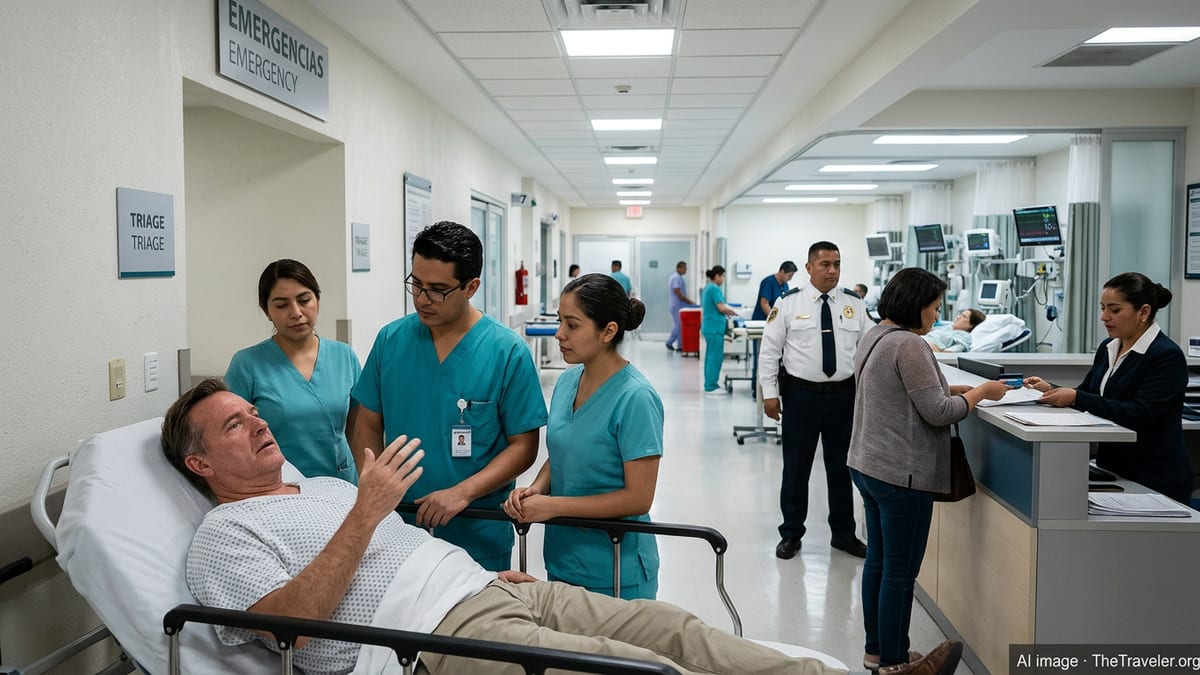
Structure of Emergency Medical Care in Mexico
Mexico operates a mixed public and private healthcare system that directly shapes what expatriates can expect in an emergency. Public services are mainly delivered through large national institutions that serve Mexican workers and low-income residents, while a dense private hospital sector caters increasingly to middle-class Mexicans and foreign residents. Roughly two-thirds of all hospitals in Mexico are private and one-third public, indicating that paid, market-based care is a major component of overall capacity in the country.
For true emergencies, hospital emergency departments in both public and private facilities can provide urgent care to anyone physically present, including foreign nationals. However, there is a practical divide in access and experience. Public emergency departments are usually more crowded, with longer waits and basic infrastructure, while private facilities often have shorter waits, more English-speaking staff in major cities, and more advanced diagnostic equipment. Expatriates who rely on emergency care typically do so through private hospitals, particularly in large urban centers and established expat destinations.
Emergency medical services in the pre-hospital phase are delivered by a combination of public ambulance services, private ambulance companies, and volunteer or charitable organizations. In major cities, response times and clinical capabilities may approach those in developed systems, but in smaller cities and rural areas, ambulance availability, equipment, and staff training can be variable. Many higher-income residents and expatriates rely on private ambulance memberships or insurance-linked providers to improve response times and quality.
The system is not designed around automatic entitlement for non-citizens. Non-resident foreigners are generally treated as private patients by default. This means emergency care is available but is not automatically subsidized, and financial responsibility is assumed to rest with the patient or their insurer.
Access, Triage, and Emergency Pathways
Mexico uses 911 as the national emergency number, and calls can be routed to medical, fire, or security services. In urban areas, 911 dispatchers can connect callers with public ambulances or, in some locales, coordinate with authorized private ambulance providers. Response quality varies by state and municipality, and in some regions expats report faster, better-equipped service from private ambulance companies than from public providers.
In serious emergencies, patients may be taken either to the nearest public hospital or to a designated private facility, depending on the ambulance provider, the patient’s stated preference, and any existing contractual arrangements with insurers. For expatriates, this routing decision is strategically important. Public hospitals can stabilize life-threatening conditions at very low direct cost, but comfort, privacy, language support, and follow-up planning are often limited. Private hospitals usually offer a significantly better experience but expect clear evidence of payment capacity from the outset.
Within hospitals, triage broadly follows standard medical urgency principles. Critical cases receive priority assessment and stabilization, but non-life-threatening conditions may wait significantly longer in busy public facilities. Available data indicate that average emergency department waiting times in public institutions can easily exceed one hour, while private facilities typically report much shorter waits. Expatriates who want predictable access to rapid emergency care tend to register in advance with nearby private hospitals in their city of residence.
In practice, the optimal pathway for many expats is to use public services only for initial life-saving stabilization if absolutely necessary, then transfer to a private hospital once stable and once payment arrangements are confirmed. This dual-pathway approach requires prior planning, including identification of acceptable private facilities and confirmation of coverage with insurers.
Quality of Care, Staffing, and Geographic Variation
Quality of emergency medical care in Mexico is heterogeneous and strongly location-dependent. Major metropolitan areas such as Mexico City, Guadalajara, and Monterrey, as well as established international hubs, host tertiary private hospitals with modern emergency departments, intensive care units, and specialist coverage. These facilities often operate to standards broadly comparable with mid-range North American private hospitals, including modern imaging, 24-hour specialist availability, and international accreditation in some cases.
Public hospitals can provide high-quality emergency care for complex conditions but may suffer from chronic resource constraints, including high bed occupancy, limited intensive care capacity, and shortages of certain drugs or consumables. Historically low levels of hospital beds per 1,000 inhabitants compared with OECD averages translate into crowding and delays in some public emergency departments. This affects both Mexican citizens and any foreigners who rely on public services during an emergency.
Staffing patterns are similarly uneven. Large urban teaching hospitals may have well-trained emergency physicians and residents, while smaller regional or rural hospitals may rely heavily on general practitioners without formal emergency medicine specialization. English proficiency among clinical staff is often better in private urban hospitals and in regions with significant tourism or expatriate presence, but cannot be assumed, particularly on night shifts or in smaller towns.
For relocation planning, an expatriate’s risk exposure is therefore highly sensitive to geography. Living within reasonable distance of a modern private hospital and credible ambulance provider substantially changes the risk profile compared with residing in remote or underserved areas where pre-hospital care and higher-level facilities may be limited or far away.
Costs, Billing Practices, and Payment Expectations
Emergency medical care in Mexico is generally less expensive than in the United States or Western Europe but can still be financially significant, especially at private hospitals and for serious conditions. Typical published ranges for emergency consultations in private facilities start from roughly the equivalent of a few hundred to low thousands of Mexican pesos, often translating into about 50 to 150 US dollars for a straightforward emergency room doctor assessment. More complex emergency visits that include imaging, laboratory tests, and short observation can escalate into several hundred to over one thousand US dollars, depending on the hospital level and city.
In public hospitals, out-of-pocket costs for emergency visits can be much lower, often in the range of modest consultation fees and subsidized procedures. However, public system reforms and local policy differences mean that actual charges for uninsured foreigners may vary and can be higher than those for enrolled Mexican beneficiaries. For expatriates, public care is usually a financial backstop rather than a primary strategy, due to non-financial trade-offs such as comfort, waiting times, and language barriers.
For serious emergencies requiring surgery, intensive care, or prolonged hospitalization in a private setting, total bills can reach five figures in US dollars. Intensive care unit costs in some higher-end private hospitals can amount to several thousand US dollars per day, particularly when advanced equipment, specialized drugs, or multiple specialists are involved. These amounts remain lower than typical charges in many high-income countries but are high enough to cause financial distress for uninsured or underinsured expats.
Payment practice is one of the most important operational differences for foreigners. Private hospitals in Mexico commonly require proof of insurance with direct billing arrangements or a substantial deposit, often several thousand US dollars, before providing non-life-saving interventions or accepting inpatient admission. In many facilities, ongoing treatment is contingent on regular settlement of interim bills. Expats who cannot demonstrate payment capacity may be redirected to public hospitals after initial stabilization, which can be disruptive during a critical health event.
Insurance, Direct Billing, and Air Evacuation Risk
For expatriates, financial protection for emergency care in Mexico typically rests on a combination of local or international health insurance and, where desired, separate emergency medical evacuation cover. Standard Mexican private health insurance or international expat policies that include inpatient and emergency benefits can substantially reduce out-of-pocket exposure, but only if the policy is accepted by local hospitals and, ideally, enables direct billing. Without direct billing, patients are often expected to pay the hospital in full and seek later reimbursement from the insurer, which can be logistically difficult in a crisis.
Emergency medical evacuation is a distinct and often underestimated risk. While many emergencies can be managed entirely within Mexico’s higher-level private hospitals, some expatriates prefer or require transfer to facilities in their home country for highly specialized care or for long-term management near family support. Air ambulance and medical repatriation costs from Mexico to the United States or Canada are substantial. Published estimates for short international air ambulance transfers from Mexico to the southern United States often fall roughly in the 30,000 to 75,000 US dollar range, with total costs sometimes exceeding 100,000 dollars for complex cases. Some sources note that medical evacuations from Mexico commonly start in the 15,000 to 25,000 dollar band, with upper-end scenarios approaching or exceeding 200,000 dollars when distance, critical care equipment, and medical staffing are taken into account.
These costs usually must be guaranteed in full before transport begins. Standard international health insurance may cover emergency evacuation only to the nearest adequate facility, not necessarily back to the expatriate’s home country. Dedicated medical evacuation or repatriation memberships can fill this gap but need to be carefully reviewed to understand geographic scope, eligibility conditions, and pre-existing condition limitations.
For relocation decision-making, the implication is that emergency risk in Mexico includes not only local hospital costs but also the low-probability yet high-impact scenario of international medical transport. Expats with chronic conditions, advanced age, or limited financial reserves should evaluate whether evacuation cover is effectively mandatory for their risk tolerance.
Practical Preparedness for Expats Facing Emergencies
Proactive preparation can significantly improve outcomes when emergencies occur in Mexico. At a minimum, expatriates should identify at least one reputable private hospital with a 24-hour emergency department within reasonable travel time of their residence, and confirm accepted insurance networks and payment policies. Many expats choose to register their details in advance with preferred hospitals or clinics, which can streamline admission and billing verification during an acute event.
Compiling a personal emergency file is strongly recommended. This typically includes passport copies, local identification numbers, insurance cards and policy summaries, a list of current medications, critical medical history translated into Spanish, and emergency contacts both in Mexico and in the home country. Having this information physically and digitally accessible can reduce delays in triage, consent, and clinical decision-making, particularly when language differences arise.
Ambulance access also merits specific planning. In some cities, private ambulance companies offer subscription models or per-use services that provide more reliable response times and higher service standards than stretched public systems. Expats should obtain key phone numbers, clarify which ambulance providers work with their preferred hospitals, and understand any membership or pre-registration requirements.
Finally, expatriates should consider realistic scenarios in which they may initially be taken to a public hospital for stabilization and then transferred to a private facility or evacuated internationally. Understanding in advance how to request transfer, who can authorize it, and how costs will be handled can prevent confusion during a critical window when clinical and logistical decisions must be taken quickly.
The Takeaway
Emergency medical care in Mexico offers a wide spectrum of possibilities for expatriates, from low-cost public services to modern private hospitals with advanced capabilities. The system is accessible to foreigners, but not on the same entitlement basis that many expats may know from universal systems in their home countries. Payment capacity and insurance design play central roles in determining where and how an expat will be treated during an emergency.
In general, expatriates who live within reach of quality private hospitals, carry robust health insurance with direct billing and evacuation benefits, and prepare operationally for ambulance access and documentation can expect emergency care experiences that are broadly acceptable and often cost-advantaged compared with many high-income countries. Those who relocate to remote areas, lack comprehensive coverage, or fail to plan for high-cost evacuation contingencies accept materially higher clinical and financial risk.
For relocation decisions, emergency medical care in Mexico should be evaluated not as a single quality metric but as a risk ecosystem combining local facility standards, system capacity, out-of-pocket cost potential, and evacuation logistics. Aligning residence choices, insurance strategies, and preparedness planning with personal health profiles and risk tolerance is essential to making Mexico a viable long-term destination from an emergency care perspective.
FAQ
Q1. Will Mexican hospitals treat me in an emergency if I am not a resident?
Yes. Both public and private hospitals will provide urgent stabilization and emergency care regardless of residency or nationality, but you will generally be treated as a private self-pay patient unless you are enrolled in a Mexican public or private insurance scheme.
Q2. Do private hospitals in Mexico require payment before treatment?
In many private hospitals, non-life-saving services and hospital admission are contingent on proof of insurance with direct billing or a substantial deposit. Life-threatening emergencies are usually stabilized first, but continuing care may be limited or redirected if payment capacity is unclear.
Q3. How expensive is an emergency room visit in a Mexican private hospital?
Indicative ranges suggest that a basic emergency consultation in a private hospital may cost roughly the equivalent of 50 to 150 US dollars, with more complex cases involving imaging, tests, or observation reaching several hundred to over one thousand dollars, depending on the facility and city.
Q4. Is the quality of emergency care in Mexico comparable to the United States or Europe?
Top-tier private hospitals in major Mexican cities can deliver emergency and intensive care that is broadly comparable with mid-range facilities in high-income countries. However, quality and capacity vary widely by region, and public hospitals may experience crowding, resource constraints, and longer waits.
Q5. Can I rely on public hospitals in an emergency as an expat?
Public hospitals can provide life-saving emergency treatment at relatively low cost, but expats should expect longer queues, fewer amenities, limited English-language support, and more basic surroundings. Many foreigners view public services as a backstop and prefer private hospitals when financially and logistically feasible.
Q6. How much does a medical evacuation from Mexico typically cost?
Short international air ambulance transfers from Mexico to nearby parts of the United States can easily cost tens of thousands of dollars, with published ranges often cited between roughly 30,000 and 75,000 dollars and extreme cases exceeding 100,000 dollars, depending on distance and medical complexity.
Q7. Does standard health insurance usually cover air evacuation back to my home country?
Not always. Many international health policies cover evacuation only to the nearest appropriate medical facility, which might be within Mexico. Repatriation to the home country often requires separate evacuation memberships or specific policy riders, which need to be checked carefully before relocation.
Q8. How reliable are ambulance services in Mexico for emergencies?
Reliability varies. Major cities often have functioning 911 dispatch and a mix of public and private ambulances, while smaller towns and rural areas may have limited coverage. Many expats improve reliability by subscribing to private ambulance services or confirming which providers serve their preferred hospitals.
Q9. Will I find English-speaking doctors in Mexican emergency departments?
English proficiency is more common in private hospitals in large cities and in areas with established expatriate or international tourism markets. It is less predictable in public hospitals and in smaller towns, so having key medical information translated into Spanish is advisable.
Q10. What practical steps should I take before moving to Mexico to prepare for emergencies?
Key steps include securing comprehensive health insurance that covers emergency and inpatient care in Mexico, considering evacuation coverage, identifying nearby private hospitals and ambulance providers, pre-registering with preferred facilities if possible, and preparing an emergency file with documents, medical history, and contact details in both English and Spanish.