

More news on this day
Emirates is set to elevate East Asia travel with new daily Airbus A380 services to Hong Kong and Guangzhou from its Dubai hub, reinforcing the region’s role as a premium gateway between Asia, the Middle East, Europe and the Americas.
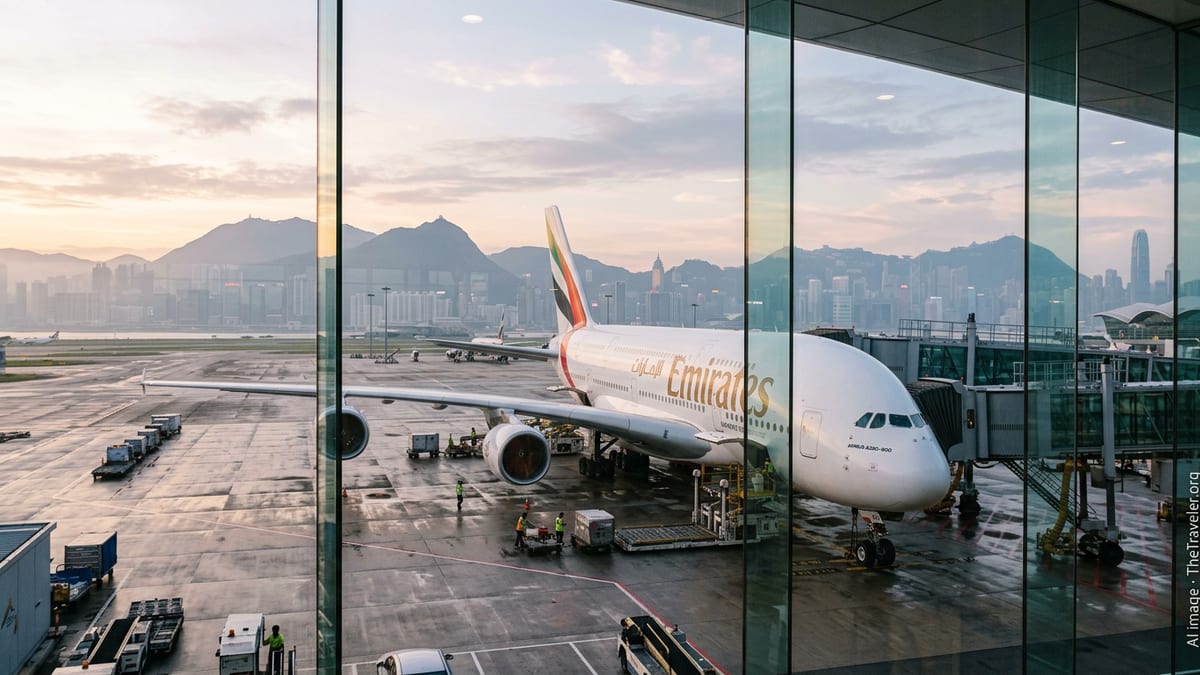
Daily A380 Service Strengthens East Asia Hub Links
The Dubai-based carrier has confirmed that from late 2026 its flagship Airbus A380 will operate daily on routes to both Hong Kong and Guangzhou, replacing existing Boeing 777-300ER services and consolidating the superjumbo’s presence in one of the world’s busiest travel corridors. The move reflects a broader strategy to concentrate high-capacity, high-yield aircraft on trunk routes linking major Asian gateways with Europe, Africa and North America via Dubai.
Schedules filed in recent weeks show the A380 taking over the EK382 and EK383 rotation between Dubai and Hong Kong as of October 2026, followed by an upgrade to the latest four-class A380 configuration from December. On the Dubai to Guangzhou route, the airline is similarly planning a daily three-class A380, phasing out the twin-engine 777 workhorse in favor of its double-deck flagship.
For travelers, the shift signals not just more seats but a higher concentration of premium products on flights that already serve as key connectors for business and leisure traffic across the Greater Bay Area, Southeast Asia and beyond. The enhanced capacity comes as Emirates continues to restore and augment its pre-pandemic East Asia network, supported by rising demand and improving bilateral traffic flows.
Luxury Products and Refitted Cabins at Scale
Emirates is leveraging its extensive A380 retrofit program to bring upgraded cabins to East Asia at scale, positioning the aircraft as a differentiator in a market where widebody capacity is returning but true luxury offerings remain relatively scarce. The four-class A380 bound for Hong Kong will feature First Class suites, Business Class, Premium Economy and Economy cabins, mirroring the latest products already rolled out on select European and North American routes.
The airline has embarked on what it describes as one of the industry’s largest interior upgrade projects, refreshing both A380s and 777s with new seats, updated inflight entertainment and redesigned galleys and lavatories. Hong Kong is among the Asian destinations specifically earmarked for these refitted aircraft, with Emirates signaling that Guangzhou will also see upgraded hardware as additional frames complete refurbishment.
For passengers originating in or connecting through the Greater Bay Area, the arrival of the A380 means access to a wider range of cabin choices, including the increasingly popular Premium Economy product that has often sold out on long-haul sectors. Coupled with Emirates’ large global network, the move is likely to intensify competition for high-yield travelers who previously favored Northeast Asian or European carriers for long-haul itineraries.
Boost for the Greater Bay Area’s Global Connectivity
The decision to place the A380 on both Hong Kong and Guangzhou routes underlines the strategic importance of the Guangdong-Hong Kong-Macao Greater Bay Area in Emirates’ long-term Asia growth plan. The airline already serves Beijing, Shanghai, Guangzhou and Shenzhen, offering dozens of weekly flights into mainland China, and sees the region as a natural super-connector between manufacturing centers, financial hubs and global tourism markets.
By aligning daily A380 operations into Hong Kong International Airport and Guangzhou Baiyun International Airport, Emirates effectively bookends the Greater Bay Area with high-capacity, long-haul links through Dubai. This provides travelers and businesses in cities such as Shenzhen, Dongguan, Foshan and Macao with multiple gateway options for one-stop connectivity to Europe, the Middle East, Africa and the Americas.
Airport authorities in both Hong Kong and Guangzhou have invested heavily in terminal and airfield infrastructure suited to large aircraft, including dual-level boarding gates and expanded lounges. The return and expansion of A380 services from a major global carrier is a timely validation of those investments and signals confidence in the region’s long-term traffic growth, even as short-term geopolitical tensions and airspace closures periodically disrupt routings between Europe and Asia.
Competitive Pressures and Network Rebalancing
Emirates’ A380 expansion into East Asia comes as full-service rivals in the region adjust their own long-haul strategies in response to evolving demand. Carriers such as Cathay Pacific, Singapore Airlines and various mainland Chinese airlines are rebuilding long-haul capacity, but many have opted for smaller next-generation twinjets rather than very large aircraft. The Dubai carrier is effectively taking the opposite bet, using the scale of the A380 to concentrate demand through its hub.
The move also reflects an ongoing network rebalancing within Emirates itself. In recent seasons, the airline has trimmed or reshaped some A380 operations to North America and secondary European points while doubling down on markets where it can reliably fill the double-decker with both point-to-point and connecting traffic. East Asia, and particularly the Greater Bay Area, offers dense flows of business travelers, expatriates, tourists and cargo, making it well-suited to the superjumbo’s economics when routes are carefully timed and marketed.
Industry analysts say the daily A380 schedule to Hong Kong and Guangzhou will likely put pressure on competitors to enhance their own premium offerings or increase frequencies to maintain share. For travelers, heightened competition could translate into sharper pricing in some cabins and more generous schedules as airlines vie for connecting traffic between Asia and long-haul destinations.
What Global Travelers Can Expect
For international travelers, the practical impact of Emirates’ decision will be felt in several ways once the new schedules take effect. The daily A380 operations are expected to unlock additional seat capacity across all cabins, reducing peak-season bottlenecks and shortening wait times for reward and upgrade redemptions, particularly for frequent flyers based in Asia and Europe.
Onboard, passengers can anticipate hallmark A380 features including a quieter cabin, more generous personal space in Economy compared with many high-density configurations, and the airline’s signature onboard lounge and shower spa for premium customers on select configurations. Combined with the latest retrofit touches and expanded Premium Economy sections, the product mix positions the East Asia routes among the carrier’s most attractive for those seeking a blend of value and comfort.
Perhaps most significantly, the daily A380 flights to Hong Kong and Guangzhou reinforce Dubai’s role as a central interchange for travelers moving between Asia and the rest of the world. In an era of shifting airspace patterns and geopolitical uncertainty, a robust, high-capacity connecting option via the Gulf provides welcome flexibility for passengers, tour operators and corporate travel planners alike, ushering in what Emirates hopes will be a new era of luxury and connectivity across East Asia’s most dynamic gateway markets.