

More news on this day
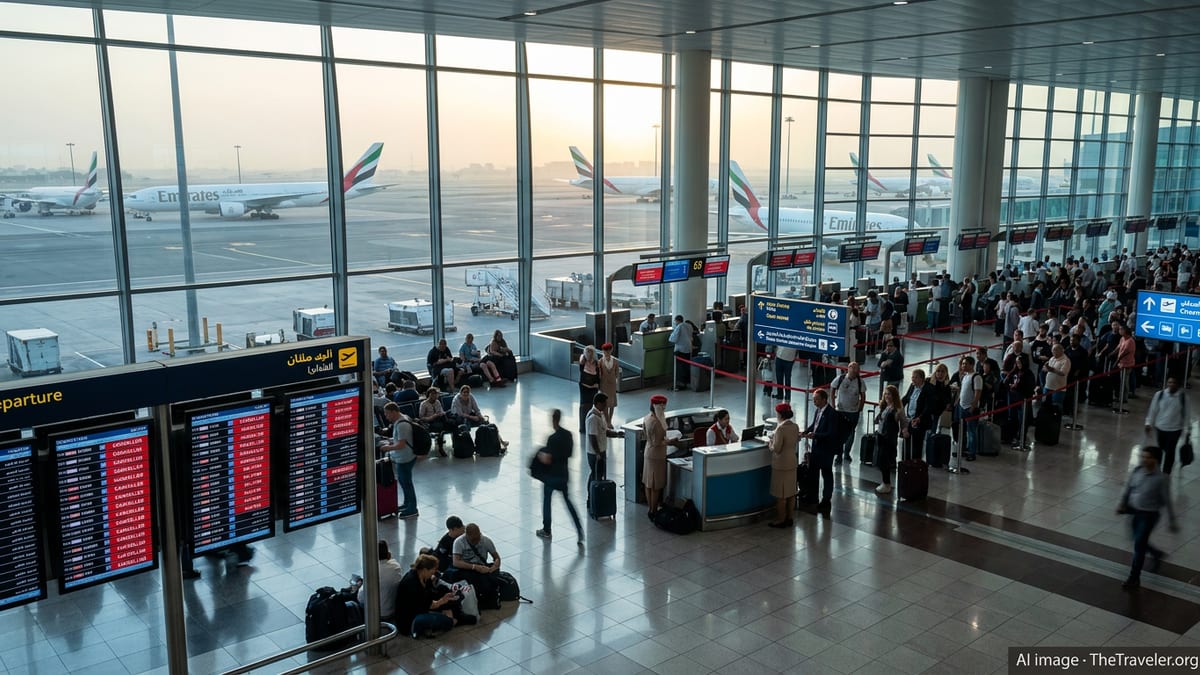
Emirates travelers are facing major disruption in March 2026 as escalating conflict involving Iran prompts widespread airspace closures across the Gulf, forcing the Dubai-based carrier to cancel, reroute, and significantly delay flights on some of its busiest global routes.
Get the latest news straight to your inbox!
Conflict Triggers Closures Across Key Middle East Corridors
The latest round of hostilities between Iran, the United States, and Israel, which intensified from February 28, 2026, has reshaped the aviation map across the Middle East in a matter of days. Publicly available aviation advisories and travel bulletins indicate that airspace over Iran and several neighboring states has been restricted or closed to civilian traffic following missile and drone attacks and retaliatory strikes.
According to open-source conflict timelines, a coordinated series of attacks on Iranian targets at the end of February was followed by retaliatory launches toward Gulf states, prompting authorities in the United Arab Emirates, Qatar, Bahrain, Kuwait, Iraq, Israel, and others to impose sweeping flight restrictions. These moves effectively shut some of the most heavily used east–west aviation corridors that connect Europe and North America with Asia via hubs such as Dubai and Doha.
Industry risk assessments published in early March describe the closures as an evolving patchwork of no-fly zones and altitude restrictions, with further caution driven by the presence of military traffic and heightened risk around strategic waterways such as the Strait of Hormuz. Airlines operating in the region have responded by suspending services, introducing long detours, or relying on limited humanitarian and repatriation flights.
For Emirates, whose network traditionally relies on overflight rights across Iran and neighboring states to maintain competitive journey times, the closure of these corridors has required rapid, large-scale operational changes and has left many passengers stranded or facing prolonged journeys.
Emirates Suspends and Reroutes Flights From Dubai Hub
Emirates announced broad schedule disruptions from late February, with publicly available statements and passenger communications indicating that regular passenger operations from Dubai were suspended for several days after the initial strikes. Travel advisories summarizing airline policies report that Emirates halted a significant proportion of departures from February 28 and operated only a limited number of special services while regional airspace was assessed.
By the first week of March, updates shared via airline channels and traveler briefings signaled a gradual restart of flights, but still under tight constraints. Several routes between Dubai and major European and Asian cities have been operating with extended flight times as aircraft detour around Iranian airspace and other restricted zones, often over the Arabian Sea, Pakistan, or alternative corridors further north or south.
Independent corporate travel alerts and risk-management bulletins describe a network running on reduced frequency, with priority given to repatriation traffic, cargo, and critical connections. Emirates has been waiving change fees for affected itineraries and has offered rebooking or refunds on tickets scheduled to travel during the main disruption window in March, according to published policy summaries.
Travel management advisories emphasize that schedules remain subject to short-notice change as operational conditions shift. Passengers connecting via Dubai from Africa, South Asia, and Australasia have reported multiple rebookings as the airline balances aircraft positioning, crew duty limits, and changing airspace permissions.
Global Ripple Effects on Europe–Asia and North America Routes
The closure or restriction of Middle East airspace has had impacts well beyond the region. Analysis from aviation data providers and risk consultancies highlights that Dubai and other Gulf hubs serve as critical junctions for long-haul travel between Europe, Asia, Africa, and Oceania. Any prolonged disruption can therefore cascade across global schedules.
With Iran’s skies and portions of neighboring airspace effectively off-limits, many carriers have been forced to stretch routings over the Arabian Sea, Central Asia, or the eastern Mediterranean. This has increased block times, fuel burn, and crew costs, and has added pressure to airport slots and air traffic control capacity on alternative pathways. Cargo flows have also been affected, particularly on high-value lanes between Asia and Europe that typically rely on passenger wide-body belly capacity transiting the Gulf.
According to economic analyses of the 2026 Iran war’s early impact, suspensions and diversions involving major Middle Eastern hubs, including Dubai, have already contributed to losses estimated in the billions across the aviation sector. European and Asian airlines have reported temporary halts to services to the Gulf and surrounding countries, while Gulf-based carriers like Emirates work to rebuild truncated schedules in a volatile environment.
For travelers, the result is a patchwork of options that can change day by day. Some long-haul itineraries that once required a single, tightly timed connection via Dubai are now operating with extended layovers, multiple stops, or even overnight stays in intermediate cities as airlines adjust to the evolving constraints.
Passenger Rights, Waivers, and Practical Advice for Affected Travelers
As Emirates continues to navigate the disruption, publicly available policy updates show that the airline has introduced a series of waivers for customers booked to travel during the height of the crisis. These include options to change travel dates without additional fees, reroute via alternative gateways where possible, or obtain refunds for flights canceled as a direct result of the conflict and airspace closures.
Consumer travel advisories stress that precise entitlements vary depending on the departure and arrival country, the type of ticket purchased, and whether the flight is canceled outright or subject to a significant delay. In jurisdictions applying strong passenger-protection rules, travelers may also have claims for care and assistance, such as meals and accommodation, when disruptions extend overnight.
Independent travel risk briefings consistently recommend that Emirates passengers monitor their booking status through the airline’s official digital channels and avoid traveling to the airport unless their flight is explicitly shown as operating. Because operational decisions are being made close to departure time in response to security developments and air traffic restrictions, same-day schedule changes remain possible.
Travel planners suggest allowing for extra connection time on multi-leg journeys, remaining flexible on dates where possible, and considering alternative routings outside the Gulf if a trip is not time-sensitive. For those with essential travel, enrolling in flight-status alerts and regularly checking airline and airport notices has become an important part of pre-departure preparation during the current crisis.
Outlook for Emirates Operations as the Crisis Continues
As of mid-March 2026, situational reports from risk consultancies and travel management companies indicate that airspace across parts of the Gulf remains restricted, though some corridors and hubs are gradually reopening under tighter controls. Emirates has signaled through public communications and internal briefings summarized by travel advisors that it aims to return to full capacity in the coming days and weeks, but that the pace of recovery will depend on security conditions and regulatory approvals.
Aviation analysts note that even as more flights resume, the airline and its passengers may continue to experience longer routings and occasional disruptions until a more stable security environment emerges. Rerouted flights that avoid Iranian airspace can add significant time to journeys between Europe and Asia, changing the competitive landscape for long-haul travel and placing sustained pressure on fuel and crew resources.
Industry observers point out that the current situation underscores the vulnerability of global aviation to regional conflicts, particularly in chokepoint regions that sit astride major flight corridors. For Emirates, whose business model is built around Dubai as a super-connector hub, navigating this period involves balancing safety-first decisions on routing with the need to maintain network connectivity for millions of passengers.
For now, travelers planning to fly with Emirates in March and early April 2026 are being advised by travel risk services and corporate travel managers to treat schedules as provisional. The overarching recommendation is to stay informed, maintain flexibility, and expect that the airspace picture over Iran and the wider Gulf may continue to evolve at short notice.