

Sunny beaches, world-famous theme parks and a calendar full of mega-events make Florida one of the most visited parts of the United States. Yet before you can dip a toe in the Atlantic or Gulf of Mexico, you must clear America’s entry rules. For many international visitors this means applying for Electronic System for Travel Authorization (ESTA); others will need a full visa. Understanding which category you fall into, and how current policy changes affect you, is now as important as booking your flights.
Understanding How ESTA Works for Florida Trips
ESTA is an online travel authorization used by citizens of countries that participate in the U.S. Visa Waiver Program. It allows eligible travelers to visit Florida and the rest of the United States for tourism or short business trips without obtaining a traditional visa in their passport. Approval is granted electronically and is linked to the traveler’s passport, so there is nothing physical to stick or stamp.
An approved ESTA generally allows multiple entries over a period of up to two years, or until the passport expires, whichever comes first. Each visit can last a maximum of 90 days, and that 90-day limit covers your entire time in the United States, not just in Florida. You cannot reset the clock simply by crossing into another state or briefly stepping over a land border; the overall time in U.S. territory is what counts.
Even with a valid ESTA you are not guaranteed admission. When you land in Florida, U.S. Customs and Border Protection officers make the final decision at the port of entry. Their role is to confirm your identity, verify that the purpose of your trip matches your authorization, and assess whether you pose any security or immigration risk. In most routine tourist cases this is a quick conversation, but travelers should be prepared to answer basic questions about their itinerary, employment and funds.
For visitors who qualify, ESTA is usually the fastest and cheapest route into Florida. The entire process happens online, there is no interview at a consulate in most cases, and decisions are often issued within minutes. However, authorities advise submitting an application at least 72 hours before departure, in case additional checks are needed or you encounter technical issues.
Eligibility, Restrictions and Overstay Risks
Only citizens of designated Visa Waiver Program countries are eligible to use ESTA. Permanent residents of those countries who hold a different passport, as well as nationals of countries outside the program, must normally apply for the appropriate U.S. visa instead. In addition, some people who hold dual nationality, or who have previously traveled to certain restricted countries, may find that they are not allowed to use ESTA even if their passport country is in the program.
ESTA is strictly limited to tourism, transit and certain short-term business activities such as attending meetings, conferences or trade shows. It does not permit paid employment in the United States, formal study leading to a degree, long-term residence or journalism assignments that go beyond ordinary tourism content. If border officers suspect that you intend to work or stay longer than 90 days, they can cancel your authorization at the airport and place you on a return flight.
Overstaying on ESTA is treated very seriously. A stay that runs beyond the 90-day limit can result in immediate removal, cancellation of your authorization and, in many cases, a bar on using the Visa Waiver Program in the future. Even shorter violations, such as repeatedly chaining trips together with minimal time outside the country, can attract attention. Officers look at your overall travel pattern and may decide you are effectively living in the United States without the correct status.
Florida’s popularity as a long-stay sun destination, particularly during winter, makes these rules especially important. Snowbirds who hope to spend several consecutive months in Florida each year should calculate their days carefully and, if necessary, consult an immigration professional about whether a visa category better suited to long visits is appropriate.
ESTA Fees, Timing and Recent Policy Changes
The cost of applying for ESTA has risen in recent years. As of late 2025, the standard fee increased from 21 U.S. dollars to around 40 dollars, reflecting changes introduced by federal legislation that also adjusted a range of immigration-related fees. Travelers should expect further modest inflation-linked increases in coming years, so always check the latest amount at the time you apply.
Payment is made online during the application process by credit or debit card. If your ESTA request is refused, only part of the fee may be refundable, because the processing portion is typically non-refundable. Since the authorization is valid for multiple trips over its lifespan, frequent Florida visitors often view the cost as spread over several holidays or business visits rather than as a one-off charge.
In parallel with fee changes, U.S. authorities have proposed expanding the information collected during the ESTA process. Customs and Border Protection has signaled an intention to make disclosure of social media identifiers used in the previous five years mandatory rather than optional, and to require additional contact details and family information. These proposals are framed as security measures, but travel industry groups warn that they may feel intrusive to ordinary tourists and could deter some visitors.
As of early 2026, public consultation on several of these measures has closed and a final rule is expected, but not all changes have taken effect yet. Because details can shift with little notice, travelers planning a Florida trip should monitor official government announcements in the months leading up to departure and be prepared to provide more detailed personal data than in the past.
When You Need a Full Visa Instead of ESTA
Many travelers assume that ESTA is an automatic option for any short U.S. visit, but there are clear situations where a traditional visa is required. If your country is not part of the Visa Waiver Program, you cannot use ESTA and must usually apply for a B1 or B2 nonimmigrant visa for business or tourism. This involves completing a more detailed application form, paying a separate fee, scheduling an in-person interview at a U.S. embassy or consulate, and submitting fingerprints and a photograph.
Even if your passport country is eligible, you may be barred from ESTA due to your personal history. Prior overstays or removals from the United States, certain criminal records, or previous travel to particular countries linked to security concerns can all make you ineligible. In those circumstances, consular officers will assess your case individually as part of a visa application, rather than allowing automated visa-free travel.
Purpose and length of stay also matter. If you plan to study in Florida, work at one of its resorts, intern at a Miami company, or join a long-term research project, ESTA is not sufficient. You will need a visa category specifically designed for your activity, such as an F, J or relevant employment-based classification. Attempting to enter on ESTA while intending to work or study is a common reason for denial of entry at Florida airports.
Finally, some travelers prefer to obtain a visa even when ESTA is technically available, especially if they anticipate repeated long visits or complex travel patterns. A multiple-entry visa can sometimes provide greater flexibility than the 90-day cap under the Visa Waiver Program, though approval is never guaranteed and processing times can fluctuate depending on staffing and demand at U.S. consulates.
Practical Steps to Apply for ESTA for a Florida Visit
The ESTA application is completed entirely online and typically takes around 20 minutes per traveler. You will need a biometric passport from a Visa Waiver Program country, your home address, a contact point in the United States such as a hotel or host, and a payment card. Answering all questions truthfully is essential; false statements can lead to denial and future problems with U.S. immigration authorities.
Authorities advise submitting your application at least 72 hours before departure, but applying earlier is wise, particularly during peak travel seasons such as school holidays, major Florida events or the period leading up to the FIFA World Cup matches scheduled across the United States. An early application gives you time to react if your authorization is refused and you need to seek a visa instead.
Most travelers receive a response quickly, often the same day. Once approved, print or save a copy of the confirmation page for your records, although airlines and border agents normally see your ESTA electronically when they scan your passport. Make sure all details, especially your passport number and date of birth, are correct. A simple typo can cause problems at check-in or on arrival.
If you renew or replace your passport, marry and change your name, or significantly alter your circumstances, you will need to submit a new ESTA application and pay the fee again. Authorization cannot be transferred between passports, even if they belong to the same person, so update your documents in the correct order: passport first, then ESTA.
Arriving in Florida: What to Expect at the Border
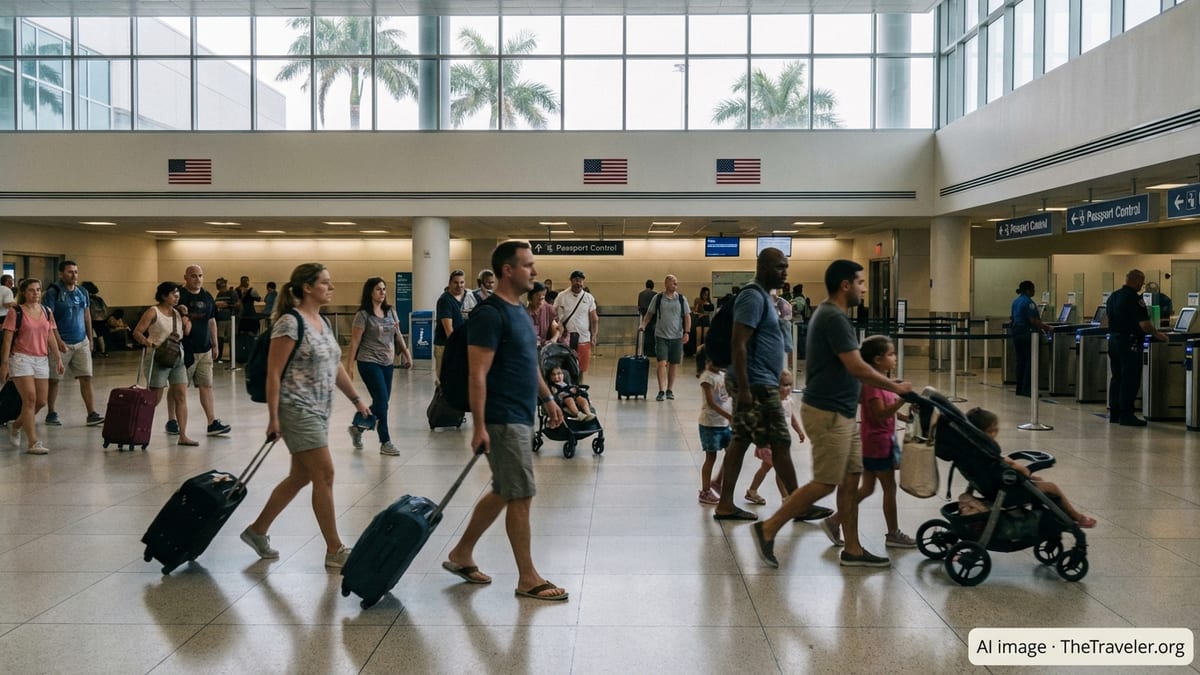
Whether you land in Orlando, Miami, Tampa or another Florida gateway, the entry process broadly follows the same pattern. After disembarking, international arrivals proceed to passport control, where separate lines usually exist for U.S. citizens, visitors with ESTA or visas, and sometimes for premium passengers. Signs and airport staff will direct you to the correct queue.
At the inspection booth or automated kiosk, an officer will scan your passport and verify your face against your travel document. You may be photographed and have your fingerprints collected, particularly on your first entry under ESTA or a new visa. The officer will ask a few questions about the purpose of your trip, where you plan to stay in Florida, how long you intend to remain in the country and how you will support yourself financially.
Being prepared with supporting documentation can help the process go smoothly. Bring a copy of your return or onward ticket, hotel bookings or a letter from any host, evidence of employment or studies back home, and proof of funds. These items are not always requested, but they can quickly resolve doubts if an officer wants reassurance that you will leave before your authorization expires.
On rare occasions, travelers are sent to secondary inspection for more detailed questioning. This can happen randomly, or because something in your record or answers requires clarification. While it can be stressful, cooperating calmly and providing honest information is vital. If officers ultimately decide you do not meet entry requirements, you may have your ESTA canceled and be returned on the next available flight, so it is better to avoid misunderstandings at the outset by ensuring your story matches the purpose allowed by your authorization.
Future Trends and What They Mean for Florida-bound Travelers
U.S. entry policy, including the ESTA framework, is in a period of change. Authorities are investing in more sophisticated digital screening, and political debates over immigration and security continue to influence how open or restrictive the system becomes. Proposals to require more detailed social media history, additional biometric data such as iris scans, and broader information on past contact details all signal a move toward deeper pre-travel vetting.
For travelers heading to Florida, this means planning needs to start earlier than in the past. Gathering five years of online identifiers or old phone numbers is not a last-minute task. Applicants should also become comfortable with the idea that their digital footprint may be reviewed as part of routine security checks, even if they pose no obvious risk. Clearing out old accounts or checking privacy settings before applying may reduce confusion.
At the same time, tourism bodies and business groups warn that too many barriers could discourage visitors, especially when rival destinations in the Caribbean, Europe or Asia offer simpler entry systems. Florida’s economy, heavily reliant on tourism and international conferences, has a stake in keeping procedures secure but manageable. Industry organizations continue to lobby for balanced rules that protect both national security and the state’s vital visitor numbers.
Given this evolving landscape, the most practical advice is to rely on current official guidance close to your travel date, expect further gradual tightening rather than sudden liberalization, and avoid assuming that what worked for a previous trip several years ago will be identical for your next Florida visit.
The Takeaway
For many international visitors, ESTA offers a streamlined way to enjoy Florida’s beaches, theme parks and cultural attractions without the complexity of a full visa. Yet it comes with non-negotiable conditions: a strict 90-day limit, no paid work or long-term study, and careful attention to personal eligibility rules. Misunderstanding those boundaries is one of the fastest paths to problems at the border.
Rising fees, expanded data collection proposals and a climate of heightened digital scrutiny mean that securing authorization is no longer a casual formality. Successful travelers treat the application as a serious legal declaration, submit it well before departure, and keep records that demonstrate strong ties to home. Those whose plans involve extended stays, work or study in Florida should proactively explore the appropriate visa options instead of trying to stretch ESTA beyond its designed purpose.
Florida remains an accessible and attractive destination, but the responsibility for a smooth arrival increasingly lies with the traveler. By staying informed about current ESTA rules, respecting time limits and being transparent with border officers, you can focus on what matters most: making the most of your time in the Sunshine State.
FAQ
Q1. Do I need ESTA if I am only transiting through a Florida airport?
Yes. If you are a citizen of a Visa Waiver Program country and you transit through any U.S. airport, including those in Florida, you generally need a valid ESTA even if you do not leave the terminal.
Q2. How long can I stay in Florida on ESTA?
Each entry under ESTA allows a stay of up to 90 days anywhere in the United States. The 90-day limit covers your total time in the country, not just in Florida.
Q3. Can I work in Florida on ESTA?
No. ESTA does not allow paid employment or running a business in the United States. You may attend meetings or conferences, but any form of work requires the correct employment visa.
Q4. My ESTA was approved, but my passport will expire soon. Is that a problem?
Yes, potentially. ESTA is only valid while your passport is valid. If you get a new passport, you must apply for a new ESTA and pay the fee again before traveling.
Q5. How far in advance should I apply for ESTA before a Florida trip?
Authorities recommend applying at least 72 hours before departure, but earlier is safer, especially during busy travel periods or if new rules are coming into effect.
Q6. What happens if I overstay my 90 days on ESTA?
Overstaying can lead to cancellation of your authorization, removal from the United States and difficulty using the Visa Waiver Program or obtaining visas in the future.
Q7. Can I visit other U.S. states during my Florida holiday on ESTA?
Yes. ESTA covers travel throughout the United States. You can fly or drive to other states as long as your total stay does not exceed 90 days and your activities remain within allowed purposes.
Q8. I have a criminal record. Can I still use ESTA to visit Florida?
It depends on the offense. Some criminal histories may disqualify you from ESTA but not from all visas. In such cases you should usually apply for a visa and answer questions honestly.
Q9. Are the proposed social media rules already in force for ESTA?
As of early 2026 some expanded data collection has been proposed and partially implemented, but details may change. Always check the current official requirements at the time you apply.
Q10. Is it safer to apply for a visa instead of using ESTA for Florida?
Not necessarily. ESTA is designed for straightforward short visits. A visa can be better for longer or more complex stays, but it involves more scrutiny and is never guaranteed.