

More news on this day
Etihad Airways is set to dramatically lift capacity between the Gulf and Southeast Asia, confirming plans to deploy its flagship Airbus A380 on the Abu Dhabi–Bangkok route from October 25, 2026, in a move that also strengthens premium links between Thailand and key European gateways Zurich and Geneva.
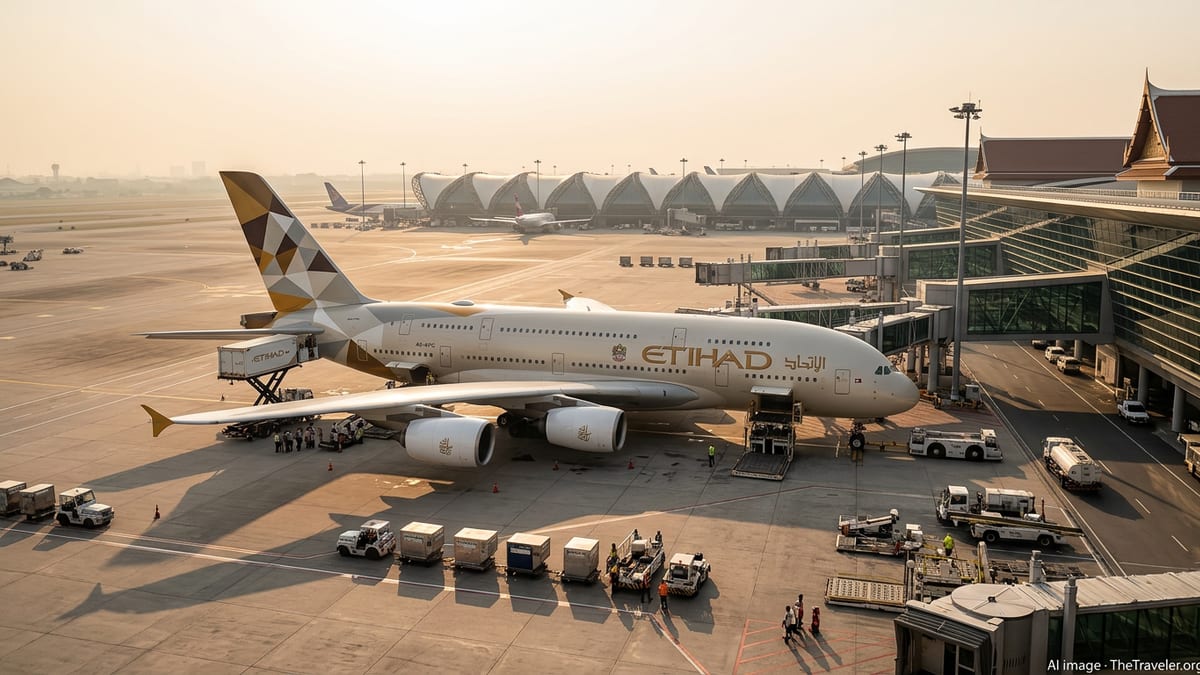
Superjumbo Returns To One of Etihad’s Busiest Leisure Routes
The A380 will take over Etihad’s daily evening Abu Dhabi–Bangkok rotation, EY402 and EY403, which currently operate with smaller widebody aircraft. From October 25, the superjumbo will depart Zayed International Airport at 21:20 and arrive into Bangkok Suvarnabhumi at 06:35 the following morning, with the return leg leaving Thailand at 08:30 and landing back in Abu Dhabi at 12:20. The schedule is designed to feed Etihad’s morning connection bank into Europe and afternoon departures back to Asia.
Bangkok is one of Etihad’s highest volume leisure and visiting friends and relatives markets, and the upgauge to an A380 signals confidence in sustained demand from the Middle East, Europe and beyond. The move follows strong performance on Etihad’s reintroduced A380 services to London, New York and Paris, where the aircraft has proved particularly popular with premium travelers and aviation enthusiasts.
For Thailand, the announcement adds further weight to the country’s strategy of attracting higher yielding long haul visitors. Tourism authorities have been courting additional widebody capacity from Gulf carriers to support year round arrivals, and the A380 provides a high profile boost ahead of the 2026 to 2027 northern winter peak.
Etihad’s decision also aligns with the carrier’s broader network expansion in Thailand, which includes new routes to Krabi and Chiang Mai from late 2025. The airline is positioning itself as a key player in connecting secondary Thai destinations with Europe and the Middle East via Abu Dhabi.
Premium Cabins, The Residence And A380 Onboard Experience
The headline feature for the Abu Dhabi–Bangkok upgrade is the reappearance of The Residence, marketed as a three room suite in the sky and one of the most exclusive commercial airline products available. Situated at the front of the upper deck, it combines a private living room, separate bedroom and an ensuite shower, serviced throughout the flight by a dedicated team member.
Behind The Residence, Etihad’s A380 upper deck is configured for premium traffic, with nine First Class Apartments and 70 Business Class seats. First passengers enjoy large private suites with an 80 inch fully flat bed, while Business Class features all aisle access lie flat seating and a shared lounge style space where travelers can stretch, socialize or work mid flight.
In Economy, the A380 offers 337 standard seats along with 68 Economy Space seats that provide extra legroom, aimed at longer haul passengers connecting beyond Bangkok to Europe. Fixed wing headrests, larger pillows and refreshed soft furnishings are intended to improve comfort on overnight sectors where rest is at a premium.
The aircraft is equipped with Wi Fi throughout, an extensive on demand entertainment library and power outlets at every seat. For many travelers in Southeast Asia, the upgrade will represent their first experience of Etihad’s full A380 product, which had been absent from the region since the type was initially withdrawn during the pandemic.
Stronger One Stop Alternatives To Zurich And Geneva
The A380 deployment is timed to enhance Etihad’s connectivity between Thailand and Switzerland, where the airline has been growing its presence in Zurich and Geneva. By scheduling the superjumbo to arrive in Abu Dhabi shortly before mid morning, Etihad can offer tighter one stop connections to both Swiss cities for Bangkok originating passengers.
This strategy positions Abu Dhabi as an attractive alternative to more crowded regional hubs for Southeast Asia travelers heading to continental Europe. With a single A380 operated leg between Thailand and the Gulf, followed by a shorter narrowbody or widebody sector to Zurich or Geneva, Etihad aims to capture a larger share of premium leisure, business and conference traffic.
Tourism flows are expected to move in both directions. Switzerland remains a fast growing source market for high spending visitors to Thailand, while Thai travelers have shown increasing interest in European city breaks and alpine destinations. A smoother one stop journey via Abu Dhabi could make itineraries combining Bangkok, Zurich and Geneva more competitive against itineraries via other hubs.
For corporate accounts and travel management companies, the additional A380 capacity also broadens options for mixed cabin itineraries, such as Business outbound and Premium or Economy return, while keeping travelers on a single carrier for duty of care and disruption management.
What Smart Travelers Should Prepare For
While the upgrade brings clear benefits, seasoned travelers will need to plan carefully to make the most of the new A380 offering. Demand for premium cabins, particularly The Residence and First Class Apartments, is likely to be strongest in the first months after launch. Securing favored dates may require booking further in advance than usual, especially around school holidays, regional festivals and the European winter sports season.
Frequent flyers should monitor how Etihad prices and releases award and upgrade inventory on the route. Historically, new flagship deployments attract a wave of redemptions as loyalty members seek to sample the top product. Those aiming to use miles between Abu Dhabi, Bangkok and onward to Zurich or Geneva will benefit from flexible travel dates and a willingness to depart midweek rather than on peak weekend days.
Given recent regional airspace disruptions that led Etihad and other Gulf carriers to temporarily suspend flights to and from Abu Dhabi, smart travelers will also want to build in resilience to their plans. That means allowing slightly longer connection windows on the outbound, ensuring tickets are issued on a single itinerary where possible, and favoring fares that permit changes without heavy penalties.
Travel insurance that explicitly covers missed connections and schedule disruption is likely to become more important for those stringing together complex itineraries that link Southeast Asia, the Gulf and Europe. Checking policy wording for coverage of airspace closures and geopolitical events will be essential rather than an afterthought at checkout.
Practical Tips On Timing, Seats And Airport Experience
The overnight Abu Dhabi–Bangkok sector means sleep strategy will matter. Travelers who can secure a window seat in Economy or Economy Space may enjoy a quieter, more restful experience, while Business and First passengers will want to familiarize themselves with seat controls, bedding and storage before lights out to maximize rest on the roughly six hour flight.
Seat maps on the A380 are likely to see high competition for upper deck Economy rows, which many travelers prefer for their smaller, more intimate feel. Those connecting onward to Zurich or Geneva should consider positioning in the forward part of the main deck or upper deck to reduce walking time between gates in Abu Dhabi during relatively tight connections.
At Zayed International Airport, the expanded A380 operation will concentrate more passengers into specific time banks, so arriving early for check in and security remains wise, particularly during peak departure evenings. Eligible travelers may see increased pressure on lounge capacity until additional seating or operational adjustments are made.
For Bangkok based passengers, Suvarnabhumi’s late night and early morning peaks can bring long queues at immigration and baggage reclaim. Smart travelers will factor this into their ground arrangements, allowing extra time for transfers to downtown hotels or connecting domestic flights to Thai beach and northern destinations that are drawing new feed from Etihad’s growing network.