

More news on this day
Thousands of passengers across Saudi Arabia, Thailand, the UAE and other destinations are facing severe disruption after Etihad Airways confirmed 192 flight cancellations and numerous delays linked to continuing airspace closures over the Gulf region.
Widespread Disruptions From Riyadh to Bangkok
The latest operational update from Etihad on March 1 confirmed that all flights to and from its Abu Dhabi hub remain suspended until 02:00 UAE time on Monday, March 2, as regional airspace restrictions continue to ripple through international schedules. The shutdown has triggered a cascade of cancellations and missed connections for travelers in key markets including Saudi Arabia, Thailand, Qatar and India.
Flight-tracking and industry data providers report that Etihad’s 192 cancellations are concentrated around Abu Dhabi’s Zayed International Airport, but the knock-on impact is being felt at major gateways such as Riyadh, Dammam, Jeddah, Bangkok and Phuket, where passengers bound for or transiting via Abu Dhabi have been left in limbo. With connecting banks effectively frozen, even flights that are still operating are heavily delayed or departing with large numbers of no-show transfer passengers.
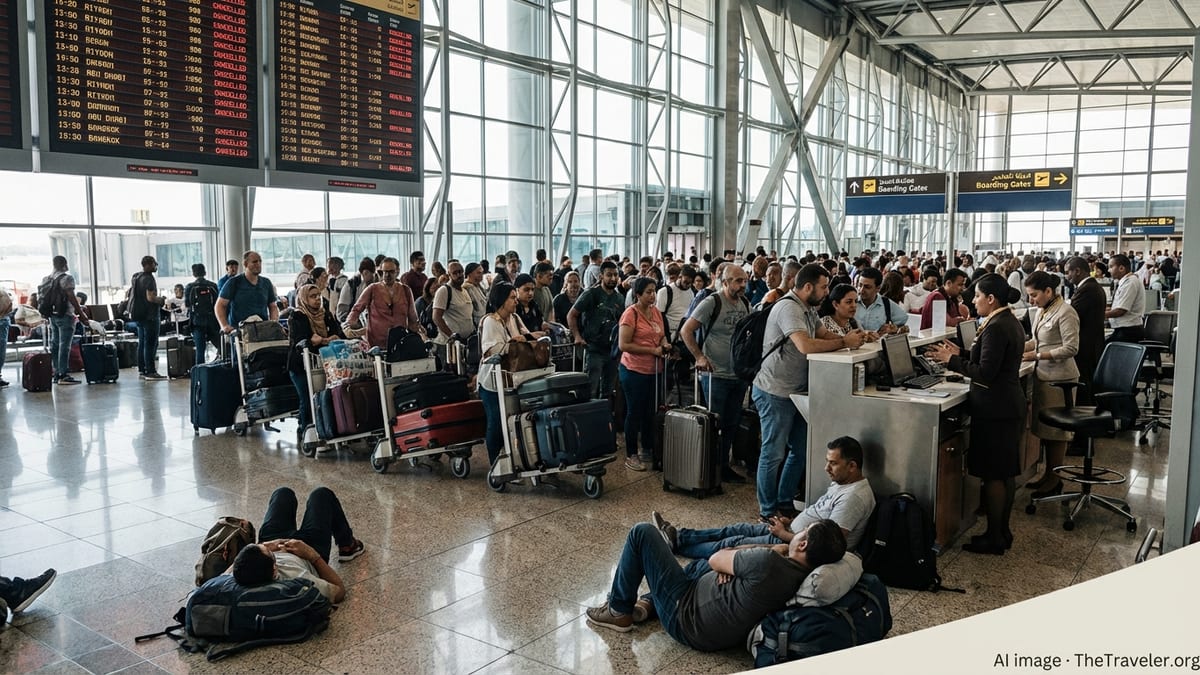
Travelers interviewed at airports across the region describe terminals filled with stranded passengers queuing at transfer desks, sleeping on makeshift bedding near departure gates and repeatedly refreshing airline apps for updates that often arrive only minutes before scheduled departure times. Many have been told that the earliest confirmed rebooking options may be several days away, as airlines work through a mounting backlog.
For leisure travelers heading to Southeast Asia at the tail end of peak winter holiday season, and for migrant workers and business travelers shuttling between the Gulf and the Indian subcontinent, the disruption comes at one of the busiest times of the year for regional aviation.
Abu Dhabi Hub at a Standstill
Abu Dhabi’s Zayed International Airport, usually one of the Middle East’s most efficient transit hubs, has been operating in a sharply reduced mode since airspace over parts of the Gulf, Iraq and Iran was restricted following a sharp escalation in regional tensions. Etihad has confirmed that all arrivals and departures are suspended until early Monday, with schedules subject to change at short notice as authorities reassess the security situation.
Industry analysts note that Etihad’s cancellations represent a significant share of the airline’s global daily schedule, effectively freezing its hub-and-spoke network. With the Abu Dhabi hub functioning at a fraction of normal capacity, aircraft and crew are out of position worldwide, complicating efforts to restart normal operations even once airspace fully reopens.
The closure of Abu Dhabi’s skies has coincided with parallel shutdowns or severe curbs at other Gulf hubs, including Dubai and Doha, amplifying the effect on global traffic flows between Europe, Africa, Asia and Oceania. Aviation data firms estimate that thousands of flights across all carriers have been cancelled or rerouted since the first restrictions took effect over the weekend, with more than a quarter of scheduled operations into the wider Middle East affected on some days.
For Etihad, whose network is built around tight connection windows in Abu Dhabi, the requirement to cancel or delay entire waves of flights has left little room for partial workarounds. Even where overflight is technically possible, long detours around closed airspace have extended block times, created crew scheduling challenges and added to fuel costs.
Saudi Arabia and Thailand Bear the Brunt of Grounded Flights
Saudi Arabian airports have emerged as some of the hardest-hit outside the UAE, as Etihad’s extensive schedule linking Riyadh, Dammam and Jeddah with Abu Dhabi has been pared back. Passengers arriving at King Khalid International Airport in Riyadh and King Fahd International Airport in Dammam over the weekend reported repeated last-minute cancellations of Abu Dhabi-bound flights, followed by long waits for rebooking or rerouting via alternative carriers where seats were available.
Local aviation officials in Saudi Arabia have advised passengers traveling on Gulf carriers to check their flight status repeatedly before heading to the airport and to be prepared for extended delays. In some cases, travelers have been rebooked via alternative hubs such as Istanbul, Muscat or Cairo, but limited capacity on these routes has meant that many remain on waiting lists.
In Thailand, where Etihad serves Bangkok and Phuket with connections across the Middle East and Europe, the disruption has left long-haul travelers particularly exposed. Holidaymakers and tour groups attempting to return to Europe, North America or Africa via Abu Dhabi describe being stranded at Bangkok’s Suvarnabhumi Airport after receiving cancellation notices for their onward flights only hours before check-in.
Thai travel agents say they are fielding a surge of urgent requests from clients seeking new itineraries on other airlines, often at significantly higher last-minute fares. Some are opting to wait in the hope that Etihad and other Gulf carriers will be able to restore at least limited connectivity from Monday afternoon, while others are choosing to break their journeys in alternative hubs and complete their trips over several days.
Passengers Face Rebookings, Refunds and Limited Alternatives
Etihad has issued a broad waiver policy for affected customers, allowing those holding tickets issued on or before February 28 for travel through early March to rebook without change fees on alternative dates or to request full refunds. The airline has urged passengers not to travel to the airport unless their flight status shows as confirmed and to ensure that contact details in bookings are up to date so that notifications can be delivered quickly.
Despite these measures, travel rights advocates warn that many passengers will still encounter significant out-of-pocket costs, particularly for accommodation, meals and missed connections on separate tickets. With call centers overwhelmed and airport help desks operating under heavy pressure, some travelers are turning to third-party claims services and travel insurance providers to recover expenses.
Airports in Riyadh, Dammam, Abu Dhabi and Bangkok have deployed additional staff and volunteers to help manage crowds, direct passengers to temporary rest areas and distribute basic amenities where possible. However, with airlines unable to offer firm timelines for a full return to normal operations, tension is rising among those who have already spent several nights on terminal floors or in nearby hotels.
Travel industry analysts say the current wave of cancellations underscores the fragility of the global hub model, where disruptions at a handful of key airports can strand passengers on multiple continents. They also note that even once airspace restrictions ease, it may take several days for carriers to reposition aircraft and crew, clear the backlog of displaced passengers and restore regular timetables.
Uncertain Outlook as Airlines Await Green Light
As of March 2, authorities in the Gulf and neighboring states continue to review the evolving security picture, with airlines braced for further last-minute changes to permitted routes and operating windows. Etihad has reiterated that safety remains its overriding priority and that any resumption of services from Abu Dhabi will be phased and closely coordinated with regulators.
Aviation experts caution that passengers should not assume that all flights will immediately resume at 02:00 UAE time on Monday, even if formal suspensions are lifted. Instead, they anticipate a gradual ramp-up of operations, with priority given to key trunk routes and the most heavily backlogged destinations such as Riyadh, Dammam, Jeddah, Bangkok and major European capitals.
In the meantime, travel agents and airline partners are advising customers with nonessential trips to consider postponement, while those already en route are being urged to remain flexible and to keep documentation of all additional expenses. With regional hubs still largely closed and overflight options limited, the prospect of further rolling cancellations remains high.
For now, thousands of travelers across Saudi Arabia, Thailand, the UAE and beyond remain grounded, watching departure boards and hoping that the Gulf’s vital air corridors will reopen soon enough to salvage long-awaited journeys, family reunions and critical business trips.