

More news on this day
Thousands of travelers across the Middle East and Asia have been stranded or forced to reroute after Etihad Airways scrapped 192 flights and delayed scores more, as regional airspace closures choked traffic through Abu Dhabi and rippled out to major airports in Saudi Arabia, Thailand and beyond.
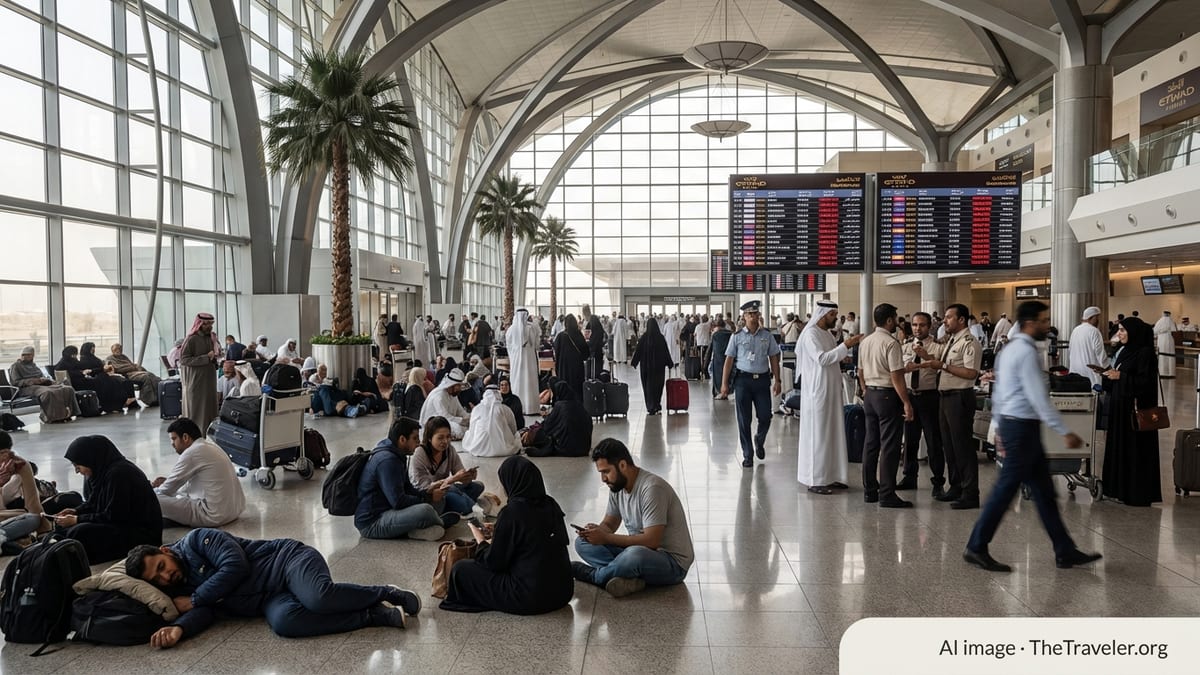
Regional Airspace Closures Trigger Sweeping Disruptions
Etihad’s network disruption follows an abrupt series of airspace closures across the Gulf, Iraq and Iran that began over the weekend, forcing airlines to suspend or divert flights around key corridors normally used by long haul services between Europe, Asia and Africa. UAE authorities temporarily restricted large portions of national airspace, leading Etihad to halt all departures from Abu Dhabi’s Zayed International Airport until at least early Monday afternoon and to cancel a large block of arriving services.
The airline’s own travel update describes an unprecedented operational pause, with all flights to and from Abu Dhabi suspended until 14:00 UAE time on Monday, March 2, and a broad rebooking and refund policy put in place for affected passengers. The decision, framed as a safety measure in coordination with aviation regulators, marks Etihad’s most extensive grounding since the height of the pandemic, and it comes as neighboring carriers Emirates, Flydubai and Air Arabia enact similar suspensions.
The impact has not been limited to the UAE. With airspace across multiple states either closed or heavily constrained, flight tracking data shows waves of cancellations and extensive rerouting across the wider region, affecting services bound for Saudi Arabia, Qatar, Kuwait and other Gulf nations. Airlines have been forced to choose between circuitous detours that add hours of flying time and outright cancellations where safe or economically viable routings are no longer available.
Analysts say the convergence of overlapping airspace bans has left carriers with few remaining corridors that meet both safety and commercial requirements. That has made Abu Dhabi, a major transfer hub for traffic between Europe, South Asia and Southeast Asia, a focal point of the disruption, with Etihad’s cancellations cascading outward into partner networks and codeshare connections.
Saudi Arabia, Thailand and UAE Hubs Bear the Brunt
Saudi Arabia’s major airports in Riyadh and Dammam have become key pressure points as Etihad’s Abu Dhabi hub struggles to operate normally. With scores of flights that would normally cross or connect via Abu Dhabi cancelled or delayed, passengers originating in or transiting through King Khalid International Airport in Riyadh and King Fahd International Airport in Dammam have faced long queues at transfer desks and sudden last minute changes to itineraries.
Travel agents in the kingdom report that outbound travelers booked on Etihad through Riyadh and Dammam have been offered reroutes via alternative Gulf or European gateways where capacity permits, while others have been pushed to travel on later dates. Domestic Saudi carriers, already running tight schedules, have had limited ability to absorb displaced Etihad customers, compounding bottlenecks for those trying to reposition to other hubs.
Thailand has emerged as another critical node in the disruption. Bangkok, a popular leisure and business destination served by Etihad and numerous codeshare partners, has seen Abu Dhabi bound flights scrubbed from departure boards, leaving passengers with onward connections to Europe and the Middle East scrambling for options. Ground staff at Suvarnabhumi Airport have been tasked with rebooking entire tour groups and families onto mixed itineraries that piece together seats on rival carriers, often involving additional stops and overnight stays.
Within the UAE, Zayed International Airport in Abu Dhabi and Dubai International Airport, two of the world’s busiest transit hubs, have experienced some of the heaviest operational strain. With Etihad, Emirates and Flydubai simultaneously scaling back or pausing departures, departure halls have oscillated between overcrowded check in zones and eerily quiet departure gates as flights disappear from information screens in blocks.
Thousands Stranded as 192 Etihad Flights Cancelled
Across Etihad’s global network, the airline acknowledges that 192 flights have been cancelled and many others delayed or retimed, a figure that aviation analysts say likely translates into tens of thousands of disrupted journeys when missed connections are included. While some aircraft have been able to operate on adjusted routings once clearance is granted, the tightly banked nature of Abu Dhabi’s schedule means that even a partial halt quickly unravels onward connections.
Stranded travelers reported mid flight turnarounds, denied boarding at origin airports when onward connections via Abu Dhabi were cancelled, and extensive waits for rebooking assistance at hub transfer desks. Social media photographs from airport lounges in Abu Dhabi, Riyadh and Bangkok show passengers sleeping on the floor or lining up at customer service counters as rolling updates push estimated departure times further into the day.
For Etihad, the challenge has been twofold. The carrier has had to reposition aircraft and crews left out of place by cancellations while simultaneously triaging passenger itineraries based on urgency, available seats on remaining services and interline opportunities with partner airlines. Industry observers note that once a hub carrier cancels a critical mass of flights, the backlog can take several days to clear even after airspace restrictions are eased.
The disruption has also hit the cargo sector, with belly hold freight on widebody passenger jets suddenly grounded. Shippers moving time sensitive goods such as pharmaceuticals and high value electronics through Abu Dhabi are now seeking space on freighter services or alternative routings through European and Asian hubs, raising costs and extending delivery times.
Airlines Roll Out Flexible Rebooking and Refund Policies
In response to the scale of the disruption, Etihad has activated a suite of customer support measures designed to give impacted travelers more flexibility. Passengers holding tickets issued on or before February 28, 2026, with original travel dates up to early March are being allowed to rebook on Etihad operated flights through mid March without additional change fees, subject to seat availability. Those who no longer wish to travel at all can request full refunds, including for non refundable fares, through the airline’s website or their travel agents.
The carrier is also providing hotel accommodation and ground transportation in cases where overnight stays are required due to missed connections or cancelled onward sectors. However, limited hotel inventory near major hubs, particularly in Abu Dhabi and Dubai, has meant that some passengers are being housed further from the airport than usual or offered meal vouchers and resting areas in terminals instead.
Travel agencies across the Gulf and in key origin markets such as India, the United Kingdom and Thailand report a surge in calls from clients seeking clarity on their options. Many are advising travelers who do not have urgent commitments to postpone non essential trips until flight schedules stabilize, noting that the pool of alternative routings is shrinking as more airlines adjust capacity and inventory in response to the evolving airspace picture.
Aviation lawyers say the extraordinary security context will be central in determining the extent of compensation owed under various national and regional passenger rights regimes. While airlines are generally required to offer care, rerouting or refunds during major disruptions, compensation for delays and cancellations can be limited when events are deemed beyond carriers’ control, such as sudden airspace closures prompted by military activity.
Travelers Urged to Monitor Flights Hour by Hour
With operational plans shifting rapidly, travel experts warn that passengers booked on Etihad or other carriers transiting the Gulf in the coming days should treat any itinerary as provisional. Official guidance from the airline urges customers to check the status of their flights on its website before leaving for the airport, ensure their contact details in bookings are up to date and remain alert to schedule changes that may occur with only a few hours’ notice.
For those already en route or mid connection, the advice from industry consultants is to prioritize securing confirmed space on any viable onward routing rather than holding out for an ideal itinerary that may never materialize. Travelers are being encouraged to accept reroutes via secondary hubs in Europe or Asia where available and to be prepared for longer journey times, multiple layovers and possible overnight stops.
Corporate travel managers with employees scheduled to transit Abu Dhabi, Riyadh, Dammam or Bangkok are reviewing duty of care protocols, including emergency accommodation budgets and communication plans. Many companies are temporarily pausing non essential trips through the region, rerouting high priority travel via alternative hubs and asking staff to keep local offices updated on their whereabouts amid the fluid situation.
While aviation authorities and airlines stress that safety remains the overriding priority, there is little clarity yet on when regional airspace will fully reopen and allow schedules to return to normal. Until then, the thousands of travelers caught up in Etihad’s cancellations and delays face a patchwork of improvised solutions as one of the world’s most important air corridors remains severely disrupted.