

More news on this day
Etihad Rail’s long-awaited passenger network is entering its final stretch before launch, with new details on key UAE stations, routes and journey times pointing to a profound shift in how residents and visitors will travel between emirates from 2026 onwards.
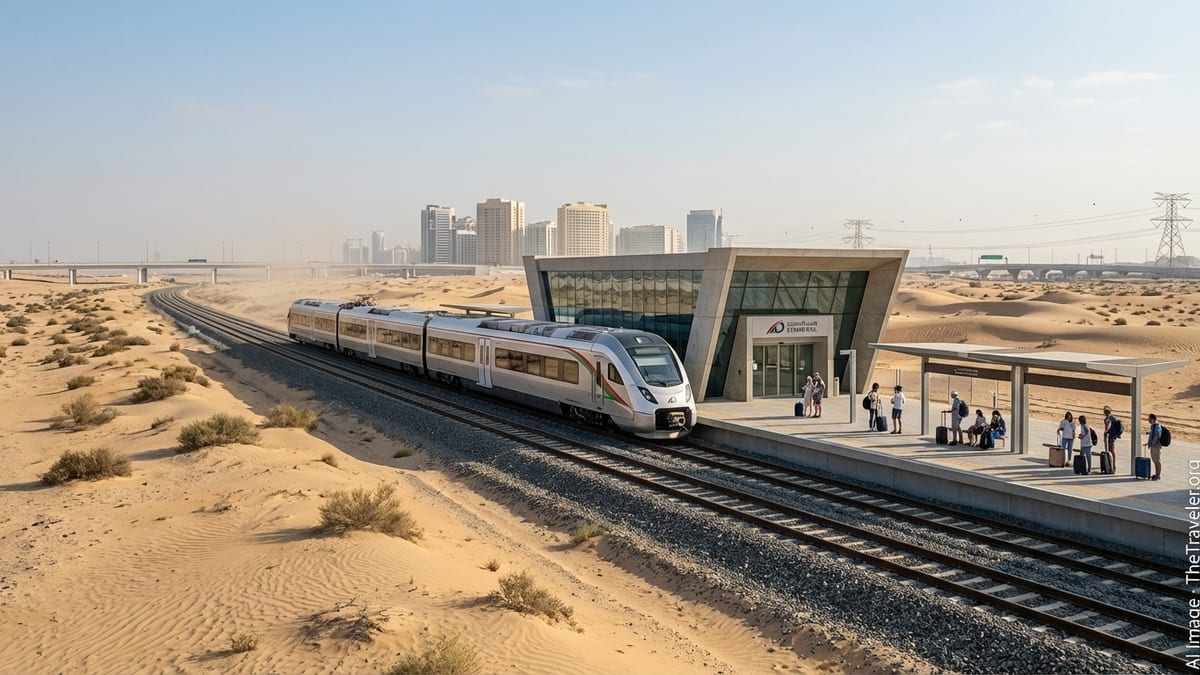
A 900km Spine Connecting 11 Cities Across the UAE
The national rail project is on track to introduce the UAE’s first inter-emirate passenger services in 2026, building on a 900-kilometre freight backbone that already links major ports and logistics hubs from Ghuwaifat on the Saudi border to Fujairah on the east coast.
According to recent briefings by Etihad Rail’s passenger division, the initial passenger offer will focus on connecting Abu Dhabi, Dubai and Fujairah, before expanding in phases to serve 11 cities and areas nationwide. Trains on the core network are designed to run at up to 200 kilometres per hour, carrying around 400 passengers per service.
The passenger corridor is intended not only to relieve pressure on busy highways, but also to anchor a wider Gulf rail ecosystem. Plans call for future integration with the Oman–UAE railway via Hafeet Rail and, over time, a broader GCC rail grid that would allow seamless regional travel by train.
Freight operations, which began in stages from 2023, have already demonstrated the network’s potential to shift traffic from road to rail. Passenger services are expected to accelerate this transition, supporting the UAE’s emissions-reduction targets and long-term growth strategy.
Strategic Stations in Abu Dhabi, Dubai, Sharjah and Fujairah
Among the most closely watched details have been the locations of the first wave of passenger stations, which are emerging as future multimodal hubs for both daily commuters and tourists. For the initial 2026 routes, three anchor stations are taking shape in Mohamed bin Zayed City in Abu Dhabi, Jumeirah Golf Estates in Dubai and the Sakamkam area of Fujairah.
The Abu Dhabi station in Mohamed bin Zayed City is envisioned as the main urban gateway to the capital, with direct access to surrounding residential districts and onward connections toward Zayed International Airport. Recent site visits have shown concourses, platforms and wayfinding systems nearing completion, signaling that the station is being readied for high passenger volumes from day one.
In Dubai, the Jumeirah Golf Estates station is being positioned close to an existing metro stop, effectively knitting the new intercity line into the city’s established urban rail network. This co-location is expected to make rail competitive with driving for commuters shuttling between Dubai’s western communities and Abu Dhabi.
On the east coast, Fujairah’s Sakamkam station, near the Al Hilal development, will anchor the line in a growing coastal city that has until now relied entirely on road connections to the rest of the country. The stop will improve access to Fujairah’s port, beaches and mountain hinterland, making rail an attractive option for both residents and holidaymakers.
Beyond the Big Four: A New Rail Lifeline for Al Dhafra and the Interior
While the first phase concentrates on the Abu Dhabi–Dubai–Fujairah spine, the full passenger network map highlights how transformative the project could be for communities far from existing metro or tram systems. A series of stations across the Al Dhafra region in western Abu Dhabi, as well as inland Sharjah, are slated to follow as passenger services roll out through 2026 and beyond.
On the western flank, stations at Al Sila near the Saudi border, Al Dhannah, Al Mirfa, Madinat Zayed and Mezairaa will give remote towns and industrial hubs a direct passenger rail link for the first time. These communities, which have relied heavily on long-distance driving and company transport, will gain faster, more predictable access to Abu Dhabi and Dubai for work, education and healthcare.
In Sharjah, confirmed passenger stops at University City and Al Dhaid, supported by an operational node at Al Faya, will knit together the emirate’s academic, agricultural and residential zones. University City, close to Sharjah International Airport, is expected to serve thousands of students and staff, while Al Dhaid’s station will provide a rail bridge between central UAE communities and the east coast.
Property and infrastructure analysts say these secondary stations could quietly drive some of the most significant long-term change, influencing where people choose to live and work and encouraging new hospitality and logistics investments along the line.
Travel Times, Phased Launch and Integrated Urban Mobility
Indicative journey times released by Etihad Rail underline the competitiveness of the new services compared with driving. A standard passenger train is expected to take about 57 minutes between Abu Dhabi and Dubai, while Abu Dhabi to Fujairah is projected at roughly one hour and 45 minutes. Trips from Abu Dhabi to Al Ruwais, Al Mirfa and Al Dhaid are all forecast to come in around or just over the one-hour mark.
Rather than a single nationwide switch-on, Etihad Rail plans to introduce passenger operations in phases through 2026. The first services will focus on the high-demand axis between Abu Dhabi, Dubai and Fujairah, before progressively adding stops and frequencies as infrastructure, staffing and safety certifications are finalized across the wider network.
Officials have emphasized that station design and operations are being built around integration with existing urban transport, particularly in Abu Dhabi, Dubai and Sharjah. That includes coordinated bus links, taxi ranks, park-and-ride facilities and digital journey-planning tools that allow passengers to plan and pay for end-to-end trips from their doorstep to their final destination.
The passenger experience is set to mirror modern long-distance rail standards, with three classes of service on board, free seating and standing areas, and provision for families and people with reduced mobility. Details of fares and timetables have yet to be released, but the operator has repeatedly stressed that rail is being positioned as a practical, everyday alternative to the car rather than a premium niche product.
Construction Push and New Governance Ahead of Launch
Across multiple emirates, the physical signs of the rail build-out are increasingly visible. In Sharjah, for example, temporary closures around Maliha Road this week highlight how road layouts are being adjusted to accommodate track works and future grade-separated crossings. Similar diversions have appeared along sections of the corridor in Abu Dhabi and Dubai as teams complete viaducts, bridges and cuttings ahead of the passenger rollout.
Alongside the engineering push, the governance of the future network is also taking shape. Keolis, the international transport operator that already runs Dubai Metro and Tram, has been selected to operate Etihad Rail’s passenger services through a dedicated joint venture. The company has recently reshaped its regional leadership as it prepares to oversee everything from driver training and station staffing to real-time control and customer service.
Transport planners argue that this combination of international operating expertise and a brand-new, purpose-built network puts the UAE in a strong position to deliver reliable, frequent rail services from day one. With the core Abu Dhabi–Dubai–Fujairah spine now defined and a broader constellation of regional stations mapped out, attention is turning to how quickly the network can scale to match fast-rising demand once the first passenger trains begin rolling in 2026.