


More news on this day
Europe’s new digital border checks are already triggering hours-long queues and missed flights across the Schengen area, with aviation and tourism groups warning that unresolved problems could turn the coming summer peak into a season of travel chaos.
Get the latest news straight to your inbox!
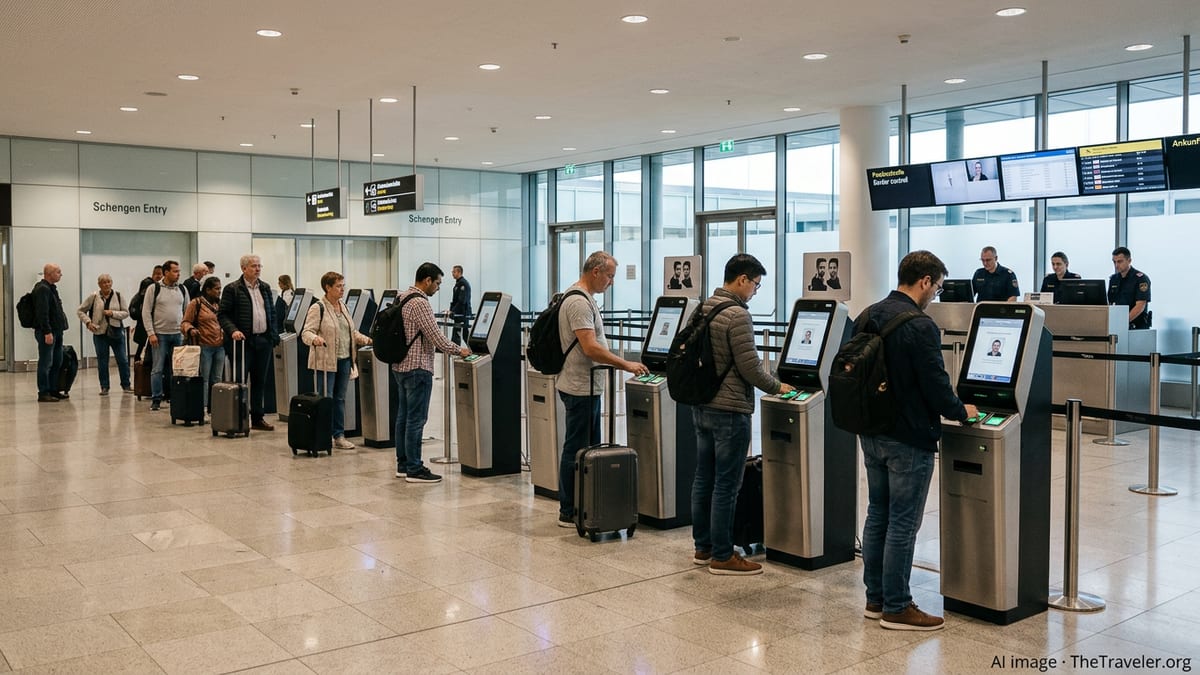
Biometric border rules collide with rising summer demand
The European Union’s new Entry/Exit System, which replaces passport stamping for non-EU nationals with biometric registration, has moved from pilot phase to widespread use just as demand for summer travel jumps. The timing is creating a difficult mix of unfamiliar procedures, longer processing times and surging passenger numbers at many European hubs.
Under the system, most non-EU travelers entering the Schengen area for short stays must have their fingerprints and facial image captured and stored, alongside personal and passport details. The process is designed to improve border security and automate future crossings, but the initial enrollment can add several minutes to each check, particularly where staff or equipment are stretched.
Reports from early rollouts indicate that at busy airports the extra steps have pushed border-control processing times up by as much as two-thirds at peak periods, with queues often spilling into departure halls. Industry groups say these strains are visible even before the main July and August rush, raising concerns about how infrastructure and staffing will cope once traffic reaches full summer levels.
European airlines and airports have jointly urged EU institutions and national governments to adjust implementation plans, warning that without more flexibility the system risks undermining Europe’s appeal as an easy, seamless destination for long-haul visitors.
Queues, missed flights and uneven impact across the bloc
Airports and passenger groups report a patchwork of experiences across the continent. At some major hubs, investments in extra kiosks, redesigned queuing areas and increased staffing have helped keep wait times manageable. Elsewhere, screens of travelers facing two to three hour lines at border control have become a regular feature in media coverage.
According to publicly available information from aviation associations, initial weekends of full-scale EES use brought queues of up to three hours at several Schengen airports, with some passengers missing flights despite arriving well ahead of departure. In extreme cases, departure gates reportedly closed with aircraft only partly filled because large numbers of passengers were still stuck in border queues.
Smaller regional airports and busy ferry and rail terminals handling holiday traffic from the United Kingdom and other non-EU markets appear particularly exposed. These facilities often have fewer staffed booths and limited space to expand border-control areas, making it harder to absorb the extra time needed for biometric capture and to separate first-time EES users from returning travelers.
Industry bodies argue that the uneven rollout risks creating a two-speed system in which some gateways function relatively smoothly while others face chronic congestion. That, they say, complicates airline scheduling and makes it more difficult for travelers to predict how much time to allow for border checks when planning connections.
Industry sounds alarm over ‘systemic’ pressures
Aviation and tourism organizations have intensified their warnings as the summer season approaches. In joint public statements, Airports Council International Europe, Airlines for Europe and the International Air Transport Association have highlighted what they describe as persistent operational problems with the new system, including technical glitches, insufficient testing and staffing shortfalls at border-control points.
These groups say that, in some locations, EES-related checks are already pushing waiting times toward two hours at busy periods, even though only a fraction of non-EU travelers have completed their first biometric registration. They caution that once mandatory registration is applied consistently to all eligible border crossings, queues of four hours or more could become common at the height of the season unless remedial steps are taken.
The World Travel and Tourism Council has backed calls for a review, warning that prolonged disruption could deter visitors from key long-haul markets and put tens of millions of arrivals and billions of dollars in visitor spending at risk. Travel companies are also reporting softer early-summer booking trends from some non-EU markets, with concerns that uncertainty over border delays is discouraging late bookings.
Some national authorities have been authorized to temporarily suspend the biometric component of the checks when queues become excessive, relying instead on traditional document inspection. Industry representatives say this flexibility has helped avoid complete gridlock in some cases, but argue that ad hoc suspensions are not a sustainable solution for a system intended to operate continuously across the Schengen area.
EU seeks phased roll-out as passengers adjust
In response to mounting pressure, EU institutions and member states have moved toward a phased introduction of the new rules. A recent political agreement allows countries to bring the system into full use over several months, including a start-up period in which biometric capture can be limited or suspended and a later phase in which checks are progressively expanded.
Publicly available EU documents frame the Entry/Exit System as a central pillar of the bloc’s border-management strategy, intended to tighten controls on overstays and irregular crossings while eventually enabling faster automated processing for bona fide travelers. Officials argue that short-term disruption must be weighed against anticipated long-term gains in security and efficiency once most frequent visitors are enrolled.
However, industry groups counter that the current pace of change is out of step with the readiness of many front-line border facilities. They point to continued reports of software issues, integration problems between national and EU-level systems and delays in delivering and installing self-service kiosks as evidence that more time and support are needed before full enforcement during peak summer travel.
For passengers, the adjustment period is likely to be marked by evolving procedures and inconsistent experiences. Travelers may find that at some borders their data are captured quickly at automated kiosks, while at others they are directed to manual booths where officers complete enrollment using shared equipment, adding to delays.
What travelers can expect this summer
With warnings of disruption now widely publicized, airlines, airports and tourism bodies are urging travelers from non-EU countries to build in extra time for border formalities. Many carriers are advising passengers to arrive earlier than usual for flights to and from the Schengen area and to pay close attention to pre-departure information from airports and tour operators.
Travelers making tight connections within Europe may face particular risk if their first point of entry into the Schengen zone has limited capacity for EES processing. Missed onward flights not only disrupt individual trips but also reverberate through airline networks, compounding delays during already busy periods.
Some airports are experimenting with measures to smooth the process, such as separate queues for travelers who have previously registered under the new system, greater use of staff to assist at kiosks and clearer multilingual signage explaining the steps required. While these efforts can ease congestion at the margins, aviation groups maintain that they cannot fully compensate for structural shortcomings in border-control staffing and infrastructure.
For now, the emerging picture is of a continent in transition to a new border regime just as demand for international travel returns to and, in some places, surpasses pre-pandemic levels. Whether incremental fixes and phased implementation will be enough to prevent a summer of severe disruption remains uncertain, leaving both industry and travelers watching closely as peak season approaches.