


More news on this day
Qatar Airways and Emirates have spent years trading places at the top of global airline rankings, but fresh industry data and passenger surveys for 2026 indicate that another carrier is emerging as the more compelling choice for international travelers.
Get the latest news straight to your inbox!
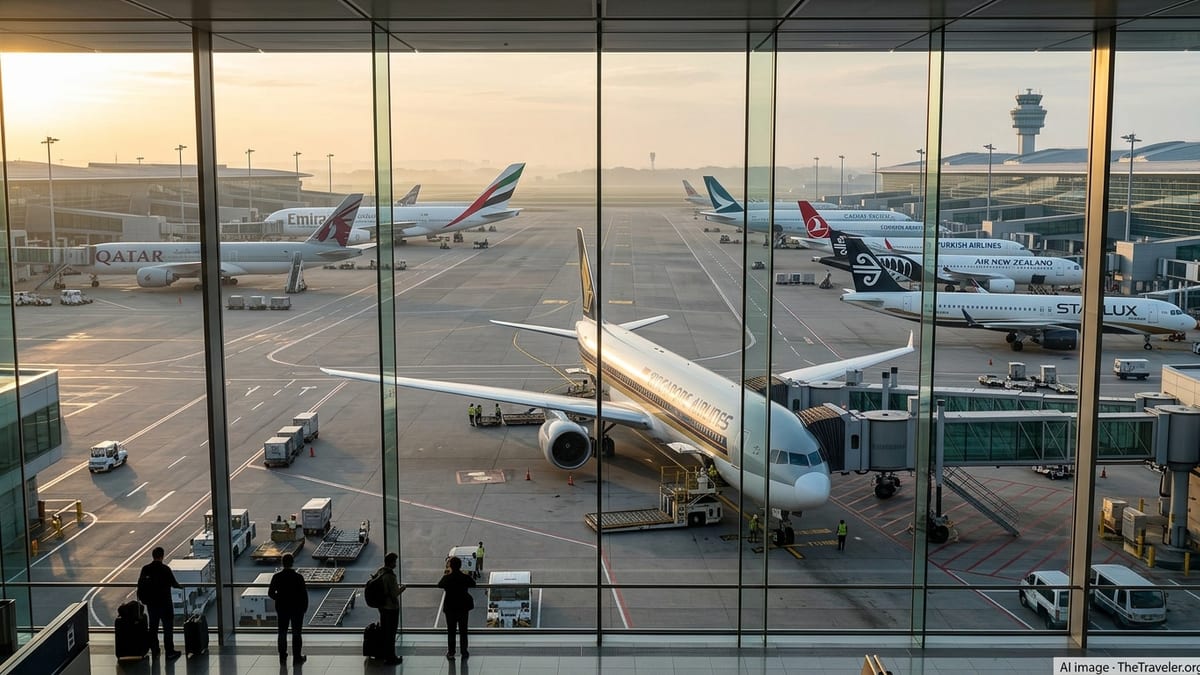
Rankings Show A Shift Beyond The Gulf Giants
For much of the past decade, global award tables have been dominated by Qatar Airways and Emirates, often joined by Singapore Airlines and ANA All Nippon Airways in the top tier. Recent editions of high profile rankings continue to place Qatar and Emirates near the summit, yet they also highlight another airline that has quietly climbed into the same conversation.
In the latest World Airline Awards, Qatar Airways once again secured the overall title of World’s Best Airline for 2025, ahead of Singapore Airlines, Cathay Pacific and Emirates. However, category breakdowns of the same awards, alongside other independent league tables, show Singapore Airlines consistently taking top positions in areas such as cabin crew quality, long haul comfort and business class product, suggesting a broader strength across the passenger experience than many competitors.
Industry analysis for the 2026 travel year, including rankings focused on onboard product rather than just safety or network size, increasingly highlights Singapore Airlines as the standout all round choice for long haul international flying. While the Gulf carriers retain accolades for premium cabins and hub connectivity, reports indicate that Singapore’s balance of service, reliability and cabin design is tipping more frequent flyers in its direction.
This divergence between overall headline awards and the finer detail of category results is at the heart of why many analysts now argue that the best airline for global travelers in 2026 is not necessarily the carrier at the top of the main trophy list, nor one of the most heavily marketed Gulf brands.
Why Singapore Airlines Is Winning Over Long Haul Travelers
Singapore Airlines has built its current reputation on a combination of soft service and hard product. Passenger surveys compiled over the past two years consistently rate the airline’s cabin crew among the world’s best, highlighting consistency of service, attentiveness and problem solving on board, even as travel demand has surged back to and beyond pre pandemic levels.
On the hardware side, the airline’s latest generation business class seats on long haul Airbus A350 and Boeing 777 aircraft are frequently cited for privacy and space, while its premium economy and economy cabins earn strong marks for legroom and seat width compared with many competitors. Across cabins, Singapore’s in flight entertainment platform and connectivity options are often ranked in the top group globally, a growing priority for business and leisure travelers alike.
Schedule reliability is another factor where Singapore Airlines has made notable gains. On time performance reports compiled through 2024 and early 2025 show the carrier frequently placed among the more punctual full service airlines on intercontinental routes. While it does not always top these tables, its combination of reliability, hub efficiency at Changi Airport and relatively smooth handling of disruptions appeals to travelers planning complex itineraries across Asia, Europe, Australia and North America.
Crucially for 2026, analysts note that Singapore’s strengths do not depend on one specific cabin. Premium travelers praise the business and first class experience, but survey data also shows high satisfaction among economy passengers, particularly on ultra long haul routes where fatigue and comfort issues can be most acute.
Value, Network And The 2026 Travel Outlook
Price has become a decisive factor as international airfares remain elevated into 2026, and here too Singapore Airlines is becoming more competitive with the Gulf carriers. Fare tracking across major long haul markets indicates that on many routes between Europe and Southeast Asia, or North America and Australasia via Singapore, the airline’s economy and premium economy fares are now aligned with or slightly below those of some rivals when booked in advance.
Travel industry commentary suggests that the airline has used targeted promotions and partnerships with regional subsidiaries to keep overall journey costs attractive without eroding the perceived premium of its flagship brand. In practice this means travelers can combine a long haul segment on Singapore Airlines with shorter connections on partners while still earning loyalty currency and maintaining through checked baggage and coordinated schedules.
The carrier’s network strategy also matters for 2026. While Doha and Dubai remain powerful hubs, Singapore’s position at the crossroads of Southeast Asia allows one stop connections to secondary cities across Indonesia, Malaysia, Vietnam and beyond that are not always as straightforward via the Gulf. For travelers whose final destinations lie beyond major capitals, this can reduce overall journey time and complexity.
Looking ahead to the rest of 2026, capacity growth and fleet renewal at Singapore Airlines, including more fuel efficient aircraft and refurbished cabins, are expected to support competitive pricing while preserving its premium positioning. Analysts see this combination of product quality and improving value as a key reason it is increasingly regarded as the most balanced choice for international travel.
How Other Contenders Compare In The 2026 Rankings
Qatar Airways and Emirates are by no means slipping out of the top echelon. Award tables and frequent flyer commentary continue to rate Qatar’s business class among the very best in the world, with its hub in Doha offering dense connectivity across Europe, Africa and Asia. Emirates, for its part, remains a favorite for travelers transiting Dubai, particularly in premium cabins on its A380 fleet with onboard lounges and suites.
However, both carriers face ongoing pressures. Reports point to increasing variability in service standards as networks expand and aircraft are deployed more intensively, a common challenge in the post pandemic ramp up. Passenger feedback collected through 2024 and 2025 notes occasional inconsistencies in cabin service and ground handling that can erode the sense of seamless luxury once associated with every flight.
Other Asian and European airlines also feature prominently in 2026 oriented rankings. ANA All Nippon Airways and Cathay Pacific are repeatedly cited for service quality and operational discipline on transpacific and intra Asian routes, while Turkish Airlines has leveraged its Istanbul hub to build an expansive network covering Europe, Africa and Central Asia. Yet these carriers, too, often excel in specific regions or cabins rather than delivering the same cross market balance that analysts now attribute to Singapore Airlines.
For global travelers choosing a single preferred airline or alliance for the coming year, this landscape means weighing the legendary business suites of Qatar or Emirates against the quieter, but increasingly comprehensive, strengths of their Asian rival. Taken together, current data suggests that in 2026 Singapore Airlines offers the most rounded proposition across comfort, reliability, service and value.
What This Means For Travelers Planning 2026 Trips
For leisure travelers mapping out complex itineraries across multiple continents, the emergence of Singapore Airlines as the best all round choice changes how routes can be planned. Instead of defaulting to connections through Doha or Dubai, many itineraries can now be structured through Singapore with similar or lower total travel time and competitive fares, while still enjoying a premium onboard environment.
Business travelers face a slightly different calculation. Corporate travel managers often prioritize reliability, alliance partnerships and total trip productivity, rather than just the most luxurious seat. With strong scores across punctuality, cabin comfort and in flight connectivity, Singapore Airlines is increasingly aligned with those priorities, especially on routes linking major financial centers in Asia with Europe and North America.
For travelers based in the United States, the airline’s expanding partnerships and codeshares extend its reach beyond its own relatively small number of nonstop routes. This provides access to Singapore’s long haul product on key transpacific and transatlantic sectors while relying on partner airlines for domestic feed, an arrangement that can suit both frequent flyer strategies and corporate travel policies.
Ultimately, the message from the latest rankings and reports is not that Qatar Airways or Emirates have suddenly lost their appeal, but that the definition of the “best” international airline in 2026 is evolving. For many travelers looking at the full picture of cost, comfort, reliability and global coverage, the data increasingly points toward Singapore rather than the Gulf as the smartest way to cross the world.